
Shadow Match
A child who has made shadow puppets knows a shadow keeps only the outline: the bumps, the curves, the corners. Shadow Match asks which shadow belongs to a shape, and only one fits every edge.
Free sets by level, ages 4–8:
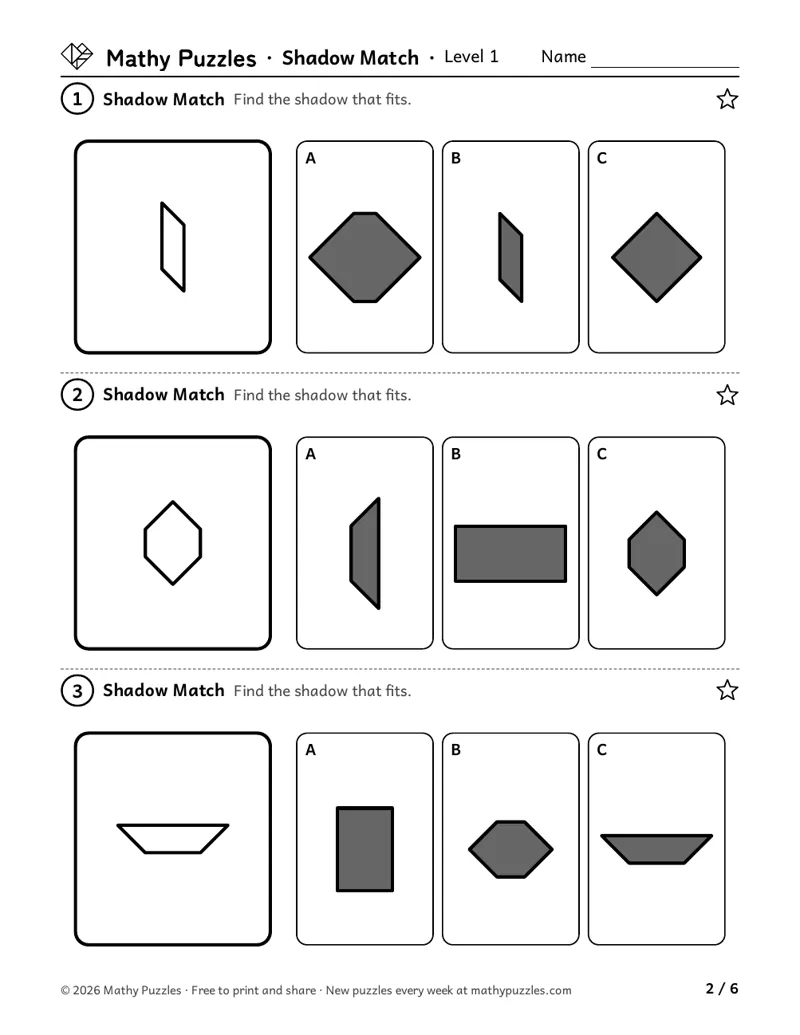 Level 1: a page from the free set
Before starting
- Know a few flat shapes by name
- Understand "the same" and "different"
- Make a cross and a check with a pencil
- Level 2: know a circle and a half circle
Free puzzles to print
Each set: a Learn sheet with a worked example, 10 puzzles from easiest to hardest, and the answers.
Level 1
Ages 4–6 · Pre-K–K
The easiest puzzles: one basic shape, such as a triangle, a hexagon or a trapezoid; each wrong shadow is a clearly different shape.
The middle puzzles: a little picture built from 2 or 3 shapes; in each wrong shadow one part is moved, swapped or resized.
The hardest puzzles: near misses; each wrong shadow is just one small bump, bite or corner away from the shape.
On the sheet: “Find the shadow that fits.”
Print Level 1 (Letter)Other paper size: A4Level 2
Ages 6–8 · Grades 1–2
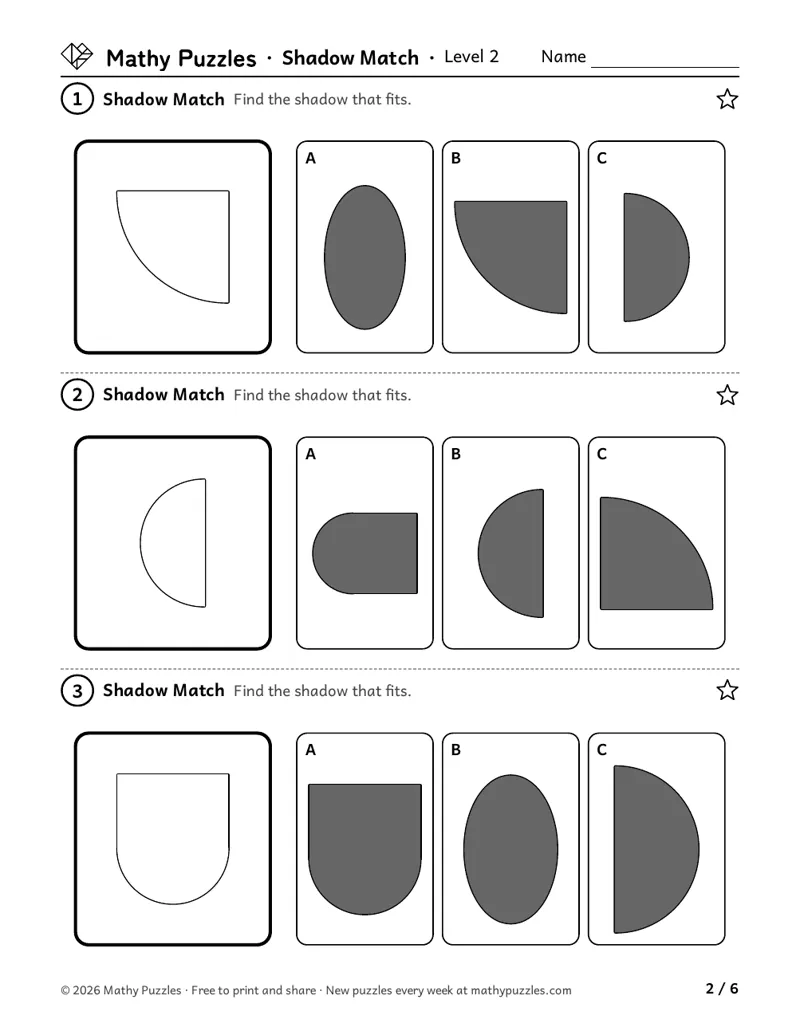
The easiest puzzles: one curved shape, such as a circle, an oval, a half circle or an arch. The other shadows are curved too and about the same size.
The middle puzzles: a picture of 2 or 3 parts mixing curves and straight sides, such as an umbrella or a snowman. In each wrong shadow a part is moved, swapped or resized.
The harder puzzles: four shadows, each wrong one a near miss: one part a little bigger, smaller or shifted.
The hardest puzzles: one wrong shadow is the picture's mirror image, facing the other way.
On the sheet: “Find the shadow that fits.”
Print Level 2 (Letter)Other paper size: A4
How it works
A white shape sits on the left, with three or four dark shadows beside it. Only one shadow is the same shape, the same way up. The child crosses out the shadows that don't fit and puts a check on the one that does. Level 1 shapes have straight sides: single shapes, then little pictures built from 2 or 3 shapes, such as a house or a boat. Level 2 brings curves: circles, ovals, half circles and pictures such as an umbrella or a mushroom; in the hardest puzzles one shadow is the mirror image.
How to play
- Look at the white shape. Notice its corners, curves, bumps and flat sides.
- Check each shadow. Is any part too long, too short or in the wrong place?
- Cross out every shadow that doesn't fit.
- Put a check on the one that fits exactly, the same way up.
When it gets hard
Picking the first shadow that looks about right.
Hint: Look at every shadow before choosing. Cross out the wrong ones first.
Missing a tiny bump or bite in the hardest puzzles.
Hint: Trace the white shape's outline with a finger, then trace each shadow the same way.
Checking only the size, not where the parts are.
Hint: Ask: is the roof on top? Is the sail on the same side?
At Level 2, picking the shadow that faces the other way.
Hint: Point to one part, such as the handle. Is it on the same side in the shadow?
Tip for grown-ups: Before your child crosses a shadow out, ask: "What is different about this one?" Saying the difference out loud is the skill.
Frequently asked questions
- Why are the shadows solid, with no inside lines?
- A shadow shows only the outline. Your child has to compare the edge of the white shape, not its inside lines, which is the looking skill this puzzle practices.
- Is it fine if my child circles instead of checking?
- Yes, a circle counts too. Crossing out the wrong shadows first is a good habit, but any clear mark on the right one is fine.
Questions about printing, levels, answers or membership: see all questions.
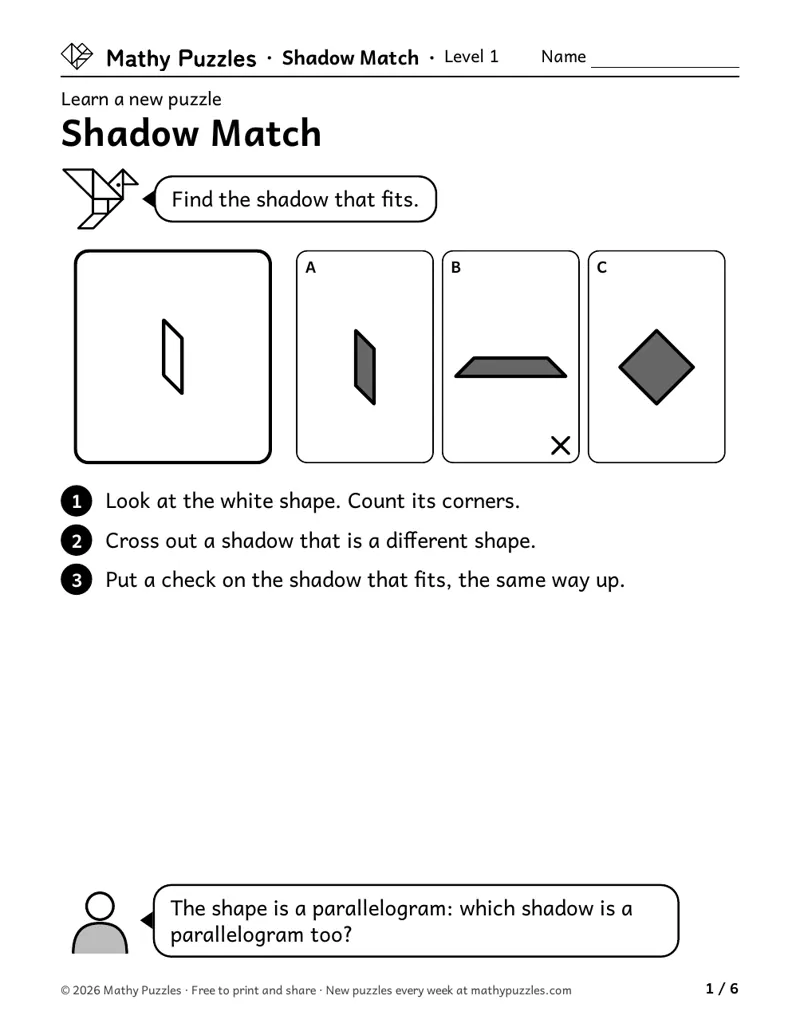
Worked example
From the Level 1 Learn sheet
- Look at the white shape. Count its corners.
- One shadow that is a different shape is already crossed out. Cross out the other one.
- Put a check on the shadow that fits, the same way up.
A question to ask: “What shape is it? Which shadow is that shape too?”
Free every Sunday A mixed bag of 20 new puzzles, all four levels. Get them by email
The thinking it works on
Spotting small differences
Notices when two outlines differ by one bump or corner.
Huurneman and Boonstra (2015) found that how closely the look-alikes resembled the target mattered more to 4- to 8-year-olds' searching than how crowded the display was. Source
Comparing part by part
Checks corners, bumps and flat sides one at a time.
Dukette and Stiles (1996) asked children to choose which of two forms best matched a target. Four-year-olds could pick out the parts, but were weaker than 6-year-olds at putting the parts together into a whole. Source
Ruling options out
Crosses out shadows that can't be right.
Hill, Collier-Baker and Suddendorf (2012) showed children aged 3 to 5 that one of two cups was empty. The children chose the other cup: ruling one out told them where the prize was. Source
Knowing shapes by their parts
Uses sides and corners to name and compare shapes.
Aslan and Arnas (2007) found that children aged 3 to 6 often did not recognize a square, triangle or rectangle that was tilted, stretched, skewed or resized. They went by looks rather than by sides and corners. Source
Holding a shape in mind
Keeps the white shape in mind while looking across.
Simmering (2012) found that 3- and 4-year-olds held 2 or 3 items in visual working memory on a change-spotting task. This rose to 3 or 4 items between ages 5 and 7. Source
Telling a shape from its mirror image
Notices when a shadow faces the other way.
Perrucci, Agnoli and Albiero (2008) found that 6- and 8-year-olds took longer to tell a picture from its mirror image the further it was turned. Source
Where is this thinking used?
- Jigsaws: A piece's outline tells you which gap it fills.
- Keys and locks: Only the key with the right cut fits the lock.
- Lids and boxes: Each container takes the lid of the same shape.
- Road signs: Signs can be known by their outline before the words can be read.
For teachers
Curriculum areas
- Common Core
- Geometry: comparing shapes by their parts, such as sides and corners (Kindergarten)
- NCERT
- Foundational stage: matching and sorting shapes (pre-primary); shadows and tracing outlines (Class 2)
- National Curriculum (England)
- Early years mathematics: spatial reasoning with shape and space (Reception)Level 2: No direct curricular match.
- Cambridge Primary Mathematics
- No direct curricular match.
Math practices: see the box below.
Math practices this puzzle uses
- Not used: MP1 Make sense of problems and persevere in solving them
- Not used: MP2 Reason abstractly and quantitatively
- Not used: MP3 Construct viable arguments and critique the reasoning of others
- Not used: MP4 Model with mathematics
- Not used: MP5 Use appropriate tools strategically
- Uses: MP6 Attend to precision
- Not used: MP7 Look for and make use of structure
- Not used: MP8 Look for and express regularity in repeated reasoning
From the Common Core Standards for Mathematical Practice.
More Shadow Match puzzles for members
Members get at least 5 more worksheets at each difficulty for every puzzle, 80 new puzzles every Sunday, and the whole archive. $39 a year or $25 for 6 months.
See membershipNot ready yet?
One email, all four levels: 20 puzzles, 5 for each level.
For grown-ups (18+). One email every Sunday with the puzzles and the odd note about membership; unsubscribe any time. We never ask about your child. How we use your email