
Turn or Flip?
Your left glove can be turned any way you like, and it will never fit your right hand. That is the difference this puzzle is about: a turned shape can be turned back to match; a flipped one never can.
Free sets by level, ages 4–8:
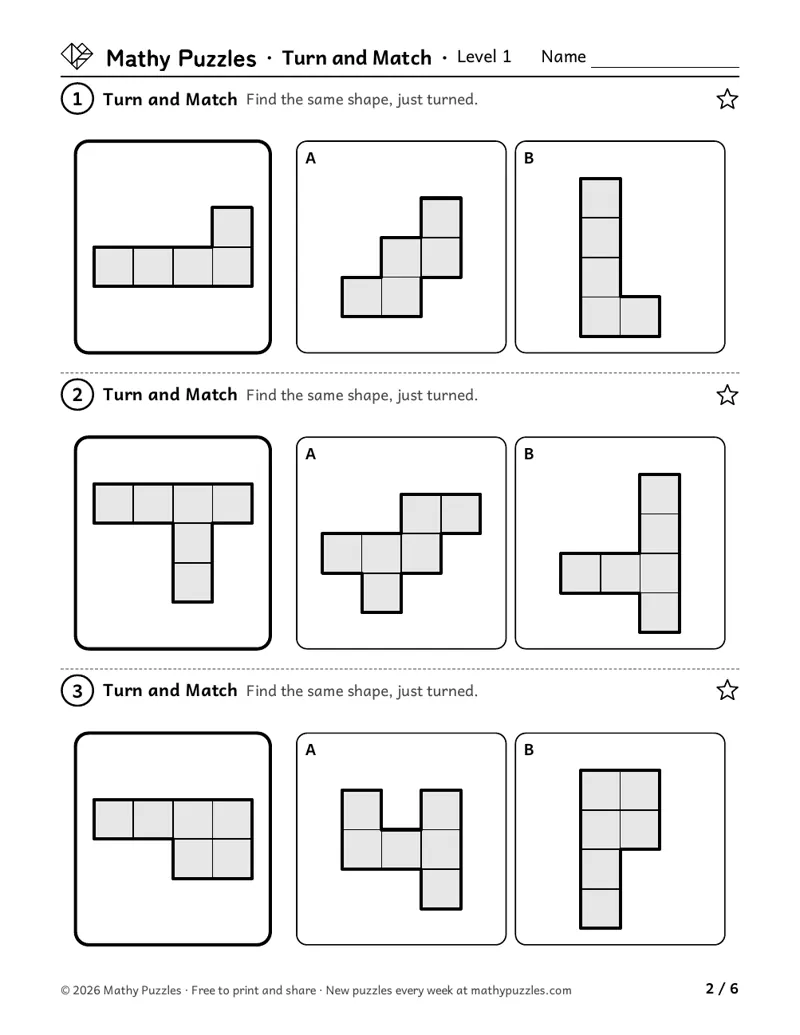 Level 1: a page from the free set
Before starting
- Know what "the same" means for shapes
- Turn a toy or a page around
- Make a cross and a check with a pencil
- Level 2: match a shape to the same shape turned (this puzzle's Level 1)
- Level 2: some play with mirrors
- Level 2: know the words turn and flip
What you need
Paper and scissors to cut out a copy of the shape, a small mirror if you have one, and a pencil.
Free puzzles to print
Each set: a Learn sheet with a worked example, 10 puzzles from easiest to hardest, and the answers.
Level 1
Ages 4–6 · Pre-K–K
The easiest puzzles: two choices; the right one is a quarter turn, and the wrong one is clearly a different shape.
The middle puzzles: three choices; the right one is a quarter or half turn, and both wrong ones are different shapes.
The hardest puzzles: three choices; the right one is turned upside down, and one wrong choice is the mirror image, a flipped copy.
On the sheet: “Find the same shape, just turned.”
Print Level 1 (Letter)Other paper size: A4The sheet is titled “Turn and Match”.
Level 2
Ages 6–8 · Grades 1–2
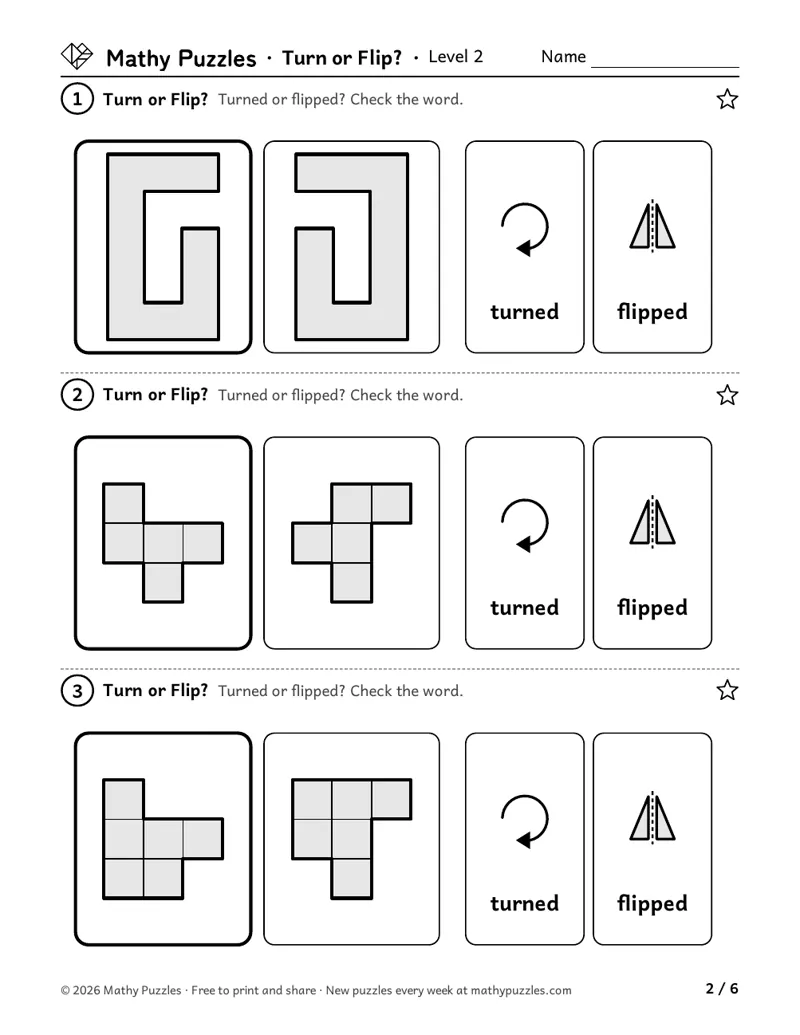
The easiest puzzles: a shape and one copy. Is the copy turned or flipped? The child checks one of two word cards.
Next: the shape and 3 copies. Two are turned, one is flipped (a mirror image or a water image, flipped top to bottom). Find the flipped one.
The hardest puzzles: 4 copies and no shape to compare with. Three are the same shape at different turns; one is flipped. Which one?
On the sheet: “Turned or flipped?”
Print Level 2 (Letter)Other paper size: A4
How it works
Each puzzle shows a shape made of squares (some with a small slanted corner) and a few copies of it. At Level 2 the shape can also be a block letter or number. At Level 1 the child finds the copy that is the same shape, only turned. At Level 2 the child decides which copies are turned and which one is flipped, like a mirror image or a reflection in water.
How to play
- Look closely at the shape: find a part that sticks out.
- Turn each copy in your head (or turn the page) to see if it matches.
- Level 1: cross out the copies that never match, however you turn them. Check the one that does.
- Level 2: cross out every copy that matches after a turn. The one left over is flipped. Check it.
When it gets hard
Calling an upside-down shape flipped.
Hint: Upside down can be a half turn. Turn the page around and see if it matches.
Missing a water image (flipped top to bottom).
Hint: A flip can go top to bottom as well as left to right.
Comparing only the outline, not where the bumps are.
Hint: Pick one bump or corner and follow it as you turn.
Picking the mirror image in the hardest puzzles.
Hint: Turn the page all the way around. A flipped shape never matches, however you turn it.
Tip for grown-ups: Cut the shape out of paper. Turn it on the table, then flip it over, and ask your child which one could match the copy.
Frequently asked questions
- Is this about b and d mix-ups?
- No. It is a shape puzzle, not a reading exercise. Letters and numbers that become another one when turned or flipped, like b, d, p and q, or 6 and 9, are left out on purpose. What it practices is noticing when a shape is reversed.
- Does Level 1 include flips?
- Only as a wrong choice. Level 1 asks for the copy that is just turned, and in its hardest puzzles one wrong choice is the mirror image. Level 2 asks which copies are turned and which one is flipped.
- Is a mirror allowed?
- Yes, as a check after choosing. Hold the page up to a mirror and see which copy matches the reflection.
Questions about printing, levels, answers or membership: see all questions.
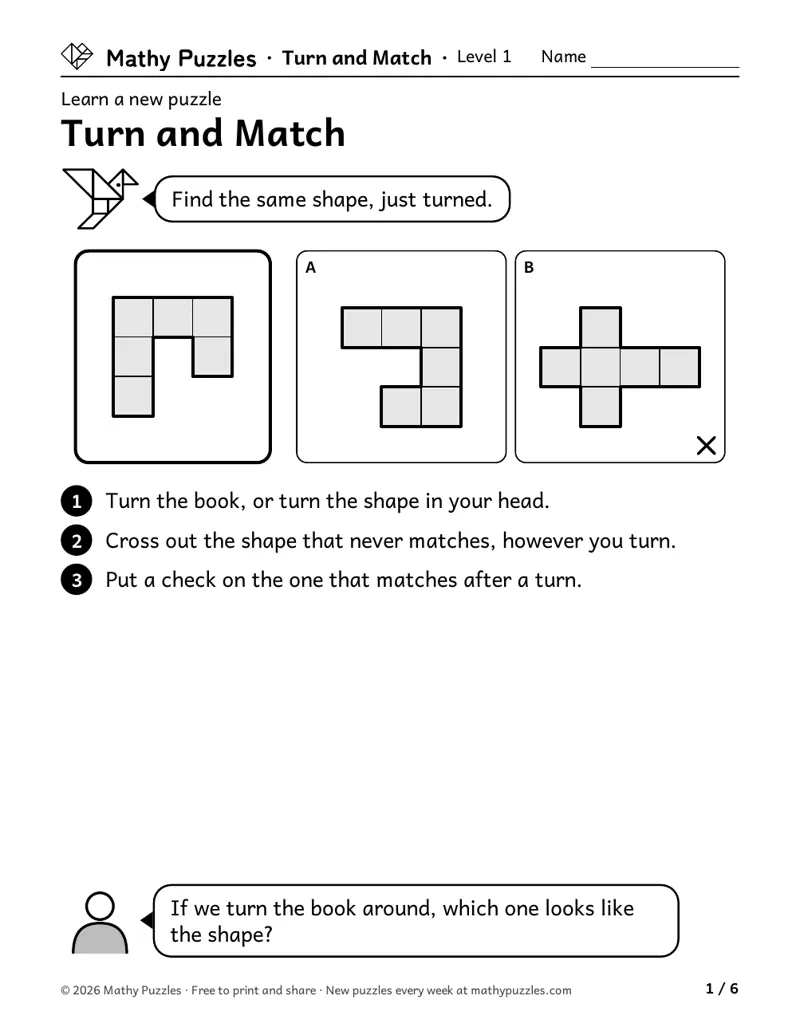
Worked example
From the Level 1 Learn sheet
- Turn the page, or turn the shape in your head.
- The shape that never matches, however you turn it, is already crossed out.
- Put a check on the one that matches after a turn.
A question to ask: “If we turn the page around, which one looks like the shape?”
Free every Sunday A mixed bag of 20 new puzzles, all four levels. Get them by email
The thinking it works on
Turning a copy back in the mind
Turns a shape in the mind to compare it.
In Estes's (1998) computer game, 6-year-olds took longer the further a shape was turned, just as adults did. Four-year-olds who did not mention picturing the turn answered at random. Source
Spotting a mirror image
Tells a shape from its mirror image.
Fernandes, Leite and Kolinsky (2016) found that preschoolers aged 5 to 7 had the most trouble telling mirror-image pairs apart, and first graders did better. Source
Following one bump or corner
Tracks one bump, corner or long side as the shape turns.
Ruling out the turned copies
Rules out the copies that match.
In Mody and Carey's (2016) cup game, 3- to 5-year-olds who saw that one cup was empty went straight to the other cup. Two-and-a-half-year-olds did not yet reason this way. Source
Turning shapes in the mind
Pictures a shape turned to compare it.
Frick, Ferrara and Newcombe (2013) found that by age 5, children took longer and made more errors the further a shape was turned from the hole it fit. Four-year-olds answered at chance. Source
Where is this thinking used?
- Reading letters and numbers: b and d differ only by a flip, so readers check which way a letter faces.
- Doing a jigsaw puzzle: Pieces are turned, never flipped over, to fit.
- Following a pattern for sewing or crafts: Some pieces must be cut out flipped, as a mirror pair.
- Recognizing signs and logos: A sign seen at an angle is still the same sign; a mirror copy is not.
For teachers
Curriculum areas
- Common Core
- Geometry: a shape keeps its name when turned; telling defining from non-defining features (Grades K–1)
- NCERT
- Foundational stage: spatial play, turning and fitting shapes (pre-primary)
- National Curriculum (England)
- Geometry – position and direction: quarter, half and three-quarter turns (Years 1–2)
- Cambridge Primary Mathematics
- Geometry and measure: shapes in different orientations; reflection in a mirror line (Stage 2)
Math practices: see the box below.
Math practices this puzzle uses
- Not used: MP1 Make sense of problems and persevere in solving them
- Not used: MP2 Reason abstractly and quantitatively
- Not used: MP3 Construct viable arguments and critique the reasoning of others
- Not used: MP4 Model with mathematics
- Not used: MP5 Use appropriate tools strategically
- Not used: MP6 Attend to precision
- Uses: MP7 Look for and make use of structure
- Not used: MP8 Look for and express regularity in repeated reasoning
From the Common Core Standards for Mathematical Practice.
More Turn or Flip? puzzles for members
Members get at least 5 more worksheets at each difficulty for every puzzle, 80 new puzzles every Sunday, and the whole archive. $39 a year or $25 for 6 months.
See membershipNot ready yet?
One email, all four levels: 20 puzzles, 5 for each level.
For grown-ups (18+). One email every Sunday with the puzzles and the odd note about membership; unsubscribe any time. We never ask about your child. How we use your email