
Mirror Match
Step back from a mirror and your reflection steps back too, the same distance on the other side. That one rule is enough to draw the missing half of a picture, dot by dot. Level 3 adds pictures that turn around a dot instead.
Free sets by level, ages 4–10:
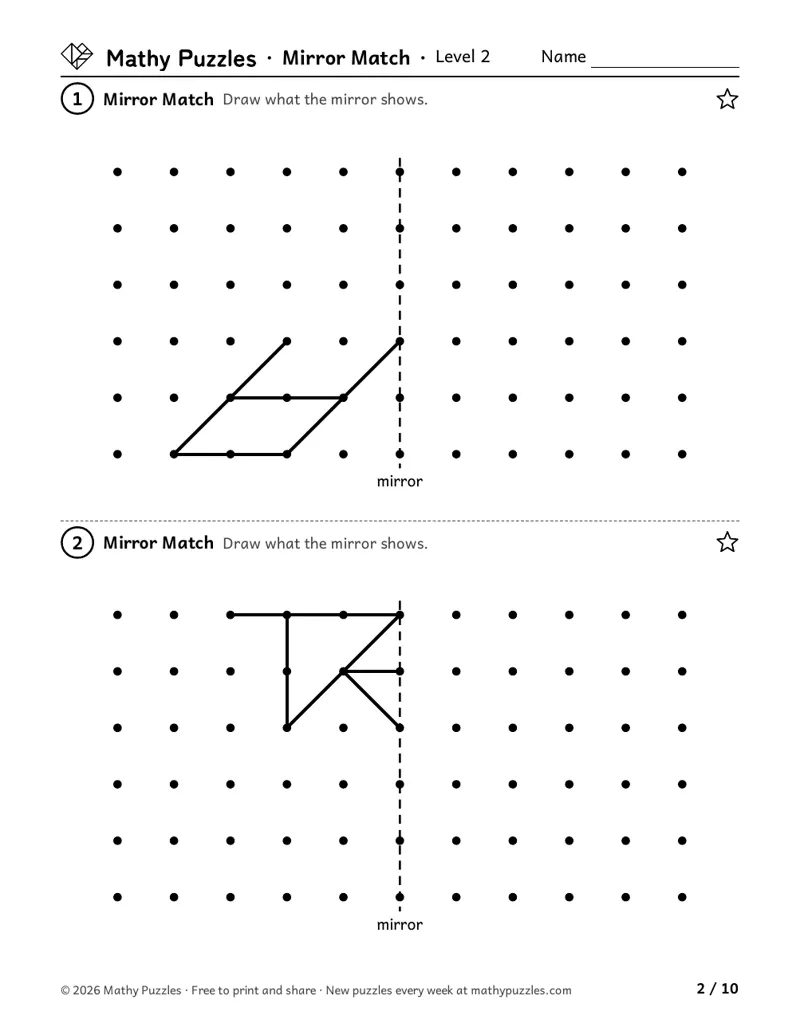 Level 2: a page from the free set
Before starting
- Hold a pencil and draw a line between two dots
- Count to 8
- Level 3: comfortable with the slanted mirror from Level 2
What you need
A small hand mirror for checking (optional), and a pencil with an eraser.
Free puzzles to print
Each set: a Learn sheet with a worked example, 10 puzzles from easiest to hardest, and the answers.
Level 1
Ages 4–6 · Pre-K–K
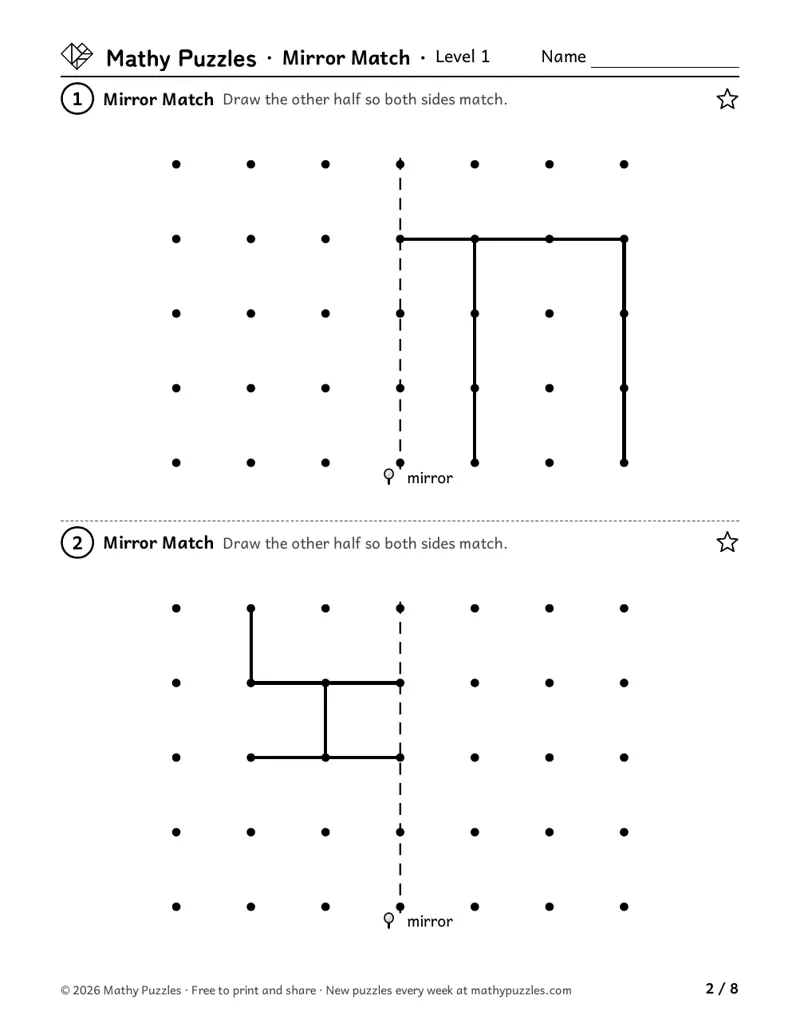
An up-and-down mirror with a few straight lines, then one slanted line, then an across mirror.
On the sheet: “Draw the other half so both sides match.”
Print Level 1 (Letter)Other paper size: A4Level 2
Ages 6–8 · Grades 1–2
More slanted lines, a mirror that runs corner to corner, then two mirrors where the child draws three quarters.
On the sheet: “Draw what the mirror shows.”
Print Level 2 (Letter)Other paper size: A4Level 3
Ages 8–10 · Grades 3–4
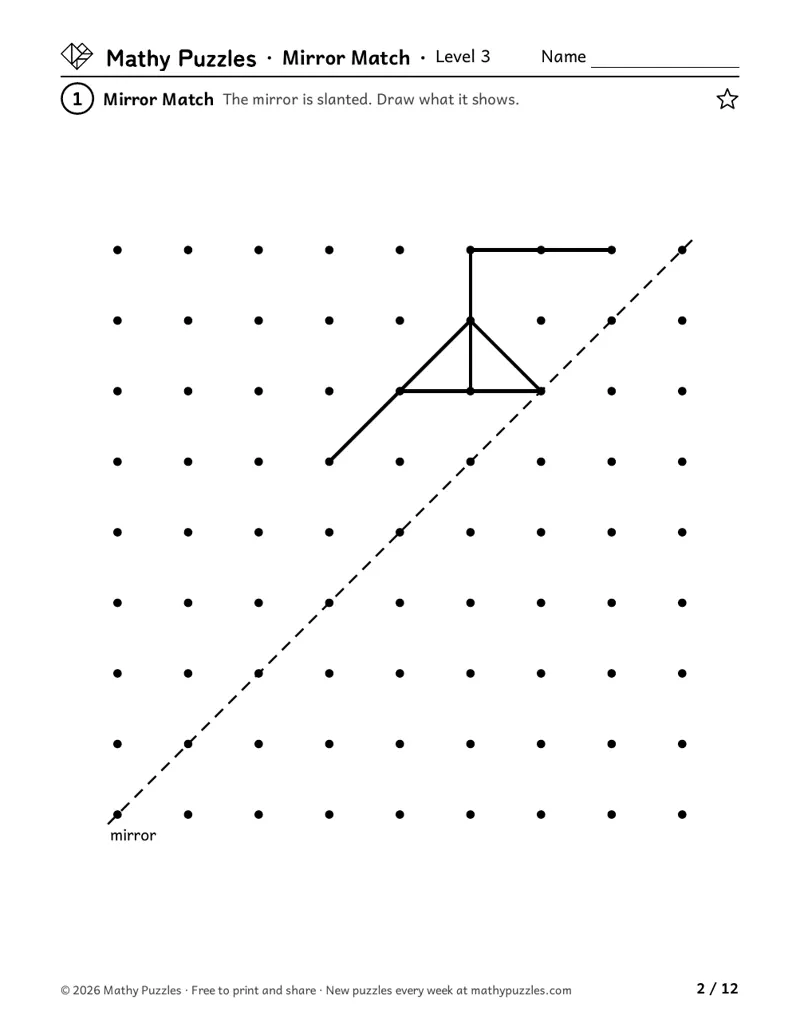
The other diagonal mirror, a picture that looks the same upside down, and pinwheels that must be turned, not flipped. In the hardest pinwheels, no turn is drawn for you and there are more lines.
On the sheet: “Draw what the mirror shows.”
Print Level 3 (Letter)Other paper size: A4
How it works
Half a picture is drawn on a grid of dots, next to a dashed line marked "mirror". The child draws the other half, dot to dot, so it looks like the mirror's reflection. Later levels add slanted mirrors, two mirrors, and pictures that turn around a middle dot.
How to play
- Find the dashed mirror line.
- Pick one corner of the drawing. Count how many dots it is from the mirror.
- Count the same number of dots on the other side and put a mark there.
- Do this for each corner, then join the marks with straight lines.
When it gets hard
Copying the half as it is (sliding it over) instead of flipping it.
Hint: The part nearest the mirror stays nearest the mirror. Which line touches the dashed line?
A slanted line that leans the same way on both sides.
Hint: Check the two ends of that line separately, one dot count at a time.
Ending one dot too far or too short.
Hint: Count dots from the mirror line, not from the edge of the page.
Tip for grown-ups: A small hand mirror stood on the dashed line lets your child check their own drawing. The Level 3 turning puzzles have no mirror line: turn the page upside down to check those instead.
Frequently asked questions
- My 5-year-old can't draw straight lines. Is that a problem?
- No. The lines go dot to dot, so wobbly is fine. What matters is landing on the right dot.
- How do we check the drawing?
- Stand a small mirror on the dashed line: the reflection should match what your child drew. The Level 3 turning puzzles have no mirror line; turn the page upside down and the picture should look the same.
Questions about printing, levels, answers or membership: see all questions.
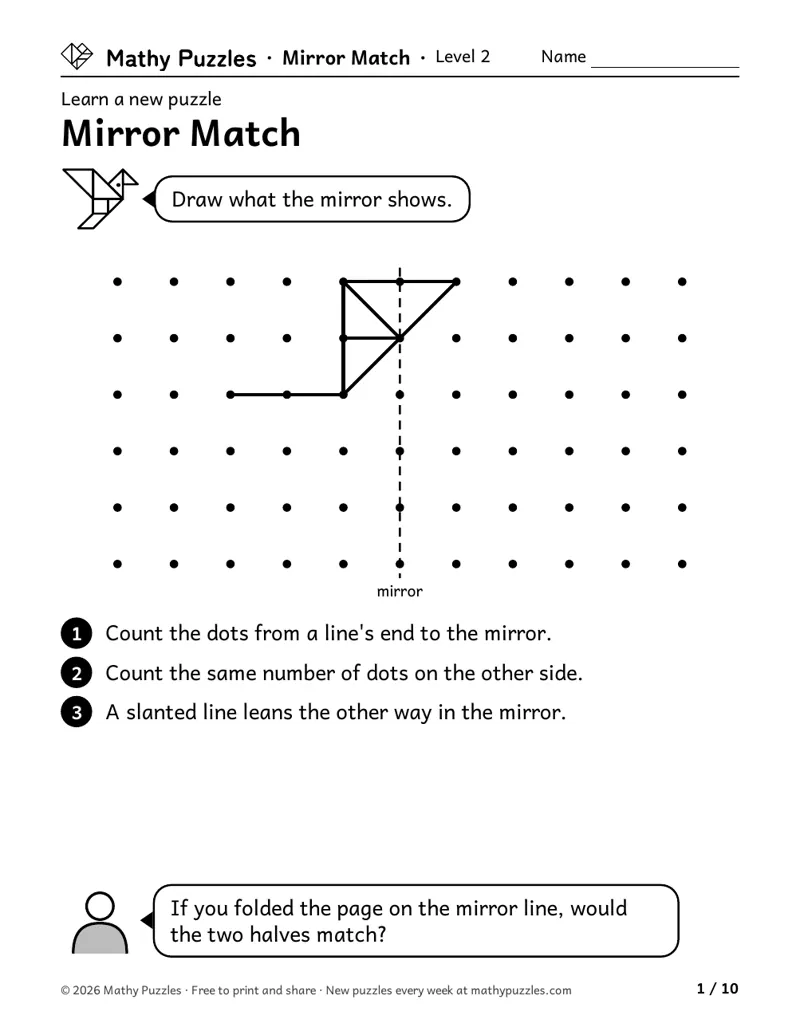
Worked example
From the Level 2 Learn sheet
- Count the dots from a line's end to the mirror.
- Count the same number of dots on the other side.
- A slanted line leans the other way in the mirror.
A question to ask: “If you folded the page on the mirror line, would the two halves match?”
Free every Sunday A mixed bag of 20 new puzzles, all four levels. Get them by email
The thinking it works on
Mapping a point across a line
Finds where each corner lands on the other side of the mirror line, one point at a time.
Götz and Gasteiger (2022) summarize earlier studies, including Küchemann (1981). Pupils find up-and-down mirror lines easiest and sideways and slanted ones harder, and often ignore the slant of a tilted mirror line. Source
Measuring and comparing distances
Counts dots to the mirror line, then the same number past it.
Frick and Newcombe (2012) found that children's skill at carrying a distance from a small map to a real layout grows a lot between ages 3 and 5. Landmarks help the youngest children. Source
Picturing a flip
Imagines the half flipped over, not slid across.
Bornstein and Stiles-Davis (1984) found that 4- to 6-year-olds picked up mirror symmetry about an up-and-down line most easily. A sideways line came next, and a slanted line was hardest. Source
Planning the drawing
Chooses where to start and works through the lines so none is missed.
Diamond (2013) reviews evidence that holding back a quick first answer is much harder for children than for adults. Children get steadily better at it through the school years. Source
Turning a picture in the mind
Turns a picture in the head for the upside-down and pinwheel puzzles.
Van Tetering and colleagues (2019) report that older primary children (about 11 on average) outscored younger ones (about 9). The paper test asked them to turn block figures in the mind. Source
Checking against a rule
Asks whether the folded page would match, or turns it upside down to check.
Where is this thinking used?
- Sewing and dressmaking: A pattern piece is cut on a fold and opens into a symmetric shape.
- Architecture and logo design: Floor plans, building fronts and logos are drawn as one half and mirrored.
- Paper crafts: Snowflakes and stencils are cut as a half; the fold gives the rest.
- Printing and stamps: A stamp is carved backward so the print reads forward.
For teachers
Curriculum areas
- Common Core
- Geometry: lines of symmetry (Grade 4)Level 1: No direct curricular match.
- NCERT
- Symmetry with mirrors, rangoli and dot grids (Classes 3–4); turn symmetry (Classes 5–6)Level 1: No direct curricular match.
- National Curriculum (England)
- Geometry: line symmetry and completing a symmetric figure (Years 2 and 4); the position of a shape after a reflection (Year 5)
- Cambridge Primary Mathematics
- Geometry and measure: reflecting shapes in mirror lines (Stages 2–6)
Math practices: see the box below.
Math practices this puzzle uses
- Not used: MP1 Make sense of problems and persevere in solving them
- Not used: MP2 Reason abstractly and quantitatively
- Not used: MP3 Construct viable arguments and critique the reasoning of others
- Not used: MP4 Model with mathematics
- Not used: MP5 Use appropriate tools strategically
- Uses: MP6 Attend to precision
- Uses: MP7 Look for and make use of structure
- Not used: MP8 Look for and express regularity in repeated reasoning
From the Common Core Standards for Mathematical Practice.
More Mirror Match puzzles for members
Members get at least 5 more worksheets at each difficulty for every puzzle, 80 new puzzles every Sunday, and the whole archive. $39 a year or $25 for 6 months.
See membershipNot ready yet?
One email, all four levels: 20 puzzles, 5 for each level.
For grown-ups (18+). One email every Sunday with the puzzles and the odd note about membership; unsubscribe any time. We never ask about your child. How we use your email