
Fold & Punch
Fold a paper napkin, poke a pencil through it, and open it up: one poke has made two holes, or four. Children love that reveal. These puzzles ask them to see it coming, one fold at a time, before the paper is opened.
Free sets by level, ages 4–12:
 Level 1: a page from the free set
Before starting
- Know what folding paper in half means
- Match two pictures that are the same
- Level 3: confident with one and two folds
- Level 4: confident with three folds, and ready to work backward from the opened sheet.
What you need
A square of scrap paper and a hole punch (or a pencil tip) to check an answer for real, and a pencil.
Free puzzles to print
Each set: a Learn sheet with a worked example, 10 puzzles from easiest to hardest, and the answers.
Level 1
Ages 4–6 · Pre-K–K
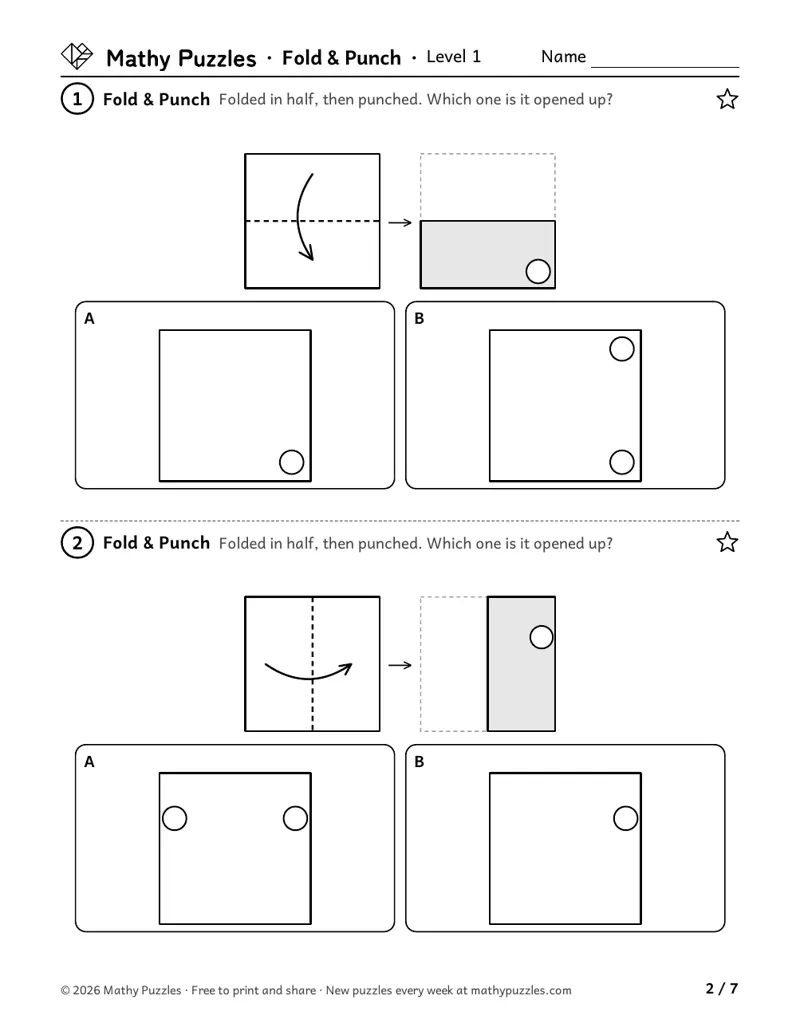
Folded once down the middle, one big hole and 2 choices. Then two holes and 3 choices. Then a heart or arrow punch, where one wrong choice has the twin in the right place but not flipped.
On the sheet: “The paper is folded, then punched. Which one is it opened up?”
Print Level 1 (Letter)Other paper size: A4Level 2
Ages 6–8 · Grades 1–2
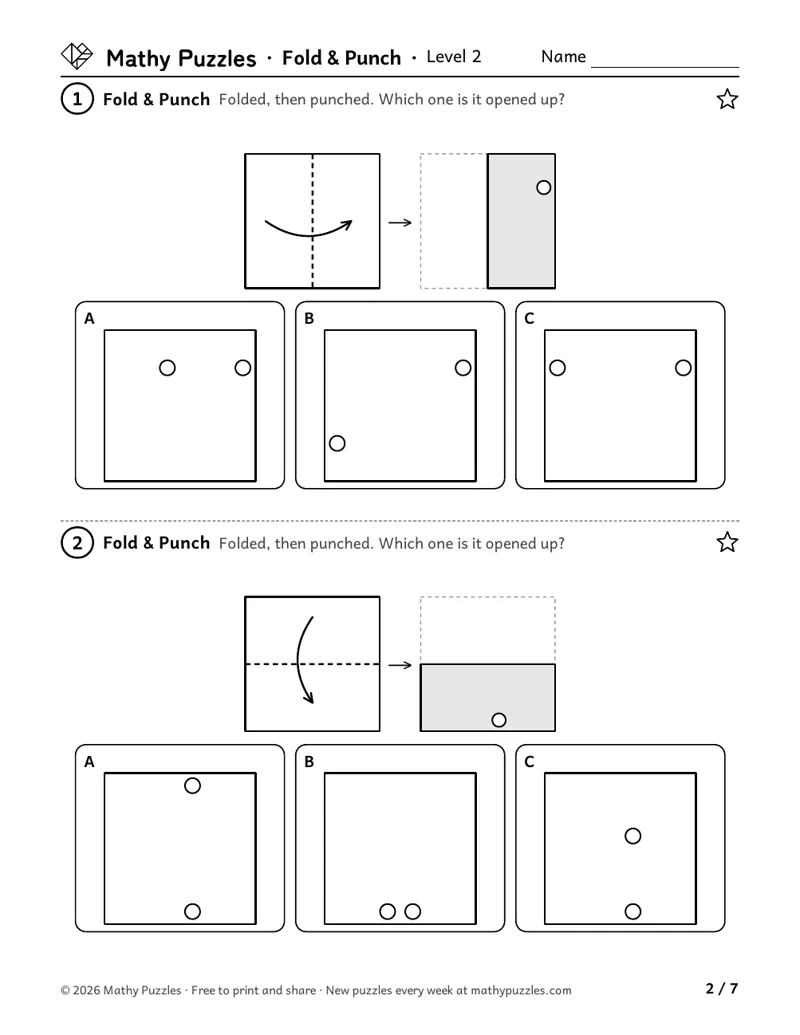
One fold and one hole with 3 choices. Then one fold (sometimes corner to corner) with two holes and 4 choices, then two folds into quarters. The hardest fold corner to corner twice.
On the sheet: “The paper is folded, then punched. Which one is it opened up?”
Print Level 2 (Letter)Other paper size: A4Level 3
Ages 8–10 · Grades 3–4
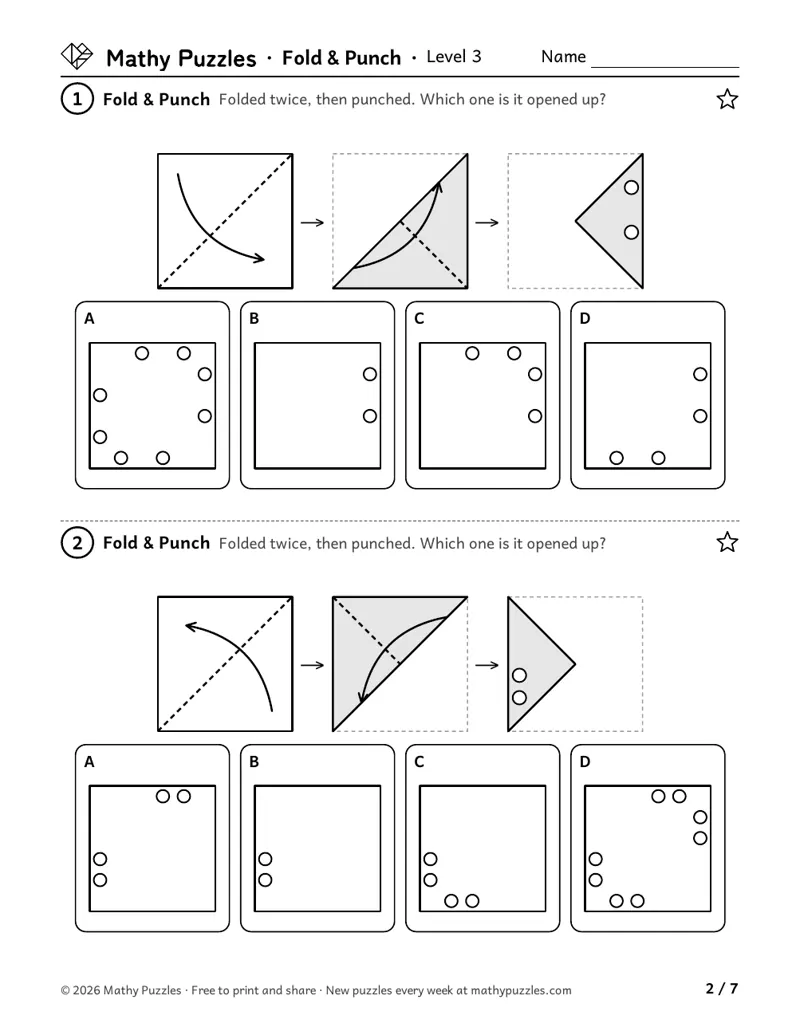
Two corner folds, then three folds, then the first snip: a cut at the fold that opens into a diamond. The hardest fold into quarters, snip at the fold and punch holes too.
On the sheet: “The paper is folded, then punched. Which one is it opened up?”
Print Level 3 (Letter)Other paper size: A4Level 4
Ages 10–12 · Grades 5–6
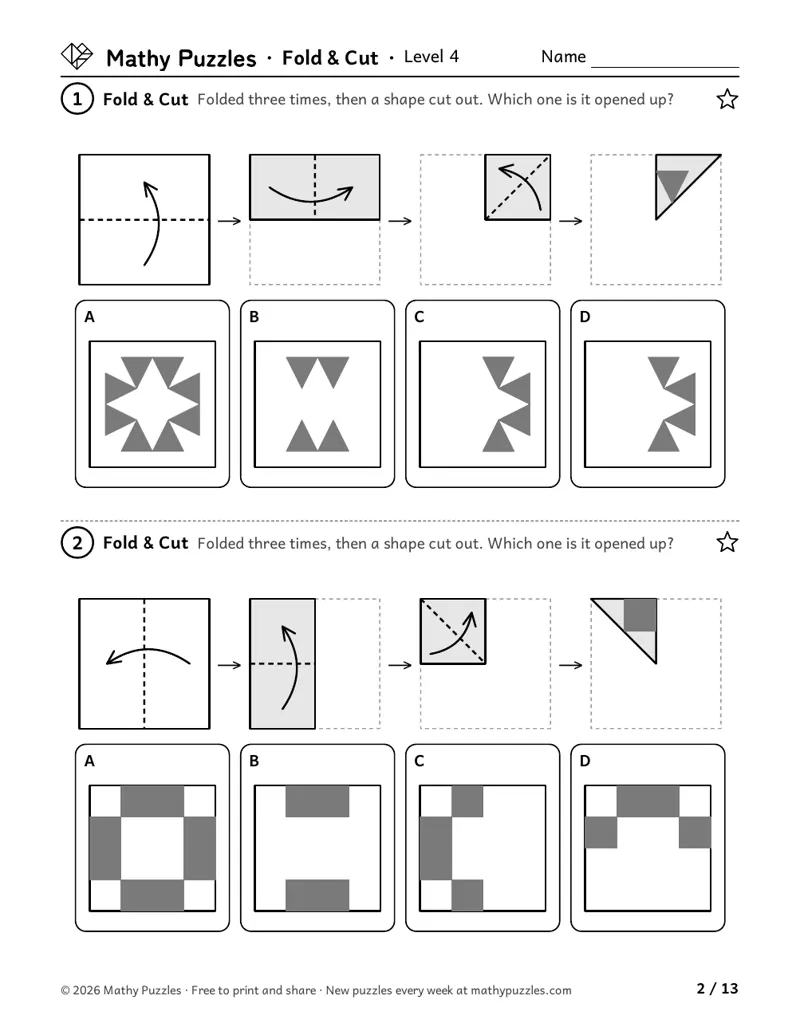
(Fold & Cut): three folds, then a square or triangle is cut out, not punched. From the middle puzzles it runs backward: you see the opened paper and pick which cut on the folded paper made it. The hardest add two cuts and a hole.
On the sheet: “The paper is folded, then punched. Which one is it opened up?”
Print Level 4 (Letter)Other paper size: A4The sheet is titled “Fold & Cut”.
How it works
Small pictures show a square of paper being folded, then a hole punched through it. The child picks the picture that shows the paper opened out flat. Each fold doubles the holes, and they land as mirror images across the fold line. At Level 1 the paper is folded once down the middle. In the hardest Level 1 puzzles the punch is a heart or an arrow, so the opened twin is flipped too. At Level 3 a snip at the fold opens into a diamond. At Level 4 (Fold & Cut) shapes are cut out instead of punched, and some puzzles run backward: you see the opened paper and find which cut made it.
How to play
- Follow the pictures in order: first fold, second fold, then the punch.
- Unfold one step at a time, starting with the last fold.
- Each time you unfold, copy every hole across the fold line, like a mirror.
- Cross out the papers that don't match. Check the one that does.
- Level 4 backward puzzles: start from the opened paper and fold it back up in your head, matching each cut to the folded paper.
When it gets hard
Picking the paper where the hole is copied by sliding it, not flipping it.
Hint: After you unfold, the new hole is as far from the fold as the old one, on the other side.
Unfolding only once when there were two folds.
Hint: Count the folds in the pictures. You need that many unfold steps.
Mixing up which line was the fold.
Hint: Put a finger on the fold line in the last picture before you start.
Tip for grown-ups: Fold and punch a real square of paper (a hole punch or a pencil tip works) to check an answer together.
Frequently asked questions
- Can we just fold real paper?
- Yes, and please do for the first few. Then ask your child to predict before unfolding. The predicting is the puzzle.
- Is only one option right?
- Each puzzle offers 2 to 4 choices, and the answers show which one matches the folds. Saying why the others fail is half the learning.
Questions about printing, levels, answers or membership: see all questions.
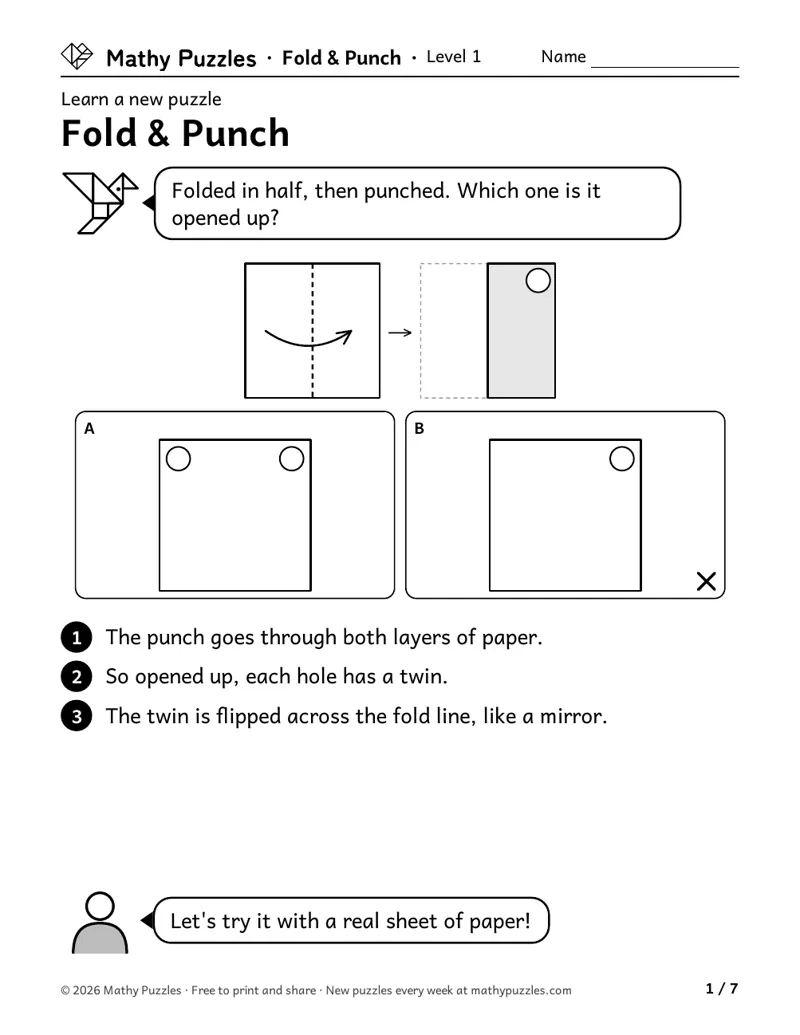
Worked example
From the Level 1 Learn sheet
- The punch goes through both layers of paper.
- So opened up, each hole has a twin.
- The twin is flipped across the fold line, like a mirror.
A question to ask: “Let's try it with a real sheet of paper!”
Free every Sunday A mixed bag of 20 new puzzles, all four levels. Get them by email
The thinking it works on
Running steps backward
Unfolds one step at a time, starting with the last fold.
Folding in the mind
Imagines the square folding in half, in quarters or corner to corner.
Harris, Newcombe and Hirsh-Pasek (2013) tested 180 children aged 4 to 7. Mental folding appeared at around 5 and a half on average, with marked differences between children. Source
Reflection across a line
Copies each hole across the fold line, the same distance away.
Götz and Gasteiger (2022) interviewed 42 children at the end of primary school about mirror tasks. They note earlier findings that many children slide a shape across the line instead of flipping it. Source
Working memory
Holds the fold order and every hole position in mind while unfolding.
Gathercole and colleagues (2004) found that working memory grows steadily from age 4 to 15. Source
Checking options against rules
Tests each option against the folds and crosses out the ones that break a rule.
Mody and Carey (2016) found that reasoning 'not this one, so it must be that one' shows up in children between ages 2½ and 5. Source
Doubling and halves
Notices that one fold gives 2 holes, two give 4 and three give 8.
Folding and cutting for real
Folds and punches a real sheet to check an answer.
Travers and colleagues (2018) found that children fold paper by hand from about age 2, more accurately with age. At least half of 4- to 5½-year-olds made the folds asked. Source
Where is this thinking used?
- Origami and pop-up cards: One cut or fold shows up in several places when the paper opens.
- Paper snowflakes and stencils: One cut on a folded sheet appears many times when opened.
- Sewing: Cloth is cut on the fold so both halves match.
- Sheet-metal and box design: A flat sheet is folded into a 3D part; an engineer unfolds it to cut it flat.
For teachers
Curriculum areas
- Common Core
- Geometry: lines of symmetry and folding into matching parts (Grade 4)Level 1: No direct curricular match.
- NCERT
- Symmetry with folding, holes and cuts (Classes 3–6)Level 1: No direct curricular match.
- National Curriculum (England)
- Geometry – properties of shapes: line symmetry (Years 2 and 4); reflections (Year 5)
- Cambridge Primary Mathematics
- Geometry and measure: lines of symmetry, including diagonal ones; completing symmetrical patterns (Stages 2–5)
Math practices: see the box below.
Math practices this puzzle uses
- Not used: MP1 Make sense of problems and persevere in solving them
- Not used: MP2 Reason abstractly and quantitatively
- Not used: MP3 Construct viable arguments and critique the reasoning of others
- Not used: MP4 Model with mathematics
- Not used: MP5 Use appropriate tools strategically
- Not used: MP6 Attend to precision
- Uses: MP7 Look for and make use of structure
- Uses: MP8 Look for and express regularity in repeated reasoning
From the Common Core Standards for Mathematical Practice.
More Fold & Punch puzzles for members
Members get at least 5 more worksheets at each difficulty for every puzzle, 80 new puzzles every Sunday, and the whole archive. $39 a year or $25 for 6 months.
See membershipNot ready yet?
One email, all four levels: 20 puzzles, 5 for each level.
For grown-ups (18+). One email every Sunday with the puzzles and the odd note about membership; unsubscribe any time. We never ask about your child. How we use your email