
Which Pieces?
Give a young child a few paper shapes and they will push them around until, all at once, they make a square. Which Pieces asks for that moment on paper: which set of small pieces makes the big shape, with nothing missing and nothing left over.
Free sets by level, ages 4–6:
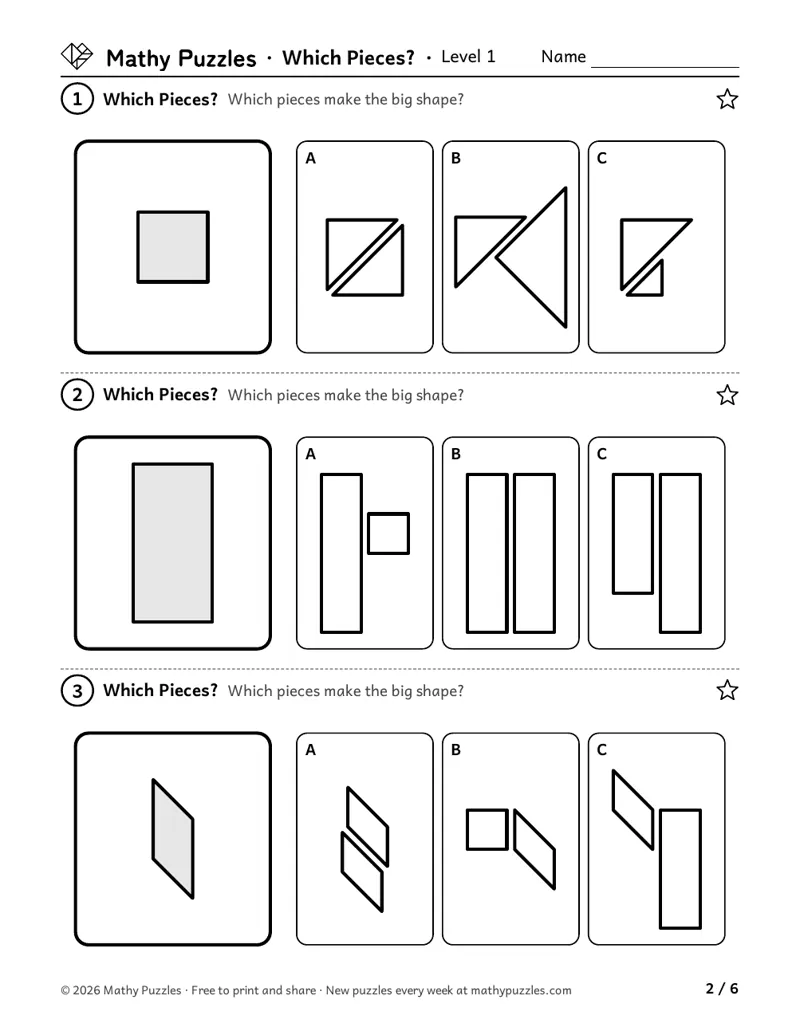 Level 1: a page from the free set
Before starting
- Name a square and a triangle
- Match two shapes that are the same
- Hold a crayon to cross out and check
What you need
Scrap paper and scissors to cut out the pieces and try them for real, and a pencil.
Free puzzles to print
Each set: a Learn sheet with a worked example, 10 puzzles from easiest to hardest, and the answers.
Level 1
Ages 4–6 · Pre-K–K
The easiest puzzles: two pieces, drawn in the places where they go; slide them together.
The middle puzzles: three pieces, drawn in place.
The harder puzzles: two or three pieces, at least one turned, and every set has the right total size.
On the sheet: “Which pieces make the big shape?”
Print Level 1 (Letter)Other paper size: A4
How it works
Each puzzle shows a big shape and three sets of smaller pieces. The child finds the set whose pieces fit together to make the big shape exactly, with no gaps and no pieces left over. It is a first step toward tangrams for young children.
How to play
- Look at the big shape. Notice its corners and bumps.
- Look at the first set. Picture the pieces pushed together.
- Do they make the big shape with nothing sticking out and no gaps? If not, cross out the set.
- Check the set that makes the shape.
When it gets hard
Choosing the set that looks most like the big shape at a glance.
Hint: Trace the outline of the big shape with a finger, then trace the pieces. Do they follow the same path?
Forgetting a piece can be turned.
Hint: Turn the page a little. Does a piece fit now?
Picking a set with a piece left over.
Hint: Every piece must be used. Point to each one and say where it goes.
Tip for grown-ups: Cut the pieces out of paper and let your child push them together on top of the big shape to check.
Frequently asked questions
- Can I use this in pre-K or kindergarten?
- Show the Learn sheet, then give out the page. Cut the pieces out of paper yourself and it becomes a table activity for the whole group.
- What if my child picks a wrong set?
- Ask them to trace the big shape's corners, then point to where each piece would go. A gap or a piece sticking out shows the mistake without you saying so.
Questions about printing, levels, answers or membership: see all questions.
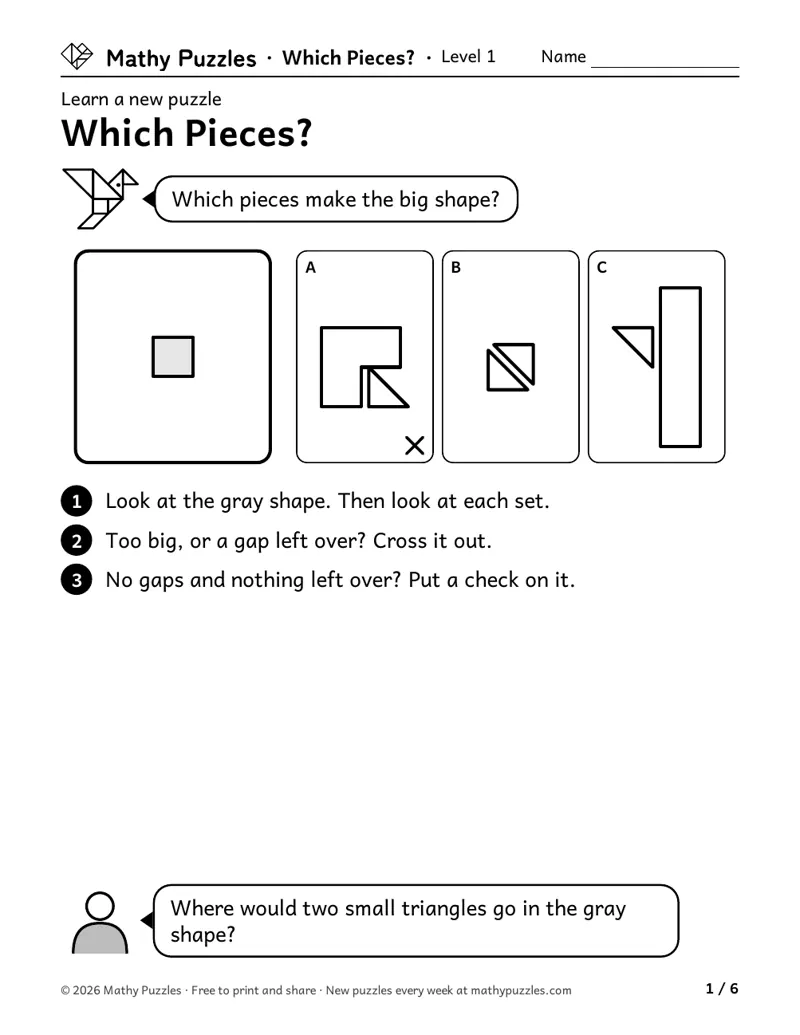
Worked example
From the Level 1 Learn sheet
- Look at the gray shape. Then look at each set.
- Too big, or a gap left over? Cross it out.
- No gaps and nothing left over? Put a check on it.
A question to ask: “Where would these pieces go in the gray shape?”
Free every Sunday A mixed bag of 20 new puzzles, all four levels. Get them by email
The thinking it works on
Putting shapes together in the mind
Pictures the pieces pushed together and compares with the gray shape.
Clements, Wilson and Sarama (2004) found that 3- to 7-year-olds move through clear levels in putting shapes together. The last level is seeing a set of shapes as one new shape. Source
Turning a shape in the mind
Turns a sideways piece a quarter or half turn in the head.
Frick, Hansen and Newcombe (2013) found that judging which turned figure fits a hole goes from about 1 in 10 three-year-olds to nearly all five-year-olds. Source
Comparing outlines, corners and sizes
Checks the corners and bumps for a gap, an overlap or a piece left over.
Ruling out choices
Crosses out a set that can't work to narrow down the one that must.
Gautam, Suddendorf and Redshaw (2021) tested 100 children aged 2½ to 5. Only the 5-year-olds passed a strict test of 'not this one, so it must be that one'. Source
Checking a whole set, not one piece
Places every piece before saying yes, since sizes alone can't decide.
Where is this thinking used?
- Jigsaws and blocks: Pieces fit together to make a picture or a tower.
- Packing: A lunchbox or a drawer where everything has to fit.
- Simple assembly: Folding a paper shape, or reading a picture of how parts go together.
For teachers
Curriculum areas
- Common Core
- Geometry: composing simple shapes to form larger shapes (Kindergarten-Grade 1)
- NCERT
- Foundational stage: shapes and spatial play (pre-primary); shapes around us (Class 1)
- National Curriculum (England)
- Early years mathematics: spatial reasoning with shape and space (Reception)
- Cambridge Primary Mathematics
- No direct curricular match.
Math practices: see the box below.
Math practices this puzzle uses
- Not used: MP1 Make sense of problems and persevere in solving them
- Not used: MP2 Reason abstractly and quantitatively
- Not used: MP3 Construct viable arguments and critique the reasoning of others
- Not used: MP4 Model with mathematics
- Not used: MP5 Use appropriate tools strategically
- Not used: MP6 Attend to precision
- Uses: MP7 Look for and make use of structure
- Not used: MP8 Look for and express regularity in repeated reasoning
From the Common Core Standards for Mathematical Practice.
More Which Pieces? puzzles for members
Members get at least 5 more worksheets at each difficulty for every puzzle, 80 new puzzles every Sunday, and the whole archive. $39 a year or $25 for 6 months.
See membershipNot ready yet?
One email, all four levels: 20 puzzles, 5 for each level.
For grown-ups (18+). One email every Sunday with the puzzles and the odd note about membership; unsubscribe any time. We never ask about your child. How we use your email