
Fill in the Blocks
Anyone who has played with a tub of pattern blocks finds out that two triangles can stand in for a rhombus, and three for a trapezoid. These puzzles build on that: fill a picture with blocks, with no gaps, and see how big blocks can replace small ones.
Free sets by level, ages 4–8:
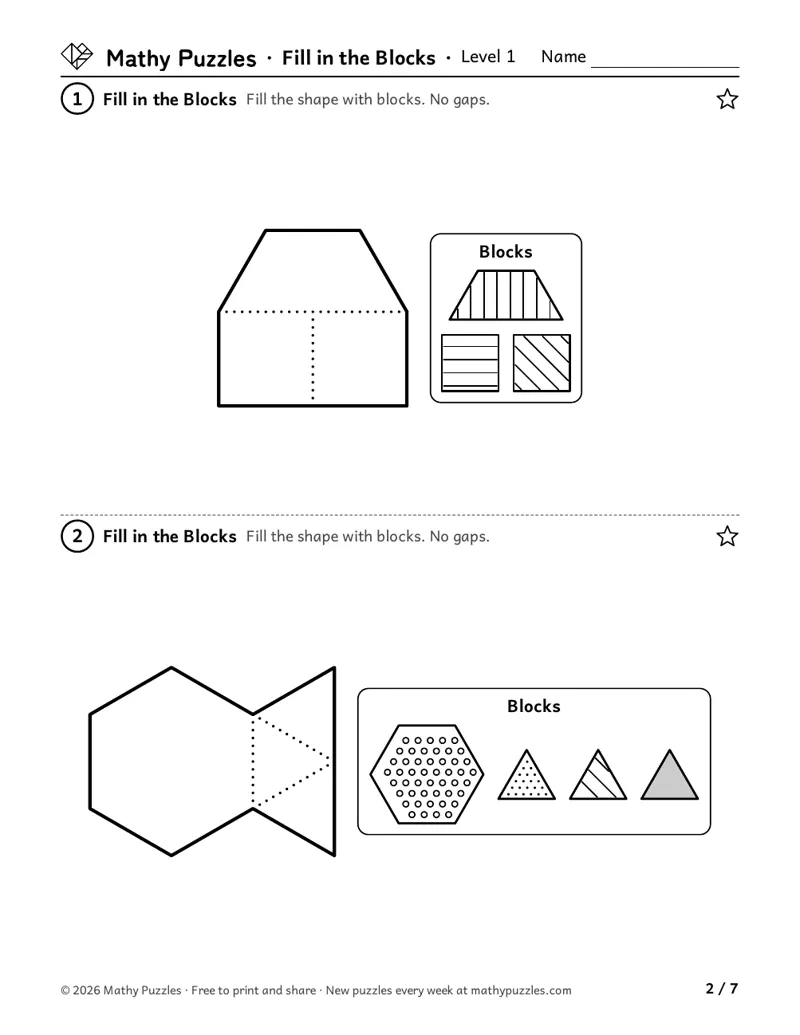 Level 1: a page from the free set
Before starting
- Know a triangle, a square and a hexagon by sight
- Hold a pencil and trace a dotted line
- Color or draw a pattern inside a small space
- Level 2: count up to 10 blocks
What you need
Pattern blocks if you have them (the page is drawn at their real size), crayons, and a pencil.
Free puzzles to print
Each set: a Learn sheet with a worked example, 10 puzzles from easiest to hardest, and the answers.
Level 1
Ages 4–6 · Pre-K–K
The easiest puzzles: every inside line is dotted, ready to trace; triangles, squares, hexagons and trapezoids; 3 to 8 blocks.
The middle puzzles: one or two inside lines are missing, so the child draws them; the wide rhombus joins; 4 to 8 blocks.
The hardest puzzles: only the outline and one starting block are shown. The picture has 4 or 5 blocks in all, of at most 3 kinds, sometimes including a thin rhombus; the child draws in the rest.
On the sheet: “Fill the shape with blocks. No gaps.”
Print Level 1 (Letter)Other paper size: A4Level 2
Ages 6–8 · Grades 1–2
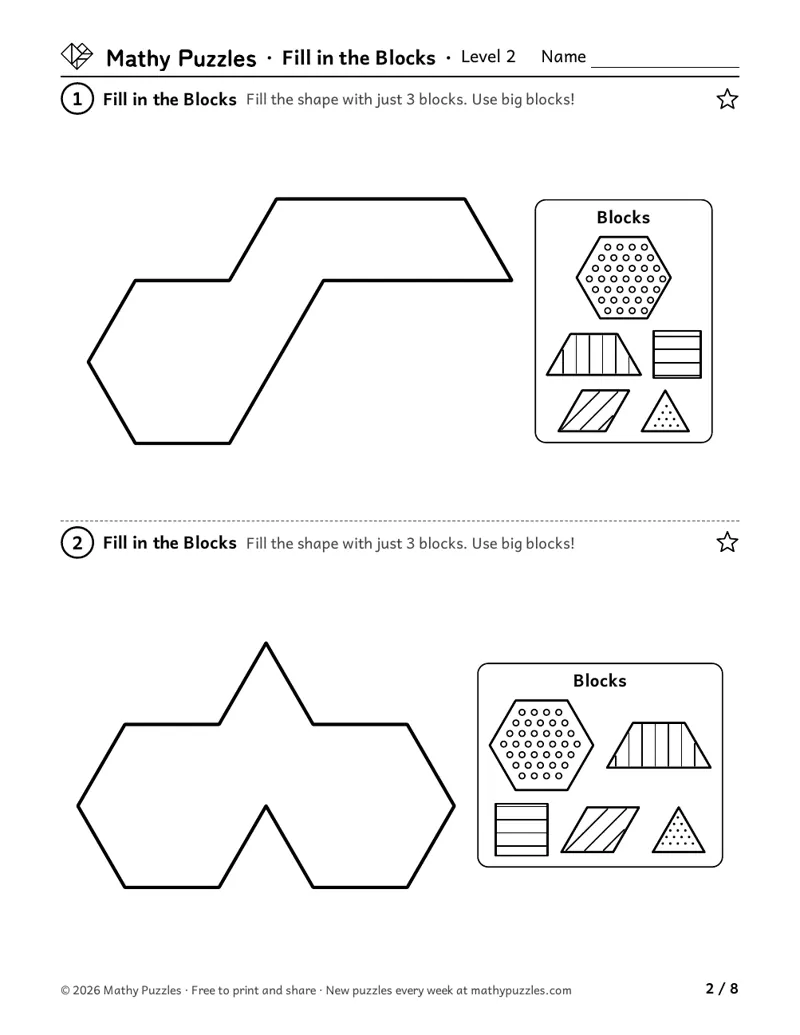
The easiest puzzles: outline only; the sheet says how many blocks to use (2 to 4), so the child has to pick big ones.
The middle puzzles: the same with 5 to 7 blocks.
The harder puzzles: no number given; fill the picture with as few blocks as you can (3 to 5) and write how many you used.
The hardest puzzles: bigger pictures on a full page, where the fewest is 6 to 9 blocks.
On the sheet: “Fill the shape with blocks. Use as few as you can.”
Print Level 2 (Letter)Other paper size: A4
How it works
Each sheet has a picture outline, such as a boat, a house or a fish, to fill with pattern-block shapes: triangles, squares, hexagons, trapezoids and rhombuses. The outline is drawn at the real size of standard pattern blocks, so a child with a set can lay them on the page. At Level 1, a Blocks box beside the picture shows every piece needed, each with its own pencil pattern. The child traces or draws the lines that make each block and copies its pattern. At Level 2 the Blocks box shows one of each kind, and the goal is to fill the outline with as few blocks as possible.
How to play
- Look at the Blocks box. Name each shape.
- Pick a corner of the picture. Which block fits there?
- Trace or draw its lines, then copy its pattern from the Blocks box.
- Keep going until the whole picture is full, with no gaps.
- At Level 2, try the biggest blocks first, then count. Could one big block replace two or three small ones?
When it gets hard
Leaving a small gap, or drawing a block that pokes out of the outline.
Hint: Run a finger along each block's edges. Every edge should meet another block or the outline.
Giving every block of one shape the same pattern.
Hint: Each piece in the Blocks box has its own pattern. Match one piece at a time.
Thinking a filling is wrong because it differs from the answers.
Hint: Other ways can be right too, as long as every block fits and nothing is left empty.
At Level 2, filling with lots of small triangles.
Hint: Two triangles make a wide rhombus, three make a trapezoid and six make a hexagon. Swap them for one big block.
Tip for grown-ups: If you have pattern blocks, let your child build the picture on the page first, then draw it. Ask which smaller blocks could make a hexagon.
Frequently asked questions
- Do we need real pattern blocks?
- No. A pencil is enough. The outline is drawn at the real size of standard pattern blocks (1-inch edges). If you have a set, your child can lay the blocks on the page first, then draw them.
- The answers show a different filling. Did my child get it wrong?
- Not if every block fits and there are no gaps. A shape may be filled more than one way; the answers show one example. In the hardest Level 1 puzzles, check that your child used exactly the pieces in the Blocks box; at Level 2, check the number of blocks too.
- How does this fit a kindergarten shapes unit?
- It practices putting simple shapes together to make larger ones, a kindergarten geometry goal, and naming triangles, squares, hexagons and trapezoids along the way.
Questions about printing, levels, answers or membership: see all questions.
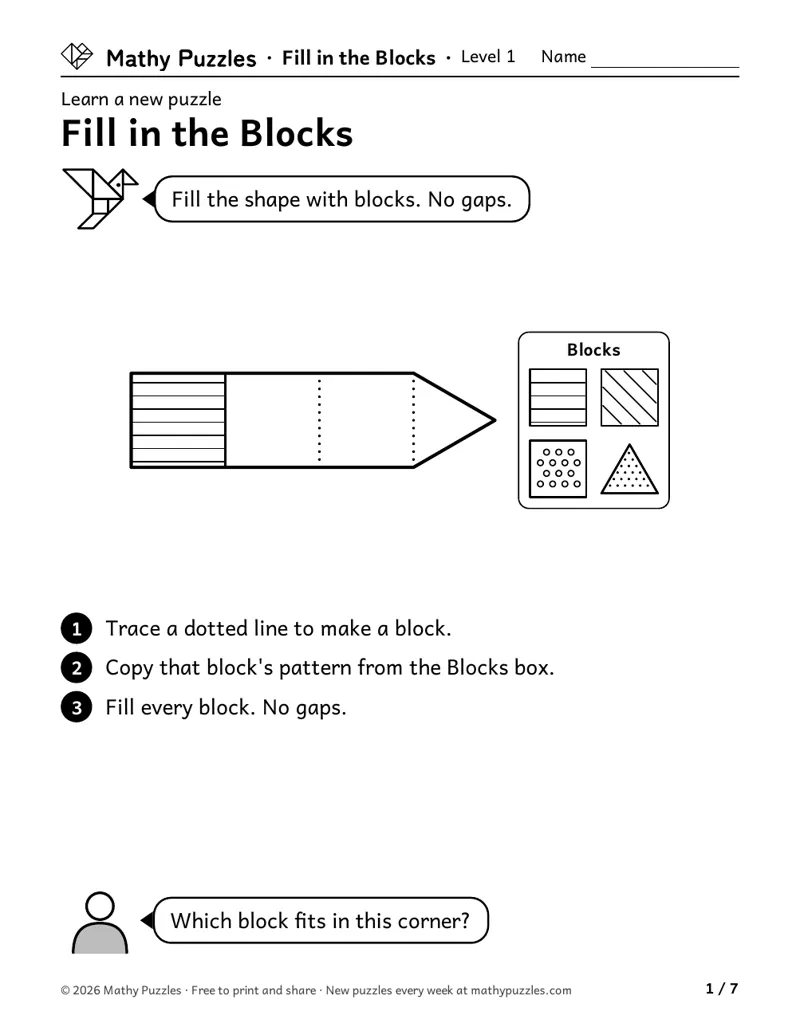
Worked example
From the Level 1 Learn sheet
- The biggest block is already traced and patterned.
- Trace a dotted line to make the next block.
- Copy that block's pattern from the Blocks box.
- Fill every block. No gaps.
A question to ask: “Which block fits in this corner?”
Free every Sunday A mixed bag of 20 new puzzles, all four levels. Get them by email
The thinking it works on
Putting shapes together
Fits shapes side by side to fill an outline.
Clements, Wilson and Sarama (2004) found that children aged 3 to 7 first put shapes together by trial and error, then by matching sides and corners. Only after that do they make a picture from them. Source
Knowing shapes by their parts
Tells a trapezoid from a rhombus by its sides and corners.
Aslan and Arnas (2007) interviewed 100 children aged 3 to 6. The children could attend to sides and corners, but mostly sorted shapes by how they looked. Source
Picturing what isn't drawn
Imagines block edges before drawing them.
Eye and hand together
Traces and draws lines that meet at corners.
Daly, Kelley and Krauss (2003) studied 54 kindergartners. Those who could copy the first nine shapes of a drawing test also copied letters more legibly than those who could not. Source
Seeing parts inside a whole
Notices a big shape can be made of smaller ones.
Stiles and Tada (1996) found that the youngest preschoolers broke a pattern into simple, separate parts and joined them in simple ways. As they grew, they built more complex parts and joins. Source
Looking for the fewest
Swaps groups of small blocks for one big block, then counts.
Sophian, Garyantes and Chang (1997) found that many 5- to 7-year-olds expected more sharers to mean bigger shares, missing that more parts means smaller parts. Source
Where is this thinking used?
- Quilting: Patchwork is sewn from triangles, squares and hexagons.
- Floors and walls: Patterned tiles cover a floor or a kitchen wall.
- Building toys: A model is built from a picture of the finished thing.
- Mosaics: Small pieces of paper or tile make one big picture.
For teachers
Curriculum areas
- Common Core
- Geometry: putting simple shapes together to make larger shapes (Kindergarten); composing flat shapes, trapezoids included (Grade 1)
- NCERT
- Foundational stage: shapes, patterns and spatial play (pre-primary); 2D shapes (Class 2)Level 1: No direct curricular match.
- National Curriculum (England)
- Early years mathematics: spatial reasoning with shape and space (Reception); Geometry: naming common 2-D shapes (Year 1)Level 2: No direct curricular match.
- Cambridge Primary Mathematics
- Geometry and measure: making a shape by combining shapes (Stage 4)Level 1: No direct curricular match.
Math practices: see the box below.
Math practices this puzzle uses
- Not used: MP1 Make sense of problems and persevere in solving them
- Not used: MP2 Reason abstractly and quantitatively
- Not used: MP3 Construct viable arguments and critique the reasoning of others
- Not used: MP4 Model with mathematics
- Not used: MP5 Use appropriate tools strategically
- Uses: MP6 Attend to precision
- Uses: MP7 Look for and make use of structure
- Not used: MP8 Look for and express regularity in repeated reasoning
From the Common Core Standards for Mathematical Practice.
More Fill in the Blocks puzzles for members
Members get at least 5 more worksheets at each difficulty for every puzzle, 80 new puzzles every Sunday, and the whole archive. $39 a year or $25 for 6 months.
See membershipNot ready yet?
One email, all four levels: 20 puzzles, 5 for each level.
For grown-ups (18+). One email every Sunday with the puzzles and the odd note about membership; unsubscribe any time. We never ask about your child. How we use your email