
Hide and Seek
Somewhere in a tangle of lines, the shape from the box is hiding in plain sight, and the eye keeps sliding past it. Holding its outline in mind, and following it one side at a time, is how it is found.
Free sets by level, ages 4–6:
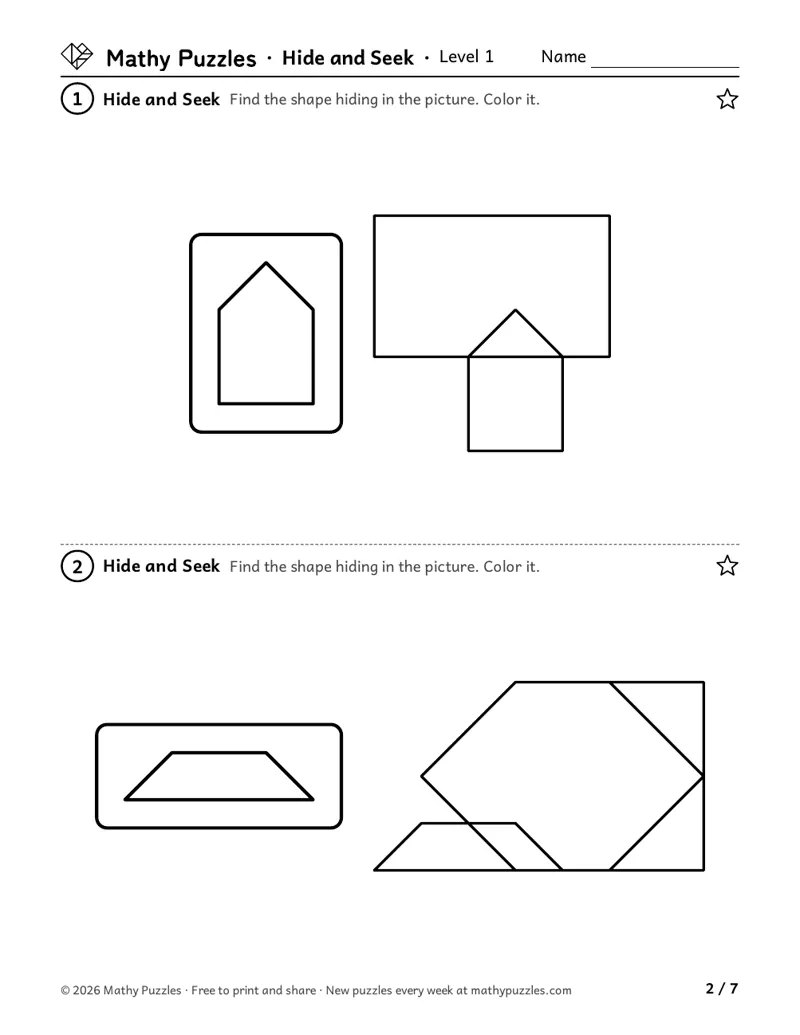 Level 1: a page from the free set
Before starting
- Know a few flat shapes, such as a rectangle, a trapezoid and a house shape
- Run a finger along a line
- Color inside an outline
What you need
A crayon or colored pencil for coloring the shape.
Free puzzles to print
Each set: a Learn sheet with a worked example, 10 puzzles from easiest to hardest, and the answers.
Level 1
Ages 4–6 · Pre-K–K
The easiest puzzles: 2 or 3 shapes in the drawing. Other lines touch or cross the hidden shape in at least 2 places, and at least 1 line runs inside it.
The middle puzzles: 5 or 6 shapes, with more crossings and more lines inside the hidden shape.
The hardest puzzles: a busier picture of 7 to 9 shapes, still clear enough to read. At every step the hidden shape is the same size and the same way up as the one in the box.
On the sheet: “Find the shape hiding in the picture. Color it.”
Print Level 1 (Letter)Other paper size: A4
How it works
A shape sits in a box, next to a line drawing of overlapping shapes. The same shape is hiding in the drawing, the same size and the same way up, with other lines crossing it. The child finds it and colors it in.
How to play
- Look at the shape in the box. Count its sides and corners.
- Look for a line in the picture that could be one of its sides.
- Follow the lines with your finger, corner by corner.
- If it is the same size and the same way up, color the whole inside.
When it gets hard
Coloring a shape of the right kind but the wrong size.
Hint: Compare with the box. The hidden shape is exactly as big as the one in the box.
Coloring only the parts that no other line crosses.
Hint: Lines across the inside don't matter. Color the whole inside of the shape.
Losing the outline where other lines cross it.
Hint: Keep a finger on one corner and move one side at a time. At each crossing, keep going straight.
Tip for grown-ups: The hidden shape is always the same size and the same way up as the one in the box, and other lines may cross it. Let your child trace with a finger before coloring. If they get stuck, point to one corner of the hidden shape, not the whole thing.
Frequently asked questions
- Why is the hidden shape always the same way up?
- At Level 1 the hidden shape always sits the same way up as the one in the box, and is the same size. That keeps the search fair for 4- to 6-year-olds. The pictures never hide a turned copy that could confuse them.
- My child can't find it at all. How do I help without telling?
- Point to one corner of the hidden shape, or trace one side together. The Learn sheet starts the same way, with one side already shown in gray.
Questions about printing, levels, answers or membership: see all questions.
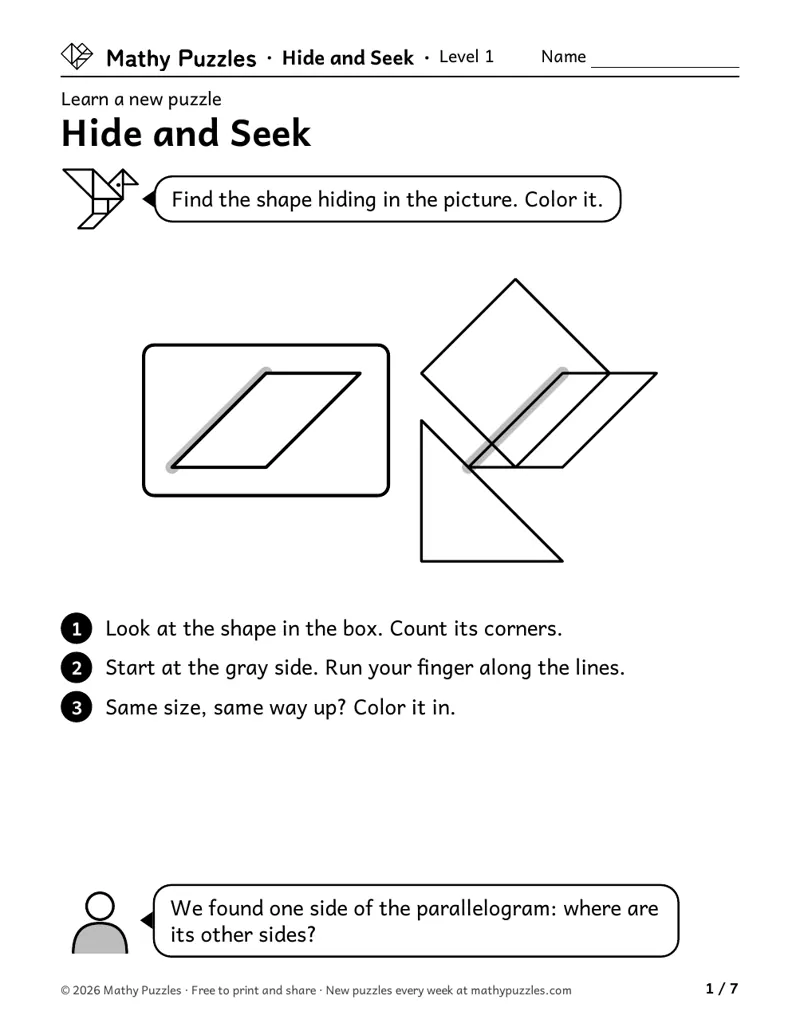
Worked example
From the Level 1 Learn sheet
- Look at the shape in the box. Count its corners.
- One side of the hidden shape is already shown in gray. Start there.
- Run your finger along the lines to find its other sides.
- Same size, same way up? Color it in.
A question to ask: “We found one side of the shape. Where are its other sides?”
Free every Sunday A mixed bag of 20 new puzzles, all four levels. Get them by email
The thinking it works on
Picking a shape out of a busy picture
Sees one shape among overlapping lines.
Kimchi and colleagues (2005) found that picking out the small pieces of a many-piece pattern develops mainly between ages 5 and 10. Seeing many small pieces as one whole is already in place by age 5. Source
Steady, careful looking
Scans the picture part by part instead of all at once.
Woods and colleagues (2013) tested 134 children aged 2 to 17. Older children searched a busy display in a more organized way, and organized searching went with finding look-alike targets. Source
Holding a picture in mind
Remembers the box shape while searching.
Riggs and colleagues (2006) found that visual working memory roughly doubles between ages 5 and 10, when it reaches the adult level of about three to four items. Source
Knowing shapes by their parts
Uses sides and corners to check a match.
Clements and colleagues (1999), interviewing 97 children aged 3 to 6, found that children judged shapes mostly by their overall look rather than by their sides and corners. Source
Comparing size and position
Checks the find is the same size and the same way up.
Gregory, Landau and McCloskey (2011) found that 4- to 6-year-olds matching which way an object was turned often chose its left-right mirror image. Adults did not make this mistake. Source
Where is this thinking used?
- Maps: Following one road or path through a busy street map.
- Everyday searching: Spotting a friend in a crowd or a lost toy in a messy room.
- Diagrams: Picking out one part in a crowded drawing or plan.
- Nature walks: Spotting an animal whose colors blend into the leaves.
For teachers
Curriculum areas
- Common Core
- Geometry: comparing shapes and their parts, such as sides and corners (Kindergarten)
- NCERT
- Foundational stage: noticing shapes in pictures and surroundings (pre-primary)
- National Curriculum (England)
- Early years mathematics: spatial reasoning with shape and space (Reception)
- Cambridge Primary Mathematics
- No direct curricular match.
Math practices: see the box below.
Math practices this puzzle uses
- Not used: MP1 Make sense of problems and persevere in solving them
- Not used: MP2 Reason abstractly and quantitatively
- Not used: MP3 Construct viable arguments and critique the reasoning of others
- Not used: MP4 Model with mathematics
- Not used: MP5 Use appropriate tools strategically
- Uses: MP6 Attend to precision
- Uses: MP7 Look for and make use of structure
- Not used: MP8 Look for and express regularity in repeated reasoning
From the Common Core Standards for Mathematical Practice.
More Hide and Seek puzzles for members
Members get at least 5 more worksheets at each difficulty for every puzzle, 80 new puzzles every Sunday, and the whole archive. $39 a year or $25 for 6 months.
See membershipNot ready yet?
One email, all four levels: 20 puzzles, 5 for each level.
For grown-ups (18+). One email every Sunday with the puzzles and the odd note about membership; unsubscribe any time. We never ask about your child. How we use your email