
Who Am I?
Try to describe a shape without saying its name and you end up counting: four sides, one square corner. Who Am I? turns that around. The clues count the parts, and the child finds the shape that fits them all.
Free sets by level, ages 4–8:
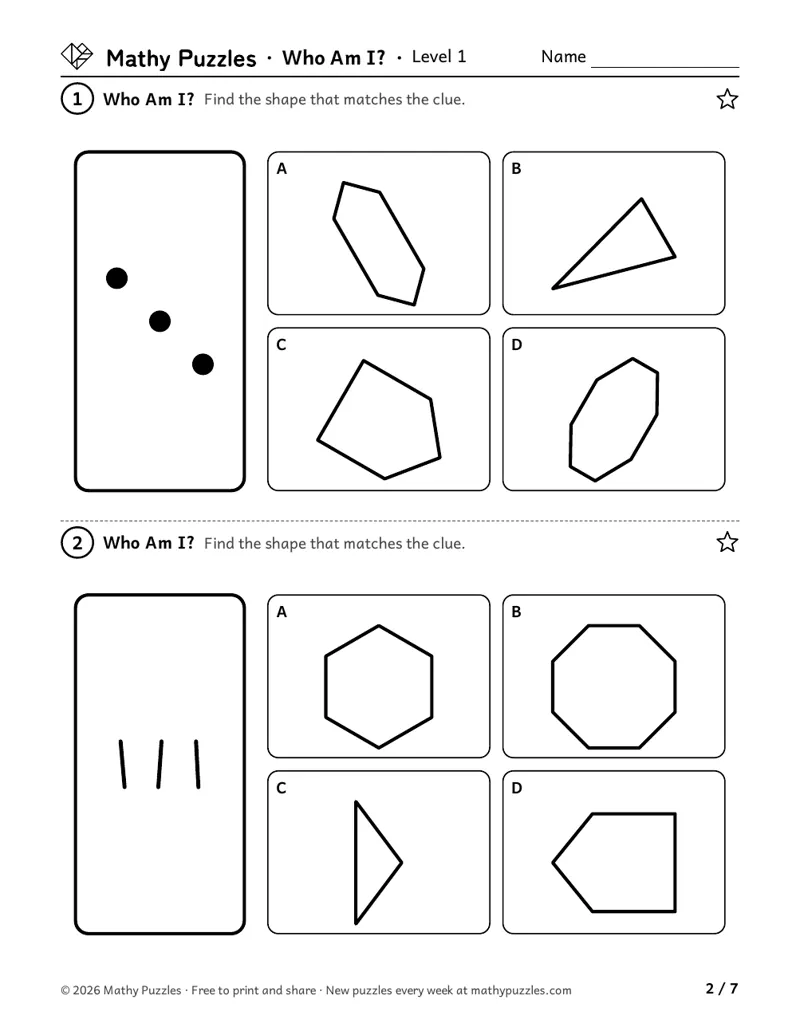 Level 1: a page from the free set
Before starting
- Count to 8
- Know that a corner is where two sides meet
- Make a cross and a check with a pencil
- Level 2: read short sentences and know a square corner
Free puzzles to print
Each set: a Learn sheet with a worked example, 10 puzzles from easiest to hardest, and the answers.
Level 1
Ages 4–6 · Pre-K–K
The easiest puzzles: the right shape is a triangle or a four-sided shape, and all four shapes are familiar. Each wrong one has at least 2 corners more or fewer.
The middle puzzles: familiar shapes with close counts, so a wrong shape may have just one corner more or fewer.
The hardest puzzles: unusual shapes children rarely see, such as darts, notched shapes and L-shapes, with close counts. Corners that point inward count too.
On the sheet: “Find the shape that matches the clue.”
Print Level 1 (Letter)Other paper size: A4Level 2
Ages 6–8 · Grades 1–2
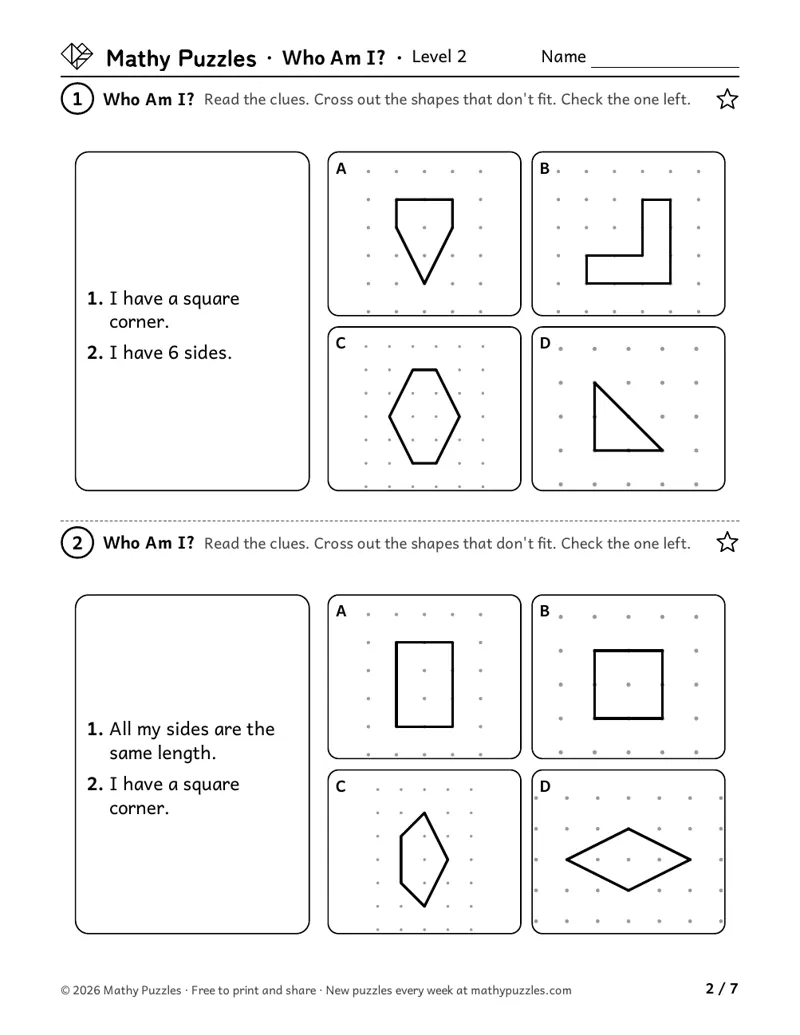
The easiest puzzles: two clues and 4 shapes on a dot grid, about the number of sides, square corners or equal sides.
The middle puzzles: 5 shapes, and one clue says what the shape is not.
The harder puzzles: three clues and 6 shapes.
The hardest puzzles: three clues, two or three of them "not" clues; each clue alone leaves at least 3 shapes, so every one is needed.
On the sheet: “Read the clues. Cross out the shapes that don't fit.”
Print Level 2 (Letter)Other paper size: A4
How it works
At Level 1, each puzzle has a clue box and four shapes. The clue is a picture: a number of dots means that many corners, and a number of sticks means that many sides. The child counts the corners or sides of each shape, crosses out the ones that don't match, and checks the one that does. At Level 2 the clues are short sentences to read, such as "I have 4 sides", "I have a square corner" or "I am not a triangle". The shapes sit on a light dot grid, and two or three clues together leave one shape.
How to play
- Look at the clue. Dots mean corners; sticks mean sides.
- Count the dots or the sticks.
- Count the corners or sides of each shape, putting a small dot on each corner as you go.
- Cross out the shapes that don't match. Check the one left.
- At Level 2, read one clue at a time and cross out every shape it rules out.
When it gets hard
Counting one corner twice, or skipping one.
Hint: Put a pencil dot on each corner as you count, starting at the top.
Missing a corner that points inward, like the notch in a dart.
Hint: Every place the outline turns is a corner, even when it points in.
Mixing up dots and sticks.
Hint: Dots mean corners. Sticks mean sides. For these shapes, the two numbers are always the same.
At Level 2, reading a "not" clue backward.
Hint: "I am not a triangle" crosses out the triangles. Say the clue aloud, then cross out.
Tip for grown-ups: Saying the reason out loud is part of the skill: "It has 3 corners, like the 3 dots." Ask for it after each check.
Frequently asked questions
- What is the difference between the dots and the sticks?
- At Level 1, dots show how many corners the shape has; sticks show how many sides. Each puzzle uses one kind of clue, and for these straight-sided shapes the two numbers are always the same.
- Why are some of the shapes so odd-looking?
- The hardest puzzles use unusual shapes, such as darts and notched shapes, on purpose, so children count instead of recognizing a familiar picture. Corners that point inward count too.
- Which kindergarten goal does this match?
- It practices describing shapes by their parts, such as the number of sides and corners, which is part of kindergarten geometry. Read the instruction aloud the first time; after that, no reading is needed.
Questions about printing, levels, answers or membership: see all questions.
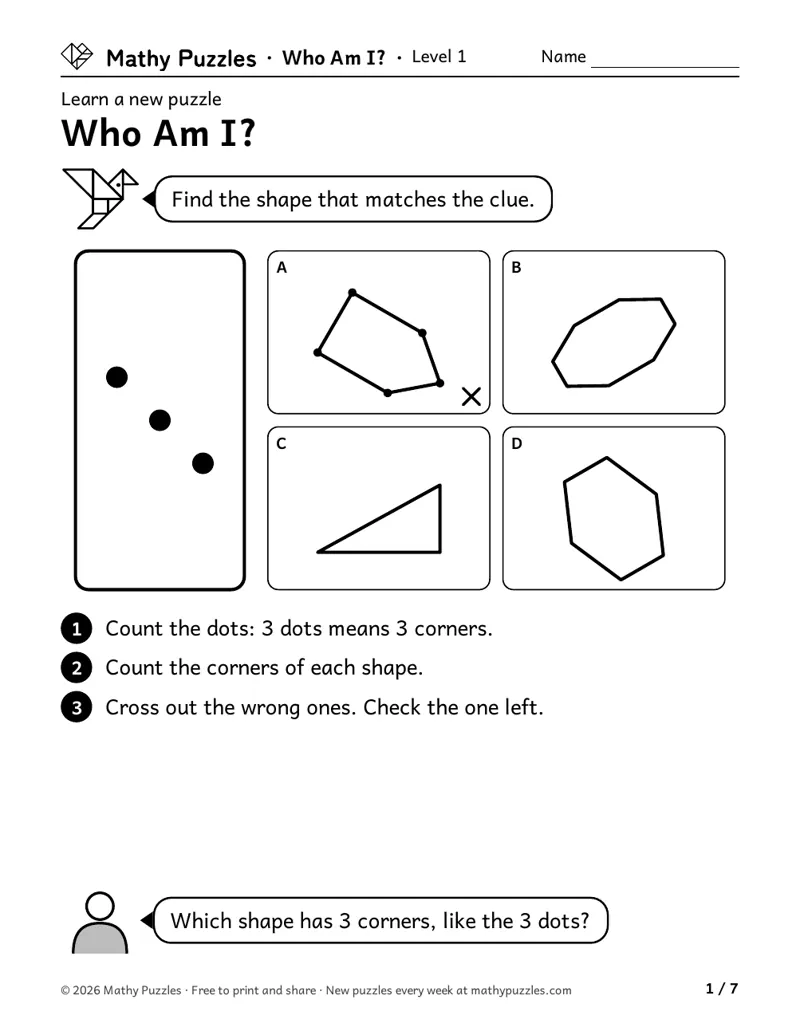
Worked example
From the Level 1 Learn sheet
- Count the dots: 3 dots means 3 corners.
- Count the corners of each shape. One wrong shape is already crossed out.
- Cross out the other wrong ones. Check the one left.
A question to ask: “Which shape has 3 corners, like the 3 dots?”
Free every Sunday A mixed bag of 20 new puzzles, all four levels. Get them by email
The thinking it works on
Knowing shapes by their parts
Describes a shape by its sides and corners.
Clements and colleagues (1999) found that children aged 3 to 6 told shapes apart mainly by their overall look. So a shape that looks unusual is often not matched to its sides and corners. Source
Counting each thing once
Counts every corner exactly once.
Rodríguez and colleagues (2013) found that children aged 5 to 8 got much better with age at spotting when someone counted a set wrongly. Source
Reading a picture clue
Reads dots and sticks as a number of corners or sides.
Starkey and Cooper (1995) found that 2- to 5-year-olds could name small sets of items shown too briefly to count, whatever their arrangement. The range grew with age, from 1 to 3 items to 1 to 5. Source
Ruling options out
Crosses out shapes that don't match the count.
Pillow and Pearson (2009) found that from kindergarten on, children rated a conclusion that had to be true, given the facts, as more certain than a guess. Source
Counting corners on unusual shapes
Counts corners on shapes it hasn't seen before.
Tsamir, Tirosh and Levenson (2008) found that a non-triangle that looks much like a triangle fooled kindergarten children more often than one that looks nothing like it. Source
Combining clues
Uses two or three clues together, "not" clues included.
Andrews and Halford (2002) tested children aged 3 to 8 on six kinds of task. A decision linking three things at once was harder than one linking two. Source
Where is this thinking used?
- Road signs: A stop sign has 8 sides, and a yield sign has 3.
- Guessing games: An object is guessed from a few facts about it.
- Building: The right piece for a frame or a model is chosen by its sides.
- Describing: Telling someone about a shape so they can draw it unseen.
For teachers
Curriculum areas
- Common Core
- Geometry: describing shapes by their parts, such as the number of sides and corners (Kindergarten); recognizing shapes by their sides and angles (Grades 1–2)
- NCERT
- Foundational stage: describing shapes and counting (pre-primary); corners and edges (Class 2); sides, square corners and equal sides (Class 3)Level 1: No direct curricular match.
- National Curriculum (England)
- Geometry – properties of shapes: naming 2-D shapes (Year 1); number of sides (Year 2); right angles (Year 3)
- Cambridge Primary Mathematics
- Geometry and measure: 2D shapes by their sides and corners; right angles (Stages 1–3)
Math practices: see the box below.
Math practices this puzzle uses
- Not used: MP1 Make sense of problems and persevere in solving them
- Not used: MP2 Reason abstractly and quantitatively
- Uses: MP3 Construct viable arguments and critique the reasoning of others
- Not used: MP4 Model with mathematics
- Not used: MP5 Use appropriate tools strategically
- Uses: MP6 Attend to precision
- Not used: MP7 Look for and make use of structure
- Not used: MP8 Look for and express regularity in repeated reasoning
From the Common Core Standards for Mathematical Practice.
More Who Am I? puzzles for members
Members get at least 5 more worksheets at each difficulty for every puzzle, 80 new puzzles every Sunday, and the whole archive. $39 a year or $25 for 6 months.
See membershipNot ready yet?
One email, all four levels: 20 puzzles, 5 for each level.
For grown-ups (18+). One email every Sunday with the puzzles and the odd note about membership; unsubscribe any time. We never ask about your child. How we use your email