
Shape Hunt
Many young children will tell you a triangle has to sit flat with its point at the top. Shape Hunt gently argues otherwise: a skinny, tilted, upside-down triangle still has three sides and three corners, so it still counts.
Free sets by level, ages 4–6:
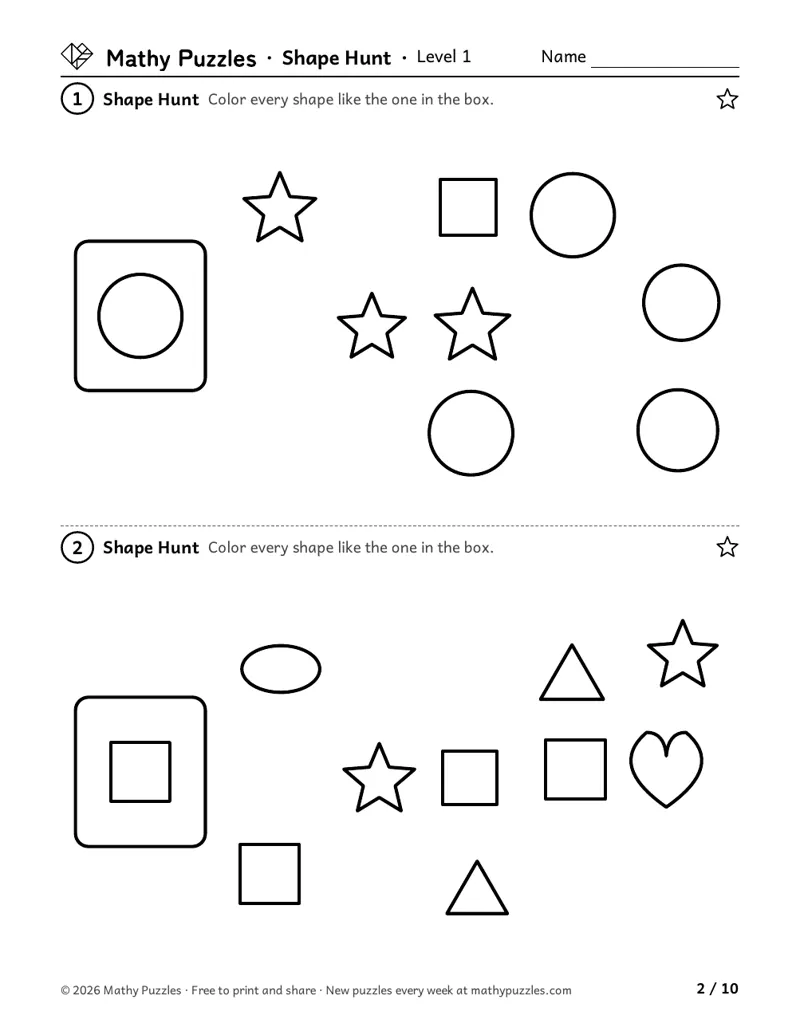 Level 1: a page from the free set
Before starting
- Know a triangle, a square, a rectangle and a circle
- Count to 6
- Color inside an outline
What you need
Crayons or colored pencils for coloring the shapes.
Free puzzles to print
Each set: a Learn sheet with a worked example, 10 puzzles from easiest to hardest, and the answers.
Level 1
Ages 4–6 · Pre-K–K
The easiest puzzles: hunt triangles, squares, rectangles or circles, all upright and regular, among clearly different shapes; 3 or 4 to find among 8 to 10.
The middle puzzles: some targets are tilted, skinny or upside down, with near misses (a curved side, a gap, rounded corners). Or pentagons and hexagons with a few crossing outlines.
The hardest puzzles: pentagons or hexagons in a crowded scatter of 16 to 20 shapes. Lopsided or long ones still count; look-alikes have one corner fewer.
On the sheet: “Color every shape like the one in the box.”
Print Level 1 (Letter)Other paper size: A4
How it works
A box shows one shape, such as a triangle. Around it is a scatter of outline shapes. The child colors every shape of that kind and leaves the look-alikes alone. Later puzzles include tilted, skinny or upside-down shapes that still count, and pentagons and hexagons in a crowded scatter where some outlines cross.
How to play
- Look at the shape in the box. Count its sides and corners.
- Touch each shape on the page and count its corners too.
- Check the sides: all straight, and no gaps?
- Color every shape that matches. Leave the others.
When it gets hard
Skipping a triangle because it is upside down or very skinny.
Hint: Count its sides and corners. Three straight sides and three corners make a triangle, any way up.
Coloring a shape with a curved side or a gap.
Hint: The shape's sides must all be straight and all join up. Look for curves and gaps.
Miscounting the corners of a hexagon.
Hint: Put a small dot on each corner as you count, then count the dots.
Tip for grown-ups: Point to a skinny or tilted one and ask: "Is this one a triangle too? How do you know?" The reason matters more than the coloring. Coloring each one as it is found keeps the count honest.
Frequently asked questions
- Why does a tilted triangle count?
- Many young children think a triangle must sit flat with its point at the top. A triangle is any closed shape with three straight sides, whatever its size or tilt. The middle and hardest puzzles include these on purpose.
- What if my child colors a near miss?
- Ask them to count its corners and look at its sides again. A curved side, a gap or one corner too few is the trick, and finding it is part of the puzzle.
Questions about printing, levels, answers or membership: see all questions.
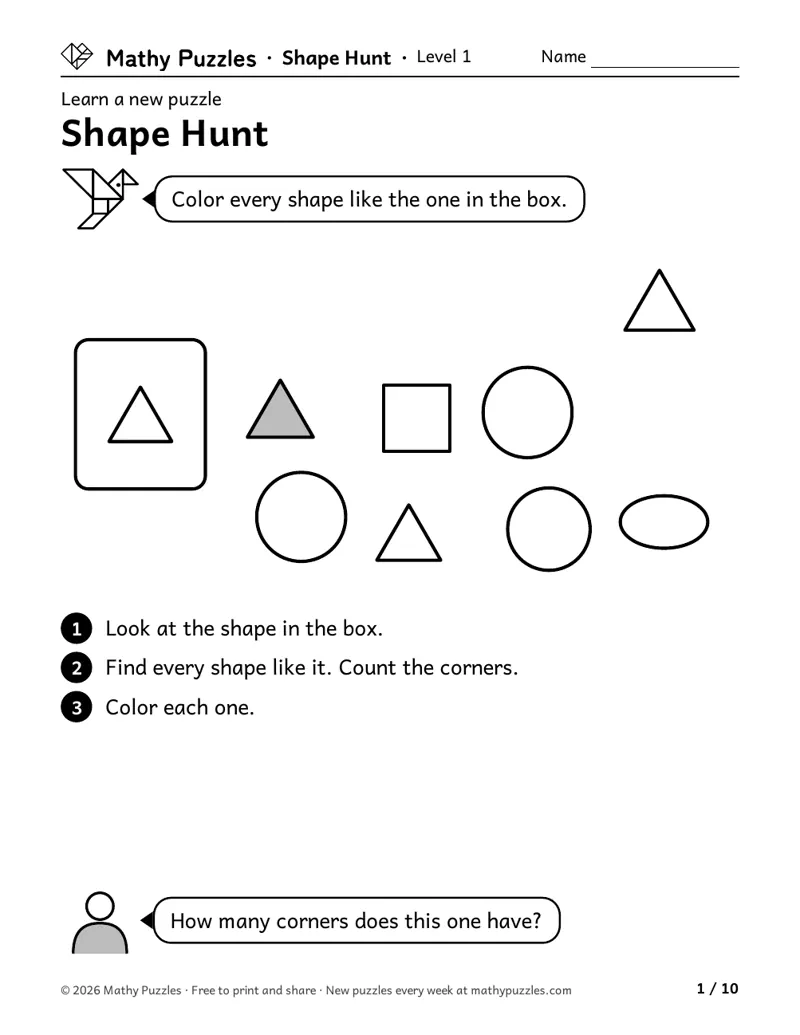
Worked example
From the Level 1 Learn sheet
- Look at the shape in the box.
- Find every shape like it. Count the corners.
- The first one is already colored. Color each of the others.
A question to ask: “How many corners does this one have?”
Free every Sunday A mixed bag of 20 new puzzles, all four levels. Get them by email
The thinking it works on
Knowing a shape beyond its usual picture
Recognizes a shape when it is tilted, skinny or upside down.
Aslan and Arnas (2007) found that preschoolers aged 3 to 6 often failed to recognize a familiar shape when it was tilted, stretched or skewed. They mostly relied on features that do not define the shape. Source
Counting sides and corners
Counts corners to decide what a shape is.
Clements and colleagues (1999) found that children aged 3 to 6 rarely used the number of sides or corners to decide what a shape was. Tilted or stretched triangles were often not called triangles. Source
Going by the rule, not the look
Checks for straight sides and closed corners; ignores size.
Tsamir, Tirosh and Levenson (2008) report that kindergarten children at once rejected non-triangles that look nothing like a triangle. Near misses that look much like one were more often taken for a triangle. Source
Searching the whole page
Scans every part so no shape is missed.
Enns and Cameron (1987) compared 4-year-olds, 7-year-olds and adults on a speeded task and found that searching for a target among other items got faster with age. Source
Sorting by a rule
Decides yes or no for each shape by one rule.
In the card sort used to study rule use (Zelazo, 2006), even 3-year-olds can sort every card by one rule, such as shape. Switching to a second rule is what most cannot do until about age 5. Source
Where is this thinking used?
- Road signs: A stop sign or a yield sign is known by its shape from any angle.
- Sorting at home: Buttons, blocks or cookie cutters can be sorted by shape.
- Buildings and design: Triangles, rectangles and hexagons show up in roofs, windows and tiles.
- Checking a page: Looking over a list or a form for every item of one kind.
For teachers
Curriculum areas
- Common Core
- Geometry: naming shapes whatever their size or which way they face (Kindergarten); telling defining features, such as three straight sides, from color or tilt (Grade 1)
- NCERT
- Foundational stage: recognizing and naming shapes (pre-primary)
- National Curriculum (England)
- Geometry – properties of shapes: recognizing and naming common 2-D shapes (Year 1)
- Cambridge Primary Mathematics
- Geometry and measure: identifying and sorting 2D shapes, including in different positions (Stages 1–2)
Math practices: see the box below.
Math practices this puzzle uses
- Not used: MP1 Make sense of problems and persevere in solving them
- Not used: MP2 Reason abstractly and quantitatively
- Not used: MP3 Construct viable arguments and critique the reasoning of others
- Not used: MP4 Model with mathematics
- Not used: MP5 Use appropriate tools strategically
- Uses: MP6 Attend to precision
- Uses: MP7 Look for and make use of structure
- Not used: MP8 Look for and express regularity in repeated reasoning
From the Common Core Standards for Mathematical Practice.
More Shape Hunt puzzles for members
Members get at least 5 more worksheets at each difficulty for every puzzle, 80 new puzzles every Sunday, and the whole archive. $39 a year or $25 for 6 months.
See membershipNot ready yet?
One email, all four levels: 20 puzzles, 5 for each level.
For grown-ups (18+). One email every Sunday with the puzzles and the odd note about membership; unsubscribe any time. We never ask about your child. How we use your email