
Winning Move
Play tic-tac-toe a few times and you find out that blocking matters as much as winning. The best move depends on what the other player can do next, so these puzzles ask you to think one turn ahead for them, not just for you.
Free sets by level, ages 4–12:
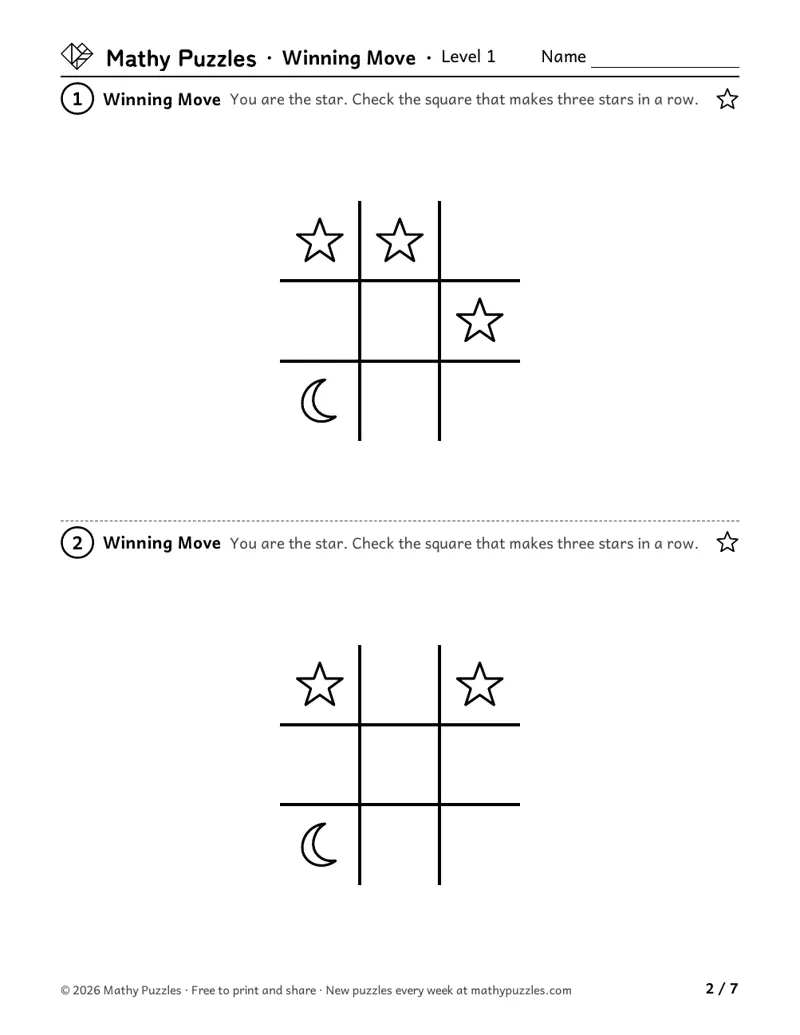 Level 1: a page from the free set
Before starting
- Level 1: no reading; see three in a row across, down or corner to corner
- Level 2: know tic-tac-toe, or play one game first
- Level 3: count to about 20 and compare piles; the Nim rule is printed on each puzzle
- Level 4: know how dots and boxes is played (a box with four sides is yours, and you go again)
Free puzzles to print
Each set: a Learn sheet with a worked example, 10 puzzles from easiest to hardest, and the answers.
Level 1
Ages 4–6 · Pre-K–K
Finish the line (stars and moons on a 3 × 3 board): first, check the one square that makes three stars in a row. Then the same with decoys, such as the moons' pairs, or star pairs that are already blocked. The hardest: you can't win, so draw a star in the one square that stops the moons' line.
On the sheet: “Finish the line: three stars in a row.”
Print Level 1 (Letter)Other paper size: A4Level 2
Ages 6–8 · Grades 1–2
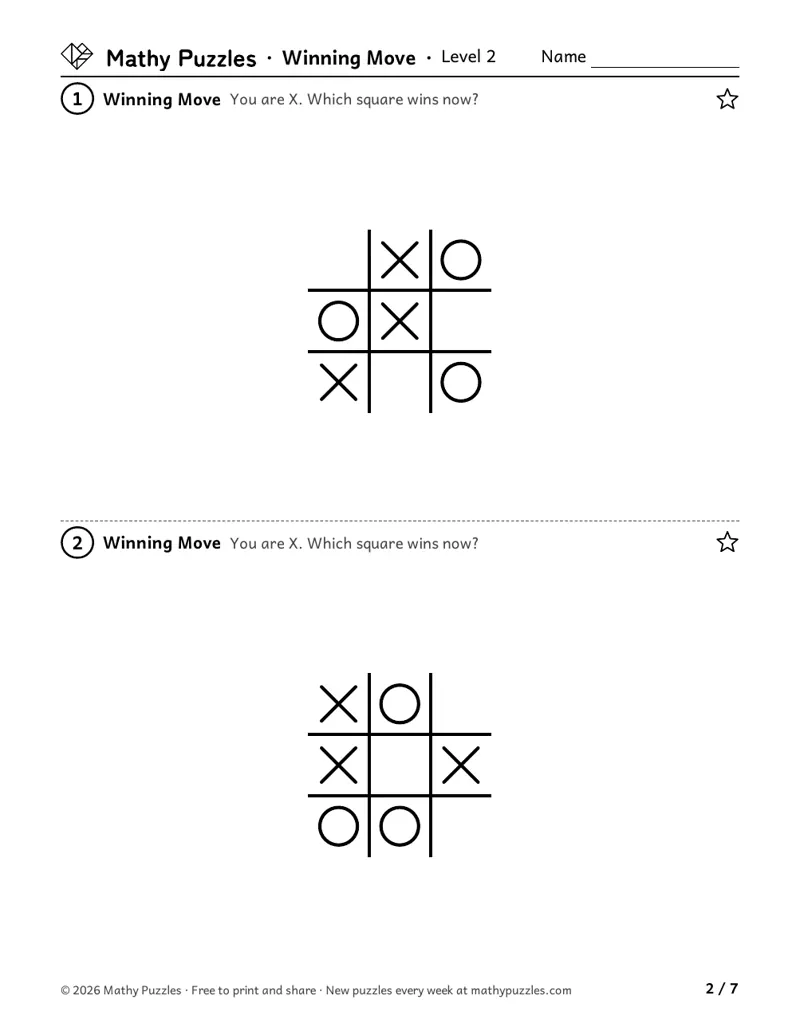
Tic-tac-toe (you are X): first win now, then block the square that stops O from winning. The hardest: make two threats at once so you must win.
On the sheet: “Tic-tac-toe: find the move.”
Print Level 2 (Letter)Other paper size: A4Level 3
Ages 8–10 · Grades 3–4
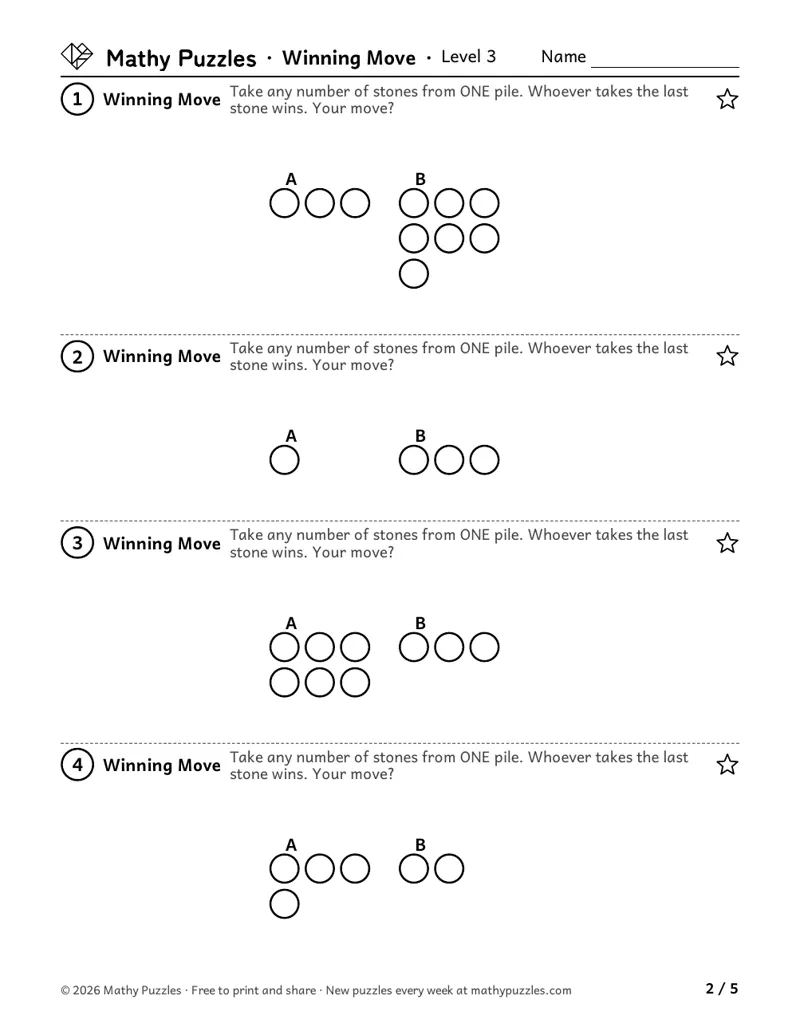
Nim: first two piles (make them equal), then bigger piles or the "take 1, 2 or 3" game. Next, three small piles, using a short list of safe positions; the hardest have three piles of up to 7.
On the sheet: “Nim: find the move that wins.”
Print Level 3 (Letter)Other paper size: A4Level 4
Ages 10–12 · Grades 5–6
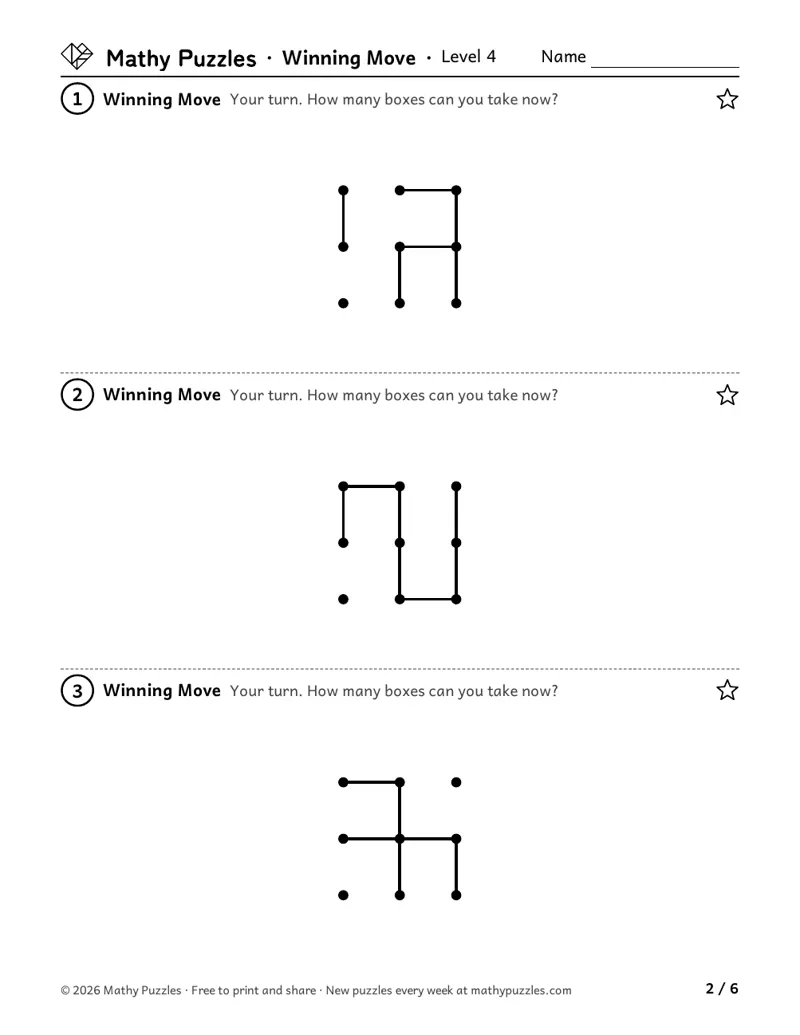
Dots and boxes, on a 2 × 2 box board: first count how many boxes you can take now. Then find the one line that gives nothing away. The hardest, on a 2 × 3 box board, are endgames where every line gives something away and one is best.
On the sheet: “Dots and boxes: find the move.”
Print Level 4 (Letter)Other paper size: A4
How it works
Each puzzle is a two-player game paused at the moment it is your turn. The child finds the best move and checks or draws it in. Each level uses a different game. Level 1 is "finish the line" on a 3 × 3 picture board (you are the star, the other player is the moon). Level 2 is tic-tac-toe, Level 3 is Nim (taking stones from piles), and Level 4 is dots and boxes. This is not chess.
How to play
- Look at the game and the question under the picture (a grown-up can read it at Level 1).
- Look for a move that wins right away, or one that stops the other player winning.
- If there is none, picture each move you could make, and what the other player would do back.
- Pick the move that leaves them no good answer. Check it or draw it in.
When it gets hard
Finish the line: picking a pair of stars whose third square already has a moon.
Hint: Look at the third square first. Only an empty square can finish the line.
Tic-tac-toe: going for your own line while O is about to win.
Hint: First look for your win. Then look for O's. Block it.
Nim: taking stones from two piles in one turn.
Hint: One pile per turn, as many stones as you like from it.
Dots and boxes: drawing the third side of a box.
Hint: A third side hands the box to the other player. Look for a line that doesn't.
Tip for grown-ups: After the sheet, play the real game together. Let your child use the move they found, and see whether you can beat it.
Frequently asked questions
- We've never played Nim. Where do we start?
- Use coins or dried beans in two piles. Take turns removing any number from one pile; whoever takes the last one wins. Play three games, then try the sheet.
- How could I use Winning Move with a class?
- Solve a puzzle on the board together, then pair students to play the real game from that position. Each level's game needs only paper, or a handful of counters for Nim.
- Isn't tic-tac-toe too easy?
- Playing it is easy. Finding the forced win in the hardest puzzles, where you make two threats at once, takes real planning for a 7-year-old.
Questions about printing, levels, answers or membership: see all questions.
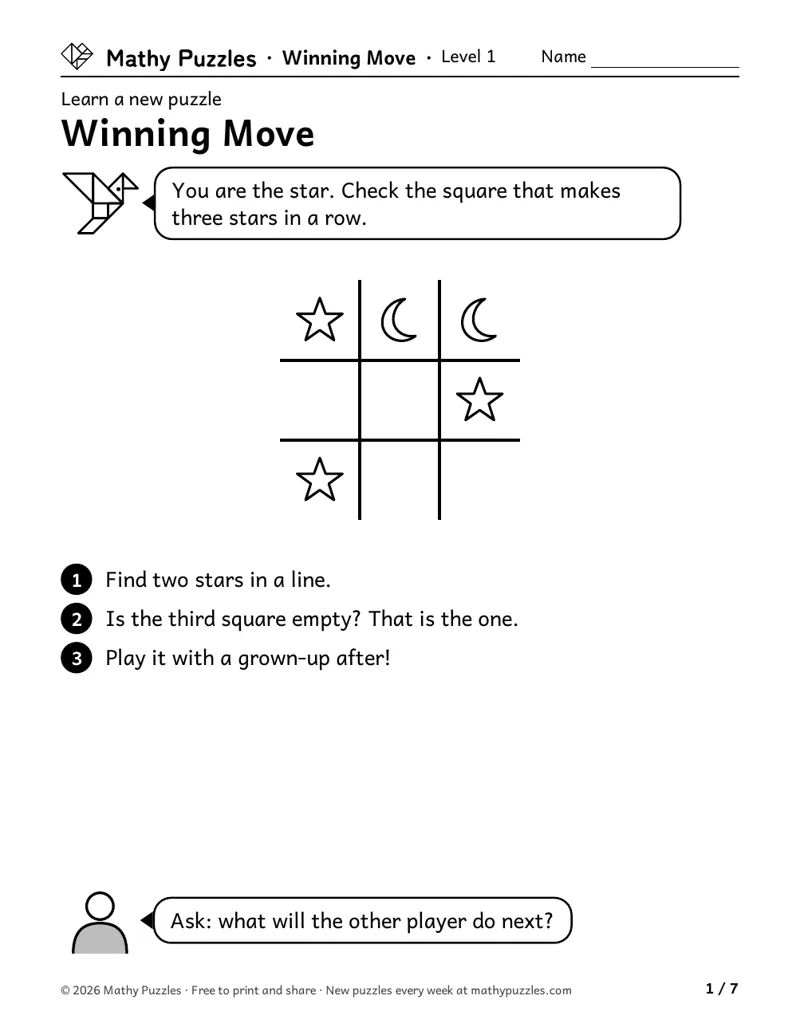
Worked example
From the Level 1 Learn sheet
- Finish the line: three stars in a row.
- Find a line that already has a pair of stars.
- Is the third square empty? That is the one.
- Play it with a grown-up after!
A question to ask: “What will the other player do next?”
Free every Sunday A mixed bag of 20 new puzzles, all four levels. Get them by email
The thinking it works on
Taking the other player's view
Asks what the opponent will do after each move.
In Sher, Koenig and Rustichini's (2014) games, 3- to 9-year-olds grew more strategic with age on their very first move. From about age 7 they began to think about the other player's choices in a farsighted rather than a short-term way. Source
Looking ahead
Pictures the game one or two turns from now.
Raijmakers and colleagues (2014) found that strategy use in a turn-taking game was linked to age from 5 to 12. No child yet used the best two-step strategy. Source
Spotting three in a row
Scans every line for two alike and an empty third.
Ordering goals
Win first, block second, then plan.
Crowley and Siegler (1993) found that young children's tic-tac-toe play is built from rules picked up one at a time. Even young children shift which rule they apply as the position changes. Source
Finding a pattern that always works
Uses positions that are safe to leave.
Weighing gains and losses
Picks the move that gives away the least.
Crone and van der Molen (2004) compared 6- to 9-year-olds, 10- to 12-year-olds, teenagers and adults on a choice task. Sensitivity to the later results of a choice, good or bad, increased with age. Source
Where is this thinking used?
- Family game night: Seeing a threat coming and blocking it in time.
- Sharing and turn-taking: Thinking about what the other person will want next.
- Saving and spending: Giving up a little now to avoid losing more later.
- Sports tactics: Setting up two chances at once so a defender can stop only one.
For teachers
Curriculum areas
- Common Core
- No direct curricular match.
- NCERT
- Maths Mela (Class 5) and Ganita Prakash (Class 6): two-player games with a winning strategy, a look ahead for the Level 3 Nim puzzlesLevels 1, 2 and 4: No direct curricular match.
- National Curriculum (England)
- No direct curricular match.
- Cambridge Primary Mathematics
- No direct curricular match.
Math practices: see the box below.
Math practices this puzzle uses
- Uses: MP1 Make sense of problems and persevere in solving them
- Not used: MP2 Reason abstractly and quantitatively
- Not used: MP3 Construct viable arguments and critique the reasoning of others
- Not used: MP4 Model with mathematics
- Not used: MP5 Use appropriate tools strategically
- Not used: MP6 Attend to precision
- Uses: MP7 Look for and make use of structure
- Not used: MP8 Look for and express regularity in repeated reasoning
From the Common Core Standards for Mathematical Practice.
More Winning Move puzzles for members
Members get at least 5 more worksheets at each difficulty for every puzzle, 80 new puzzles every Sunday, and the whole archive. $39 a year or $25 for 6 months.
See membershipNot ready yet?
One email, all four levels: 20 puzzles, 5 for each level.
For grown-ups (18+). One email every Sunday with the puzzles and the odd note about membership; unsubscribe any time. We never ask about your child. How we use your email