
Mate in One
Checkmate is the moment the king is attacked and has no way out: it can't run, nothing can block, and nobody can take the attacker. In each puzzle one White move does it, and the work is testing each check against those three escapes.
Free sets by level, ages 8–10:
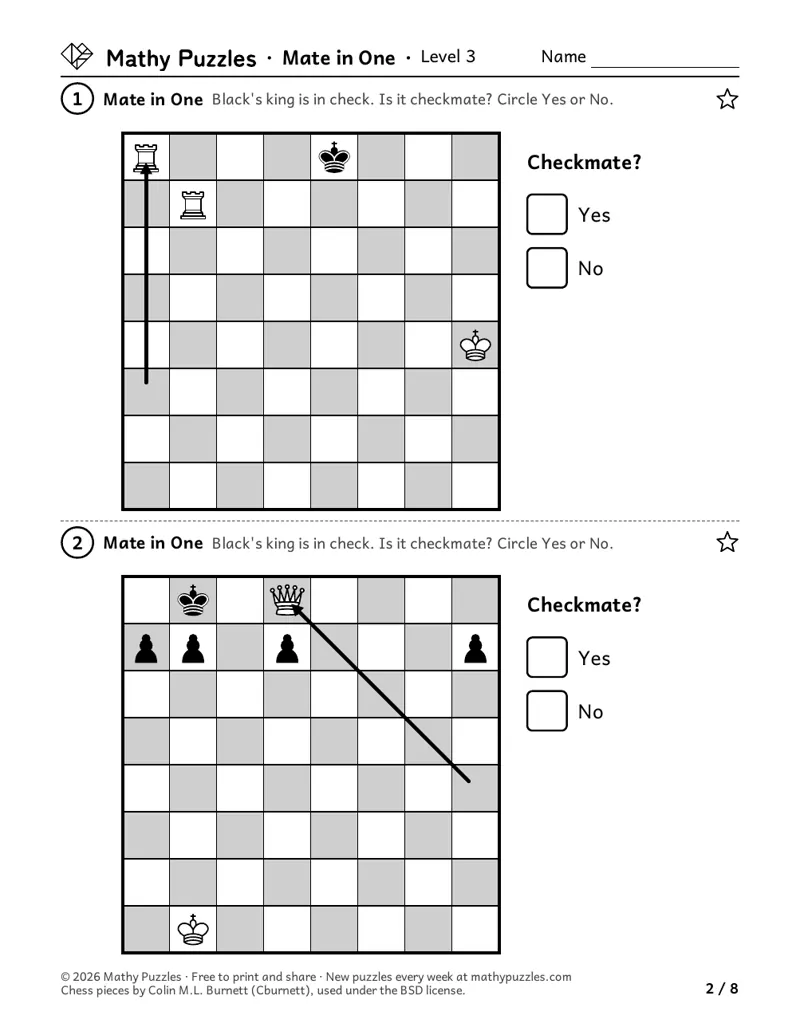 Level 3: a page from the free set
Before starting
- Know how every piece moves, including pawns
- Know what check is (Check or Not? at Level 2 builds this)
- For the harder puzzles: read square names like e4 (a free chess notation sheet explains them)
What you need
Our free chess notation sheet once square names come in, and a pencil for arrows.
Free printable: How chess moves are written
Free puzzles to print
Each set: a Learn sheet with a worked example, 10 puzzles from easiest to hardest, and the answers.
Level 3
Ages 8–10 · Grades 3–4
The easiest puzzles: White has only one check, a rook or a queen gives mate, and there are at most 12 pieces. Some are a warm-up instead: is it checkmate, Yes or No?
Next: two or three checks to compare.
Then four or more checks, or the mate comes from a knight, bishop or pawn. The child also writes the square's name.
The hardest puzzles: the mate needs a pawn to become a queen, or a piece moving out of the way to uncover a check. Or two other checks come very close to mate.
On the sheet: “White to move. Find the move that checkmates. Draw an arrow.”
Print Level 3 (Letter)Other paper size: A4
How it works
Each puzzle is a chess position on a full 8 × 8 board, with White to move. The child finds the move that checkmates and draws it as an arrow; on harder puzzles they also write the square's name, such as g7. Many positions come from real games. Warm-up puzzles ask a simpler question: is this checkmate, Yes or No?
How to play
- Find the black king. Look at the squares around it.
- List every move White can make that gives check.
- Test each check: can the king step away, can a black piece block, can a black piece take the checker?
- The check that passes all three tests is mate. Draw the arrow, and write the square if asked.
When it gets hard
Playing the first check that comes to mind.
Hint: List all the checks before choosing. The obvious one often lets the king escape.
Forgetting that a black piece can take the checking piece.
Hint: After each check, look at every black piece: can it capture?
Missing a king escape on the far side.
Hint: Point at each of the king's neighbor squares in turn.
Tip for grown-ups: Before the arrow goes down, ask to be shown why the king can't run. If your child can point at the guard on every escape square, they have it. Keep our chess notation sheet nearby once square names come in.
Frequently asked questions
- Where do the positions come from?
- The easiest puzzles are built by our own program. The harder ones come from real games in a free, open puzzle collection; our program checks each one again before it goes on a sheet.
- Will my students need to know chess notation?
- Not for the easier puzzles, which only ask for an arrow. The harder ones ask for the square's name; a free chess notation sheet explains letters and numbers in one page.
- My child solves these fast. What comes next?
- Mate in Two at Level 4 asks for a plan two moves deep, with every Black reply answered.
Questions about printing, levels, answers or membership: see all questions.
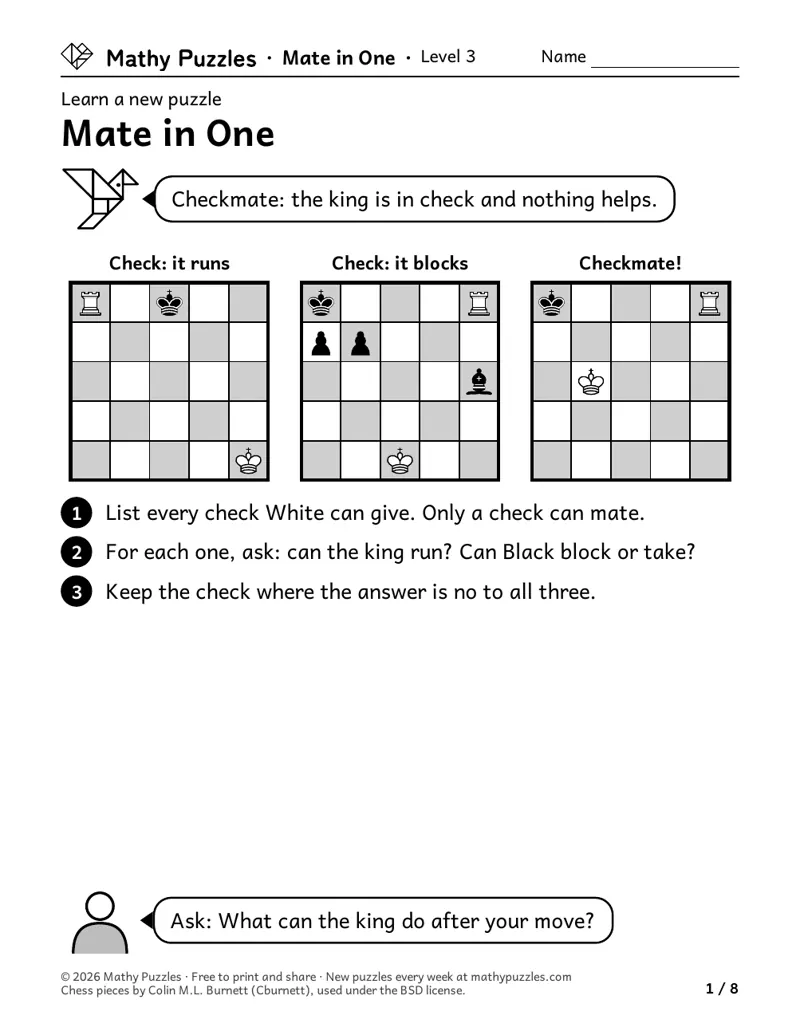
Worked example
From the Level 3 Learn sheet
- Checkmate means the king is in check and nothing helps.
- List every check White can give. Only a check can mate.
- For each check, ask: can the king run? Can Black block or take?
- Keep the check where the answer is no to all three.
A question to ask: “What can the king do after your move?”
Free every Sunday A mixed bag of 20 new puzzles, all four levels. Get them by email
The thinking it works on
Listing every option
Finds all of White's checking moves before choosing.
English (1993) asked 7- to 12-year-olds to find every way of dressing toy bears. The study found five increasingly orderly strategies, from trial and error to an "odometer" method that holds one item fixed and runs through the rest. Source
Testing cases
Runs each check through the same three questions.
Seeing the whole board
Notices the far piece that guards an escape square.
Schneider and colleagues (1993) found that how well children and adults remembered real chess positions depended on how much chess they knew. Plain digit memory differed by age. Source
Resisting the obvious move
Doesn't stop at the first check found.
Luna and colleagues (2004) tested 245 people aged 8 to 30. The ability to hold back an automatic eye movement grew steeply through childhood and reached adult level at about age 14. Source
Naming squares
Writes the mating square as a letter and a number.
Where is this thinking used?
- Checking a plan: Testing each option against the same short list of questions.
- Spreadsheets and seat maps: Finding a cell or seat by its letter and number.
- Debugging: Asking what could still go wrong after a fix.
- Strategy games: Looking for the one move that leaves no reply.
For teachers
Curriculum areas
- Common Core
- No direct curricular match.
- NCERT
- Hide and Seek in Maths Mela (Class 4): naming places by row and column
- National Curriculum (England)
- No direct curricular match.
- Cambridge Primary Mathematics
- No direct curricular match.
Math practices: see the box below.
Math practices this puzzle uses
- Uses: MP1 Make sense of problems and persevere in solving them
- Not used: MP2 Reason abstractly and quantitatively
- Uses: MP3 Construct viable arguments and critique the reasoning of others
- Not used: MP4 Model with mathematics
- Not used: MP5 Use appropriate tools strategically
- Not used: MP6 Attend to precision
- Not used: MP7 Look for and make use of structure
- Not used: MP8 Look for and express regularity in repeated reasoning
From the Common Core Standards for Mathematical Practice.
More Mate in One puzzles for members
Members get at least 5 more worksheets at each difficulty for every puzzle, 80 new puzzles every Sunday, and the whole archive. $39 a year or $25 for 6 months.
See membershipNot ready yet?
One email, all four levels: 20 puzzles, 5 for each level.
For grown-ups (18+). One email every Sunday with the puzzles and the odd note about membership; unsubscribe any time. We never ask about your child. How we use your email