
Check or Not?
When someone says "check" in a chess game, the king is under attack. There are only three ways out: move it, block the line, or take the attacker. These puzzles are about spotting that danger, and the way out, on a quiet board.
Free sets by level, ages 6–8:
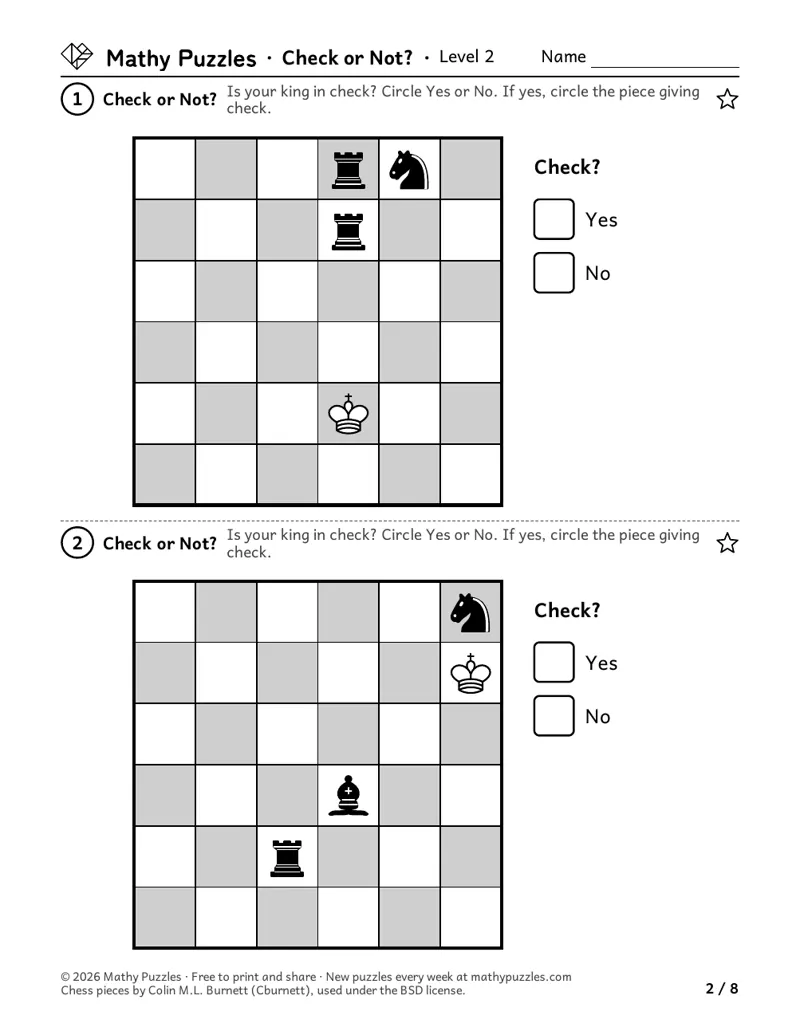 Level 2: a page from the free set
Before starting
- Know how the rook, bishop, queen, knight and pawn move
- Know which king is yours (white) on the sheet
- Helpful: Safe Squares & Captures first
Free puzzles to print
Each set: a Learn sheet with a worked example, 10 puzzles from easiest to hardest, and the answers.
Level 2
Ages 6–8 · Grades 1–2
The easiest puzzles: one 6 × 6 board; is your king in check, Yes or No? A "No" board always has a black piece whose line to the king is blocked, so the child has to look closely.
Next: two small 4 × 4 boards; which king is in check, A or B?
Then: the king is in check and can step to a safe square. Dot it.
The hardest puzzles: the king cannot step out of check. The child must block the line or take the attacker, and draws that move.
On the sheet: “Is the king in check? How does it get out?”
Print Level 2 (Letter)Other paper size: A4
How it works
Each chess picture asks one question: is your king under attack? That is called "check". The child decides Yes or No and circles the attacker. Or the child picks which of two kings is in check, dots a safe square for the king, or draws a move that saves it.
How to play
- Find your king. Look at each black piece and ask: can it reach the king?
- If no black piece can reach it, the answer is No, not in check.
- If one can, the king is in check. Try the three ways out: move, block, take.
- Mark the answer the question asks for: a circle, a dot or an arrow.
When it gets hard
Saying "check" when another piece stands in the attacker's way.
Hint: Follow the line square by square. If a piece is in between, there is no check.
Stepping the king backward along the same line as the attacker.
Hint: The line goes on past the king. That square is still attacked.
Trying to block a knight.
Hint: A knight jumps, so nothing can block it. Move the king or take the knight.
Tip for grown-ups: After each puzzle, ask your child to say why the other two ways out don't work. Ruling out the wrong answers is half the skill.
Frequently asked questions
- What's the difference between check and checkmate?
- Check means the king is attacked but has a way out. Checkmate means it is attacked and none of the three ways out works. This sheet is about check; Mate in One (Level 3) is about checkmate.
- Why is there no black king on the board?
- The puzzle is only about your king, so the board leaves out pieces that don't matter. It keeps the picture clear for young players.
Questions about printing, levels, answers or membership: see all questions.
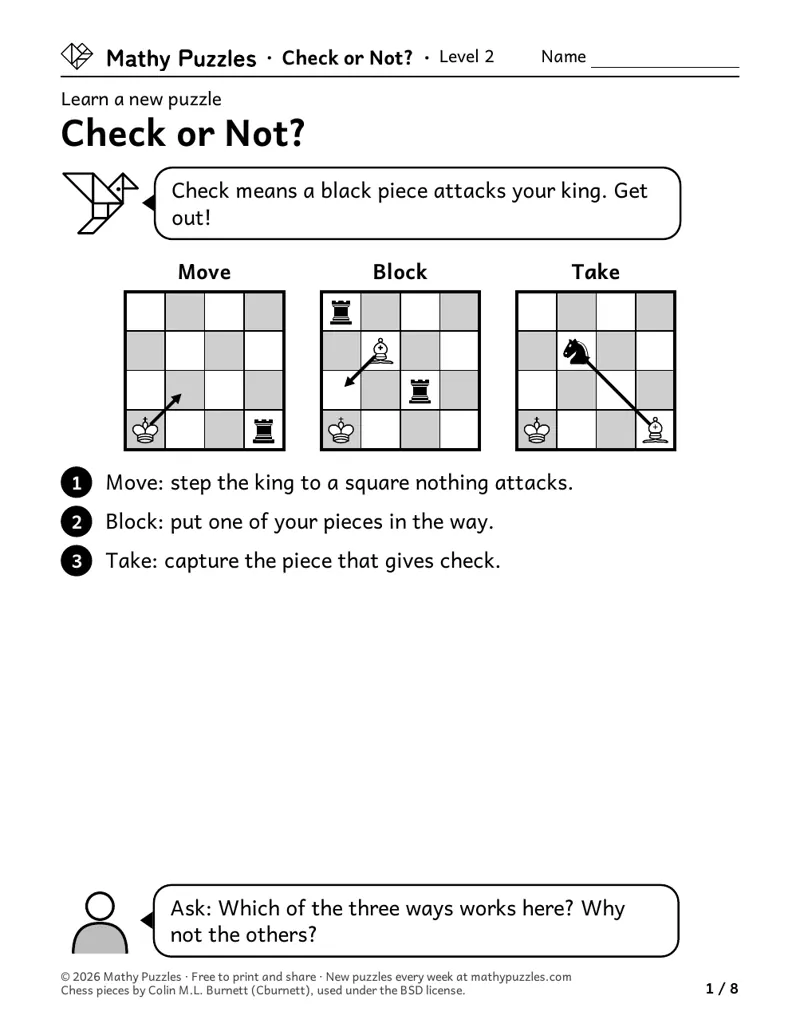
Worked example
From the Level 2 Learn sheet
- Move: step the king to a square nothing attacks.
- Block: put one of your pieces in the way of the attack.
- Take: capture the piece that gives check.
A question to ask: “Which of the three ways works here? Why not the others?”
Free every Sunday A mixed bag of 20 new puzzles, all four levels. Get them by email
The thinking it works on
Spotting a threat
Checks every black piece for a line to the king.
Hommel, Li and Li (2004) studied visual search in 298 people aged 6 to 89. Children's search was slowed most by the mere presence of other items on the screen. Source
Reasoning by elimination
Rules out the ways out that fail.
Mody and Carey (2016) found that 3- to 5-year-olds, but not 2½-year-olds, could reason 'it is not in this cup, so it must be in the other'. Source
Comparing two pictures
Finds the one board that differs in the way that matters.
Shore and colleagues (2006) showed children aged 6 to 10 and young adults two versions of a picture in turn. The children were slower to spot the change, especially a changed color or a missing part. A turned object was easier to notice. Source
Noticing what blocks a line
Sees that a piece in between stops an attack.
Explaining a choice
Says why one move works and the others don't.
Where is this thinking used?
- Fixing a problem: Listing the few ways out, then trying each one.
- Games: Seeing a threat to your key piece before it is too late.
- Spotting blockers: Noticing what stands between a cause and its effect.
- Making a choice: Saying why the other options fail, not just which one works.
For teachers
Curriculum areas
- Common Core
- No direct curricular match.
- NCERT
- No direct curricular match.
- National Curriculum (England)
- No direct curricular match.
- Cambridge Primary Mathematics
- No direct curricular match.
Math practices: see the box below.
Math practices this puzzle uses
- Uses: MP1 Make sense of problems and persevere in solving them
- Not used: MP2 Reason abstractly and quantitatively
- Uses: MP3 Construct viable arguments and critique the reasoning of others
- Not used: MP4 Model with mathematics
- Not used: MP5 Use appropriate tools strategically
- Not used: MP6 Attend to precision
- Not used: MP7 Look for and make use of structure
- Not used: MP8 Look for and express regularity in repeated reasoning
From the Common Core Standards for Mathematical Practice.
More Check or Not? puzzles for members
Members get at least 5 more worksheets at each difficulty for every puzzle, 80 new puzzles every Sunday, and the whole archive. $39 a year or $25 for 6 months.
See membershipNot ready yet?
One email, all four levels: 20 puzzles, 5 for each level.
For grown-ups (18+). One email every Sunday with the puzzles and the odd note about membership; unsubscribe any time. We never ask about your child. How we use your email