
Safe Squares & Captures
Before every move, a chess player asks two things: what can I take, and what is attacked? These little chess pictures ask just that, one question at a time.
Free sets by level, ages 6–8:
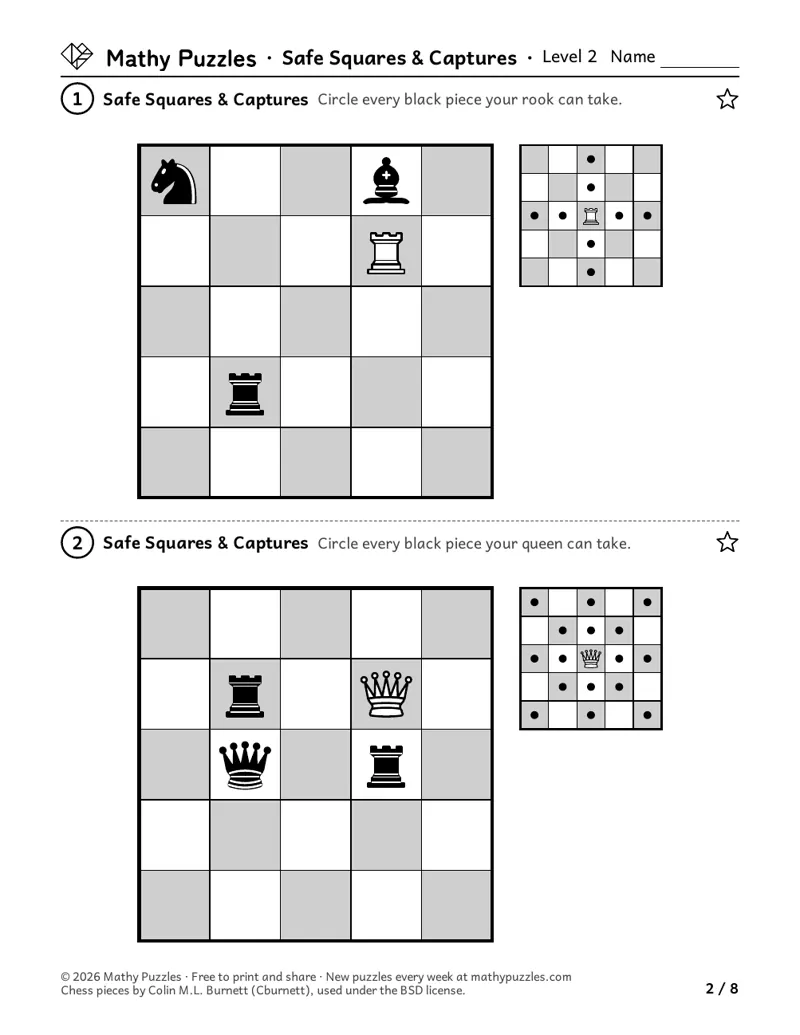 Level 2: a page from the free set
Before starting
- Know how the rook, bishop, queen and knight move (cards on the sheet help)
- Know that a pawn takes on the diagonal, not straight ahead (the Learn sheet shows it)
- Comfortable with Where Can It Go? at Level 2
Free puzzles to print
Each set: a Learn sheet with a worked example, 10 puzzles from easiest to hardest, and the answers.
Level 2
Ages 6–8 · Grades 1–2
The easiest puzzles: one white piece among three or four black pieces on a 5 × 5 board; circle every black piece it can take.
Next: your king and one or two black rooks or bishops; X the attacked squares next to the king and dot the safe ones.
Then 6 × 6 boards with three or four attackers, always including a knight or a pawn.
The hardest puzzles: your one or two pieces can take two or three black pieces, but only one is not guarded. Circle that free piece.
On the sheet: “Find the squares and pieces each picture asks for.”
Print Level 2 (Letter)Other paper size: A4
How it works
Each small chess picture has one job. Which black pieces can your piece take? Which squares next to your king are under attack, and which are safe? Which black piece can you take without losing your own? The child circles pieces, marks attacked squares with an X and dots the safe ones.
How to play
- Read the question under the board: take, safe or free?
- To find takes, follow your piece's lines. Circle each black piece at the end of a line.
- To find safe squares, look at the squares around your king. X each one a black piece can reach. Dot the rest.
- To find a free piece, check who guards each black piece you can take. The one nobody guards is free.
When it gets hard
Marking the square straight in front of a pawn as attacked.
Hint: Pawns move straight but take on the diagonal. Look at the corners in front.
Following a line through another piece.
Hint: A rook, bishop or queen stops at the first piece it meets.
Circling a black piece that another black piece guards.
Hint: Before you circle it, ask: if I take it, can a black piece take me back?
Tip for grown-ups: Ask your child to point at each black piece in turn and say out loud which squares it hits. Saying it slows the eye down enough to catch the pawn and the knight.
Frequently asked questions
- Will these teach my child to play chess?
- They practice two habits players use every move: seeing what you can take, and seeing what is attacked. A full game needs more, but these sheets make a good bridge.
- How would a chess club or class use these?
- As a warm-up before games: one picture each, then talk about the free-piece puzzle as a group.
- What does "guarded" mean on the hardest puzzles?
- A black piece is guarded when another black piece could take back if you capture it. The free piece is the one with no guard.
Questions about printing, levels, answers or membership: see all questions.
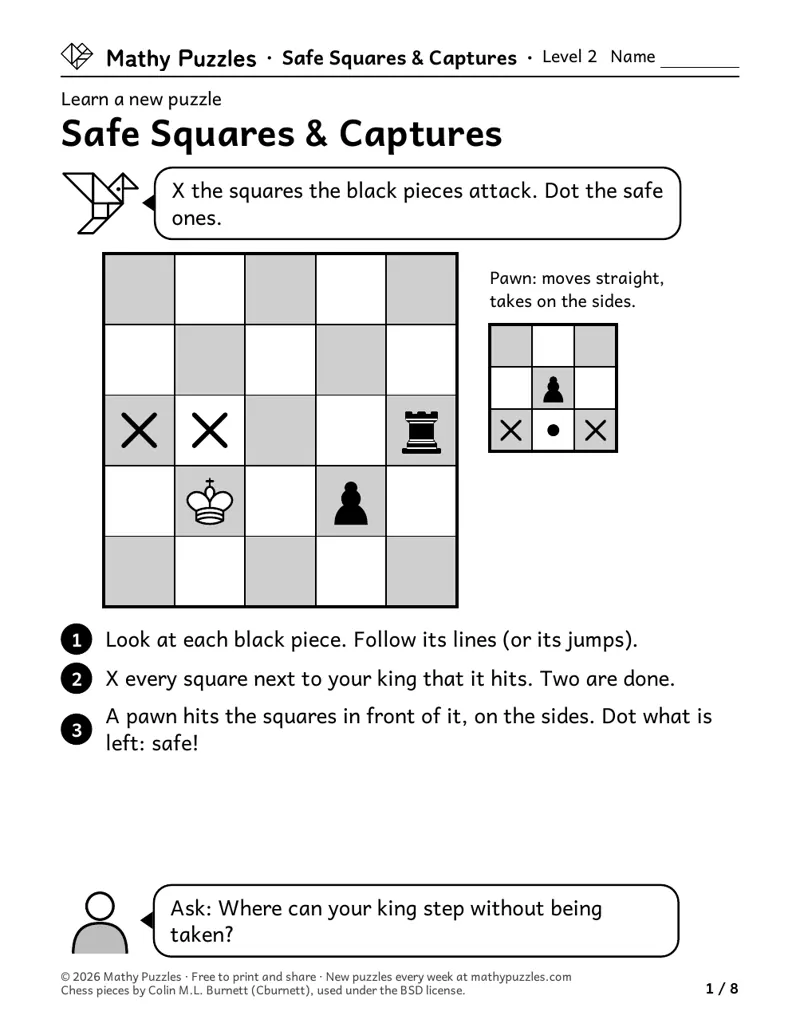
Worked example
From the Level 2 Learn sheet
- Look at each black piece. Follow its lines, or its jumps.
- X every square next to your king that a black piece hits.
- A pawn hits the two squares diagonally in front of it. Dot what is left: those squares are safe.
A question to ask: “Where can your king step without being taken?”
Free every Sunday A mixed bag of 20 new puzzles, all four levels. Get them by email
The thinking it works on
Seeing the board from the other side
Asks what the black pieces can do, not just what white can do.
Sher, Koenig and Rustichini (2014) had children aged 3 to 9 play two simple games against another player. By about age 7, the children anticipated the other player's competitive and deceptive moves. Source
Combining several pieces at once
Puts together the reach of three or four attackers.
Sorting into two groups
Splits the king's neighbors into attacked and safe.
Thinking one move ahead
Asks "and then what?" before taking.
Kaller and colleagues (2008) gave 4- and 5-year-olds a tower puzzle. Problems that needed a look one step ahead were much harder for the 4-year-olds. The 5-year-olds managed them as well as the simpler ones. Source
Holding back the obvious answer
Ignores the straight-ahead square for a pawn.
Williams and colleagues (1999) asked 275 people aged 6 to 81 to stop a response they had already started. The speed of stopping kept getting faster throughout childhood. Source
Where is this thinking used?
- Crossing the road: Checking every direction a car could come from before stepping out.
- Team games: Seeing which spaces a defender can reach and which are open.
- Planning a trade: Asking what you could lose before you swap.
- Safety checks: Looking at a plan from the side of what could go wrong.
For teachers
Curriculum areas
- Common Core
- No direct curricular match.
- NCERT
- No direct curricular match.
- National Curriculum (England)
- No direct curricular match.
- Cambridge Primary Mathematics
- No direct curricular match.
Math practices: see the box below.
Math practices this puzzle uses
- Uses: MP1 Make sense of problems and persevere in solving them
- Not used: MP2 Reason abstractly and quantitatively
- Not used: MP3 Construct viable arguments and critique the reasoning of others
- Not used: MP4 Model with mathematics
- Not used: MP5 Use appropriate tools strategically
- Uses: MP6 Attend to precision
- Not used: MP7 Look for and make use of structure
- Not used: MP8 Look for and express regularity in repeated reasoning
From the Common Core Standards for Mathematical Practice.
More Safe Squares & Captures puzzles for members
Members get at least 5 more worksheets at each difficulty for every puzzle, 80 new puzzles every Sunday, and the whole archive. $39 a year or $25 for 6 months.
See membershipNot ready yet?
One email, all four levels: 20 puzzles, 5 for each level.
For grown-ups (18+). One email every Sunday with the puzzles and the odd note about membership; unsubscribe any time. We never ask about your child. How we use your email