
Capture Chain
Picture a game of checkers where every move must jump a piece. Take the wrong one first and you are left with a piece nobody can reach. Capture Chain works that way with chess pieces, so each capture is a small look ahead.
Free sets by level, ages 6–8:
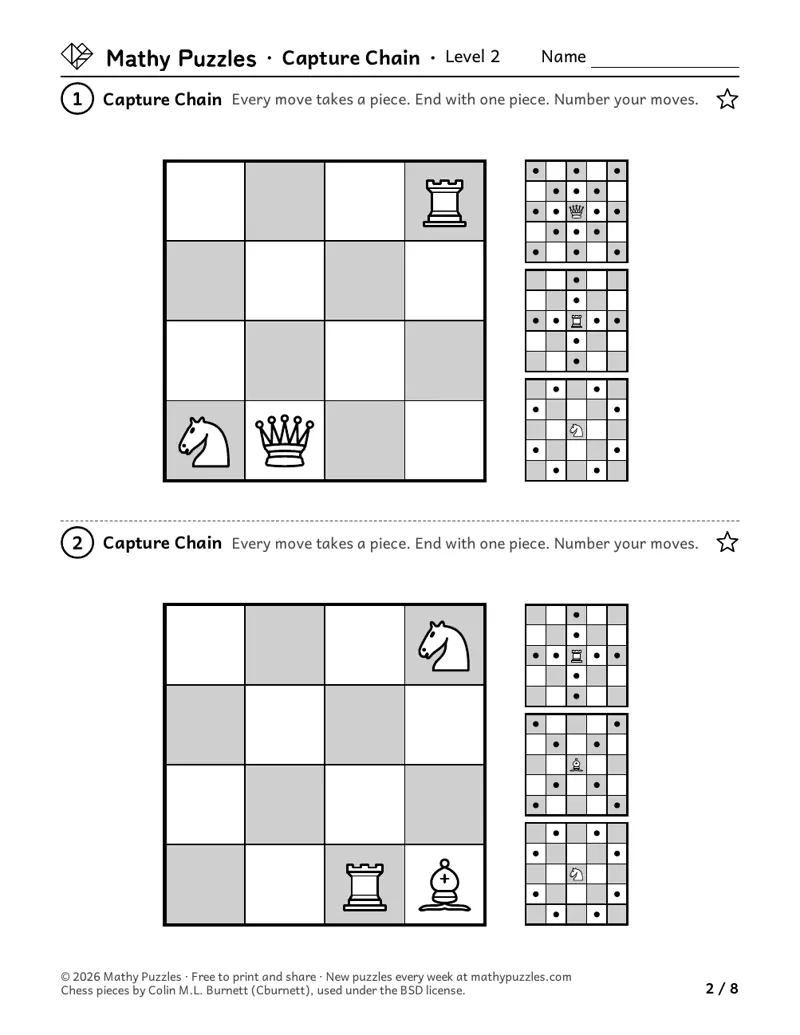 Level 2: a page from the free set
Before starting
- Know how the rook, bishop, queen, knight and pawn move (move cards are on the sheet)
- Know that a pawn takes on the diagonal
- Helpful: Where Can It Go? at Level 2
Free puzzles to print
Each set: a Learn sheet with a worked example, 10 puzzles from easiest to hardest, and the answers.
Level 2
Ages 6–8 · Grades 1–2
The easiest puzzles: 3 pieces on a 4 × 4 board, and no first capture gets stuck.
Next: 4 pieces on 4 × 4.
Then 5 pieces, with at least one tempting first capture that gets stuck.
The hardest puzzles: 6 pieces on a 5 × 5 board.
On the sheet: “Every move takes a piece. End with one piece. Number your moves.”
Print Level 2 (Letter)Other paper size: A4
How it works
Each puzzle is a small board with a few chess pieces, all on the same side. Every move must take another piece, and the child keeps going until only one piece is left. They number the moves 1, 2, 3 on the board. Pieces move as in chess, pawns take diagonally up the page, and there are no kings.
How to play
- Look at every piece. Which pieces can it take right now?
- Pick a capture. Write 1 on the square where the move ends, and cross out the piece that was taken.
- From the new board, find the next capture. Write 2, and so on.
- No capture left but more than one piece? You are stuck. Erase and try a different first move.
When it gets hard
Making a move that doesn't take anything.
Hint: Every single move must land on a piece.
Forgetting that the taken piece is gone.
Hint: Cross it out lightly so the board you see is the board you have.
Giving up when stuck.
Hint: Stuck is information. That first move was the wrong one, so try another.
Tip for grown-ups: Act it out with real chess pieces or with coins labeled R, B and N. Children try more first moves when undoing one is easy.
Frequently asked questions
- My child gets stuck halfway through. Is that normal?
- Yes, and the harder puzzles are built so that a tempting first move leads to a dead end. Getting stuck, then finding a better first move, is the puzzle working as planned.
- Can students check their own chains?
- Yes. A chain is right if every move is a legal chess capture and one piece is left. The answers show one chain as an example; another that follows the rules is right too.
- Why are there no kings?
- Kings can't be taken in chess, so leaving them out keeps the rule simple: every piece on the board can be captured.
Questions about printing, levels, answers or membership: see all questions.
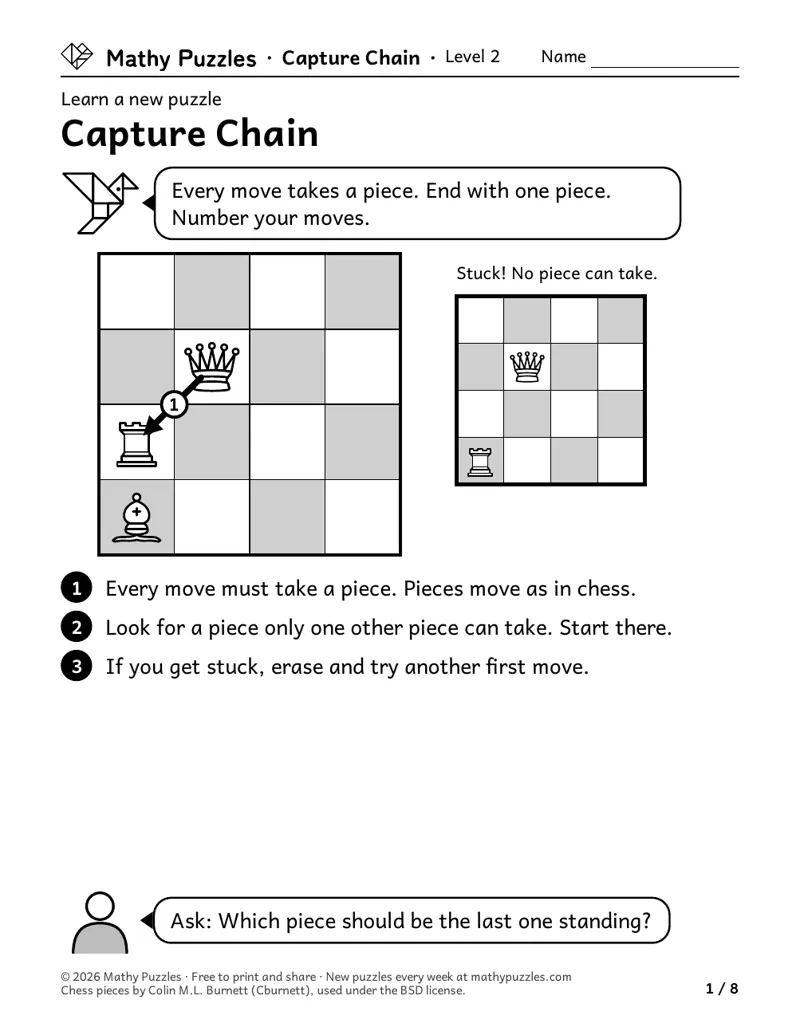
Worked example
From the Level 2 Learn sheet
- Every move must take a piece. Pieces move as in chess.
- Look for a piece that only one other piece can take. Start there.
- If you get stuck, erase and try another first move.
A question to ask: “Which piece should be the last one standing?”
Free every Sunday A mixed bag of 20 new puzzles, all four levels. Get them by email
The thinking it works on
Planning a sequence
Puts captures in an order that keeps the chain going.
In a tower puzzle that needs moves planned in order, Luciana and Nelson (1998) found that even 8-year-olds were not yet at adult level on the longest problems. Source
Looking ahead
Pictures the board after a move before making it.
Huizinga, Dolan and van der Molen (2006) compared 7-, 11-, 15- and 21-year-olds. Holding things in mind and switching between rules, both used in planning puzzles, kept developing into the teenage years. Source
Learning from a dead end
Treats getting stuck as a clue, not a failure.
In a card-sorting task, Huizinga and van der Molen (2007) found that 11-year-olds switched to a new rule as well as adults once the old one stopped working. Seven-year-olds did not. Source
Working backward
Thinks about which piece should survive.
Finding the tight spot
Starts with the piece only one other can take.
Where is this thinking used?
- Cooking: Doing steps in an order that keeps the next step possible.
- Packing a bag or a car: Deciding what goes in first so everything fits.
- Building with blocks: Thinking about which piece must go on last.
- Cleaning up: Clearing the item that blocks the others first.
For teachers
Curriculum areas
- Common Core
- No direct curricular match.
- NCERT
- No direct curricular match.
- National Curriculum (England)
- No direct curricular match.
- Cambridge Primary Mathematics
- No direct curricular match.
Math practices: see the box below.
Math practices this puzzle uses
- Uses: MP1 Make sense of problems and persevere in solving them
- Not used: MP2 Reason abstractly and quantitatively
- Not used: MP3 Construct viable arguments and critique the reasoning of others
- Not used: MP4 Model with mathematics
- Not used: MP5 Use appropriate tools strategically
- Not used: MP6 Attend to precision
- Uses: MP7 Look for and make use of structure
- Not used: MP8 Look for and express regularity in repeated reasoning
From the Common Core Standards for Mathematical Practice.
More Capture Chain puzzles for members
Members get at least 5 more worksheets at each difficulty for every puzzle, 80 new puzzles every Sunday, and the whole archive. $39 a year or $25 for 6 months.
See membershipNot ready yet?
One email, all four levels: 20 puzzles, 5 for each level.
For grown-ups (18+). One email every Sunday with the puzzles and the odd note about membership; unsubscribe any time. We never ask about your child. How we use your email