
Who's Where?
Lining children up for a class photo is a puzzle of its own: Sam behind Ava, Leo next to Sam. Each clue about order is one link, and joined together, the links put the whole line, or the whole table, in place.
Free sets by level, ages 4–12:
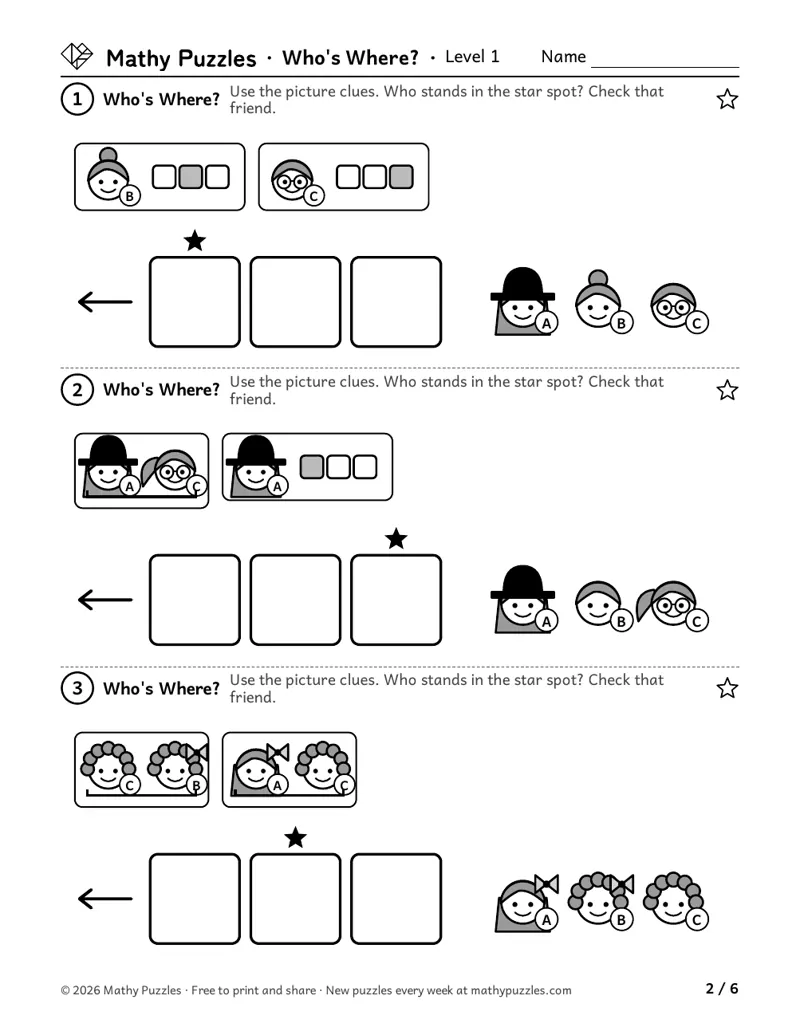 Level 1: a page from the free set
Before starting
- Level 1: no reading or writing; tell a shaded box from a crossed one
- Know in front of and right behind (the Level 1 and 2 sheets show each with a picture)
- Level 2 and up: know first, second and third; at Level 2 friends wear letter badges, so there are no names to read
- Level 4: left and right
What you need
Coins, buttons or small toys to move around as friends, and a pencil with an eraser.
Free puzzles to print
Each set: a Learn sheet with a worked example, 10 puzzles from easiest to hardest, and the answers.
Level 1
Ages 4–6 · Pre-K–K
3 friends and 2 or 3 picture clues (a shaded box for "here", dots for "ahead", a bracket for "right behind"). First the child checks the friend in the star spot; then "not here" clues (a crossed box) join in. The hardest puzzles ask the child to draw a line from each friend to their spot.
On the sheet: “Use the picture clues. Draw a line from each friend to their spot.”
Print Level 1 (Letter)Other paper size: A4Level 2
Ages 6–8 · Grades 1–2
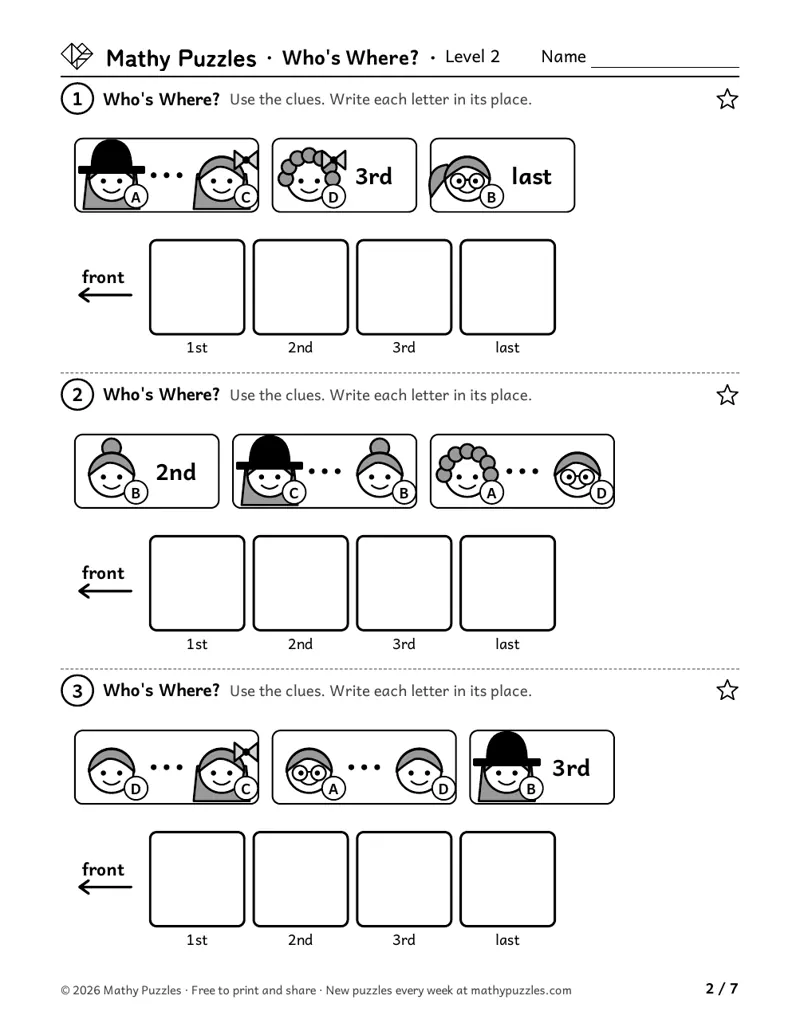
4 or 5 friends in a line with picture clues. Dots mean "ahead", a bracket means "right behind", and a place badge says "1st", "last", or "not 1st and not last". The hardest ask only who stands in the middle.
On the sheet: “Use the clues. Write each letter in its place.”
Print Level 2 (Letter)Other paper size: A4Level 3
Ages 8–10 · Grades 3–4
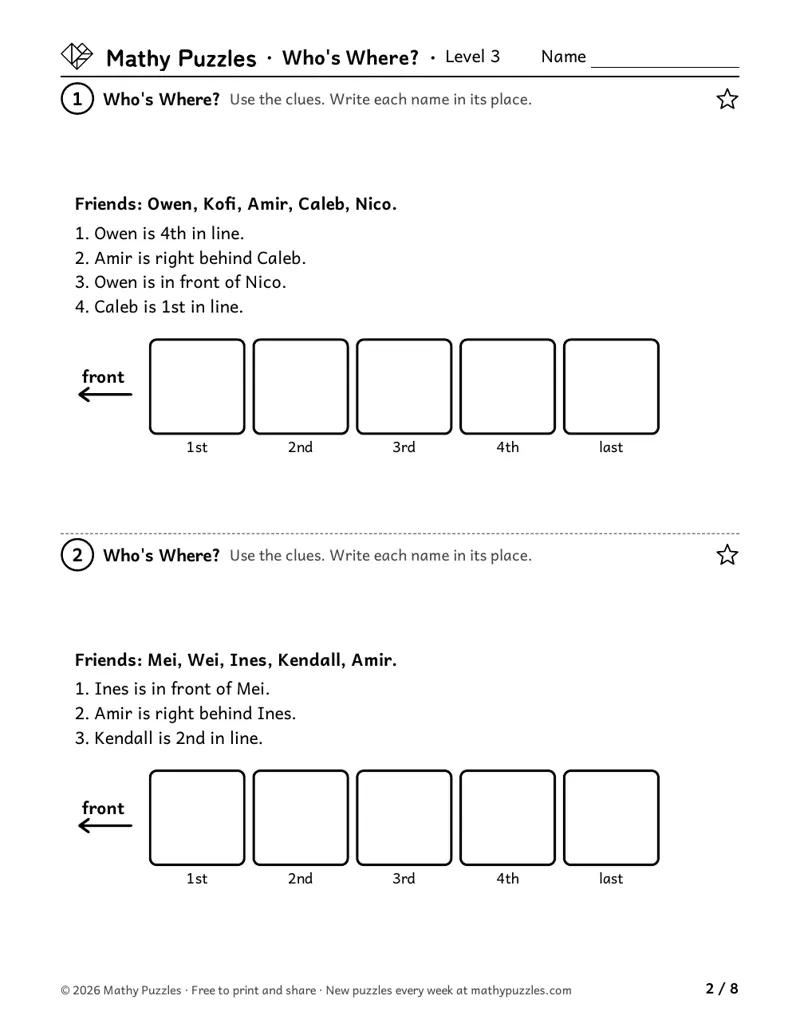
5 friends with written clues: "in front of" and "right behind", then "not next to" and "between"; the hardest add a second order, who is taller.
On the sheet: “Use the clues. Write each name in its place.”
Print Level 3 (Letter)Other paper size: A4Level 4
Ages 10–12 · Grades 5–6
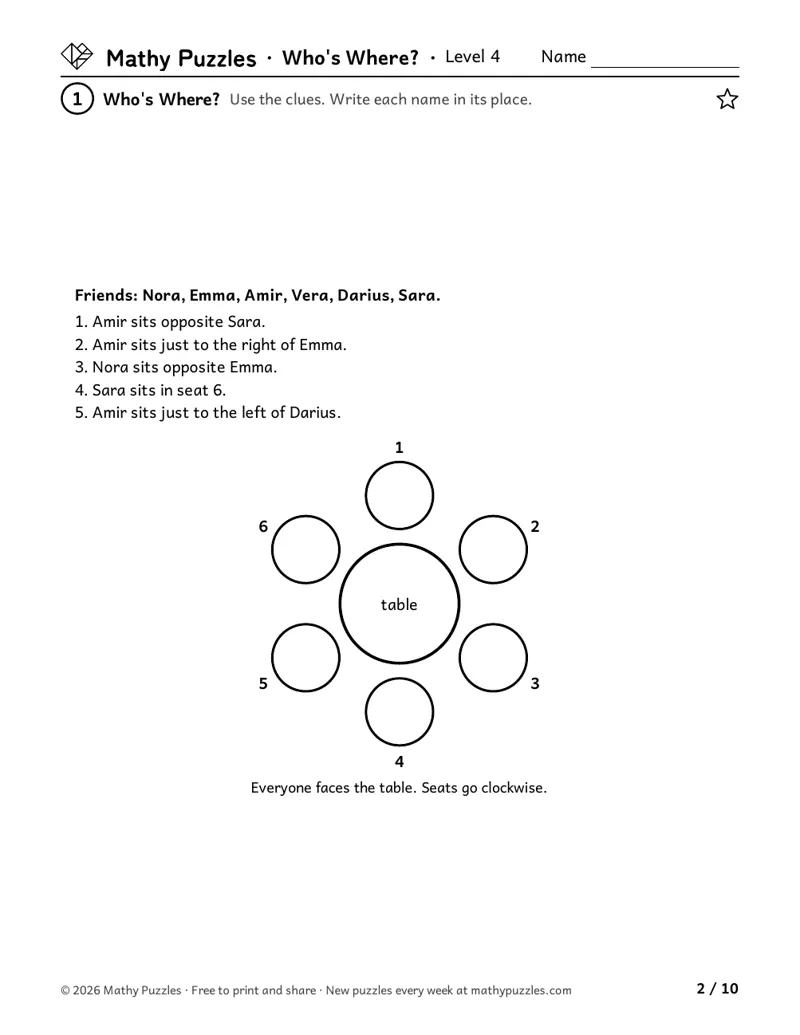
6 seats around a table ("opposite", "just to the left of"), or 5 friends in a line who each have a pet. The hardest is a 7-seat table that needs one "what if" test.
On the sheet: “Use the clues. Write each name in its place.”
Print Level 4 (Letter)Other paper size: A4
How it works
Friends stand in a line or sit around a table. Clues say who is in front of whom, who is right behind someone, or who sits opposite. The clues are pictures with no words at Levels 1 and 2, and written from Level 3. The child uses the clues to place each friend. At Level 1 the child checks a friend or draws lines; at Level 2 the child writes letters, and at Levels 3 and 4, names.
How to play
- Look at the empty places and find the front of the line.
- Place any friend a clue puts in an exact place.
- Use "right behind" clues to place pairs together.
- Try each clue again after each new friend is placed. When the line is full, check every clue.
When it gets hard
Reading "in front of" as "right in front of".
Hint: "In front of" means somewhere ahead. Only "right behind" means the very next place.
Mixing up left and right around a table.
Hint: Everyone faces the table. Turn the sheet so you sit in that friend's seat, then look left.
Placing a friend from one clue and never checking the others.
Hint: When the line is full, read every clue once more.
Tip for grown-ups: Act out the first puzzle with stuffed toys or family members standing in a line; moving people is easier than erasing names.
Frequently asked questions
- Why pictures at first, and names later?
- Level 1 has no reading or writing: the child checks a friend or draws lines. Level 2 friends wear letter badges, so a 6-year-old writes one letter, not a whole name, and the clues are still pictures. Written names and sentences start at Level 3.
- Does this fit a lesson on position words?
- It does. Level 2 works well after a lesson on in front of, behind and next to. Line up a few students to act out the first puzzle, then hand out the sheet.
- My child's line is different from the answers.
- Check each clue against their line, one at a time. If every clue fits, the line is right. Most often an "in front of" was read as "right in front of". Puzzles that ask about one spot (the star spot at Level 1, the middle at Level 2) only need that spot to be right.
Questions about printing, levels, answers or membership: see all questions.
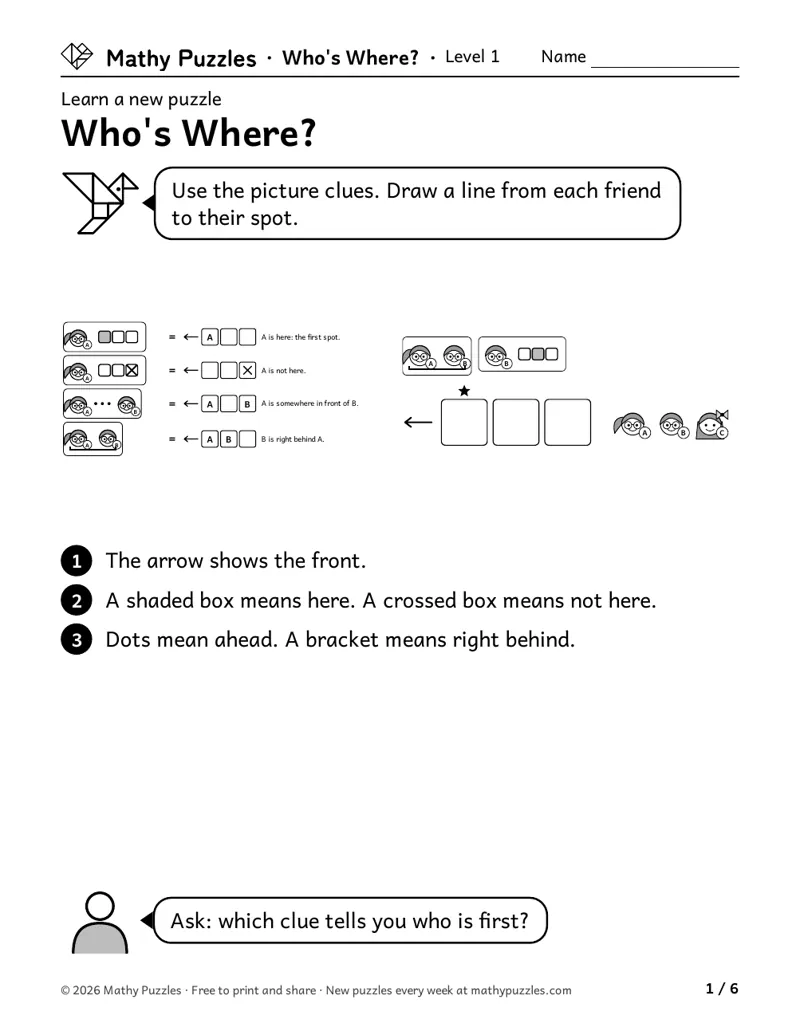
Worked example
From the Level 1 Learn sheet
- The arrow shows the front.
- A shaded box means here. A crossed box means not here.
- Dots mean ahead. A bracket means right behind.
A question to ask: “Which clue tells you who is first?”
Free every Sunday A mixed bag of 20 new puzzles, all four levels. Get them by email
The thinking it works on
Joining order clues in a chain
Links two order clues to place a friend no single clue places.
Somerville and colleagues (1979) had 5- and 6-year-olds work out where animals and people were from simple models. Most 6-year-olds could tell a conclusion that had to be true from one that only could be. Source
Reading position words exactly
Keeps "in front of", "right behind" and "between" apart.
Johnston and Slobin (1979) found, across four languages, that children aged 2 to 4½ used 'in', 'on' and 'under' before 'between', and 'front' and 'back' later still. Source
Taking another person's point of view
Works out whose left is whose around a table.
Rigal (1994) found that even at 11, half the children tested did not yet apply 'left' and 'right' correctly to other people. Source
Holding two facts per friend
Keeps line place and a second fact apart.
Riggs and colleagues (2006) found that the number of items children could hold in visual working memory roughly doubled between ages 5 and 10. It reached the adult level of about three to four items. Source
Checking a finished answer
Reads every clue against the filled line.
Where is this thinking used?
- Seating plans: Who sits next to whom at a party table.
- Race results: Working out the finishing order from who beat whom.
- Shelves and closets: Arranging things when some must sit next to each other.
- Giving directions: Saying left and right for someone facing you.
For teachers
Curriculum areas
- Common Core
- Geometry: words for relative position (in front of, behind, next to), Kindergarten, used as review through Level 3; the real work is deductionLevel 4: No direct curricular match.
- NCERT
- Joyful Mathematics (Class 1): who is before and after each child in a lineLevels 3–4: No direct curricular match.
- National Curriculum (England)
- Geometry – position and direction: describing position (Year 1), used as review; the real work is deductionLevels 3–4: No direct curricular match.
- Cambridge Primary Mathematics
- Geometry and measure: words for position (Stage 1); Number: ordinal numbers (Stage 2)Levels 3–4: No direct curricular match.
Math practices: see the box below.
Math practices this puzzle uses
- Uses: MP1 Make sense of problems and persevere in solving them
- Not used: MP2 Reason abstractly and quantitatively
- Uses: MP3 Construct viable arguments and critique the reasoning of others
- Not used: MP4 Model with mathematics
- Not used: MP5 Use appropriate tools strategically
- Uses: MP6 Attend to precision
- Not used: MP7 Look for and make use of structure
- Not used: MP8 Look for and express regularity in repeated reasoning
From the Common Core Standards for Mathematical Practice.
More Who's Where? puzzles for members
Members get at least 5 more worksheets at each difficulty for every puzzle, 80 new puzzles every Sunday, and the whole archive. $39 a year or $25 for 6 months.
See membershipNot ready yet?
One email, all four levels: 20 puzzles, 5 for each level.
For grown-ups (18+). One email every Sunday with the puzzles and the odd note about membership; unsubscribe any time. We never ask about your child. How we use your email