
Which Is Heavier?
A seesaw never argues: the heavier side goes down. Put a few side by side. If the bag is heavier than the box, and the box is heavier than the ball, then the bag is heavier than the ball. No third weighing is needed.
Free sets by level, ages 4–8:
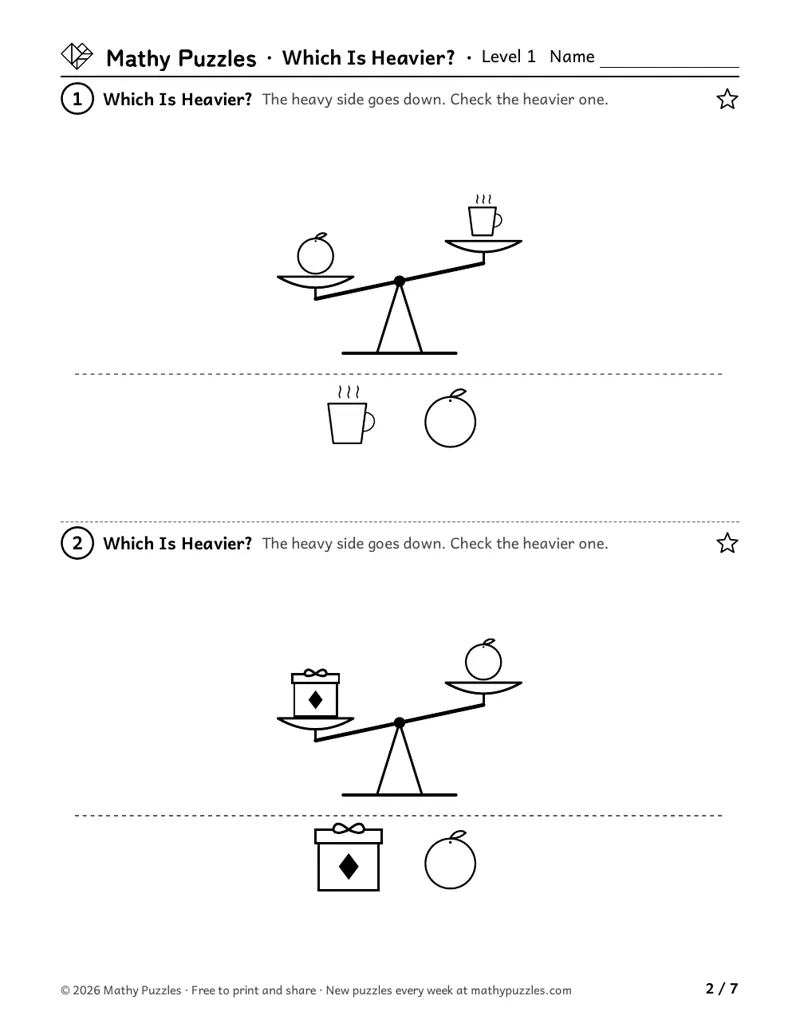 Level 1: a page from the free set
Before starting
- Level 1: no reading or counting
- Know the words heavier and lighter
- Level 2: write the numbers 1 to 5 to show an order
What you need
A crayon. A seesaw, or a coat hanger with two bags, shows the heavy side going down.
Free puzzles to print
Each set: a Learn sheet with a worked example, 10 puzzles from easiest to hardest, and the answers.
Level 1
Ages 4–6 · Pre-K–K
One scale and two objects; then two scales with three objects in a chain. Then three scales and four objects (heaviest or lightest); the hardest ask for the heaviest and the lightest together.
On the sheet: “Use the scales. The heavy side goes down.”
Print Level 1 (Letter)Other paper size: A4Level 2
Ages 6–8 · Grades 1–2
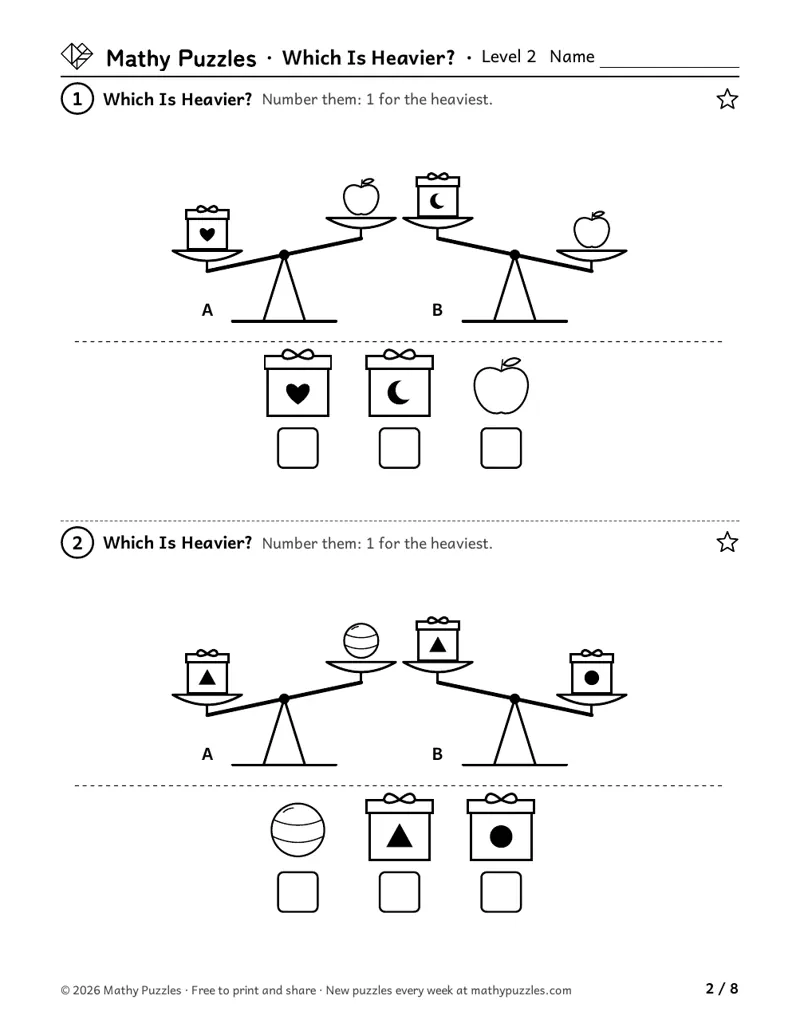
Number 3 objects from heaviest to lightest; then 4 objects with one level scale (two the same). Next, 5 objects with the scales out of order, or "Is the X heavier than the Y?" for two that never share a scale. The hardest have a scale you don't need.
On the sheet: “Use the scales. The heavy side goes down.”
Print Level 2 (Letter)Other paper size: A4
How it works
Each puzzle shows balance scales with one object in each pan. The heavy side goes down; a level scale means the two weigh the same. The child reads the scales to find the heaviest or lightest object, or puts them all in order. The objects are about the same size, so only the scales decide.
How to play
- Point to the low side of a scale. That one is heavier.
- Do the same for every scale.
- Link them: who is heavier than someone who is heavier than someone else?
- Mark your answer, then read each scale again to be sure.
When it gets hard
Picking the higher pan as heavier.
Hint: Push down on your hand: heavy things go down.
Deciding from real life, such as "an apple must be heavier than a cup".
Hint: Only the scales count. These things are about the same size.
At Level 2, giving two objects on a level scale different numbers.
Hint: Level means the same. Give them the same number.
Tip for grown-ups: Before the sheet, let your child hold one thing in each hand and tip their arms like a scale. Then the drawing makes sense. A seesaw at the park, or a coat hanger with a bag on each end, shows the heavy side going down.
Frequently asked questions
- Is this the same as Balance Puzzles?
- No. Here each scale has one object per side and the child only compares: heavier, lighter or the same. Balance Puzzles adds counting, such as how many beads balance a toy car.
- Does this fit a kindergarten lesson on weight?
- Yes. Level 1 matches comparing two objects by weight, which young children often do with a pan balance. Weigh real objects first, then hand out the sheet.
- Why are the objects all the same size?
- So real weight never fights the scale. A feather beating an elephant would confuse a 5-year-old. With same-size gift boxes and fruit, only the scale tells.
Questions about printing, levels, answers or membership: see all questions.
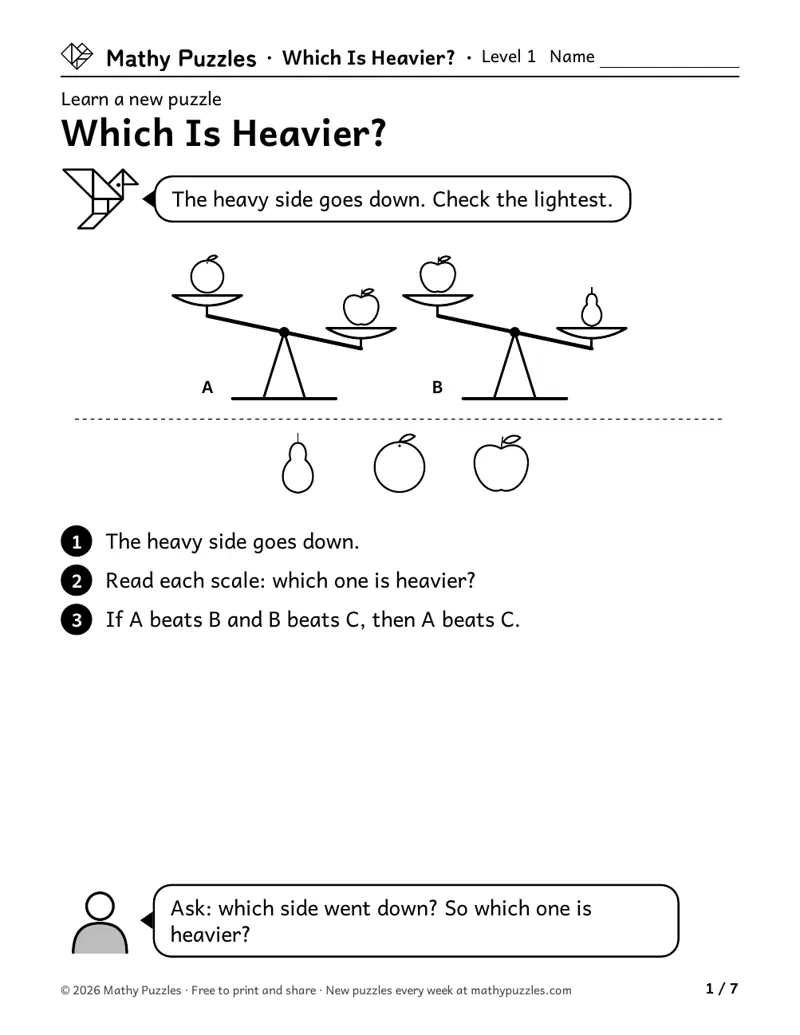
Worked example
From the Level 1 Learn sheet
- The heavy side goes down.
- Read each scale: which one is heavier?
- If A beats B and B beats C, then A beats C.
A question to ask: “Which side went down? So which one is heavier?”
Free every Sunday A mixed bag of 20 new puzzles, all four levels. Get them by email
The thinking it works on
Comparing weight on a balance
Reads the down side as heavier and level as the same.
Halford and colleagues (2002) found that even 2-year-olds could tell which way a balance goes when only the weights differ. The 5- and 6-year-olds also handled weight and distance together. Source
Linking comparisons
Compares two objects that never shared a scale.
Pears and Bryant (1990) showed 58 four-year-olds small towers of two colored bricks. With considerable success, the children worked out which of two colors that never shared a tower would end up higher. Source
Ordering a series
Numbers objects from heaviest to lightest.
Trusting the scale over looks
Decides from the scales, not from the picture.
Spotting what isn't needed
Finds the scale whose fact already follows.
Where is this thinking used?
- Cooking: Comparing bags of flour on a kitchen scale.
- Sports rankings: If one team beat a second and the second beat a third, who ranks highest?
- The playground: Two children on a seesaw: the heavier one goes down.
- Packing a bag: Putting the heaviest things at the bottom.
For teachers
Curriculum areas
- Common Core
- Measurement and data: comparing two objects by weight (Kindergarten); ordering objects and comparing two through a third is a Grade 1 idea, taught there with lengthLevel 2: No direct curricular match.
- NCERT
- Joyful Mathematics: heavier and lighter (Class 1); heaviest, lightest and a home-made balance (Class 2)
- National Curriculum (England)
- Measurement: comparing mass, heavier and lighter (Year 1); comparing and ordering mass (Year 2)
- Cambridge Primary Mathematics
- Geometry and measure: comparing mass, heavier and lighter (before Stage 1 and Stage 1)
Math practices: see the box below.
Math practices this puzzle uses
- Uses: MP1 Make sense of problems and persevere in solving them
- Not used: MP2 Reason abstractly and quantitatively
- Uses: MP3 Construct viable arguments and critique the reasoning of others
- Not used: MP4 Model with mathematics
- Not used: MP5 Use appropriate tools strategically
- Not used: MP6 Attend to precision
- Not used: MP7 Look for and make use of structure
- Not used: MP8 Look for and express regularity in repeated reasoning
From the Common Core Standards for Mathematical Practice.
More Which Is Heavier? puzzles for members
Members get at least 5 more worksheets at each difficulty for every puzzle, 80 new puzzles every Sunday, and the whole archive. $39 a year or $25 for 6 months.
See membershipNot ready yet?
One email, all four levels: 20 puzzles, 5 for each level.
For grown-ups (18+). One email every Sunday with the puzzles and the odd note about membership; unsubscribe any time. We never ask about your child. How we use your email