
Logic Grids
Three friends, three pets, and a handful of clues, none of which says outright who owns the cat. Most of the work is ruling things out. Every "no" leaves the answer less room, until the cat has nowhere else to go.
Free sets by level, ages 6–12:
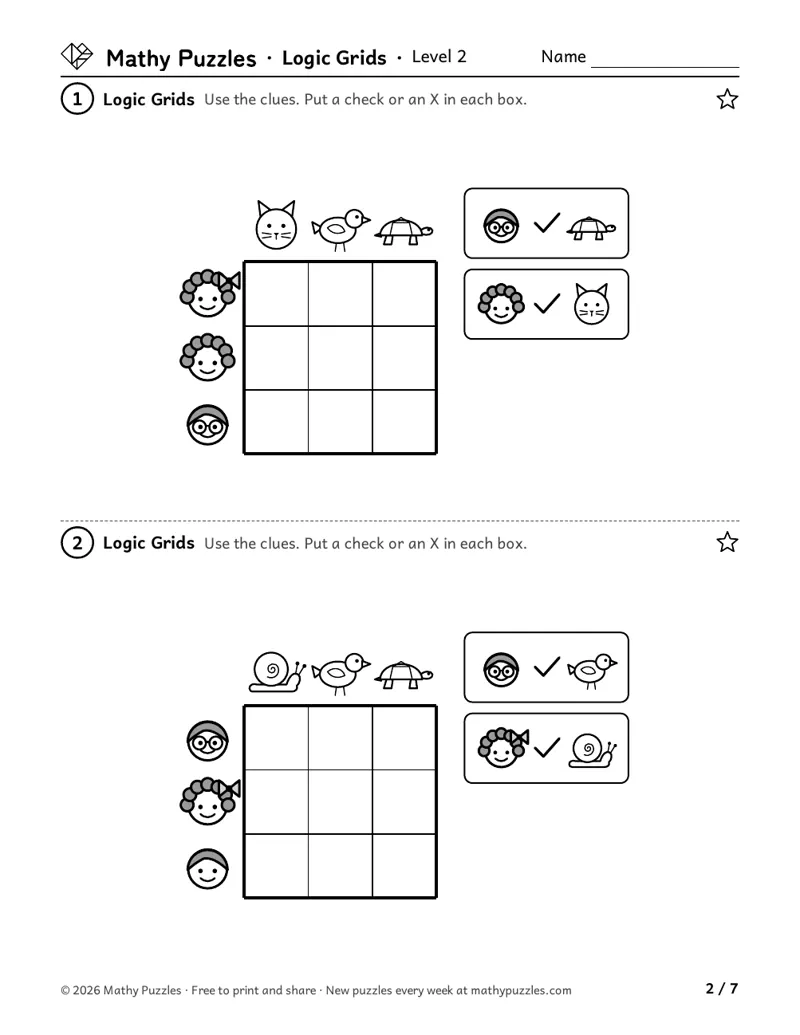 Level 2: a page from the free set
Before starting
- Level 2: match pictures; no reading needed for picture clues
- Levels 3–4: read short sentences
- Know that a check means yes and an X means no
Free puzzles to print
Each set: a Learn sheet with a worked example, 10 puzzles from easiest to hardest, and the answers.
Level 2
Ages 6–8 · Grades 1–2
Picture clues for 3 friends and 3 pets, from "yes" clues only to "no" clues only, then a third set (fruit) to carry across.
On the sheet: “Use the clues. Put a check or an X in each box.”
Print Level 2 (Letter)Other paper size: A4Level 3
Ages 8–10 · Grades 3–4
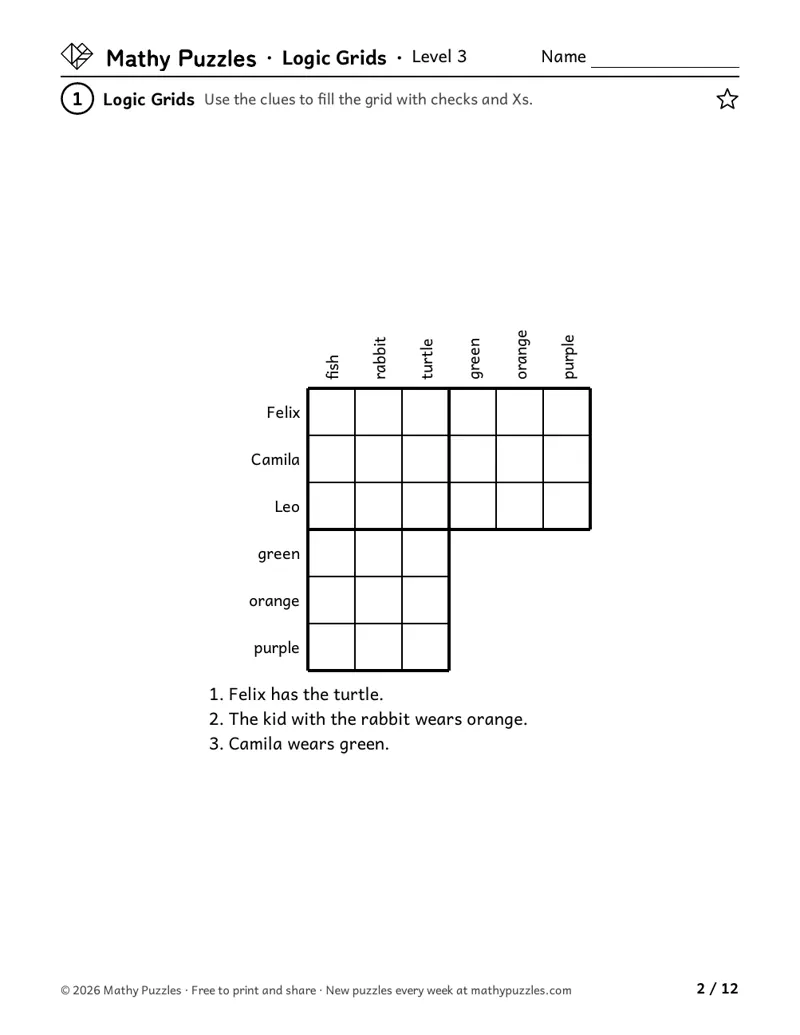
Written clues in the classic step-shaped grid, from 3 × 3 up to 4 items with days or ages in order.
On the sheet: “Use the clues to fill the grid with checks and Xs.”
Print Level 3 (Letter)Other paper size: A4Level 4
Ages 10–12 · Grades 5–6
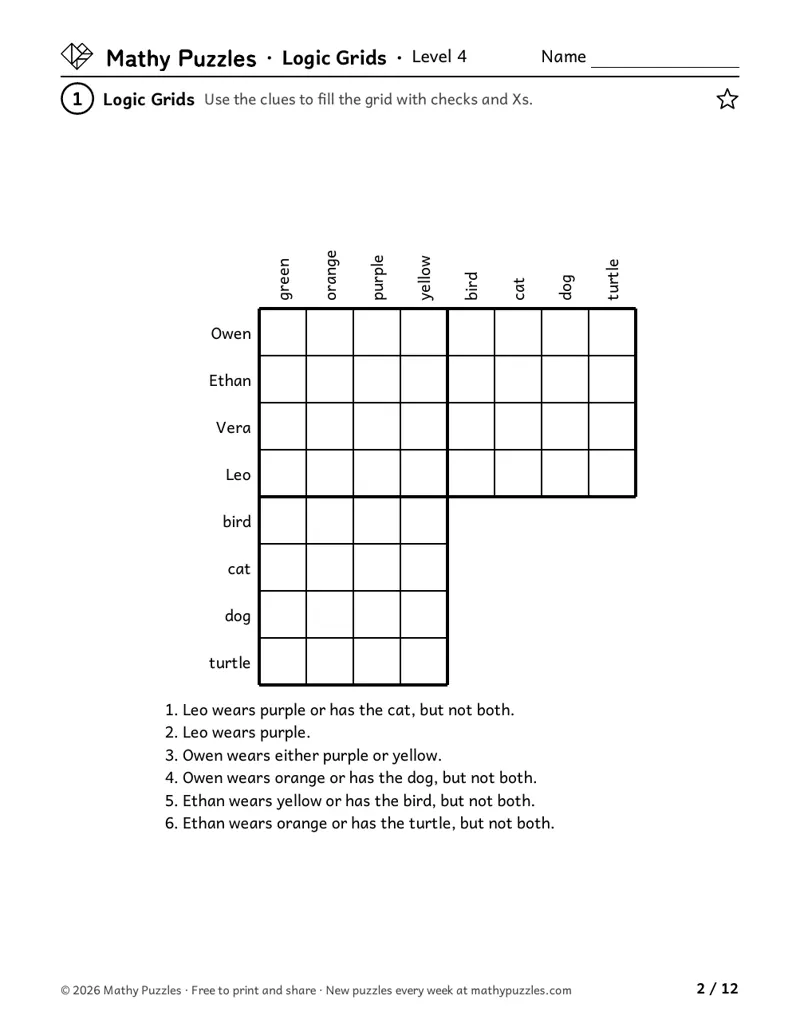
"either… or" clues, then 4 × 4 grids with order clues; the hardest puzzles need one "what if" test.
On the sheet: “Use the clues to fill the grid with checks and Xs.”
Print Level 4 (Letter)Other paper size: A4
How it works
Each puzzle has a short list of clues and a grid that pairs things up: which friend has which pet, snack or club. The child puts an X in a box for every "no" the clues give, and a check for every "yes". When a row has an X in every box but one, the last box must be a check. That small step, done again and again, fills the whole grid.
How to play
- Read one clue. Put a check or an X in the box it tells you about.
- When you put a check, put Xs in the rest of that row and column. Each friend has only one pet.
- Look for a row with only one empty box left. That box gets the check.
- Go back over the clues until every box is filled. Then write the answers.
When it gets hard
Putting a check but not crossing out the rest of the row and column.
Hint: After every check, ask: who else can't have this now?
Reading a "not" clue as a "yes".
Hint: Underline the word "not" before you mark anything.
Using each clue only once.
Hint: Read every clue again after each new check. Some clues help twice.
Tip for grown-ups: Read the clues aloud with your child for the first few grids and let them decide every mark; the reading is not the puzzle.
Frequently asked questions
- My 6-year-old can't read the clues yet.
- Level 2 clues are pictures with a check or an X, so reading isn't needed. Read any words aloud and let your child make every mark.
- What if my child's grid comes out different?
- Re-read the clues together and test each mark against them; one word like "not" usually explains a slip. If every clue holds for your child's grid, it is right. The answers show a filled grid as an example.
Questions about printing, levels, answers or membership: see all questions.
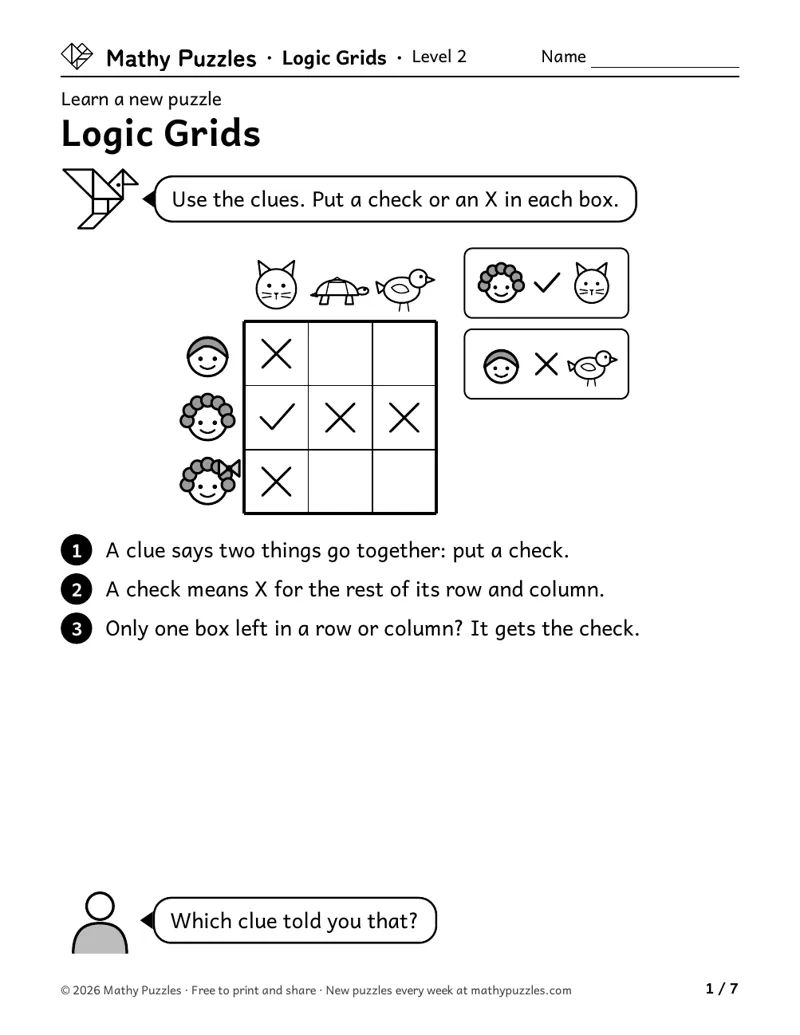
Worked example
From the Level 2 Learn sheet
- A clue says two things go together: put a check.
- A check means X for the rest of its row and column.
- Only one box left in a row or column? It gets the check.
A question to ask: “Which clue told you that?”
Free every Sunday A mixed bag of 20 new puzzles, all four levels. Get them by email
The thinking it works on
Putting facts together
Combines clues to reach a conclusion that must be true.
Pillow (2002) found that children from first grade on rated their own worked-out conclusions as surer than guesses. They did not tell another person's sound conclusion from a guess until fourth grade. Source
Ruling boxes out
Uses 'not this, not that, so it must be the other' when one box is left.
Gautam, Suddendorf and Redshaw (2021) found that a strict 'one of these two, and not this one' cup game was passed reliably only from age 5. Source
Holding several clues in mind
Keeps earlier clues alive while reading the next one.
Gathercole and colleagues (2004) found that working memory, which keeps earlier clues alive, grows roughly in a straight line from age 4 to 15. Source
Keeping careful records
Writes each fact down as a check or an X so the grid remembers.
Eskritt and Lee (2002) found that fifth and seventh graders made notes that helped them in a memory card game, and leaned on them. First and third graders' notes mostly did not help. Source
Reading every word closely
Reads 'not', 'either… or' and order words exactly as written.
Testing a 'what if'
Supposes one possibility and follows it until it works or breaks.
The idea that a conclusion can follow from the facts given, whether or not those facts are really true, typically forms between ages 10 and 12. It keeps sharpening after that. Source
Where is this thinking used?
- Everyday mysteries: Working out who ate the last cookie from a few small facts.
- Schedules and seating plans: Several "cannot" rules narrow what is possible.
- Reading rules closely: A contract, a recipe or a rule book means exactly what it says.
- Games: Card and board games where a few 'not' facts settle who holds what.
For teachers
Curriculum areas
- Common Core
- No direct curricular match.
- NCERT
- Maths Mela (Class 5), Shapes and Patterns: a puzzle solved from cluesLevels 2–3: No direct curricular match.
- National Curriculum (England)
- Algebra: listing the possible combinations of two variables (Year 6)Levels 2–3: No direct curricular match.
- Cambridge Primary Mathematics
- No direct curricular match.
Math practices: see the box below.
Math practices this puzzle uses
- Uses: MP1 Make sense of problems and persevere in solving them
- Not used: MP2 Reason abstractly and quantitatively
- Uses: MP3 Construct viable arguments and critique the reasoning of others
- Not used: MP4 Model with mathematics
- Not used: MP5 Use appropriate tools strategically
- Uses: MP6 Attend to precision
- Not used: MP7 Look for and make use of structure
- Not used: MP8 Look for and express regularity in repeated reasoning
From the Common Core Standards for Mathematical Practice.
More Logic Grids puzzles for members
Members get at least 5 more worksheets at each difficulty for every puzzle, 80 new puzzles every Sunday, and the whole archive. $39 a year or $25 for 6 months.
See membershipNot ready yet?
One email, all four levels: 20 puzzles, 5 for each level.
For grown-ups (18+). One email every Sunday with the puzzles and the odd note about membership; unsubscribe any time. We never ask about your child. How we use your email