
Whodunit
Someone left the garden gate open. A witness saw rain boots; three friends signed in at the library all morning. Every clue rules some friends out, and when only the ones who did it are left, the case is closed.
Free sets by level, ages 8–12:
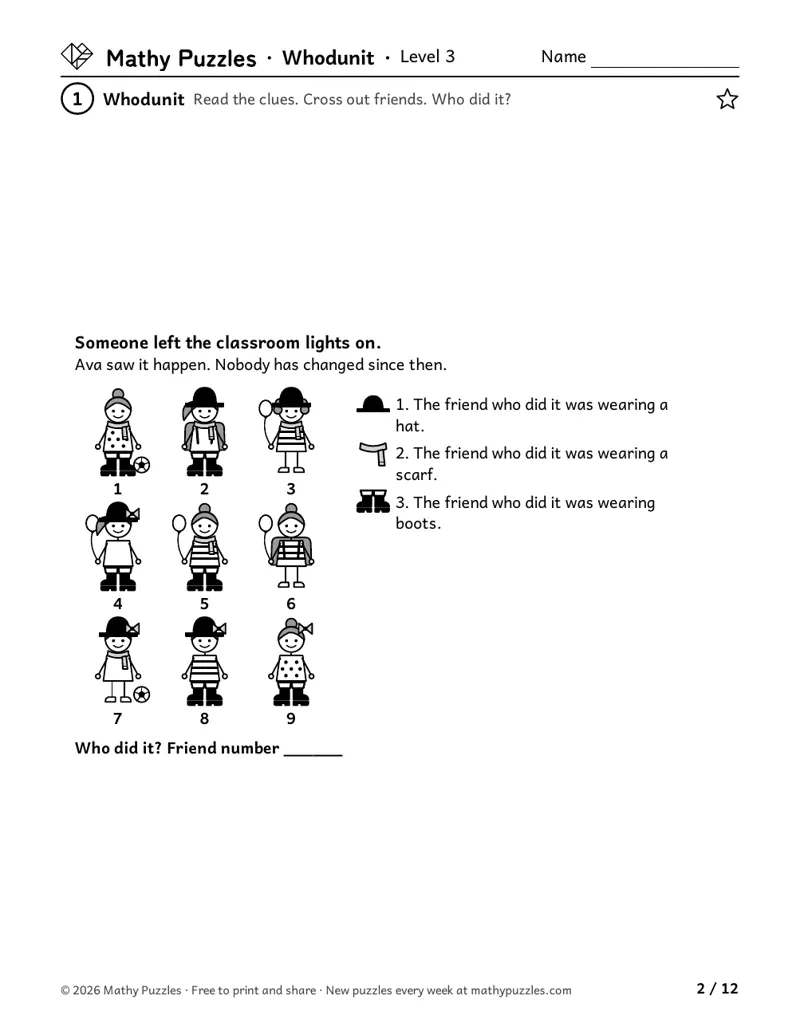 Level 3: a page from the free set
Before starting
- Read short sentences
- Spot details on a drawing (boots, a scarf, stripes)
- Know what "not" does to a clue
- Level 4: read times on a simple room log (1:00 to 4:00)
Free puzzles to print
Each set: a Learn sheet with a worked example, 10 puzzles from easiest to hardest, and the answers.
Level 3
Ages 8–10 · Grades 3–4
9 friends and 3 clues about what the witness saw. Then a sign-in sheet clears friends who were elsewhere. Then a "not" clue, with every clue needed. The hardest have two friends who did it together ("Both of them…", "Neither of them…").
On the sheet: “Read the clues. Cross out friends. Who did it?”
Print Level 3 (Letter)Other paper size: A4Level 4
Ages 10–12 · Grades 5–6
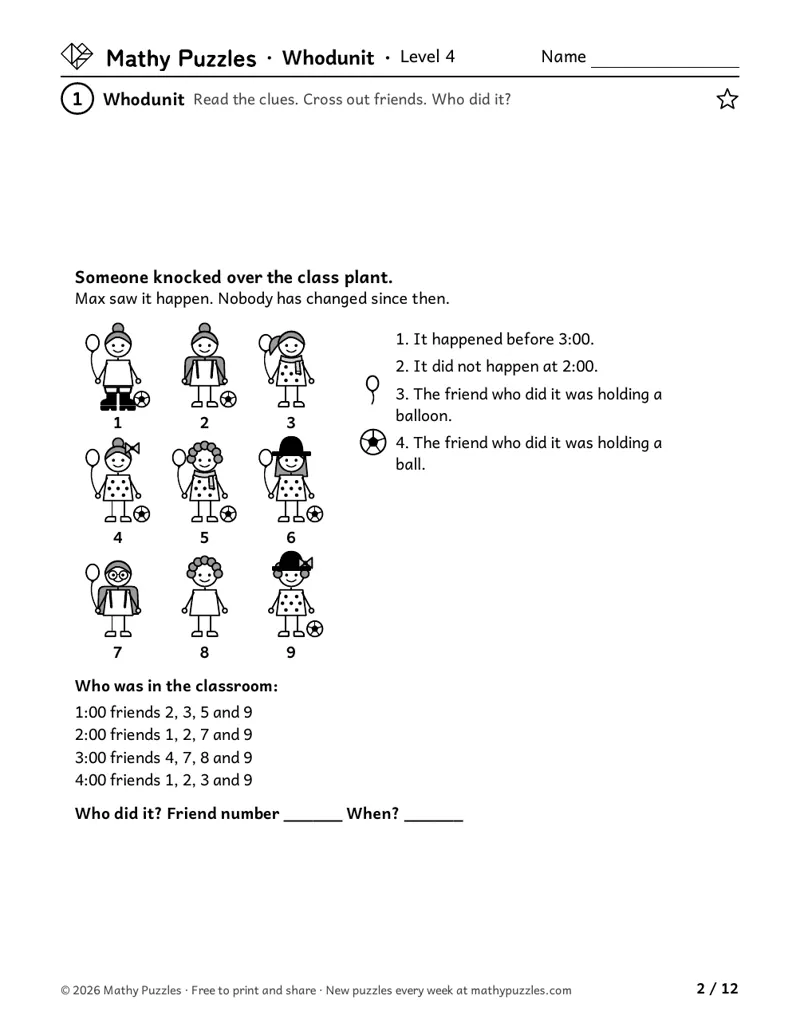
First find when it happened from a room log, then who was there. Then 12 friends with "was with" clues that clear a second friend. The hardest hide one false clue, found because two clues can't both be true.
On the sheet: “Read the clues. Cross out friends. Who did it?”
Print Level 4 (Letter)Other paper size: A4
How it works
Each case is a small, gentle mystery, such as who ate the last cookie at the bake sale. A lineup of numbered friends sits under clues: what a witness saw, and a sign-in sheet of friends who were somewhere else. The child crosses out friends until one is left.
How to play
- Read the case and all the clues once.
- Take one clue. Cross out every friend it rules out.
- Use the sign-in sheet: friends who were somewhere else are cleared.
- When one friend is left, check them against every clue.
When it gets hard
Crossing out the friends who match a clue.
Hint: The friend who did it matches the clue. Keep the matches; cross out the rest.
Missing a "not".
Hint: Circle every "not" before you start crossing out.
Stopping as soon as one friend is left.
Hint: Read every clue against that friend. All of them must fit.
Tip for grown-ups: Point to a crossed-out friend and ask which clue cleared them. "Friend 4 was in the library" is the reasoning said out loud.
Frequently asked questions
- Is this too scary for my child?
- No. The cases are gentle: a cookie eaten, a gate left open, a kite let go. There are no police, no injuries and no grown-ups who did it.
- Could pairs of students solve one together?
- Yes. One reads the clues aloud, the other crosses out; then they swap for the next case. Ask each pair to name the clue that cleared every friend.
- What if two friends are left at the end?
- A clue was probably missed, or a "not" was read as a "yes". Go through the clues again from the top. In the hardest Level 3 puzzles two friends did it together, and the sheet says so.
Questions about printing, levels, answers or membership: see all questions.
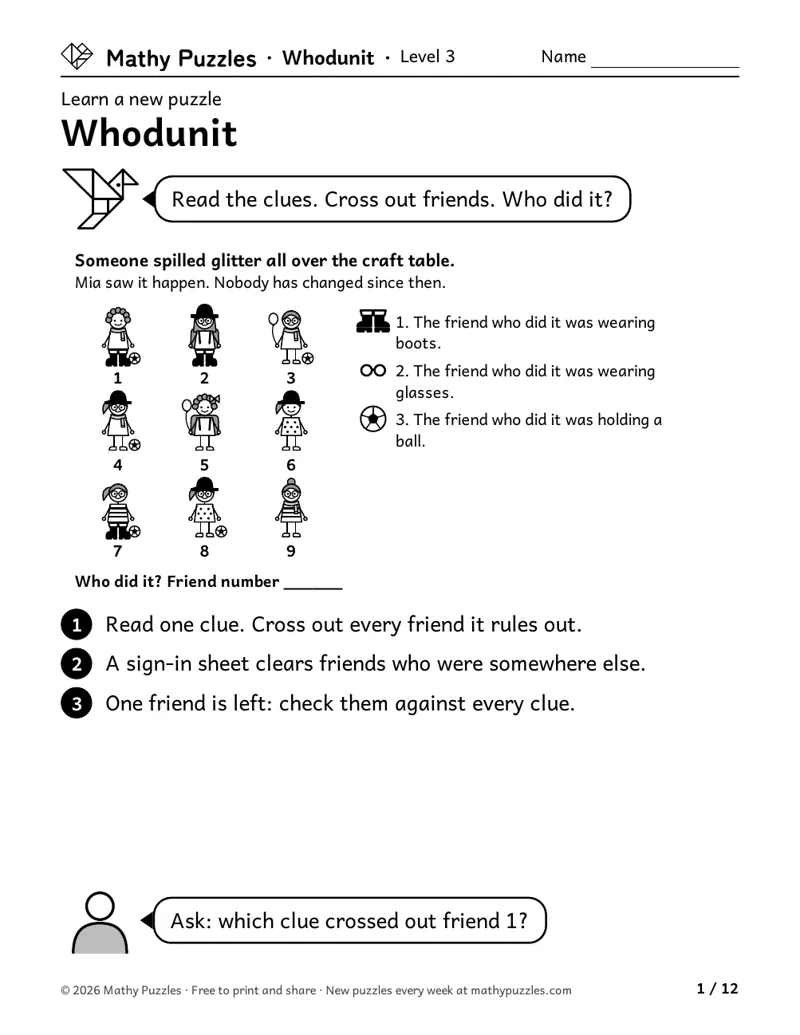
Worked example
From the Level 3 Learn sheet
- Read one clue. Cross out every friend it rules out.
- A sign-in sheet clears friends who were somewhere else.
- One friend is left: check them against every clue.
A question to ask: “Which clue crossed out friend 1?”
Free every Sunday A mixed bag of 20 new puzzles, all four levels. Get them by email
The thinking it works on
Ruling out by evidence
Crosses out every friend a clue rules out, clue after clue.
Careful looking
Checks every drawn friend for one small detail.
Hommel and colleagues (2004) tested 298 people aged 6 to 89 and found that children's search was slowed most by the mere presence of other items. Source
Reasoning with not, both and neither
Handles clues about what a friend was not wearing, or about two friends.
Two-step reasoning
Finds when first, then who.
Spotting a contradiction
Finds two clues that can't both be true.
Markman (1979) found that third to sixth graders often judged short passages with plain contradictions as making sense. They remembered the facts and could draw the inference, but did not compare the two statements unless prompted. Source
Where is this thinking used?
- Lost keys: Working out where they went from who was where.
- Science: Ruling out explanations one test at a time.
- Hearing two stories: Noticing when two accounts can't both be true.
- Mystery games: Board and card games where suspects are crossed off a list.
For teachers
Curriculum areas
- Common Core
- No direct curricular match.
- NCERT
- Maths Mela (Classes 3 and 5): number riddles solved by ruling out with several clues
- National Curriculum (England)
- No direct curricular match.
- Cambridge Primary Mathematics
- No direct curricular match.
Math practices: see the box below.
Math practices this puzzle uses
- Uses: MP1 Make sense of problems and persevere in solving them
- Not used: MP2 Reason abstractly and quantitatively
- Uses: MP3 Construct viable arguments and critique the reasoning of others
- Not used: MP4 Model with mathematics
- Not used: MP5 Use appropriate tools strategically
- Uses: MP6 Attend to precision
- Not used: MP7 Look for and make use of structure
- Not used: MP8 Look for and express regularity in repeated reasoning
From the Common Core Standards for Mathematical Practice.
More Whodunit puzzles for members
Members get at least 5 more worksheets at each difficulty for every puzzle, 80 new puzzles every Sunday, and the whole archive. $39 a year or $25 for 6 months.
See membershipNot ready yet?
One email, all four levels: 20 puzzles, 5 for each level.
For grown-ups (18+). One email every Sunday with the puzzles and the odd note about membership; unsubscribe any time. We never ask about your child. How we use your email