
Where Can It Go?
A rook slides in straight lines; a bishop slides corner to corner. Every chess piece has its own way of moving. These first puzzles ask a child to follow each of its paths, one square at a time, until the path runs out.
Free sets by level, ages 4–8:
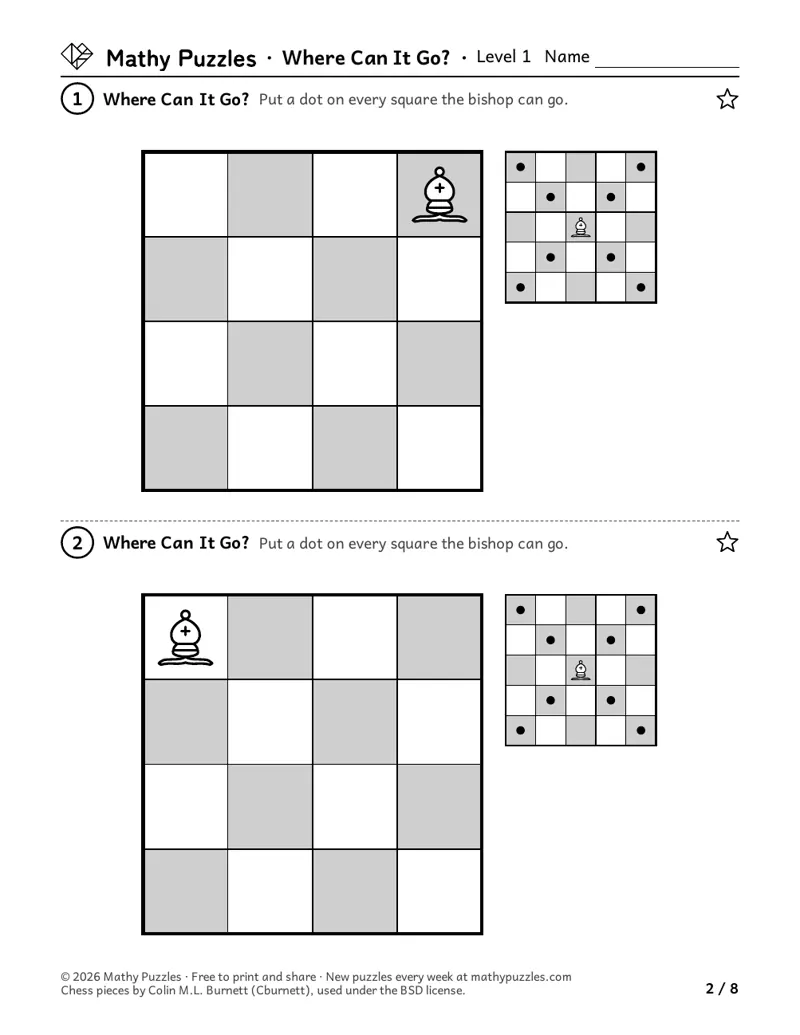 Level 1: a page from the free set
Before starting
- Level 1: no chess needed; the Learn sheet meets the rook, bishop, queen, king and knight, and a card shows each move
- Level 1: follow a line of squares with a finger
- Level 2: know how the five pieces move (the cards still help) and count to about 20
What you need
A real chess set for trying the moves (optional), and a sharp pencil for small dots.
Free puzzles to print
Each set: a Learn sheet with a worked example, 10 puzzles from easiest to hardest, and the answers.
Level 1
Ages 4–6 · Pre-K–K
The easiest puzzles: a rook or a bishop alone on a 4 × 4 board.
Then: a rook or a bishop on a 5 × 5 board, or the king; then the queen or the knight on 5 × 5.
The hardest puzzles turn it around: the dots are already drawn, and the child circles which of three pieces made them.
On the sheet: “Put a dot on every square the piece can go.”
Print Level 1 (Letter)Other paper size: A4Level 2
Ages 6–8 · Grades 1–2
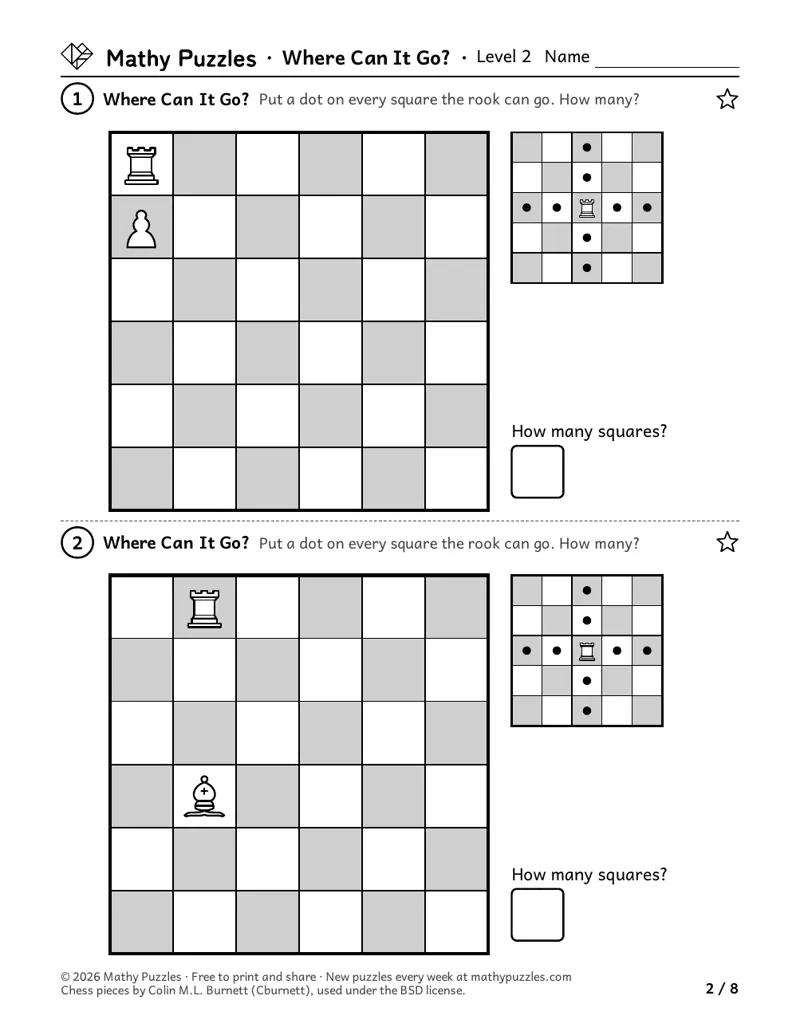
6 × 6 boards with other pieces in the way. First one of your own pieces (stop before it), then an enemy piece too (you may take it, then stop).
The hardest puzzles: the queen or the knight among two or three pieces of both colors. Then two of your pieces at once: circle the squares both can reach. In the dot puzzles the child also writes how many squares.
On the sheet: “Put a dot on every square the piece can go.”
Print Level 2 (Letter)Other paper size: A4
How it works
Each puzzle is a small chessboard with one chess piece on it. The child puts a dot on every square that piece can move to. A picture card beside the board shows how the piece moves, so no chess is needed to start. At Level 2 other pieces stand in the way, and the child counts the dots.
How to play
- Find the piece and its card. The card shows which ways it moves.
- Start at the piece. Go one way, one square at a time, and dot each square.
- Stop at the edge. At Level 2, stop before one of your own pieces; an enemy piece can be taken, so dot its square and stop there.
- The knight is different: it jumps two squares, then one to the side, and hops over pieces.
- Do every direction. At Level 2, count the dots and write the number.
When it gets hard
Putting a dot on the piece's own square.
Hint: The piece is already there. Dots go only where it can move to.
Stopping a path one or two squares early.
Hint: Run a finger along the line until it reaches the edge, or a piece.
Jumping a rook or bishop over a piece in the way.
Hint: Only the knight jumps. Everyone else stops.
Counting the knight's two squares as two moves.
Hint: The whole jump, two then one to the side, is one move. Dot only where it lands.
Tip for grown-ups: Set up the same board on a real chessboard, or draw a grid and use a coin. Let your child slide the piece along each path before dotting. Then play a quick race: whose piece reaches the far side first?
Frequently asked questions
- We don't play chess at home. Can we still use these?
- Yes. Level 1 starts with a Learn sheet that meets each piece, and every puzzle has a move card beside the board. A child can meet the pieces on these sheets before ever seeing a chess set.
- Can I use this sheet with a class that has never seen a chessboard?
- Yes. The move cards carry the rules, and the first puzzles use only the rook or the bishop.
- Why does my child find the knight so much harder?
- Every other piece slides in a line; the knight jumps in an L shape. Try tracing its jump with a finger, two squares then one to the side, before dotting.
Questions about printing, levels, answers or membership: see all questions.
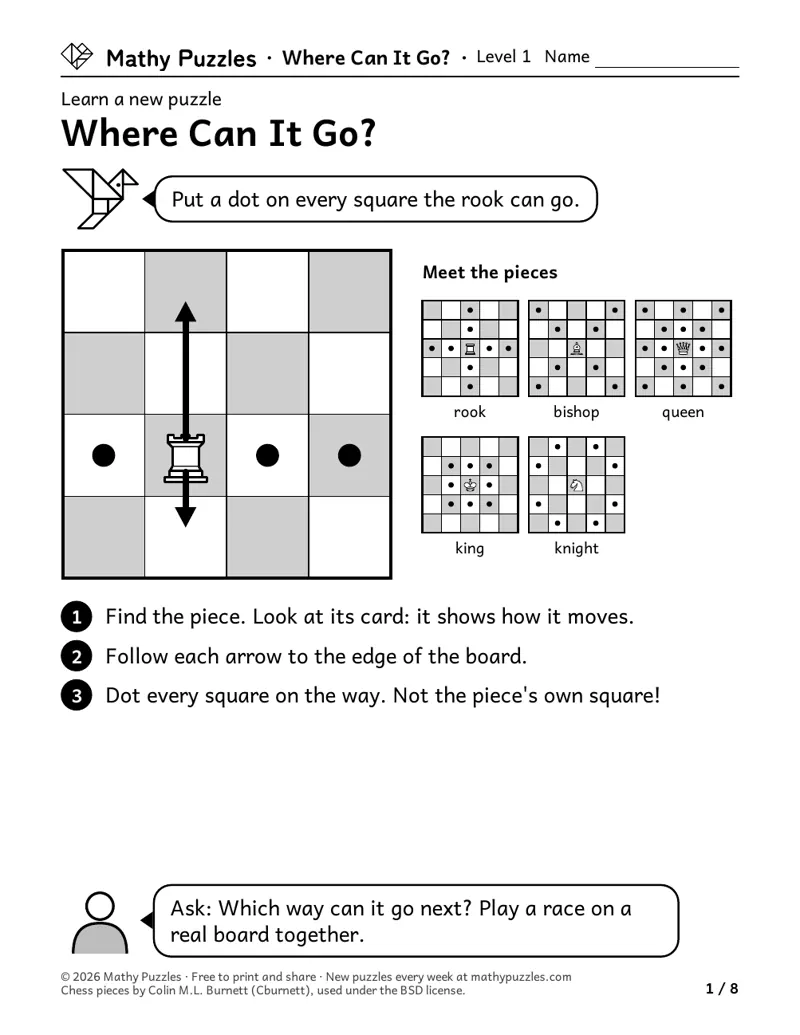
Worked example
From the Level 1 Learn sheet
- Find the piece. Look at its card: it shows how the piece moves.
- Follow each arrow all the way to the edge of the board.
- Dot every square on the way, but not the square the piece stands on.
A question to ask: “Which way can it go next?”
Free every Sunday A mixed bag of 20 new puzzles, all four levels. Get them by email
The thinking it works on
Following lines in space
Tracks a row, a column or a diagonal across the board.
Applying a rule
Uses the piece's card to decide which squares count.
Davidson and colleagues (2006) tested 325 people aged 4 to 13 and young adults. Even the 4-year-olds could hold a rule in mind and act on it, as long as the rule stayed the same. Switching between rules took much longer to develop. Source
Searching in an orderly way
Goes through every direction so none is missed.
English (1991) watched children aged about 4 to 9 make every pairing from two sets of items. The study found six ways of working, from picking at random to a method that holds one item fixed. Some children used that method by age 7. Source
Stopping at the right moment
Stops before a friend and on an enemy.
Klenberg, Korkman and Lahti-Nuuttila (2001) studied 400 Finnish children aged 3 to 12. Basic impulse control and holding back a response matured earliest, before selective attention and the more complex thinking skills. Source
Working backward from the result
Looks at the dots and names the piece that made them.
Counting and checking
Counts the dots and checks the total.
Among 255 children from kindergarten to grade 2, LeFevre and colleagues (2006) found that speed and accuracy at counting a set of objects rose with each grade. Source
Where is this thinking used?
- Board games: Knowing at a glance where a piece can travel.
- Maps and floor plans: Following a straight route from one place until something blocks it.
- Moving around a room: Seeing which paths are clear and which are cut off by furniture.
- Sports: Spotting the open lines a ball or a player can travel along.
For teachers
Curriculum areas
- Common Core
- Counting and cardinality: counting to answer "how many?" (Kindergarten), used at Level 2Level 1: No direct curricular match.
- NCERT
- No direct curricular match.
- National Curriculum (England)
- No direct curricular match.
- Cambridge Primary Mathematics
- No direct curricular match.
Math practices: see the box below.
Math practices this puzzle uses
- Not used: MP1 Make sense of problems and persevere in solving them
- Not used: MP2 Reason abstractly and quantitatively
- Not used: MP3 Construct viable arguments and critique the reasoning of others
- Not used: MP4 Model with mathematics
- Not used: MP5 Use appropriate tools strategically
- Uses: MP6 Attend to precision
- Uses: MP7 Look for and make use of structure
- Not used: MP8 Look for and express regularity in repeated reasoning
From the Common Core Standards for Mathematical Practice.
More Where Can It Go? puzzles for members
Members get at least 5 more worksheets at each difficulty for every puzzle, 80 new puzzles every Sunday, and the whole archive. $39 a year or $25 for 6 months.
See membershipNot ready yet?
One email, all four levels: 20 puzzles, 5 for each level.
For grown-ups (18+). One email every Sunday with the puzzles and the odd note about membership; unsubscribe any time. We never ask about your child. How we use your email