
Twin Drawings
Copying a drawing well is mostly counting: this line starts two dots in and ends three dots down. Get every start and end right and the copy matches, wobbles and all.
Free sets by level, ages 4–8:
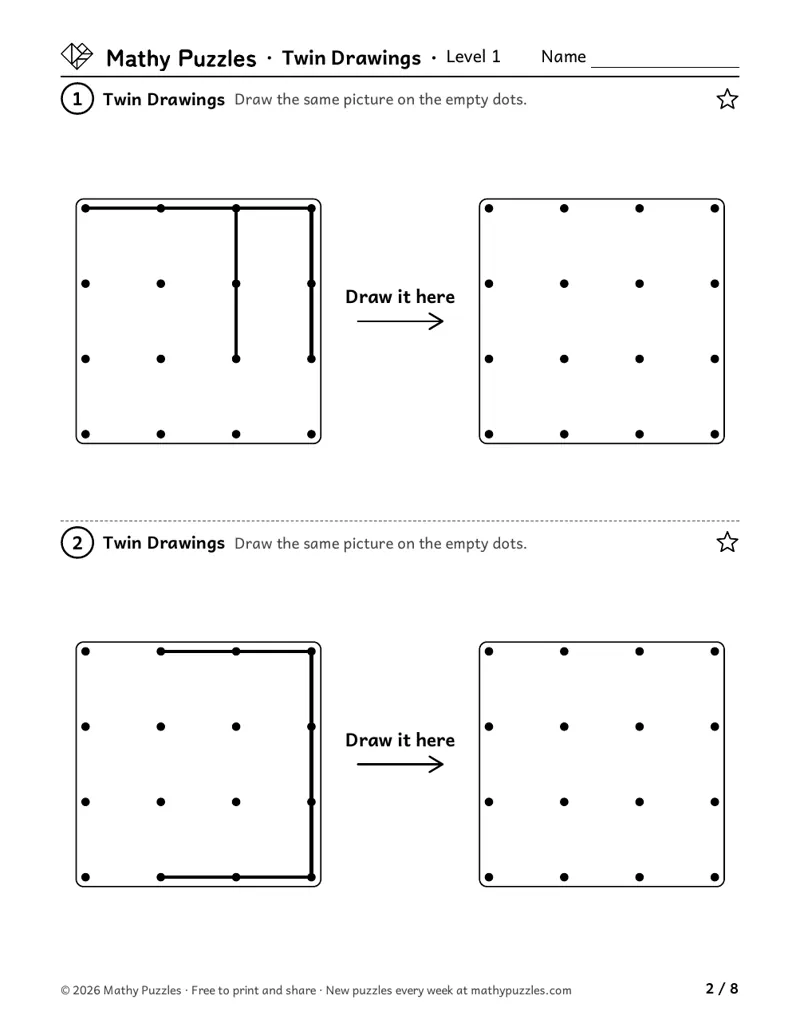 Level 1: a page from the free set
Before starting
- Count to 5 (Level 1) or to 12 (Level 2)
- Draw a line from one dot to another
- Know across, up and down
What you need
A ruler if your child likes one, and a sharp pencil with an eraser.
Free puzzles to print
Each set: a Learn sheet with a worked example, 10 puzzles from easiest to hardest, and the answers.
Level 1
Ages 4–6 · Pre-K–K
The easiest puzzles: a grid of 4 dots on a side and 3 or 4 lines. All go straight across or up and down, joined in one drawing.
The middle puzzles: 5 dots on a side, 5 or 6 lines, with exactly one slanted line.
The hardest puzzles: 6 dots on a side, 7 to 9 lines, at least two slanted, and at least one closed shape such as a triangle.
On the sheet: “Draw the same picture on the empty dots.”
Print Level 1 (Letter)Other paper size: A4Level 2
Ages 6–8 · Grades 1–2
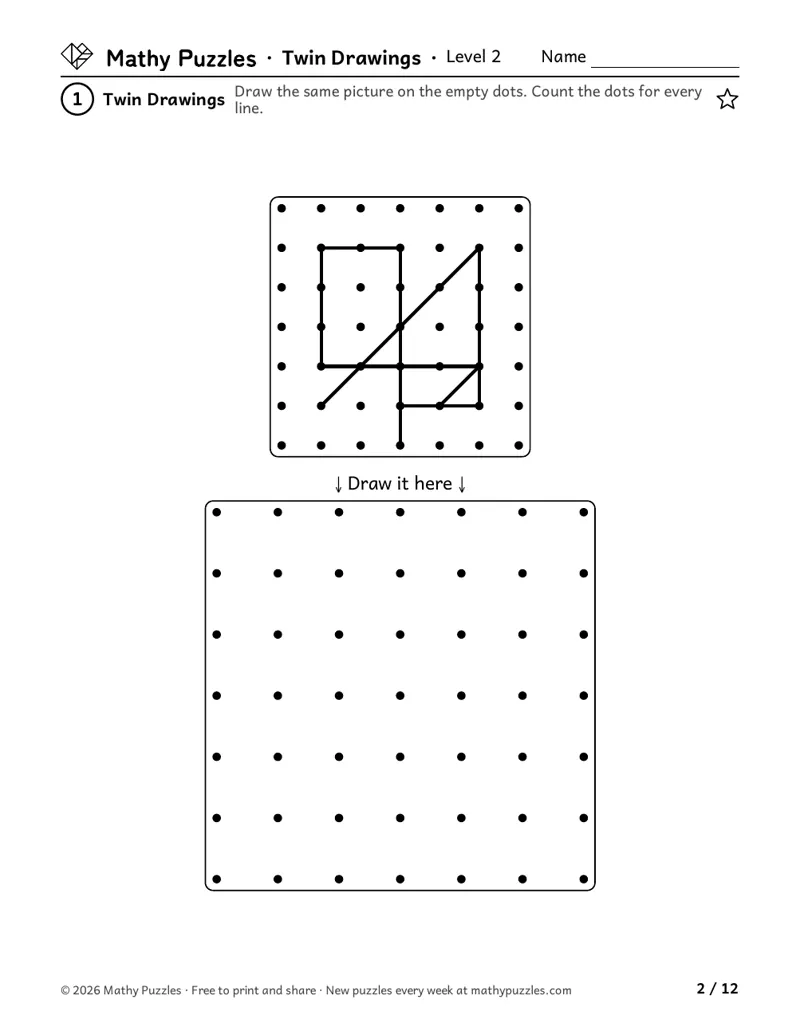
The easiest puzzles: 7 dots on a side, 8 to 10 lines, some slanted corner to corner.
The middle puzzles: steep slants that go 2 dots one way and 1 dot the other.
The harder puzzles: 12 to 16 lines, more steep slants and at least one closed shape.
The hardest puzzles: a small drawing copied twice as big, so every line is twice as long.
On the sheet: “Draw the same picture on the empty dots.”
Print Level 2 (Letter)Other paper size: A4
How it works
Each puzzle shows a drawing made of straight lines on a grid of dots, beside an empty dot grid the same size. The child copies the drawing dot for dot, so every line starts and ends in the same place. Some drawings are pictures, such as a flag or a house with one unusual detail; others are simple line patterns. At Level 2 the grid is bigger and some lines are steep (two dots one way for one dot the other). In the hardest puzzles a small drawing is copied twice as big.
How to play
- Pick one line in the drawing. Put a finger on its start.
- Count dots across and down to find the same dot on the empty grid.
- Draw the line to the same end dot.
- Go line by line, then check that the two pictures match.
- Twice as big? Count the dots for a line, then go twice as many on your grid.
When it gets hard
Drawing from memory ("a house") instead of copying.
Hint: Each picture has one unusual detail. Copy what you see, line by line.
Starting a line one dot off.
Hint: Count from a corner of the grid: across first, then down.
A slanted line that misses its dot.
Hint: A slant goes one dot over for each dot down; a steep one goes 2 over for 1 down, or 1 over for 2 down. Count as you draw.
Tip for grown-ups: Ask "How many dots across did that line go?" rather than pointing to the right dot. A ruler helps with long lines, but freehand is fine.
Frequently asked questions
- Does a wobbly line count as right?
- Yes, if it starts and ends at the right dots. Neat lines come with practice; the puzzle is about putting each line in the right place.
- Why does the house have a strange door?
- Each familiar picture has one unusual detail, such as a door off to one side, so a child who draws a house from memory sees the difference. It keeps the copying careful.
Questions about printing, levels, answers or membership: see all questions.
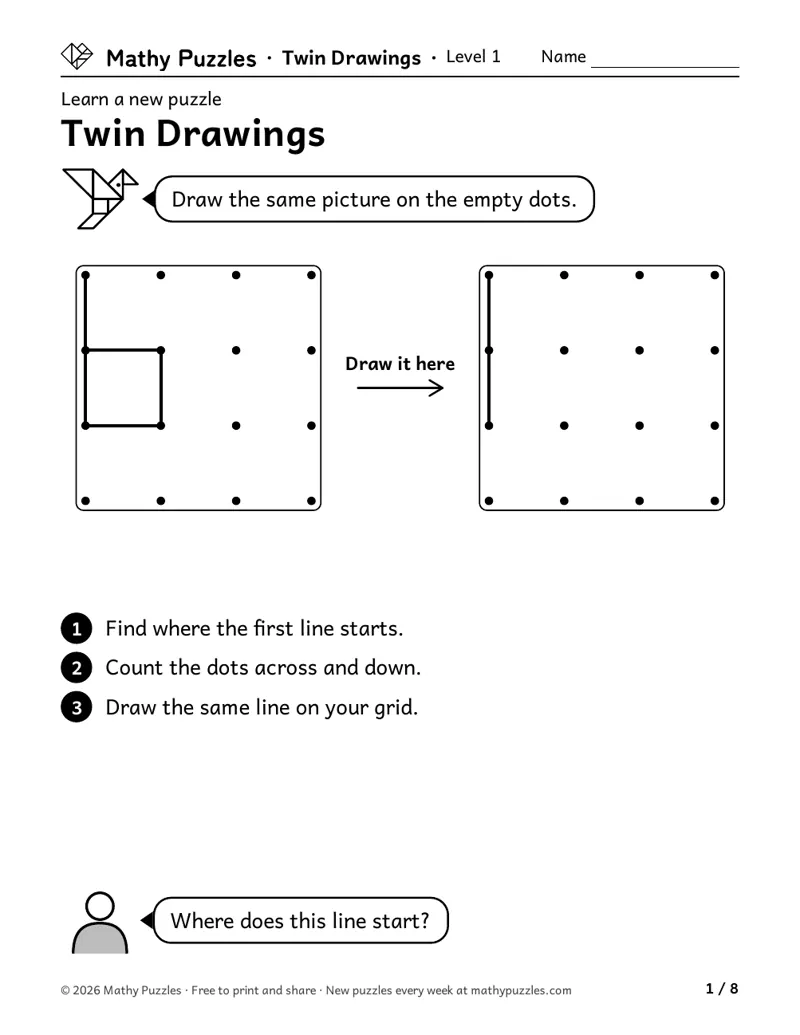
Worked example
From the Level 1 Learn sheet
- Find where the first line starts.
- Count the dots across and down.
- Draw the same line on your grid. The first one is already drawn.
- Do the same for every line, dot to dot.
A question to ask: “Where does this line start?”
Free every Sunday A mixed bag of 20 new puzzles, all four levels. Get them by email
The thinking it works on
Eye and hand together
Turns what the eyes see into pencil lines.
Weil and Amundson (1994) tested 60 kindergartners aged 5 years 4 months to 6 years 3 months. Those who could copy more of the shapes on a drawing test also copied letters more legibly. Source
Finding a place on a grid
Finds the same dot by counting across and down.
Somerville and Bryant (1985) found that children aged 4 to 6 could find the one point that lined up with two markers, one across and one down. Five- and 6-year-olds did extremely well even with 16 points to choose from. Source
Holding a line in mind
Remembers a line's start and end while drawing it.
Simmering (2012) found that visual working memory grows roughly in a straight line in early childhood. It goes from 2 or 3 items at ages 3 to 4 to 3 or 4 items at ages 5 to 7. Source
Seeing a picture as parts
Sees the picture as separate straight lines.
Stiles and Tada (1996) found that preschool children copying simple forms in two mediums began with the simplest, separate parts. With age, they reproduced more complex parts and the relations between them. Source
Checking one's own work
Compares the two drawings and fixes a line that's off.
Lyons and Ghetti (2011) found that even 3-year-olds reported less confidence in their wrong answers than in their right ones. Children aged 3 to 5 told the two apart better with age. Source
Doubling lengths
Draws each line twice as long and keeps the picture's shape.
Boyer, Levine and Huttenlocher (2008) found that children from kindergarten to grade 4 matched proportions well with smooth amounts. With countable units they often went wrong, matching the number instead. Source
Where is this thinking used?
- Copying from the board: A letter, a number or a diagram is copied into a notebook.
- Grid maps: A place is found by counting squares across and down.
- Crafts: A cross-stitch or beading pattern is followed stitch by stitch.
- Building from a picture: A block design is copied from a drawing.
For teachers
Curriculum areas
- Common Core
- Geometry: drawing shapes (Kindergarten)Level 2: No direct curricular match.
- NCERT
- Foundational stage: drawing, copying patterns and position words (pre-primary); straight and slanted lines (Class 2)
- National Curriculum (England)
- Early years mathematics: spatial reasoning (Reception); Geometry: drawing 2-D shapes (Year 3)
- Cambridge Primary Mathematics
- No direct curricular match.
Math practices: see the box below.
Math practices this puzzle uses
- Not used: MP1 Make sense of problems and persevere in solving them
- Not used: MP2 Reason abstractly and quantitatively
- Not used: MP3 Construct viable arguments and critique the reasoning of others
- Not used: MP4 Model with mathematics
- Not used: MP5 Use appropriate tools strategically
- Uses: MP6 Attend to precision
- Not used: MP7 Look for and make use of structure
- Not used: MP8 Look for and express regularity in repeated reasoning
From the Common Core Standards for Mathematical Practice.
More Twin Drawings puzzles for members
Members get at least 5 more worksheets at each difficulty for every puzzle, 80 new puzzles every Sunday, and the whole archive. $39 a year or $25 for 6 months.
See membershipNot ready yet?
One email, all four levels: 20 puzzles, 5 for each level.
For grown-ups (18+). One email every Sunday with the puzzles and the odd note about membership; unsubscribe any time. We never ask about your child. How we use your email