
Coordinate Pictures
To find your seat at a show, you need a row and a seat number; either one alone isn't enough. Each point here works the same way, two values for one spot. Join the spots in order and a picture turns up.
Free sets by level, ages 8–10:
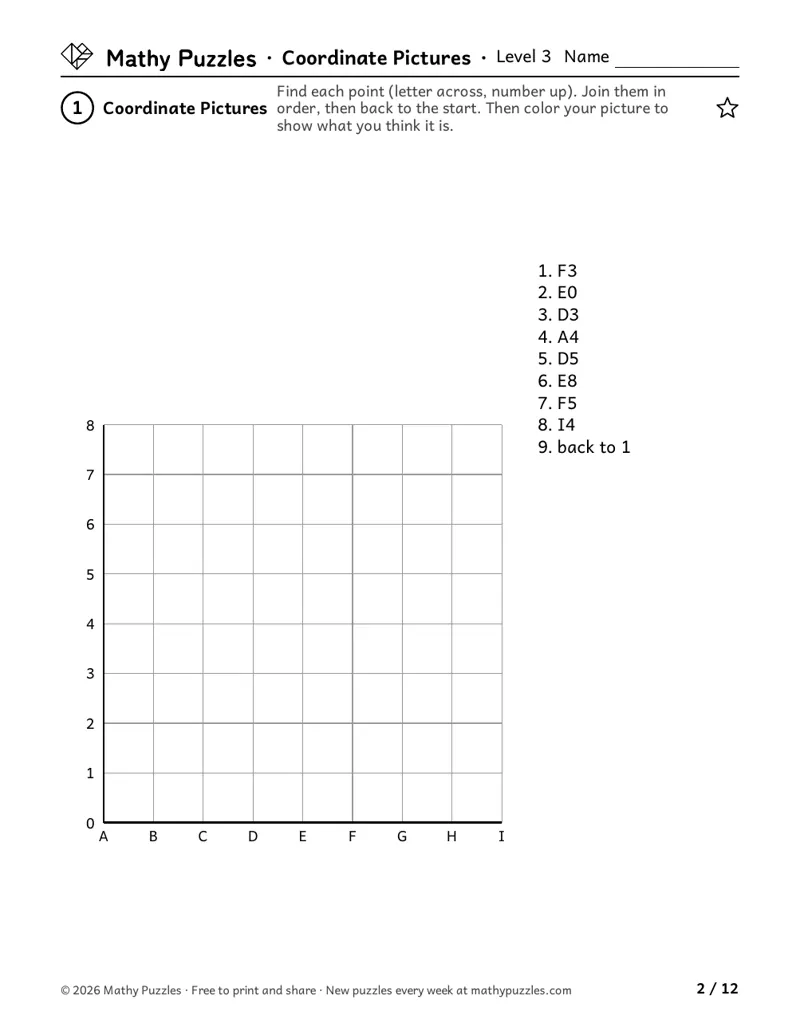 Level 3: a page from the free set
Before starting
- Read numbers to 16
- Know which way is across and which is up
- Use a ruler to join two points
What you need
A ruler for joining the points, colored pencils to finish the picture, and a sharp pencil.
Free puzzles to print
Each set: a Learn sheet with a worked example, 10 puzzles from easiest to hardest, and the answers.
Level 3
Ages 8–10 · Grades 3–4
The easiest puzzles: map-style points like "C4" (letter across, number up) on a small grid.
The middle puzzles: number pairs (x, y) on a 0–8 grid.
The harder puzzles: number pairs on a grid twice as big, with up to 30 points.
The hardest puzzles: a picture with a hole, such as a window. Join the outline, lift the pencil, then join a second list for the hole; up to 40 points in all.
On the sheet: “Plot the points and join them in order. What is it?”
Print Level 3 (Letter)Other paper size: A4
How it works
Each puzzle has a grid with labeled lines and a list of points. The child finds each point on the grid, marks it, and joins the points in order. When the last point joins the first, the picture is complete.
How to play
- Read the first point. Go across first, then up.
- Put a small dot where the two lines cross.
- Find the next point and join it to the last one with a ruler.
- Keep going down the list. Join the last point back to the first. What is the picture?
When it gets hard
Going up first, then across.
Hint: Say it like walking into a building: along the hall first, then up the stairs.
Putting dots in the squares instead of where lines cross.
Hint: Every point sits on a crossing of two lines.
Joining points out of order, so the picture looks scrambled.
Hint: Check off each point in the list as you draw it.
Tip for grown-ups: If the picture looks wrong, cover all but the last few points in the list. Check them one at a time; one swapped pair is the usual cause. A ruler keeps the joining lines straight, and coloring the finished picture is the reward.
Frequently asked questions
- Across first, or up first?
- Across first, then up. The first puzzles use a letter for across and a number for up, which makes the order hard to mix up.
- Can my child do these without a ruler?
- Yes, on the small grids; a wobbly line still shows the picture. On the bigger grids a ruler keeps the picture clean, and using one is good practice.
Questions about printing, levels, answers or membership: see all questions.
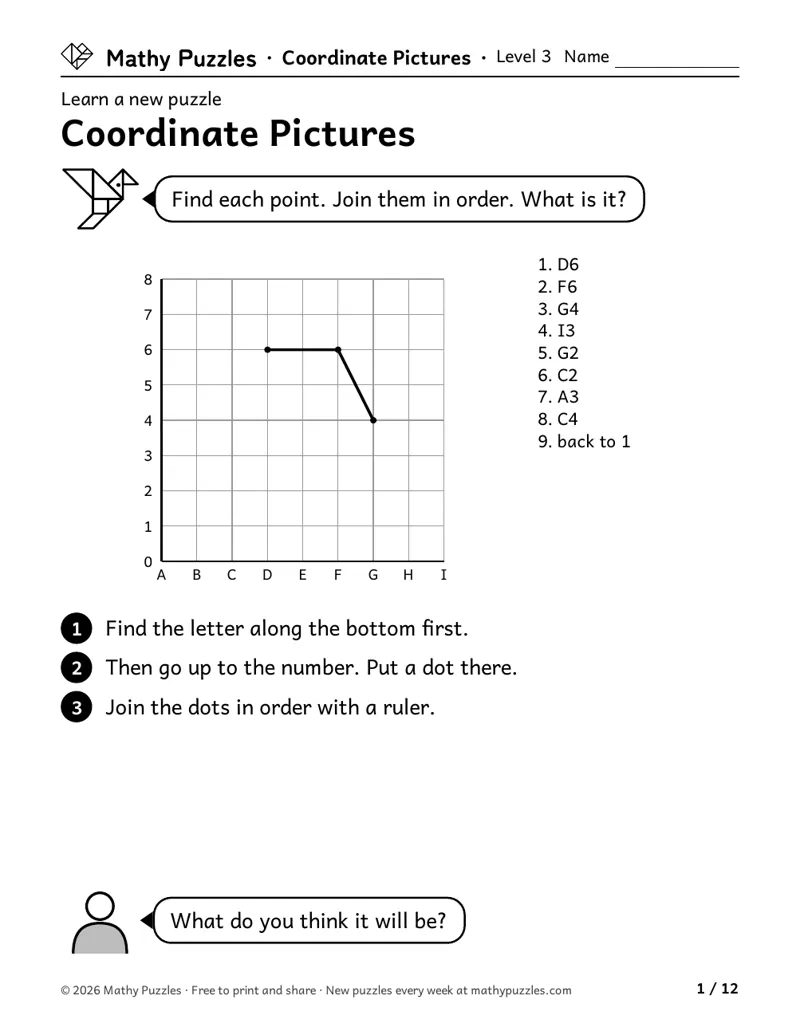
Worked example
From the Level 3 Learn sheet
- Find the letter along the bottom first.
- Then go up to the number. Put a dot there.
- Join the dots in order with a ruler.
A question to ask: “What do you think it will be?”
Free every Sunday A mixed bag of 20 new puzzles, all four levels. Get them by email
The thinking it works on
Reading a position from two directions at once
Runs a finger across, then up, and marks where the two meet.
Lidster and Bremner (1999) found that most 4- and 5-year-olds could set up two markers to show where something was hidden. They did less well reading markers someone else had placed. Source
Seeing the grid as lines, not boxes
Treats the grid as two number lines that cross, not as boxes.
Fourth graders found it hard to read grid parts as lines rather than regions. Children who could tell apart and join the two numbers of a pair did best. Source
Following an ordered list without skipping
Works down the list in order, joining each point to the last.
Gathercole and colleagues (2004) found that working memory grows roughly in a straight line from age 4 to 15. Here it holds 'where am I in the list' while the next point is found. Source
Checking and fixing errors
Uses a stray line as a clue to find the misplaced point.
Checking one's own work (monitoring) gets stronger steadily through childhood, according to a review linking it with self-control skills. Source
Working with care and precision
Places each dot exactly on the crossing and joins with a ruler.
Sarama and colleagues (2003) observed that fourth graders working on grids often had trouble pinning down an exact location. Source
Where is this thinking used?
- Maps and seats: A street map, a theater seat or a spreadsheet cell is found by two values.
- Games on a grid: Many board games name a square by a letter and a number.
- Computer graphics and games: Every shape on screen is a list of points.
For teachers
Curriculum areas
- Common Core
- Geometry: points on a grid named by a pair of numbers (Grade 5, looks ahead)
- NCERT
- Rows and columns on a grid (Class 4); maps with number-pair positions (Class 5)
- National Curriculum (England)
- Geometry – position and direction: coordinates in the first quadrant, plotting points to complete a shape (Year 4)
- Cambridge Primary Mathematics
- Geometry and measure: reading and plotting coordinates, joining points to make shapes (Stages 4–5)
Math practices: see the box below.
Math practices this puzzle uses
- Not used: MP1 Make sense of problems and persevere in solving them
- Not used: MP2 Reason abstractly and quantitatively
- Not used: MP3 Construct viable arguments and critique the reasoning of others
- Not used: MP4 Model with mathematics
- Uses: MP5 Use appropriate tools strategically
- Uses: MP6 Attend to precision
- Not used: MP7 Look for and make use of structure
- Not used: MP8 Look for and express regularity in repeated reasoning
From the Common Core Standards for Mathematical Practice.
More Coordinate Pictures puzzles for members
Members get at least 5 more worksheets at each difficulty for every puzzle, 80 new puzzles every Sunday, and the whole archive. $39 a year or $25 for 6 months.
See membershipNot ready yet?
One email, all four levels: 20 puzzles, 5 for each level.
For grown-ups (18+). One email every Sunday with the puzzles and the odd note about membership; unsubscribe any time. We never ask about your child. How we use your email