
Move It
Move a sofa across a room by pushing one end, and it ends up crooked. Moving a shape on a grid is the same: slide, flip or turn every corner by the same rule, and the whole shape lands where it should.
Free sets by level, ages 10–12:
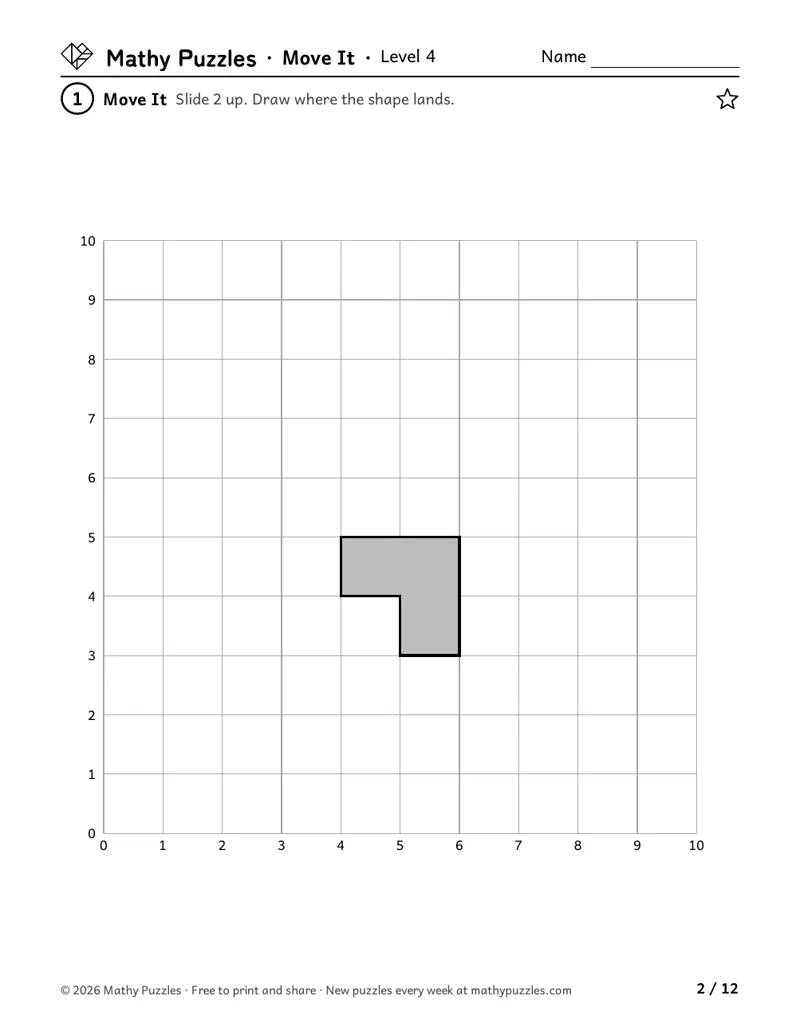 Level 4: a page from the free set
Before starting
- Read a point on a grid from its two numbers
- Know left, right, up and down; clockwise and counterclockwise
- Draw straight lines between dots
What you need
Paper and scissors to cut out the shape for checking, and a sharp pencil with an eraser.
Free puzzles to print
Each set: a Learn sheet with a worked example, 10 puzzles from easiest to hardest, and the answers.
Level 4
Ages 10–12 · Grades 5–6
The easiest puzzles: one move on a 10 × 10 grid: a slide, a flip over a line, or a quarter turn about a dot. Draw where the shape lands.
Next: two moves in a row; draw where the shape ends up.
Then: the two moves are hidden. Shape A and where it landed (B) are shown; which one move does the same job? Three choices.
The hardest puzzles: which two moves, in order, took A to B? Four choices, and the wrong ones are near misses. They have the right moves in the wrong order, a mirror or turned copy of B, or a pair off by one square.
On the sheet: “Draw where the shape lands.”
Print Level 4 (Letter)Other paper size: A4
How it works
A shape sits on a numbered square grid. The sheet says how to move it: slide it so many squares, flip it over a line, or turn it a quarter turn about a marked point. The child draws where it lands. Harder puzzles use two moves in a row, or work backward from where the shape ended up.
How to play
- Read the move written with the puzzle.
- Move one corner at a time and mark where each one lands.
- Join the marks to draw the shape in its new place.
- For two moves, do the first move fully, then the second from there.
When it gets hard
Turning the wrong way.
Hint: Draw a small curved arrow by the dot first. Clockwise goes the way clock hands move.
Flipping over the wrong line, or measuring from the shape's edge instead of each corner.
Hint: Count squares from each corner to the line, then the same number past it.
Doing two moves in the wrong order.
Hint: Draw the shape after the first move lightly, then move that drawing.
Tip for grown-ups: Cut the shape out of paper and let your child slide, flip and turn it on the grid to check a drawing. Then try the next one without the cut-out.
Frequently asked questions
- Is this the same as what my child will learn in grade 8?
- It is an early look. Grade 8 describes slides, flips and turns with coordinates in full. Here the child draws them on a grid and counts squares, which is the hands-on start.
- Can my child use a ruler and tracing paper?
- Yes. A ruler helps keep lines straight. Tracing paper is a good way to check a turn after the drawing is done, not before.
Questions about printing, levels, answers or membership: see all questions.
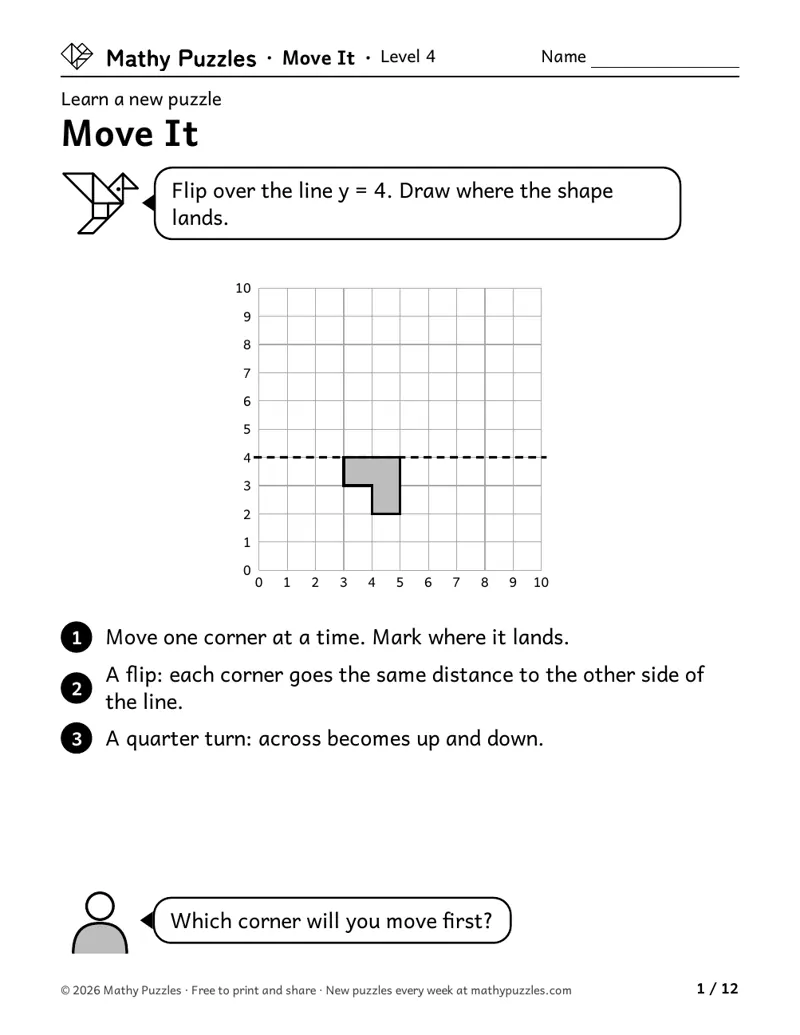
Worked example
From the Level 4 Learn sheet
- Read the move: a slide, a flip over a dashed line, or a quarter turn about a dot.
- Pick one corner of the shape. Move just that corner and mark where it lands.
- For a flip, each corner goes the same distance to the other side of the line. For a quarter turn, a step across becomes a step up or down.
- Move every corner the same way, then join the marks in order. Check the new shape is the same size as the old one.
A question to ask: “Which corner will you move first?”
Free every Sunday A mixed bag of 20 new puzzles, all four levels. Get them by email
The thinking it works on
Turning a shape in the mind
Turns a shape a quarter turn in the mind before drawing it.
Van Tetering and colleagues (2019) gave 729 children aged 7 to 12 a paper test of turning block figures in the mind. Children in grades 5 and 6 scored clearly higher than those in grades 2 to 4. Source
Telling mirror images from turns
Knows a flip makes a mirror image that no turn can make.
Kail (1991) found that 9- and 10-year-olds, like adults, turned a letter in the mind to decide whether it was normal or mirror-reversed. They did so even while remembering other things. Source
Reading points on a grid
Reads and plots points from two numbers.
In a study of fourth graders learning about grids, the children who did best could keep the two numbers of a pair apart, then use them together. Source
Holding steps in order
Keeps the result of one move in mind while doing the next.
Gathercole and colleagues (2004) found that the ability to hold one result in mind while working on the next grows steadily from age 4 to 15. Source
Checking what a move can't change
Uses what a move cannot change to catch errors.
Roebers (2017) reviews evidence that children get steadily better through the school years at checking their own answers against what they know must be true. Source
Where is this thinking used?
- Reading a map: A route is a list of moves: so many blocks east, then a turn.
- Arranging furniture on a floor plan: A piece is slid, turned or flipped to fit a space.
- Laying out tiles and patterns: One shape is repeated by sliding, turning and flipping it.
- Following a dance or drill: Each step moves you from one spot to the next, in order.
For teachers
Curriculum areas
- Common Core
- Geometry: graphing points on the coordinate grid (Grade 5); a first look at slides, flips and turns, which Grade 8 covers in full
- NCERT
- Grid positions and moves (Class 5); symmetry, including turning a shape about a point (Class 6)
- National Curriculum (England)
- Geometry – position and direction: translating and reflecting shapes on a grid (Years 5–6); translations, rotations and reflections (Key Stage 3)
- Cambridge Primary Mathematics
- Geometry and measure: sliding, reflecting and turning shapes on a grid (Stages 5–6)
Math practices: see the box below.
Math practices this puzzle uses
- Not used: MP1 Make sense of problems and persevere in solving them
- Not used: MP2 Reason abstractly and quantitatively
- Not used: MP3 Construct viable arguments and critique the reasoning of others
- Not used: MP4 Model with mathematics
- Not used: MP5 Use appropriate tools strategically
- Uses: MP6 Attend to precision
- Uses: MP7 Look for and make use of structure
- Not used: MP8 Look for and express regularity in repeated reasoning
From the Common Core Standards for Mathematical Practice.
More Move It puzzles for members
Members get at least 5 more worksheets at each difficulty for every puzzle, 80 new puzzles every Sunday, and the whole archive. $39 a year or $25 for 6 months.
See membershipNot ready yet?
One email, all four levels: 20 puzzles, 5 for each level.
For grown-ups (18+). One email every Sunday with the puzzles and the odd note about membership; unsubscribe any time. We never ask about your child. How we use your email