
Repeat Loops
A dance teacher doesn't say "step, clap, step, clap, step, clap"; they say "step and clap, three times". Repeat Loops asks the child to spot the part of a robot's path that repeats, and write it once with a number.
Free sets by level, ages 6–10:
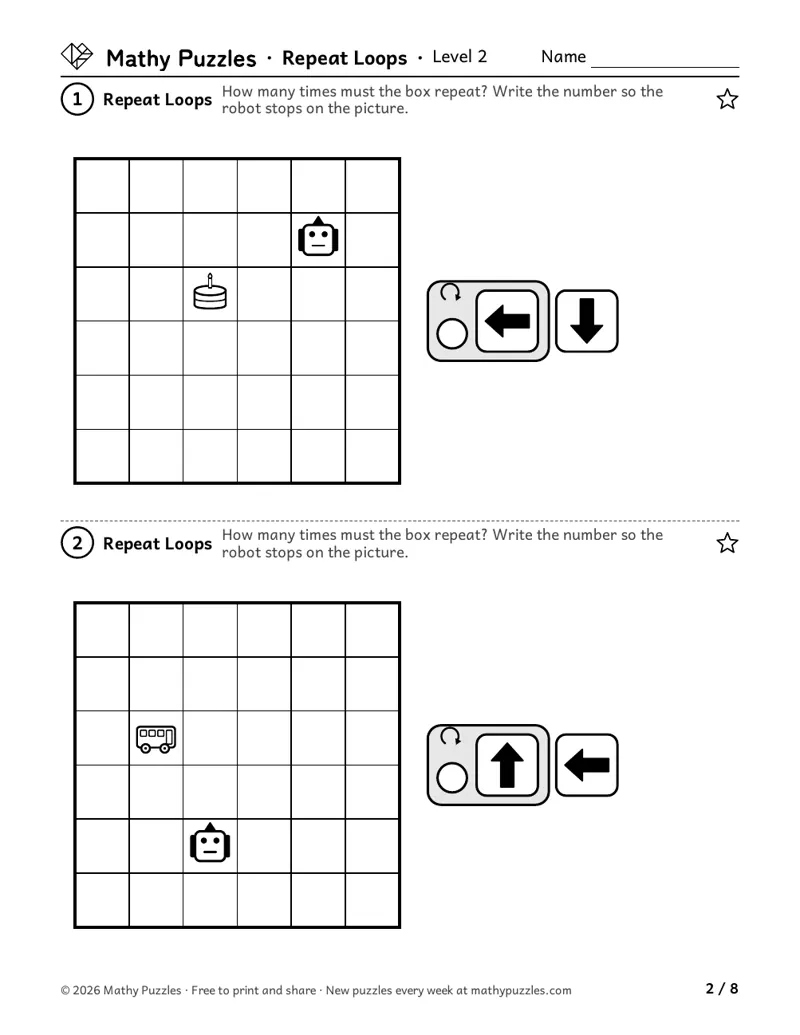 Level 2: a page from the free set
Before starting
- Level 2: follow a program of arrow cards on a grid
- Count to 5
- Level 3: forward, turn left and turn right cards
What you need
A colored pencil to circle each repeat on the path, and a pencil for the boxes.
Free puzzles to print
Each set: a Learn sheet with a worked example, 10 puzzles from easiest to hardest, and the answers.
Level 2
Ages 6–8 · Grades 1–2
(arrow cards on a small grid with rocks): fill only the number. Then the number and the two cards of a stair pattern. Then every blank, with a card before and after the box. The hardest puzzles print a long program and ask the child to write it again with the fewest cards, using one repeat box.
On the sheet: “Fill in the blanks so the robot stops on the picture. The cards in the box repeat.”
Print Level 2 (Letter)Other paper size: A4Level 3
Ages 8–10 · Grades 3–4
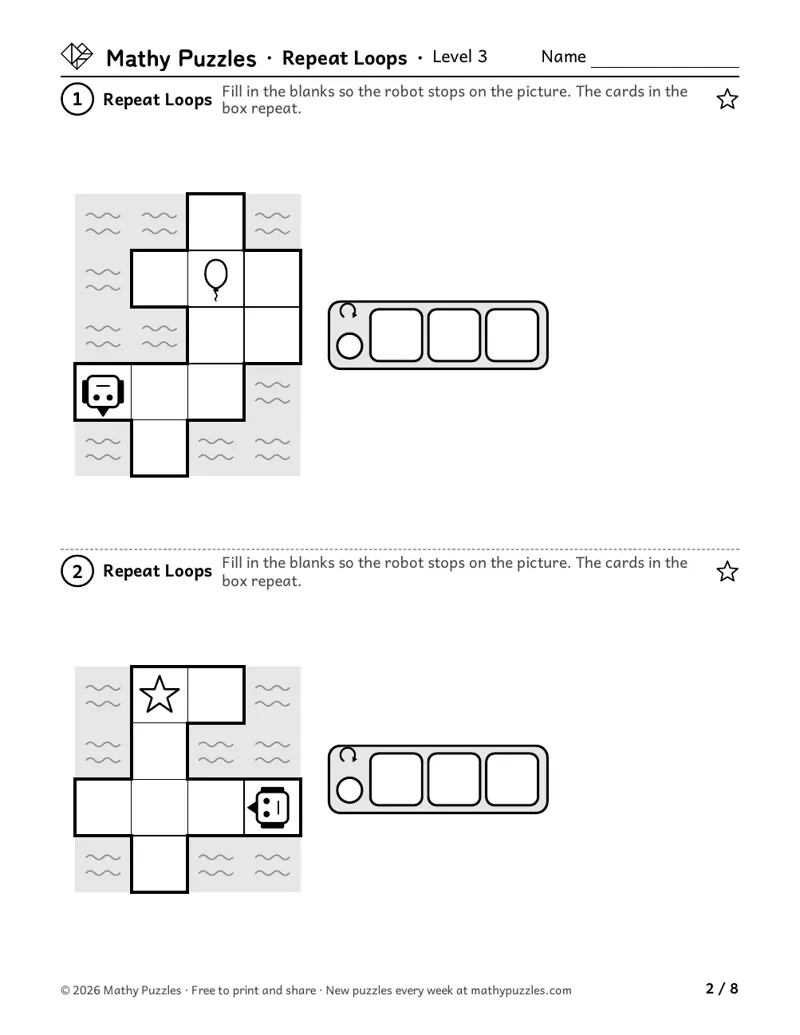
(turn cards on path-shaped boards): a box of three cards and its number to fill, then four cards. Then a box inside a box (forward a few times, then turn, all repeated). The hardest puzzles print a long program of 12 to 22 cards to write again with a box inside a box. Numbers run from 2 to 4.
On the sheet: “Fill in the blanks so the robot stops on the picture. The cards in the box repeat.”
Print Level 3 (Letter)Other paper size: A4
How it works
Each program has a repeat box: the cards inside the box run again and again, as many times as the number beside it says. Some cards and numbers are left blank. The child finds the part of the path that repeats and fills the blanks so the robot stops on the picture. Level 2 uses arrow cards; Level 3 uses forward and turn cards.
How to play
- Trace the path from the robot to the picture.
- Find a piece of the path that comes again and again, such as right, up, right, up.
- Write that piece in the box once, and the number of times in the circle.
- Run your program: do the whole box, then do it again, until the number is used up.
When it gets hard
Writing the number of squares instead of the number of repeats.
Hint: The number says how many times the whole box runs. Count the circles, not the squares.
Running only the last card of the box again.
Hint: Each time the box runs, go back to its first card.
At Level 3, losing track of a box inside a box.
Hint: Finish the small box completely every time before the next card of the big box.
Tip for grown-ups: Clap a pattern (clap, clap, stomp) three times, then ask your child how to say it in fewer words. "Clap, clap, stomp, three times" is a repeat box.
Frequently asked questions
- Is this a pattern puzzle or a coding puzzle?
- Both. It uses the same eye for patterns as a picture pattern, but here the pattern is in the robot's moves. The child also counts how many times it repeats and writes it as one box, which is how a loop works in code.
- What if my child writes out every move instead?
- In most puzzles the boxes are printed, so the child only fills the blanks. In the rewrite puzzles the long program is already on the page, and the job is to write it shorter. Ask: which part is written more than once?
Questions about printing, levels, answers or membership: see all questions.
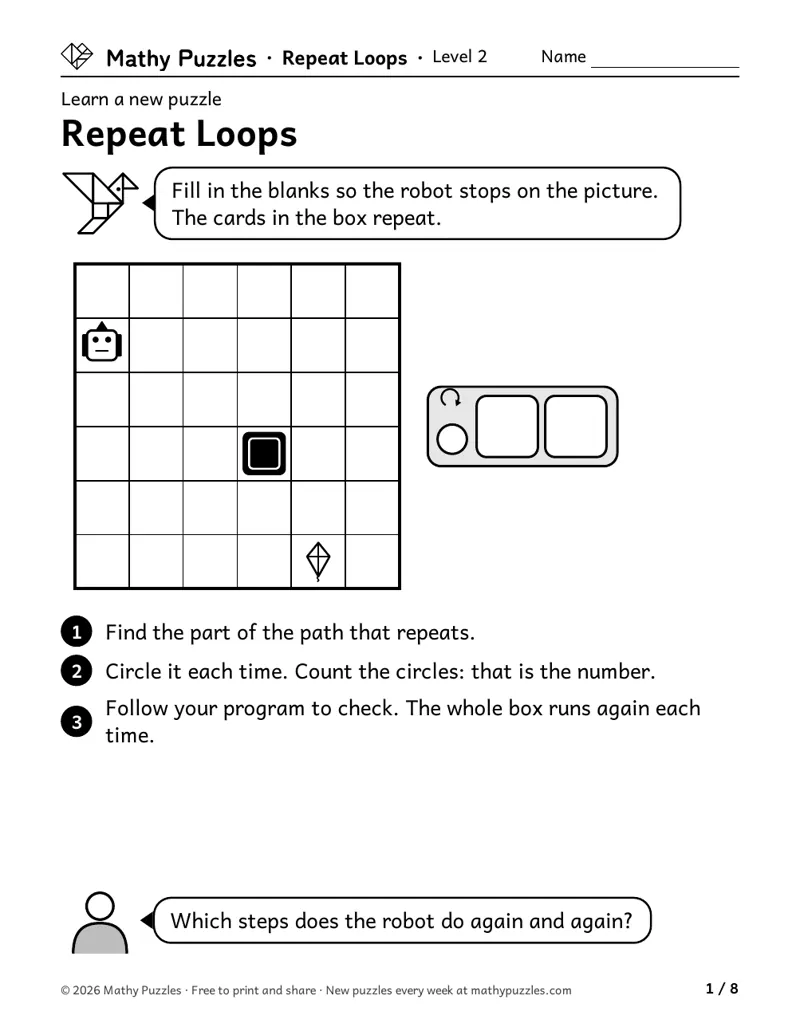
Worked example
From the Level 2 Learn sheet
- Find the part of the path that repeats.
- Circle it each time it comes. Count the circles: that is the number.
- Follow your program to check. The whole box runs again each time.
A question to ask: “Which steps does the robot do again and again?”
Free every Sunday A mixed bag of 20 new puzzles, all four levels. Get them by email
The thinking it works on
Spotting a repeating pattern
Finds the piece of the path that comes again and again.
Mulligan and Mitchelmore (2009) studied 103 first graders. Noticing pattern and structure showed up across many kinds of math task and went with general math understanding. Source
Counting equal groups
Counts how many times the piece repeats.
Mulligan and Mitchelmore (1997) followed girls through grades 2 and 3. They found three main ways of working out multiplication problems: counting one by one, adding the same number again, and multiplying. Source
Saying more with less
Writes the repeating piece once, with a number.
Keeping count while running a loop
Knows which pass of the box the robot is on.
Vourletsis (2026) gave 517 children in grades 1 to 3 a paper test of coding ideas. They did best on step-by-step sequences and less well on loops, and the gap between the two was statistically clear. Source
A pattern inside a pattern
Sees a small repeat inside a big one.
Where is this thinking used?
- Music: A chorus written once with "repeat 3 times" above it.
- Crafts: A bead or knitting pattern repeated down a whole bracelet or scarf.
- Exercise: Three sets of ten jumps, written as one line.
- Programming: A loop in code that runs the same steps again and again.
For teachers
Curriculum areas
- Common Core
- Operations and algebraic thinking: equal groups (Grade 3)Level 2: No direct curricular match.
- NCERT
- Joyful Mathematics (Class 2): counting in groups; Maths Mela: Equal Groups (Class 4) and weaving patterns that repeat (Class 5)
- Computer science (CSTA)
- Programs with loops, including a loop inside a loop (algorithms and programming, ages 5–14)
- National Curriculum (England)
- Geometry – position and direction: movement and turns (Year 2); multiplication as repeated addition (Year 2); angles as turns (Year 3)
- Cambridge Primary Mathematics
- Geometry and measure: movement and turns (Stages 2–3); Number: multiplication as repeated addition (Stage 2)
Math practices: see the box below.
Math practices this puzzle uses
- Not used: MP1 Make sense of problems and persevere in solving them
- Not used: MP2 Reason abstractly and quantitatively
- Not used: MP3 Construct viable arguments and critique the reasoning of others
- Not used: MP4 Model with mathematics
- Not used: MP5 Use appropriate tools strategically
- Not used: MP6 Attend to precision
- Uses: MP7 Look for and make use of structure
- Uses: MP8 Look for and express regularity in repeated reasoning
From the Common Core Standards for Mathematical Practice.
More Repeat Loops puzzles for members
Members get at least 5 more worksheets at each difficulty for every puzzle, 80 new puzzles every Sunday, and the whole archive. $39 a year or $25 for 6 months.
See membershipNot ready yet?
One email, all four levels: 20 puzzles, 5 for each level.
For grown-ups (18+). One email every Sunday with the puzzles and the odd note about membership; unsubscribe any time. We never ask about your child. How we use your email