
Robo Tricks
A recipe might say "make the sauce (see page 12)" instead of writing it all out again. Robo Tricks gives the robot a helper like that, called F1, so a short program can steer it along a long path. Level 4 adds cards that only work on matching squares.
Free sets by level, ages 8–12:
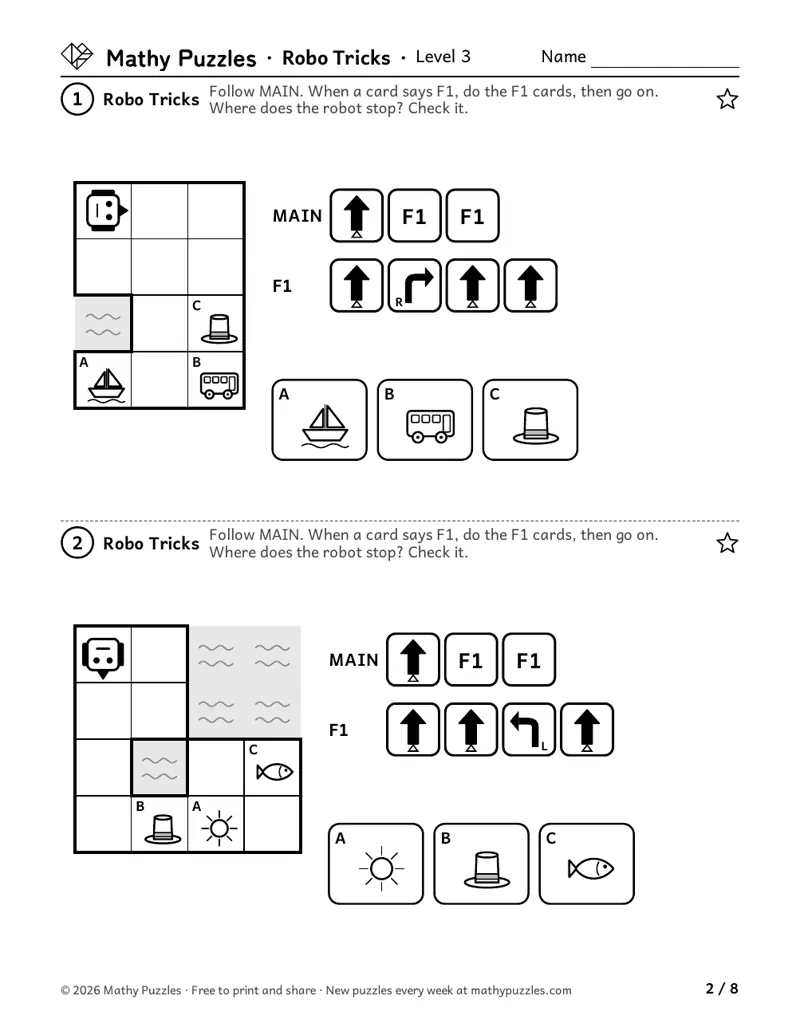 Level 3: a page from the free set
Before starting
- Forward, turn left and turn right cards (Follow the Arrows Level 2 or Write the Program Level 3)
- Following a program with a finger
- Repeat Loops helps but is not needed
- F1, a named little program (Robot Helpers is a good start)
- Reading a short rule with "only when"
What you need
Scrap paper to try a helper before writing it in, and a pencil with an eraser.
Free puzzles to print
Each set: a Learn sheet with a worked example, 10 puzzles from easiest to hardest, and the answers.
Level 3
Ages 8–10 · Grades 3–4
First, MAIN (3 cards) and F1 (3 or 4 cards) are printed and the child traces where the robot stops. Then the child fills 3 MAIN boxes and 4 F1 boxes, with two or three apples to pick up. Next come 4 MAIN boxes, where a move or turn of MAIN's own sits before or between the F1 calls. The hardest puzzles have 5 MAIN boxes and three apples. F1 is called two or three times, with loose cards around the calls, and one apple sits on a square that only one of MAIN's own cards reaches.
On the sheet: “Fill in MAIN and F1. Pick up every apple and stop on the picture.”
Print Level 3 (Letter)Other paper size: A4Level 4
Ages 10–12 · Grades 5–6
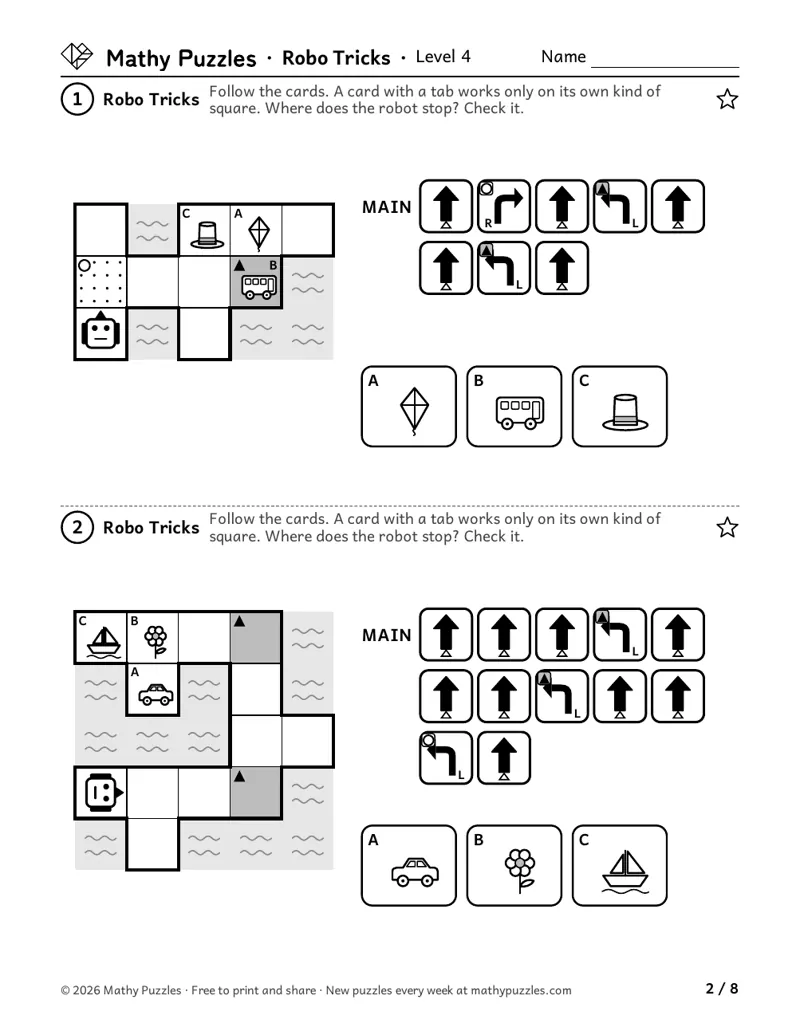
First, a printed program with 'if' cards; the child finds where the robot stops, skipping cards whose tab doesn't match the square. Then the child writes a 2-card F1 that repeats, with one kind of tile. Next comes a 3-card F1 with both kinds of tile. Here more than one order can work, and every working order walks the same path. The hardest puzzles have 4 cards, where the order decides where each turn happens, plus a decoy tile where the robot must not turn.
On the sheet: “Fill in F1 so the robot picks up every apple. A card with a gray tab works only on a gray square; a dotted tab only on a dotted square.”
Print Level 4 (Letter)Other paper size: A4
How it works
Each program has two rows of cards: MAIN, the robot's program, and F1, a helper (a little program with a name). When MAIN says F1, the robot does every F1 card, then goes back to MAIN. In the first puzzles both rows are printed and the child finds where the robot stops. After that the child fills both rows so the robot picks up every apple and stops on the picture. At Level 4 some squares are gray or dotted, and cards with a matching tab work only on those squares. There the child writes a short F1 that runs itself again and steers the robot along the whole path.
How to play
- Trace the path from the robot to the picture, past every apple.
- Find a piece of the path that happens more than once. Write it in F1.
- Fill MAIN with F1 and any loose cards around it.
- Run MAIN from the start. Each F1 means: do the whole F1 row, then come back.
When it gets hard
Losing your place in MAIN after doing F1.
Hint: Keep a finger on MAIN and use the pencil tip for F1, so you know where to come back to.
Putting a once-only turn inside F1.
Hint: Ask: does this turn happen every time, or just once? Once-only cards belong in MAIN.
Reaching the picture but missing an apple.
Hint: Cross off each apple as the robot passes over it.
Doing a tab card on every square.
Hint: Before each tab card, look at the robot's square. Match? Do it. No match? Skip it.
Tip for grown-ups: Use a helper word at home: "Do the tidy-up" can stand for toys in the box, books on the shelf, shoes by the door. Then ask what MAIN would be for a whole morning. Writing a helper on scrap paper first makes it easy to test and change.
Frequently asked questions
- What does F1 stand for?
- Function 1. It is a little program with a name, and the robot only does it when MAIN says F1. Coders call these functions; the sheet just says F1.
- Is this too hard for my grade 3 class?
- The first puzzles only ask children to follow MAIN and F1 and find where the robot stops. The writing puzzles get harder quickly; the hardest suit confident grade 4 students or a pair working together.
- My child's F1 is different from the answer.
- Test it: run MAIN from the start and check every apple and the last square. If it passes, it is right: the answer shown is one example. Talk about where the two differ. If it fails, the robot's path shows which card to change.
Questions about printing, levels, answers or membership: see all questions.
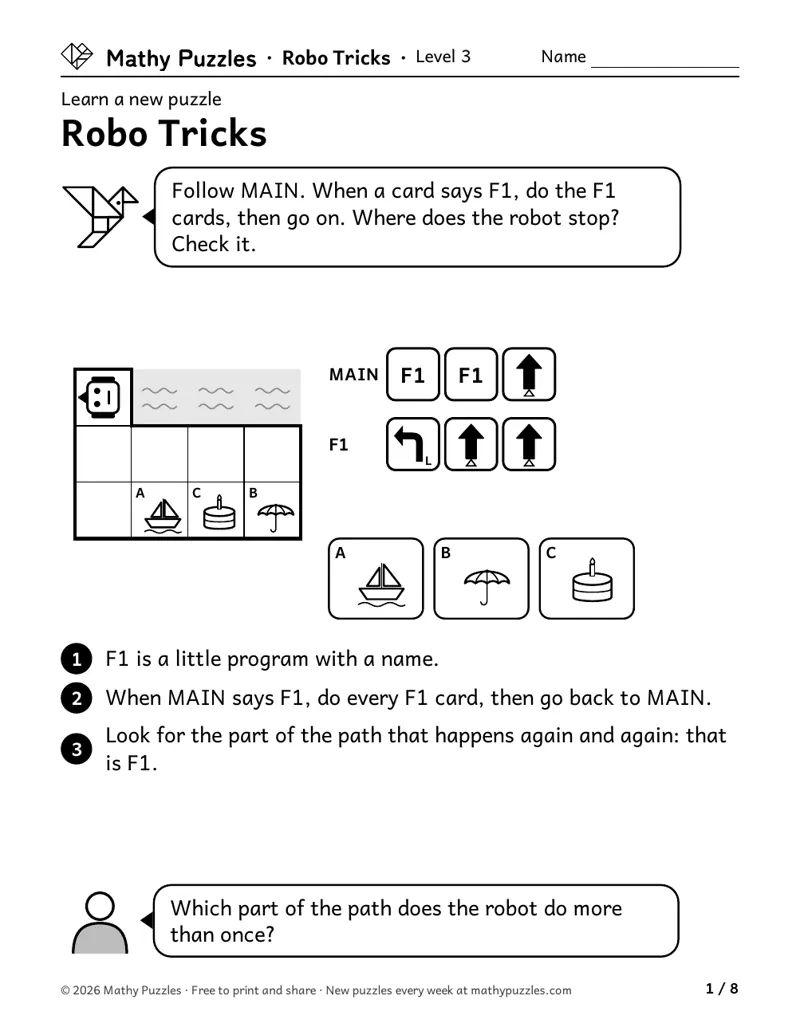
Worked example
From the Level 3 Learn sheet
- F1 is a little program with a name.
- When MAIN says F1, do every F1 card, then go back to MAIN.
- Look for the part of the path that happens again and again: that is F1.
A question to ask: “Which part of the path does the robot do more than once?”
Free every Sunday A mixed bag of 20 new puzzles, all four levels. Get them by email
The thinking it works on
Naming a set of steps
Treats F1 as one step that stands for several cards.
Breaking a route into parts
Splits the path into repeated pieces and loose moves.
Jumping and coming back
Goes into F1 and returns to the right card in MAIN.
Jaroslawska and colleagues (2016) had 42 children aged 7 to 11 carry out spoken strings of tasks around a virtual school. How well they kept to the instructions over a long stretch was closely tied to their verbal working memory (holding spoken words in mind). Source
Planning with few boxes
Plans both rows together because there are few boxes.
Luciana and Nelson (1998) tested 181 children aged 4 to 8 on a plan-the-moves task. The 8-year-olds solved harder problems than younger children, but had not yet reached adult level on the hardest ones. Source
Testing against every condition
Checks that every apple is picked up, and at Level 3 that the robot stops on the picture.
If-then reasoning
Does a tab card only when its condition is true.
Janveau-Brennan and Markovits (1999) gave 512 children in grades 1 to 6 'if this cause, then this effect' problems. With age, more of them saw when a conclusion was not certain. Source
Where is this thinking used?
- Recipes: "Make the dough" as one named step inside a bigger recipe.
- Routines: A morning routine where "get dressed" stands for several smaller steps.
- Assembly: Instructions that say "repeat step 3 for each leg".
- Programming: Functions: a block of steps written once and used again by name.
For teachers
Curriculum areas
- NCERT
- Maths Mela: following turn-by-turn directions (Class 3) and moving step by step on a grid (Class 4)Level 4: No direct curricular match.
- Common Core
- No direct curricular match.
- Computer science (CSTA)
- Programs with a named helper, a loop and cards that run only on some squares (algorithms and programming, ages 8–14)
- National Curriculum (England)
- Geometry – position and direction: movement and turns (Year 2)
- Cambridge Primary Mathematics
- Geometry and measure: position, direction and movement; turns (Stages 2–4)
Math practices: see the box below.
Math practices this puzzle uses
- Uses: MP1 Make sense of problems and persevere in solving them
- Not used: MP2 Reason abstractly and quantitatively
- Not used: MP3 Construct viable arguments and critique the reasoning of others
- Not used: MP4 Model with mathematics
- Not used: MP5 Use appropriate tools strategically
- Uses: MP6 Attend to precision
- Uses: MP7 Look for and make use of structure
- Not used: MP8 Look for and express regularity in repeated reasoning
From the Common Core Standards for Mathematical Practice.
More Robo Tricks puzzles for members
Members get at least 5 more worksheets at each difficulty for every puzzle, 80 new puzzles every Sunday, and the whole archive. $39 a year or $25 for 6 months.
See membershipNot ready yet?
One email, all four levels: 20 puzzles, 5 for each level.
For grown-ups (18+). One email every Sunday with the puzzles and the odd note about membership; unsubscribe any time. We never ask about your child. How we use your email