
One Fib
Every family has heard it: "I didn't break the vase!" These puzzles turn that into a game of logic. Suppose a friend is fibbing, check whether everyone else's words still fit, and keep only the story where everything holds.
Free sets by level, ages 8–12:
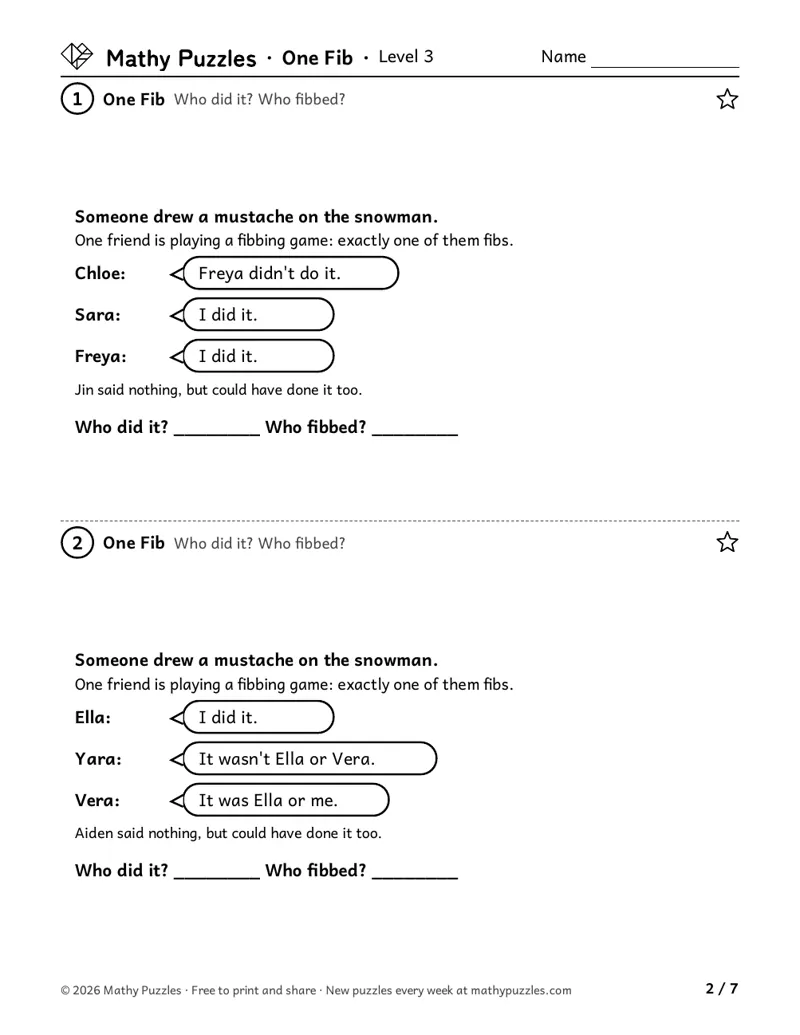 Level 3: a page from the free set
Before starting
- Read short sentences
- Know that a fib is a sentence that isn't true (here it is the game's rule)
- Know what "It was Leo or Mia" and "It wasn't Leo or Mia" rule in and out
- Level 4: keep 4 or 5 sentences in mind while counting
- Fib Island: know "at least one", "all" and "exactly one"
- Fib Island: some practice with the Level 3 friends puzzles first
What you need
Scrap paper for trying each friend as the fibber, and a pencil.
Free puzzles to print
Each set: a Learn sheet with a worked example, 10 puzzles from easiest to hardest, and the answers.
Level 3
Ages 8–10 · Grades 3–4
3 friends, one fibs. First, two say opposite things ("Leo did it." / "Leo didn't do it."). Then two sentences that can't both be true, then a printed "If this friend fibs" table to test each case. The hardest flip it: only one friend tells the truth.
On the sheet: “Who did it? Who fibbed?”
Print Level 3 (Letter)Other paper size: A4Level 4
Ages 10–12 · Grades 5–6
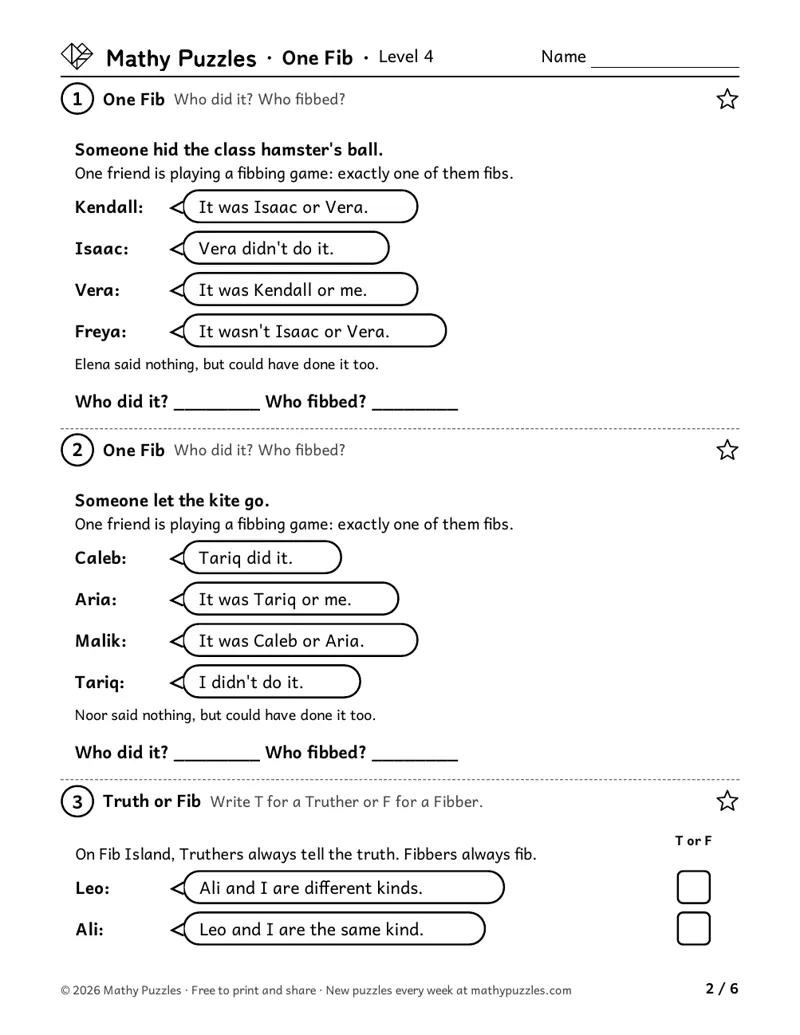
4 friends and one fib, then exactly two telling the truth. Then 5 friends and two fibs; the hardest have friends talking about each other ("Mia is fibbing.").
Fib Island, the easiest puzzles: 2 islanders, settled straight from the island rules.
Fib Island, the middle puzzles: 3 islanders who talk about each other, so the rules chain together. Then sentences with "at least one of us", "all of us" or "exactly one of us", needing at most one "what if" test.
Fib Island, the hardest puzzles: 4 islanders, "same kind" or "different kinds" sentences and a group count.
On the sheet: “Who did it? Who fibbed?”
On the sheet: “Write T for a Truther or F for a Fibber.”
Print Level 4 (Letter)Other paper size: A4
How it works
Three to five friends each say one sentence about who did something, such as who ate the last cookie. One more friend says nothing but could have done it. The sheet says how many of them fib, as part of a game. The child works out who did it and who fibbed. Level 4 also has Fib Island puzzles: Truthers always tell the truth and Fibbers always fib, and the child works out who is which.
How to play
- Read what each friend says. Check how many fib.
- Find two sentences that can't both be true. One of them is a fib.
- With one fib, everyone else tells the truth. Use their sentences to find who did it.
- Stuck? Try each friend as the fibber and keep the try where the rest fit.
- On Fib Island (Level 4), suppose one islander is a Truther, follow what that means for the others, and keep the idea only if every sentence fits. Write T or F for each.
When it gets hard
Deciding who fibbed by who seems nice.
Hint: Only the sentences count. Test each one.
Forgetting that "I didn't do it" can be the fib.
Hint: If that friend did it, "I didn't do it" is false.
Stopping at the first case that seems to work.
Hint: Count the false sentences in your answer. The number must match the sheet.
Thinking a Fibber's sentence just swaps one word.
Hint: A Fibber's whole sentence is false. "All of us are Truthers" is false if even one of them is a Fibber.
Tip for grown-ups: Fibbing here is a game rule, like bluffing in a card game. If your child asks, say so plainly: the puzzle is about checking sentences, not about people. On scrap paper, try each friend as the fibber in turn and cross out the ones that don't fit.
Frequently asked questions
- Doesn't this teach children to fib?
- The puzzle treats fibbing as a game rule, and no one is praised for it. The child's job is the opposite: checking each sentence to find the one that isn't true.
- How do I teach the "If this friend fibs" table?
- Draw it on the board with one row per friend. For each row, suppose that friend fibs and check whether everyone else can be telling the truth. The row that works gives the answer, so the table is a method, not a guess.
- What are the Fib Island puzzles?
- They are part of Level 4. In the friends puzzles you are told how many friends fib, and you also find who did something. On Fib Island each islander always tells the truth or always fibs, and you sort them all, writing T or F.
Questions about printing, levels, answers or membership: see all questions.
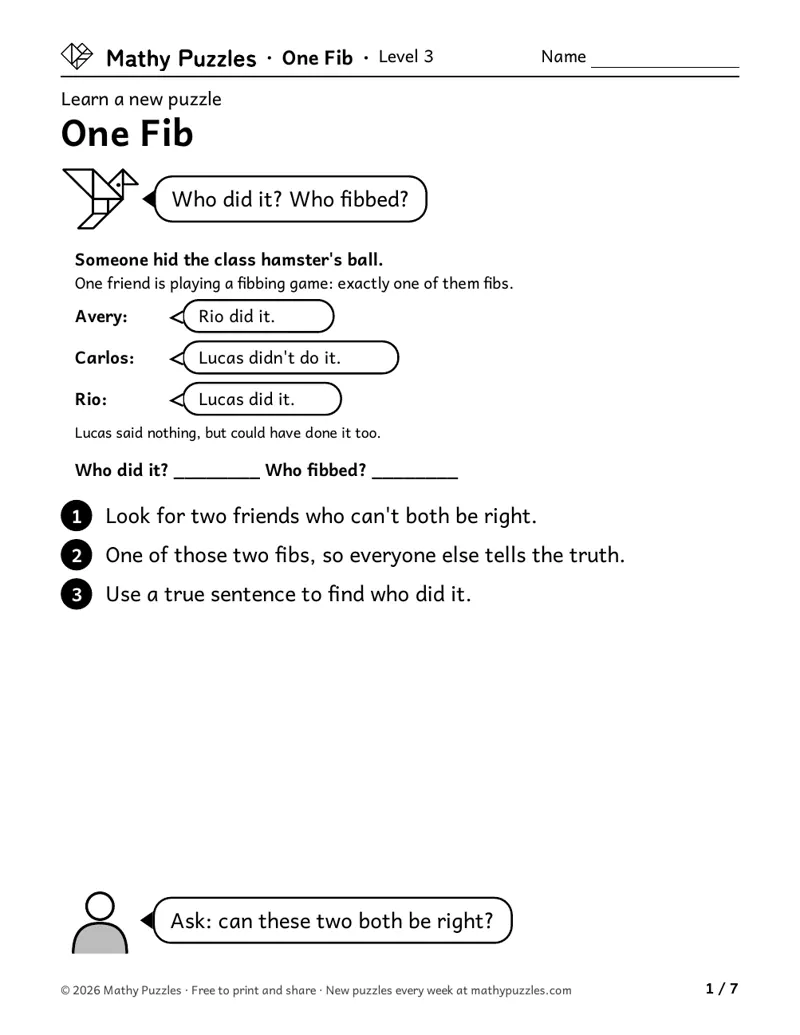
Worked example
From the Level 3 Learn sheet
- Look for two friends who can't both be right.
- One of those two fibs, so everyone else tells the truth.
- Use a true sentence to find who did it.
A question to ask: “Can these two both be right?”
Free every Sunday A mixed bag of 20 new puzzles, all four levels. Get them by email
The thinking it works on
Spotting a clash
Finds two sentences that can't both be true.
Ruffman (1999) ran five experiments with 245 children. Seeing that two claims can't both be true, such as a man described as tall and as very short, first appeared at about age 6. Children under 6 missed the clash even when they remembered both claims well. Source
Testing cases one at a time
Supposes each friend fibs in turn and checks the rest.
Holding a "suppose"
Keeps a supposition in mind, then drops it if it fails.
Counting the fibs
Checks the number of fibs matches the sheet.
Reasoning about what others say
Follows sentences about another speaker.
Following an islander's kind through
Supposes an islander's kind and follows it through.
Moshman and Franks (1986) found that no fourth graders, but nearly half of seventh graders, sorted arguments by whether the conclusion had to follow, true or not. They placed this idea at ages 10 to 12. Source
Where is this thinking used?
- Checking stories: Two accounts that can't both be true mean one is wrong.
- Comparing sources: Finding the one source that disagrees with the rest.
- Lab work: Finding the one measurement that doesn't fit the others.
- Bluffing games: Working out which player can't be telling the truth.
For teachers
Curriculum areas
- Common Core
- No direct curricular match.
- NCERT
- Maths Mela (Class 4), Equal Groups: deciding whether statements are always, sometimes or never trueLevel 4: No direct curricular match.
- National Curriculum (England)
- No direct curricular match.
- Cambridge Primary Mathematics
- No direct curricular match.
Math practices: see the box below.
Math practices this puzzle uses
- Uses: MP1 Make sense of problems and persevere in solving them
- Not used: MP2 Reason abstractly and quantitatively
- Uses: MP3 Construct viable arguments and critique the reasoning of others
- Not used: MP4 Model with mathematics
- Not used: MP5 Use appropriate tools strategically
- Uses: MP6 Attend to precision
- Not used: MP7 Look for and make use of structure
- Not used: MP8 Look for and express regularity in repeated reasoning
From the Common Core Standards for Mathematical Practice.
More One Fib puzzles for members
Members get at least 5 more worksheets at each difficulty for every puzzle, 80 new puzzles every Sunday, and the whole archive. $39 a year or $25 for 6 months.
See membershipNot ready yet?
One email, all four levels: 20 puzzles, 5 for each level.
For grown-ups (18+). One email every Sunday with the puzzles and the odd note about membership; unsubscribe any time. We never ask about your child. How we use your email