
True, False or Can't Tell
If every dog in the park wears a collar and you find a collar on a bench, did a dog leave it? You can't tell. These puzzles are about that third answer: a rule tells you only what it covers, and it doesn't work backward.
Free sets by level, ages 8–12:
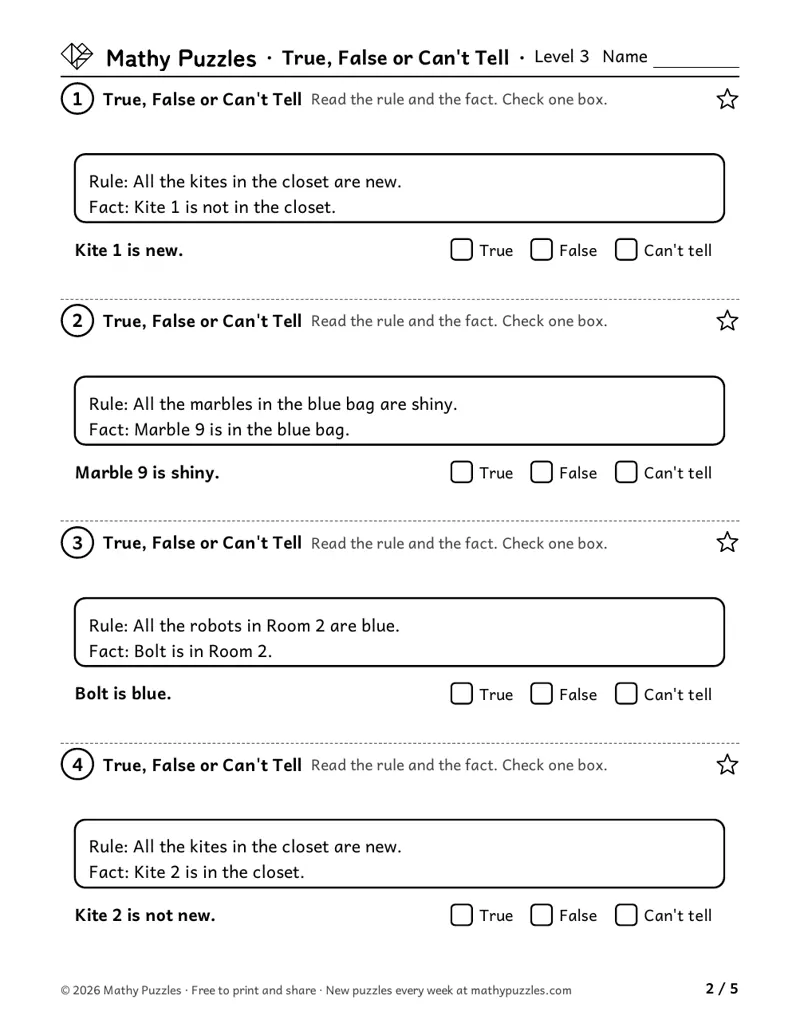 Level 3: a page from the free set
Before starting
- Read two or three short sentences
- Know "all", "some" and "none" (the sheet says "some" means at least one, maybe all)
- Level 4: read "if… then" sentences
What you need
A highlighter for the words all, some, none and if (optional), and a pencil.
Free puzzles to print
Each set: a Learn sheet with a worked example, 10 puzzles from easiest to hardest, and the answers.
Level 3
Ages 8–10 · Grades 3–4
One "all" rule and a fact about one fish or robot. Then can't-tell traps, where the rule is run backwards. Then "some" and "none" cards; the hardest chain two rule cards.
On the sheet: “Read the rule and the fact. Check one box.”
Print Level 3 (Letter)Other paper size: A4Level 4
Ages 10–12 · Grades 5–6
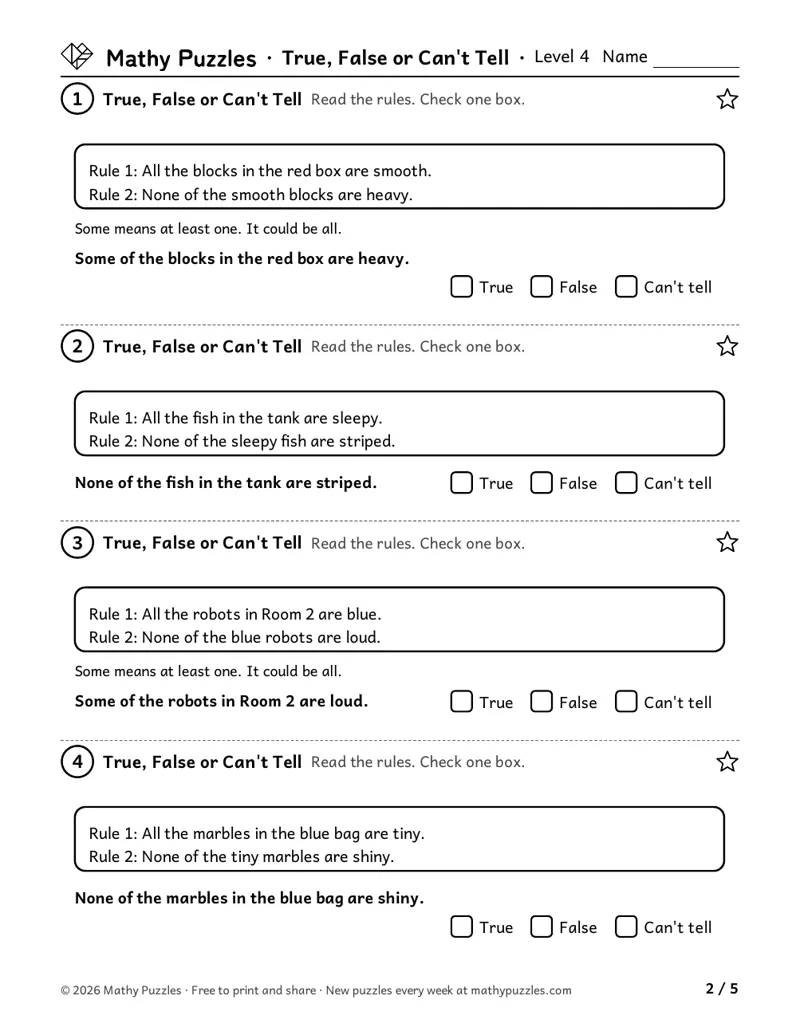
Two rules in words; then "if… then" cards, including when the "then" part is false. Next, two rules and a fact, with three sentences to judge (one True, one False, one Can't tell). The hardest ask which of three extra facts would make a Can't-tell sentence True.
On the sheet: “Read the rule and the fact. Check one box.”
Print Level 4 (Letter)Other paper size: A4
How it works
Each puzzle has a rule card, such as "All the fish in the tank are striped", often with a fact about one fish, and a sentence to judge. The child checks True, False or Can't tell. The things on the cards are made up or plain, so only the rule decides.
How to play
- Read the rule card. Underline all, some, none or if.
- Read the fact. Is this thing inside what the rule talks about?
- If the rule covers it, decide True or False.
- If nothing settles it, check Can't tell.
When it gets hard
Running the rule backwards: "All fish in the tank are striped," so a striped fish must be in the tank.
Hint: The rule goes one way. A striped fish could be anywhere.
Treating "some" as "not all".
Hint: Some means at least one. It could be all.
Deciding by what seems likely.
Hint: Only the card counts. Point to the words that prove your answer.
Tip for grown-ups: When your child picks True or False, ask them to point to the words on the card that prove it. If they can't point to any, the answer may be Can't tell. A highlighter on the words all, some, none and if shows where the answer hides.
Frequently asked questions
- Why is "Can't tell" so often the answer?
- Answers are spread across True, False and Can't tell. Can't tell feels strange at first, because children expect a yes or a no. Learning when to say it is part of the puzzle.
- Can I use this as a quick warm-up?
- Yes. Put it on the board, let students vote, then ask someone to point to the words that decide it.
- My child says real fish wouldn't be striped.
- The cards use plain or made-up features, like striped fish and sleepy fish, so real life never decides it. Point back to the card: what does it say about this fish?
Questions about printing, levels, answers or membership: see all questions.
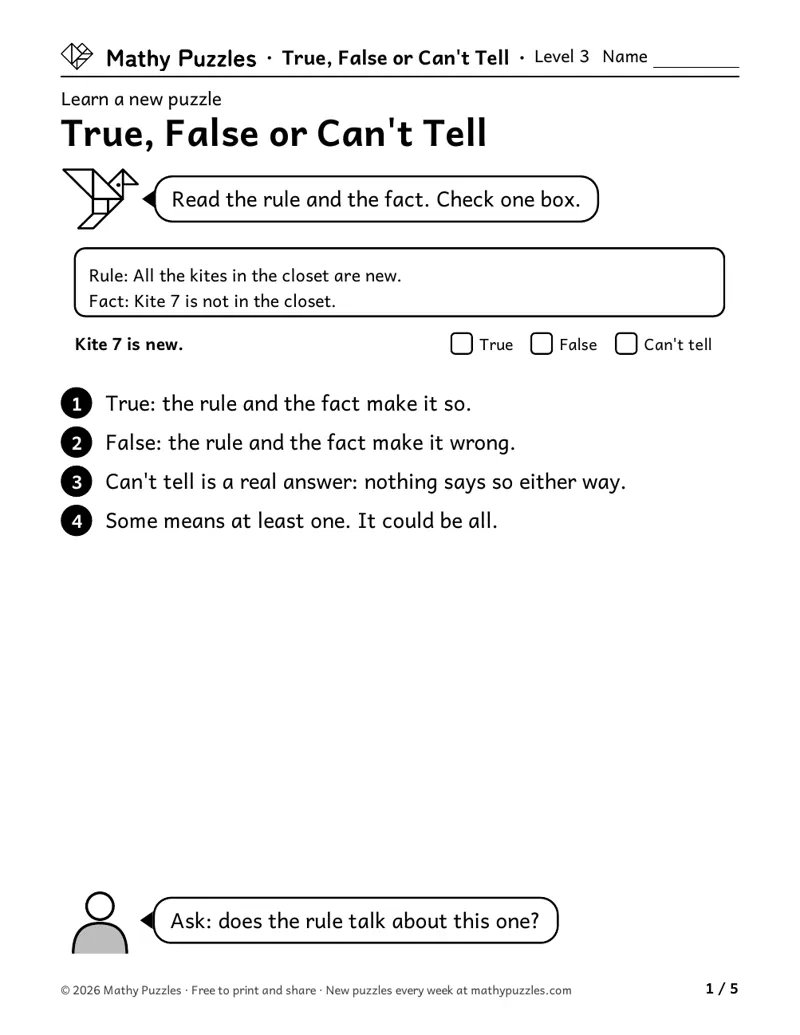
Worked example
From the Level 3 Learn sheet
- True: the rule and the fact make it so.
- False: the rule and the fact make it wrong.
- Can't tell is a real answer: nothing says so either way.
- Some means at least one. It could be all.
A question to ask: “Does the rule talk about this one?”
Free every Sunday A mixed bag of 20 new puzzles, all four levels. Get them by email
The thinking it works on
Reasoning from a rule and a fact
Uses a rule and a fact to reach a sure answer.
Datsogianni and colleagues (2020) gave if-then problems to 102 children in grades 2, 4 and 6: even second graders drew some correct conclusions, and accuracy rose by grade. Source
Recognizing when you can't tell
Says Can't tell when the card doesn't settle it.
Byrnes and Overton (1986) studied first, third and fifth graders. All handled sure cases alike, but seeing when a concrete situation was still undecided got better with grade. Only fifth graders showed it with if-then sentences. Source
Avoiding the backwards trap
Knows a rule doesn't run backwards.
Janveau-Brennan and Markovits (1999) studied 512 children in grades 1 to 6. With age there was a steady rise in answering "can't tell" to the two forms that don't follow, such as reasoning backwards from an effect to its cause. Source
Understanding all, some and none
Keeps the quantity words apart.
Noveck (2001) found that 8- and 10-year-olds usually read "some" as compatible with "all", as logic does, while adults were split. Source
Chaining rules
Joins two rule cards to reach a new fact.
Andrews and Halford (2002) studied children aged 3 to 8. Linked problems with three parts, such as ordering from two clues, were solved later than two-part ones, around age 5. Source
Where is this thinking used?
- Reading the news: Asking whether a claim really follows from the facts given.
- Signs and rules: A rule for one area says nothing about the next.
- Science: Saying "we can't tell yet" until a test settles it.
- Computer code: If-then rules act only when their condition is met.
For teachers
Curriculum areas
- Common Core
- No direct curricular match.
- NCERT
- Maths Mela (Class 4): statements that are always, sometimes or never trueLevel 4: No direct curricular match.
- National Curriculum (England)
- No direct curricular match.
- Cambridge Primary Mathematics
- No direct curricular match.
Math practices: see the box below.
Math practices this puzzle uses
- Not used: MP1 Make sense of problems and persevere in solving them
- Not used: MP2 Reason abstractly and quantitatively
- Uses: MP3 Construct viable arguments and critique the reasoning of others
- Not used: MP4 Model with mathematics
- Not used: MP5 Use appropriate tools strategically
- Uses: MP6 Attend to precision
- Not used: MP7 Look for and make use of structure
- Not used: MP8 Look for and express regularity in repeated reasoning
From the Common Core Standards for Mathematical Practice.
More True, False or Can't Tell puzzles for members
Members get at least 5 more worksheets at each difficulty for every puzzle, 80 new puzzles every Sunday, and the whole archive. $39 a year or $25 for 6 months.
See membershipNot ready yet?
One email, all four levels: 20 puzzles, 5 for each level.
For grown-ups (18+). One email every Sunday with the puzzles and the odd note about membership; unsubscribe any time. We never ask about your child. How we use your email