
Mate in Two
A plan for a picnic has to work whether it rains or shines. Mate in Two asks for that kind of plan: a first move after which every Black reply, whatever it is, still loses to a mate.
Free sets by level, ages 10–12:
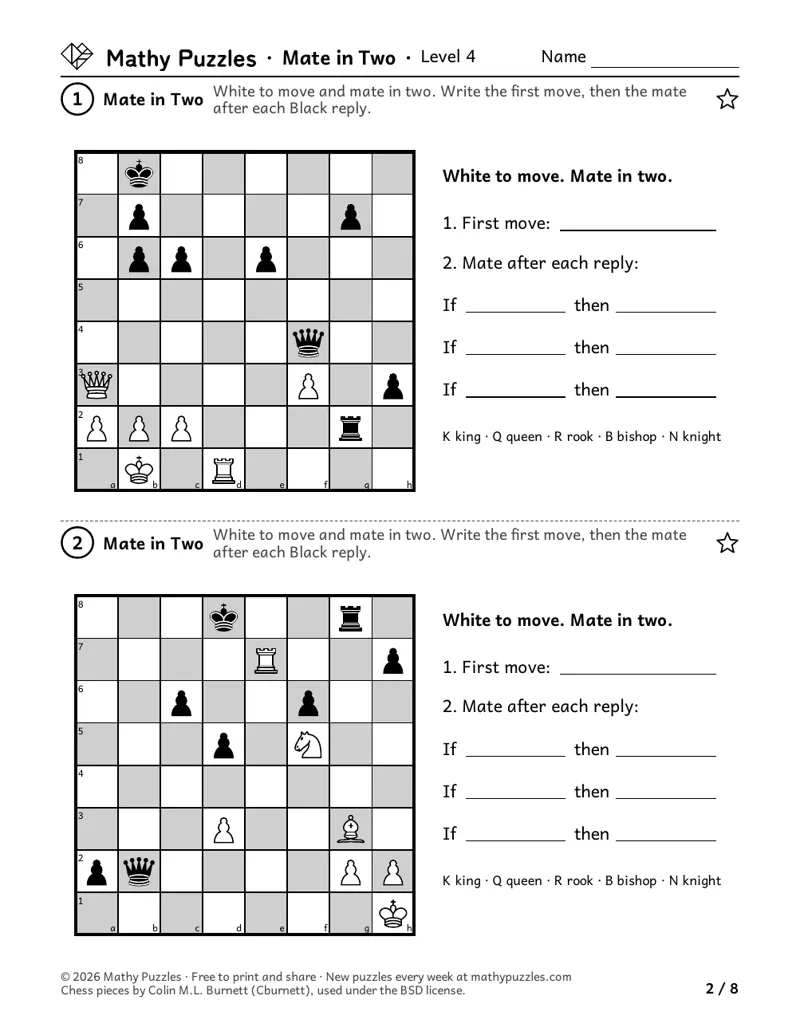 Level 4: a page from the free set
Before starting
- Know how every piece moves, and what check and checkmate are
- Solve Mate in One puzzles with confidence
- Read and write chess notation such as Nf3 (a free chess notation sheet explains it)
What you need
Our free chess notation sheet, a real chessboard for testing replies (optional), and a pencil.
Free printable: How chess moves are written
Free puzzles to print
Each set: a Learn sheet with a worked example, 10 puzzles from easiest to hardest, and the answers.
Level 4
Ages 10–12 · Grades 5–6
The easiest puzzles: the first move is a check and Black has only one reply. These come from real games.
Next: the first move is a check with two or three replies, a sacrifice, or a capture. These also come from real games.
Then a quiet first move: no check and no capture, with up to three Black replies to answer.
The hardest puzzles: a quiet first move with four to six Black replies, each needing its own mate.
On the sheet: “White to move and mate in two. Write the first move, then the mate after each Black reply.”
Print Level 4 (Letter)Other paper size: A4
How it works
Each puzzle is a chess position with White to move and checkmate in two moves. The child writes White's first move (called the key), then, for each way Black can answer, the move that mates. Answers are written in chess notation, such as Qg6, with the square names printed inside the board's edge.
How to play
- Check for a mate in one. If there is none, look for a first move that takes away the king's room.
- For your first move, list every legal Black reply, not just the one you hope for.
- Find a mate after each reply. If any reply has no mate, try a different first move.
- Write the first move, then each reply with its mate, in chess notation.
When it gets hard
Checking only the Black reply you expect.
Hint: List every legal Black move. The key must beat all of them.
Trying only checks and captures.
Hint: In the harder puzzles the first move is quiet. Ask what squares the king will need, and take them away.
Writing the notation wrong, such as missing the piece letter.
Hint: Piece letter first, then the square: Q for queen, N for knight, no letter for a pawn.
Tip for grown-ups: You don't need to play chess to help. Ask "What else could Black do?" after each idea; that question is the whole method. Our chess notation sheet helps with square names, and a real board makes testing a reply easy.
Frequently asked questions
- My child knows the moves but has never written chess notation.
- Start with the free chess notation sheet: one page on square names and piece letters. The square names are also printed inside the board's edge on every puzzle.
- Is Mate in Two a good fit for a school chess club?
- Yes, especially for players who solve Mate in One easily. Pairs can work well: one suggests a first move, the other hunts for a Black reply that escapes.
- Why does the first move sometimes not give check?
- In the harder puzzles the key is a quiet move: no check and no capture. It often takes away the king's escape squares. Black is not in check yet, but every reply allows a mate.
Questions about printing, levels, answers or membership: see all questions.
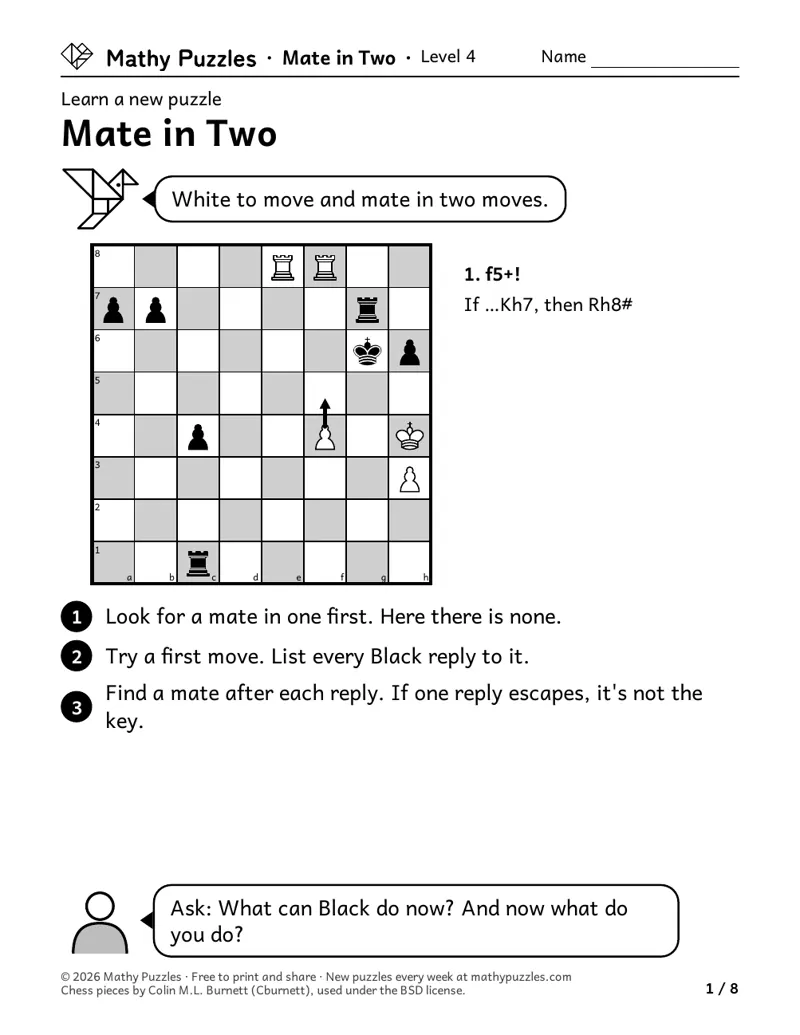
Worked example
From the Level 4 Learn sheet
- Look for a mate in one first. In these puzzles there is none.
- Try a first move. List every Black reply to it.
- Find a mate after each reply. If one reply escapes, it is not the key.
A question to ask: “What can Black do now? And now what do you do?”
Free every Sunday A mixed bag of 20 new puzzles, all four levels. Get them by email
The thinking it works on
Thinking two moves ahead
Pictures the board after White's move and Black's reply.
Flobbe and colleagues (2008) had 40 children aged 8 to 10 and 27 adults play a game that needs thinking about the other player's next choice. Reasoning two steps ahead was harder for the children. Source
Answering every case
Finds a mate for each Black reply, not just the likely one.
If… then reasoning
Writes the plan as "if Black does this, then I do that".
Letting go of a favorite idea
Drops a first move as soon as one reply escapes.
In Davidson and colleagues' (2006) study of 4- to 13-year-olds, switching from one rule to another was the slowest skill to mature. Thirteen-year-olds were still not at adult levels, even when little had to be held in memory. Source
Seeing quiet moves
Finds a first move that neither checks nor captures.
Writing in a code
Records moves in chess notation.
Where is this thinking used?
- Planning for what-ifs: Having an answer ready for each way a plan could go.
- Writing instructions: Spelling out "if this, then that" so anyone can follow.
- Negotiating: Thinking about every reply the other side might make.
- Coding: Covering each case so nothing slips through.
For teachers
Curriculum areas
- Common Core
- No direct curricular match.
- NCERT
- Maps and Locations in Maths Mela (Class 5): finding places on a grid by numbered rows and columns
- National Curriculum (England)
- No direct curricular match.
- Cambridge Primary Mathematics
- No direct curricular match.
Math practices: see the box below.
Math practices this puzzle uses
- Uses: MP1 Make sense of problems and persevere in solving them
- Not used: MP2 Reason abstractly and quantitatively
- Uses: MP3 Construct viable arguments and critique the reasoning of others
- Not used: MP4 Model with mathematics
- Not used: MP5 Use appropriate tools strategically
- Not used: MP6 Attend to precision
- Not used: MP7 Look for and make use of structure
- Not used: MP8 Look for and express regularity in repeated reasoning
From the Common Core Standards for Mathematical Practice.
More Mate in Two puzzles for members
Members get at least 5 more worksheets at each difficulty for every puzzle, 80 new puzzles every Sunday, and the whole archive. $39 a year or $25 for 6 months.
See membershipNot ready yet?
One email, all four levels: 20 puzzles, 5 for each level.
For grown-ups (18+). One email every Sunday with the puzzles and the odd note about membership; unsubscribe any time. We never ask about your child. How we use your email