
Magic Squares & Triangles
A magic square looks like a scatter of numbers until you add up any line and get the same total, every time. That sameness gives the clues: a spot on two lines counts twice, and some spots, like the middle of a 3 × 3 square, follow rules you can use.
Free sets by level, ages 6–12:
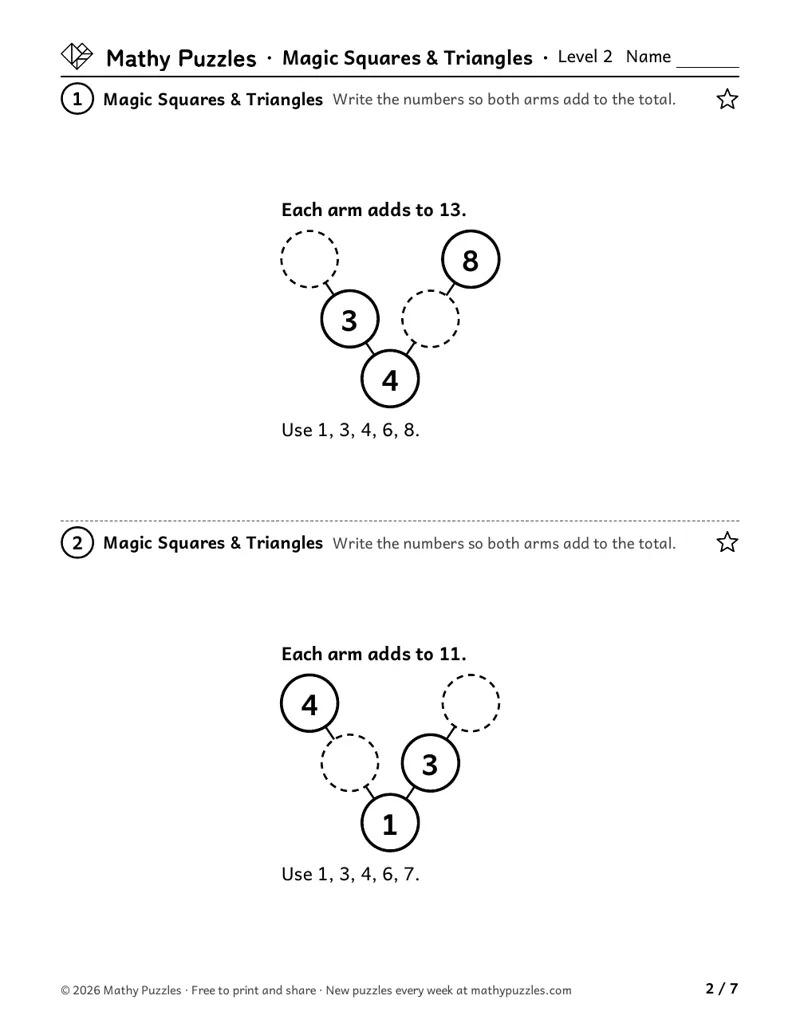 Level 2: a page from the free set
Before starting
- Level 2: add up to seven small numbers (to about 50), and take away within 60
- Level 3: add three numbers up to 50 and subtract within 130; know what a diagonal is (or learn it on the first square)
- Level 4: add four numbers to 34, and divide 136 by 4 for the hardest
What you need
Small paper number cards to slide around before writing, and a pencil.
Free puzzles to print
Each set: a Learn sheet with a worked example, 10 puzzles from easiest to hardest, and the answers.
Level 2
Ages 6–8 · Grades 1–2
Vs whose two arms share the bottom circle, with the total and the numbers to use printed. The easiest have 5 circles and need each arm's last gap; then 7 circles. Then the bottom is empty, so the child works out that it counts twice (bottom = two totals − all the numbers). The hardest do that with 7 circles.
On the sheet: “Write the numbers so both arms add to the total.”
Print Level 2 (Letter)Other paper size: A4Level 3
Ages 8–10 · Grades 3–4
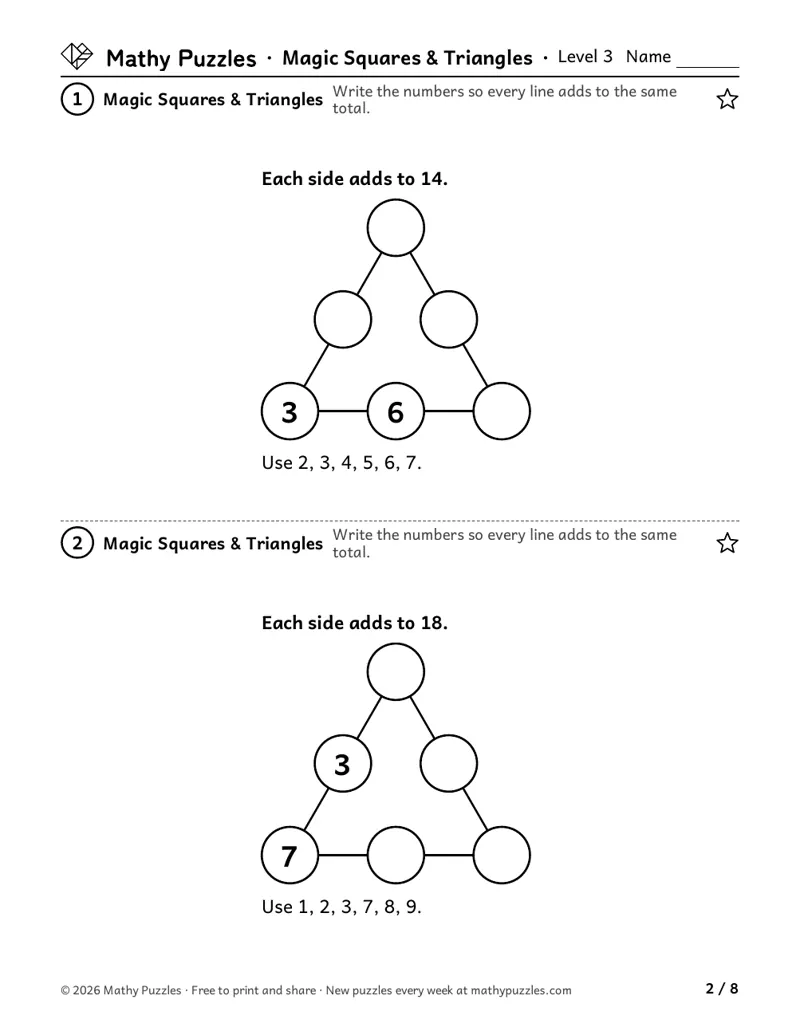
Triangles with 3 circles on each side, six different numbers up to 9, and the total and two numbers printed. Then 3 × 3 squares from an evenly spaced set (such as 5, 7, 9 … 21), with the total given. Then squares with numbers up to 50 and no list. The hardest give no total, only the middle and two more numbers, so the child works out that the total is 3 times the middle.
On the sheet: “Write the numbers so every line adds to the same total.”
Print Level 3 (Letter)Other paper size: A4Level 4
Ages 10–12 · Grades 5–6
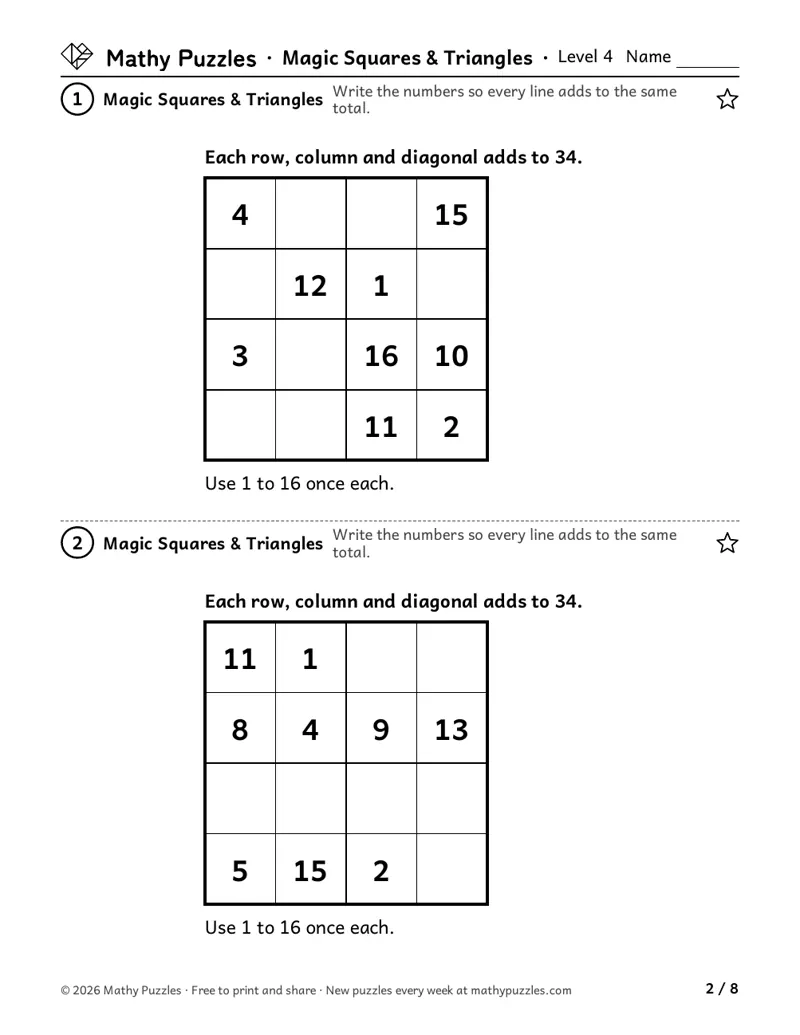
4 × 4 squares of 1 to 16, where every row, column and diagonal adds to 34. The easiest print 8 or 9 numbers, so each line's last gap fills in turn. Then fewer numbers, using groups of four that always add to 34, such as the four corners. Then lines with two gaps to split. The hardest print 5 numbers and no total, so the child works it out. The numbers 1 to 16 add to 136, and four rows share it, so each makes 34.
On the sheet: “Write the numbers so every line adds to the same total.”
Print Level 4 (Letter)Other paper size: A4
How it works
In each puzzle, numbers go in circles or squares so every line adds to the same total. At Level 2 the shape is a V: two arms that share the bottom circle, with the total printed. At Level 3 it is a triangle with circles along its sides, or a 3 × 3 square where a line is a row, column or diagonal. At Level 4 it is a 4 × 4 square that uses 1 to 16 once each. Some numbers are printed; most puzzles give the total and the hardest at Levels 3 and 4 don't.
How to play
- Find the total each line must make. If it isn't given, look for a full line, or add every number and share it between the rows.
- Fill any line that has only one empty place: total minus the numbers already there.
- In a V or a triangle, work out the places that sit on two lines first. In a 3 × 3 square, look at the middle; in a 4 × 4 square, the four corners add to the total.
- Check every line, including both diagonals of a square.
When it gets hard
Forgetting the diagonals of the square.
Hint: A 3 × 3 square has 8 lines: 3 rows, 3 columns and 2 diagonals. A 4 × 4 square has 10. Check them all.
Using a number twice.
Hint: Each number goes in once. Cross it off the list when it's used.
Counting the bottom of a V, or a corner of the triangle, only once.
Hint: It sits on two lines, so it is part of two totals.
Tip for grown-ups: Cut out small number cards and let your child move them around first. Writing comes last, once every line checks out.
Frequently asked questions
- Why do the middle and the corners matter so much?
- In a 3 × 3 square the middle is in four lines: a row, a column and both diagonals. It is always a third of the total, so finding it often unlocks the rest. In a 4 × 4 square of 1 to 16, the four corners always add to 34, like every line.
- How could I use one with a whole grade 3 class?
- Draw a triangle on the board, hand out number cards 1 to 6, and let groups find a way to make each side 9. Then ask why the corners matter.
- My child's square seems to work but doesn't match the answers.
- Check that every line, including both diagonals, makes the total, that each number is used once, and that the printed numbers are unchanged. If all of that holds, the square is right. Some puzzles can be filled more than one way, and the answers show an example.
Questions about printing, levels, answers or membership: see all questions.
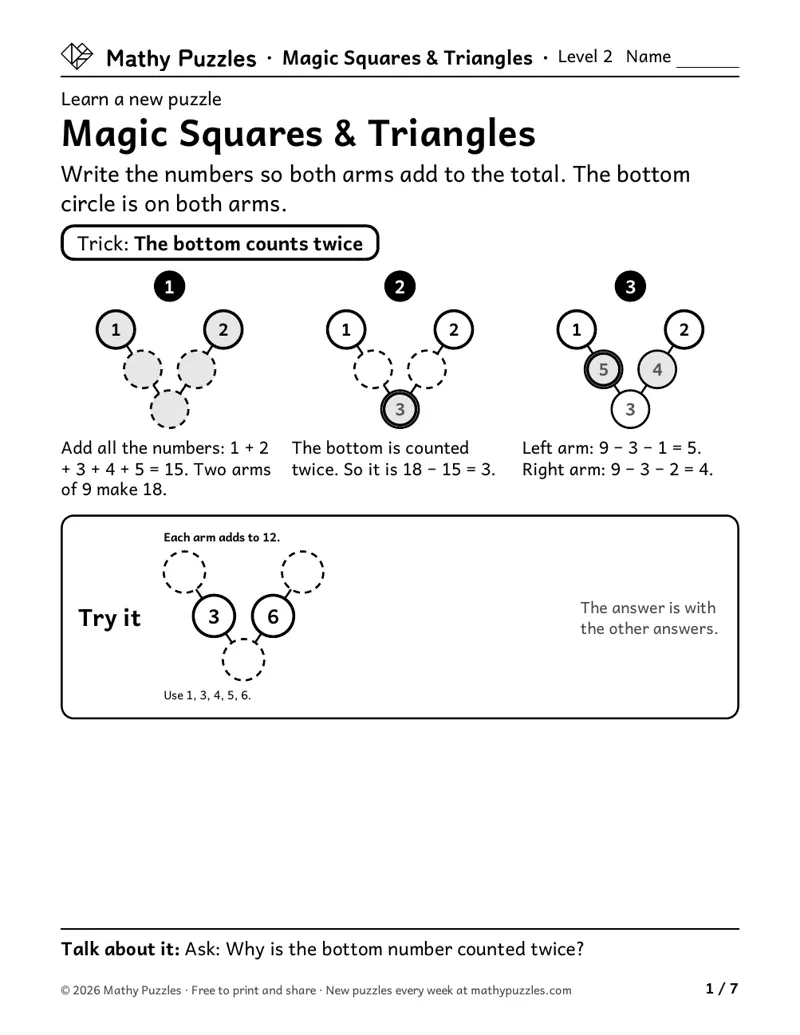
Worked example
From the Level 2 Learn sheet
- Use 1 to 5. Each arm of the V must make 9. The bottom circle is on both arms.
- Add all the numbers: 1 + 2 + 3 + 4 + 5 = 15. Two arms of 9 make 18.
- The bottom is counted twice, so it is 18 − 15 = 3.
- Fill each arm: 9 minus the bottom and the number already on that arm.
A question to ask: “Why is the bottom number counted twice?”
Free every Sunday A mixed bag of 20 new puzzles, all four levels. Get them by email
The thinking it works on
Adding to a target
Finds the number that makes a line reach its total.
Barrouillet and Lépine (2005) studied third and fourth graders. Those with larger working memory spans answered single-digit sums from memory more often, and faster, than classmates with smaller spans. Source
Seeing places shared by two lines
Notices that some places count in more than one line.
Reasoning about the middle
Uses the center of the square as the key.
Trying and checking
Tests a choice against every line before keeping it.
Desoete, Roeyers and Buysse (2001) studied 165 third graders. Skill at predicting how hard a problem would be, and at checking the answer afterward, set the above-average problem solvers apart from the average ones. Source
Number patterns
Works with evenly spaced sets of numbers.
Where is this thinking used?
- Sharing fairly: Arranging piles so every group gets the same amount.
- Quilts and tile patterns: Each row and column balanced the same way.
- Team picking: Making teams whose skills add up evenly.
- Checking work: Adding a table across and down to see that the totals agree.
For teachers
Curriculum areas
- Common Core
- Operations and algebraic thinking: finding the unknown number in an addition sentence (Grade 1), adding and taking away within 20 (Grade 2), arithmetic patterns (Grade 3); Number and operations in base ten: adding and subtracting within 1,000 (Grade 3, used again at Level 4)
- NCERT
- Joyful Mathematics (Class 1): lines that add to the same total (How Many?); Maths Mela (Class 3): the magic square in Vacation with My Nani MaaLevel 4: No direct curricular match.
- National Curriculum (England)
- Number – addition and subtraction: addition facts and missing number problems (Years 2–3)
- Cambridge Primary Mathematics
- Number: adding whole numbers (Stages 2–3)
Math practices: see the box below.
Math practices this puzzle uses
- Not used: MP1 Make sense of problems and persevere in solving them
- Not used: MP2 Reason abstractly and quantitatively
- Not used: MP3 Construct viable arguments and critique the reasoning of others
- Not used: MP4 Model with mathematics
- Not used: MP5 Use appropriate tools strategically
- Not used: MP6 Attend to precision
- Uses: MP7 Look for and make use of structure
- Uses: MP8 Look for and express regularity in repeated reasoning
From the Common Core Standards for Mathematical Practice.
More Magic Squares & Triangles puzzles for members
Members get at least 5 more worksheets at each difficulty for every puzzle, 80 new puzzles every Sunday, and the whole archive. $39 a year or $25 for 6 months.
See membershipNot ready yet?
One email, all four levels: 20 puzzles, 5 for each level.
For grown-ups (18+). One email every Sunday with the puzzles and the odd note about membership; unsubscribe any time. We never ask about your child. How we use your email