
Cross Sums
Some totals are fussy: two squares that add to 3 can only be 1 and 2. Cross Sums is full of totals like that, and where an across run crosses a down run, one digit has to work for both. The fussy totals are where to begin.
Free sets by level, ages 8–12:
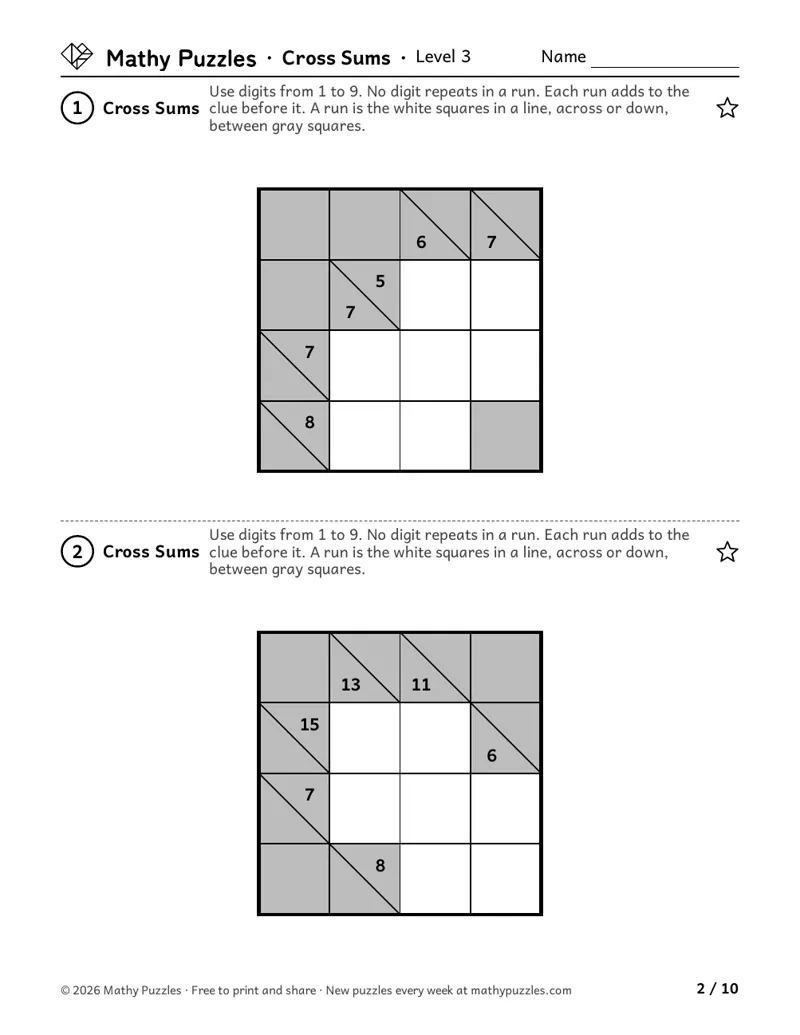 Level 3: a page from the free set
Before starting
- Level 3: add three or four one-digit numbers in your head
- Level 4: add a string of five one-digit numbers, and add and compare two bigger totals
- Know that digits here run from 1 to 9, with no zero
Free puzzles to print
Each set: a Learn sheet with a worked example, 10 puzzles from easiest to hardest, and the answers.
Level 3
Ages 8–10 · Grades 3–4
Boards grow from 4 × 4 to 7 × 7 squares (counting the clue row and column), with runs of 2 to 5 squares. In the harder puzzles, the child has to list every way a run can still be made, at least twice.
On the sheet: “Use digits from 1 to 9. No digit repeats in a run. Each run adds to the clue before it. A run is the white squares in a line, across or down, between gray squares.”
Print Level 3 (Letter)Other paper size: A4Level 4
Ages 10–12 · Grades 5–6
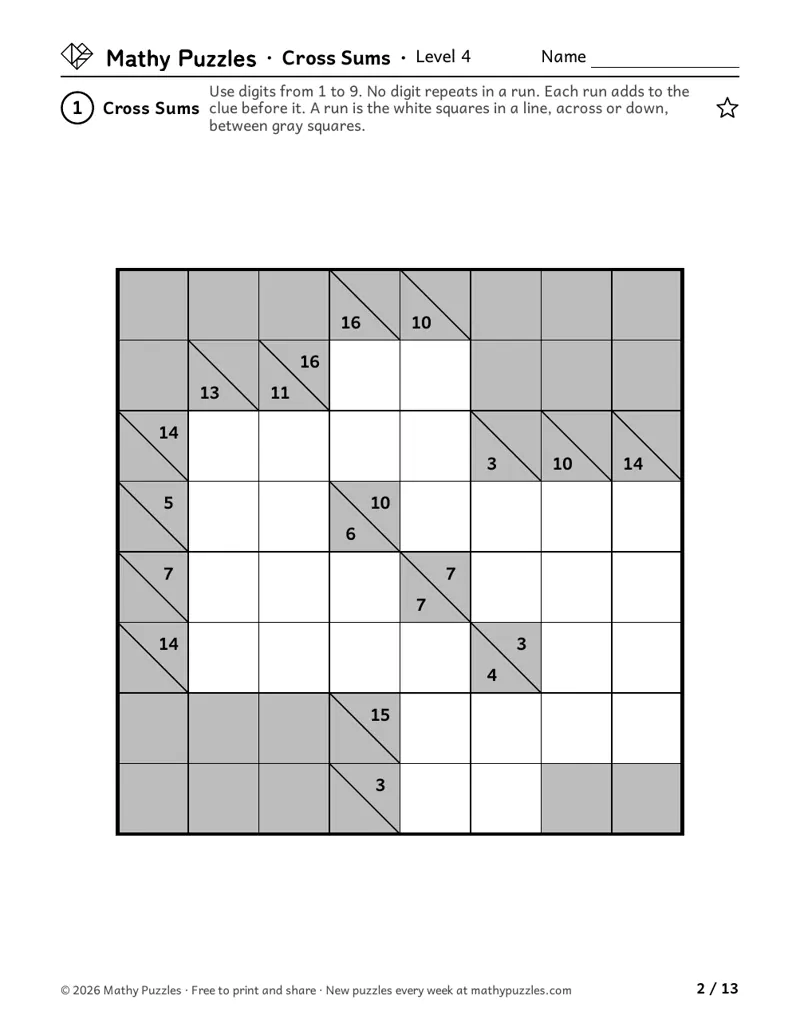
Bigger boards, from 8 × 8 to 10 × 10, with runs up to 5 squares. A new move joins: the block total. Add the across clues of one to three rows and compare them with the down clues that cross those rows. The difference belongs to the squares that stick out.
On the sheet: “Use digits from 1 to 9. No digit repeats in a run. Each run adds to the clue before it. A run is the white squares in a line, across or down, between gray squares.”
Print Level 4 (Letter)Other paper size: A4
How it works
The grid of white and gray squares looks like a small crossword. Each white square takes one digit from 1 to 9. A gray square holds the total for the run of white squares next to it, across or down. No digit repeats inside a run.
How to play
- Read a clue: the number above the slash is for the run going across, the number below is for the run going down.
- Look for runs that can be made only one way. Write their digits small in the squares.
- Where two runs cross, keep only a digit that fits both lists.
- Fill a square when only one digit is left. Check that no run repeats a digit.
When it gets hard
Making 4 in two squares as 2 + 2.
Hint: No digit repeats inside a run, so 4 in two squares must be 1 + 3.
Using the across clue for the run going down.
Hint: Across is above the slash, down is below. Trace the run with a finger before writing.
Writing a digit as soon as one option looks right.
Hint: Write the options small first. Ink in a digit only when the crossing run agrees.
Tip for grown-ups: Make a small card of the totals that can be made only one way. In two squares these are 3, 4, 16 and 17; in three squares, 6, 7, 23 and 24. Children like spotting them in each new grid.
Frequently asked questions
- Is this a crossword with numbers?
- Close. The grid looks like a crossword, but the clues are totals, not words. Each answer is a short run of digits that adds to its clue, with no digit used twice in a run.
- How would I use these with a grade 4 class?
- Start the class on the smaller Level 3 boards and share the one-way totals as a list on the board. Strong solvers can move to Level 4.
- Why can't my child use 5 + 5 for 10?
- A digit can appear only once in each run. So 10 in two squares has four ways: 1 + 9, 2 + 8, 3 + 7 and 4 + 6.
Questions about printing, levels, answers or membership: see all questions.
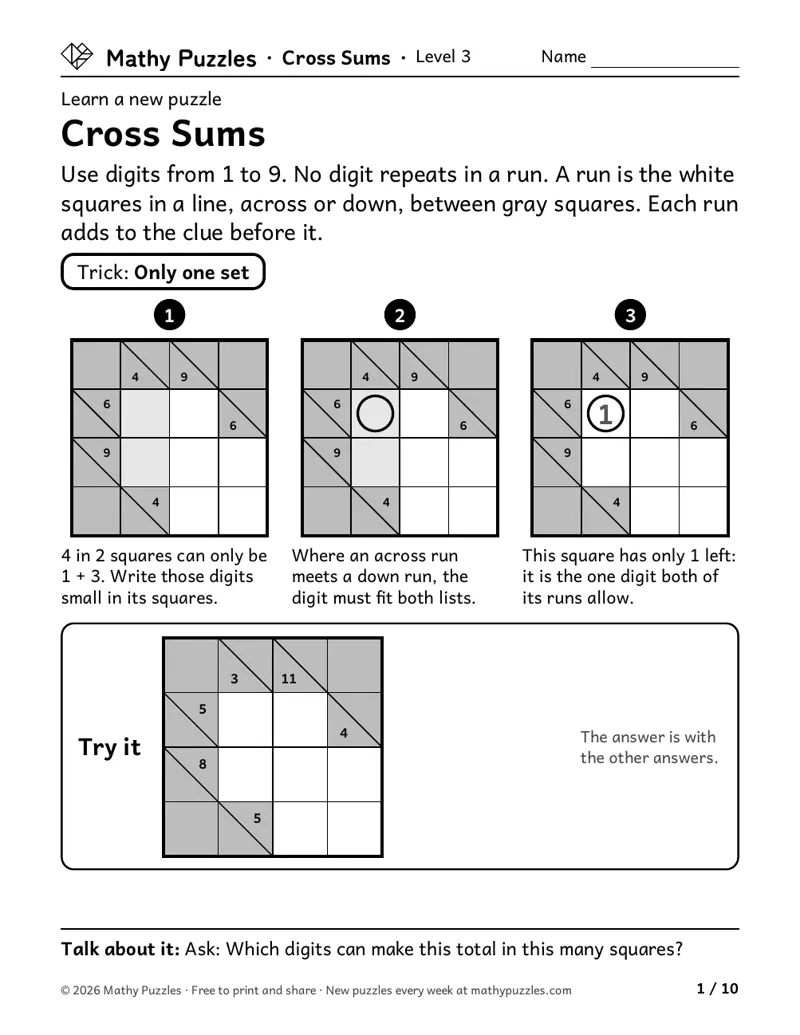
Worked example
From the Level 3 Learn sheet
- A run is the white squares in a line between gray squares. The clue before it is its total.
- Find a run whose total can be made only one way: 3 in two squares is always 1 + 2, and 24 in three is always 7 + 8 + 9. Write those digits small in its squares.
- Where an across run meets a down run, the digit must fit both lists. Often only one does.
- Write it in, then look at the runs it touches.
A question to ask: “Which digits can make this total in this many squares?”
Free every Sunday A mixed bag of 20 new puzzles, all four levels. Get them by email
The thinking it works on
Quick adding
Adds small groups of digits quickly and accurately.
Geary, Hoard and Nugent (2012) followed 275 children from grade 1 to 4 as they added small numbers by counting, recalling the sum, or splitting a number. Source
Listing every way to make a total
Lists every set of different digits that makes a total.
When English (1993) gave 7- to 12-year-olds 'find every combination' problems, the most organized children worked like an odometer, changing one part at a time. Source
Reasoning with two crossing clues
Keeps only a digit that fits both runs where they meet.
Crone and colleagues (2009) found that 8- to 12-year-olds were much less accurate than adults on matrix puzzles that needed two relations put together. Source
Keeping track of options
Updates pencil notes as squares fill.
Working with children aged 4 to 11, Alloway, Gathercole and Pickering (2006) found the parts of working memory in place by age 4. There were separate stores for words and for positions on a page. One shared system worked on what was stored. Source
Parts and wholes
Compares the totals of a block of runs to find what sticks out.
Torbeyns and colleagues (2016) studied 9- and 10-year-olds. On problems where it helped, they used the link 'if a − b = c, then c + b = a' about 40% of the time, with wide differences. Source
Where is this thinking used?
- Checking a receipt: The items must add to the total printed at the bottom.
- Crosswords and word games: A solved word gives a letter that helps the word crossing it.
- Packing a bag: Choosing different items that together stay under a weight limit.
- Sports scores: Working out which plays could add up to a final score.
For teachers
Curriculum areas
- Common Core
- Operations and algebraic thinking: sums of one-digit numbers known from memory (Grade 2), used quickly and many times; Number and operations in base ten: adding and subtracting totals within 1,000 for the block-total move (Grade 3)
- NCERT
- Maths Mela (Class 3): the "Magic Sums" puzzles in Vacation with My Nani MaaLevel 4: No direct curricular match.
- National Curriculum (England)
- Number: addition facts to 20 and adding three one-digit numbers (Year 2); Algebra: pairs of numbers that make an equation true (Year 6)
- Cambridge Primary Mathematics
- Number: adding in any order and grouping (Stage 3); adding with regrouping (Stage 3)
Math practices: see the box below.
Math practices this puzzle uses
- Uses: MP1 Make sense of problems and persevere in solving them
- Not used: MP2 Reason abstractly and quantitatively
- Not used: MP3 Construct viable arguments and critique the reasoning of others
- Not used: MP4 Model with mathematics
- Not used: MP5 Use appropriate tools strategically
- Not used: MP6 Attend to precision
- Uses: MP7 Look for and make use of structure
- Not used: MP8 Look for and express regularity in repeated reasoning
From the Common Core Standards for Mathematical Practice.
More Cross Sums puzzles for members
Members get at least 5 more worksheets at each difficulty for every puzzle, 80 new puzzles every Sunday, and the whole archive. $39 a year or $25 for 6 months.
See membershipNot ready yet?
One email, all four levels: 20 puzzles, 5 for each level.
For grown-ups (18+). One email every Sunday with the puzzles and the odd note about membership; unsubscribe any time. We never ask about your child. How we use your email