
Sum Corners
A small total can only be made from small numbers: four different numbers that add to 10 must be 1, 2, 3 and 4. Each circle in Sum Corners narrows down what goes around it, and since circles share squares, each one helps the next.
Free sets by level, ages 8–12:
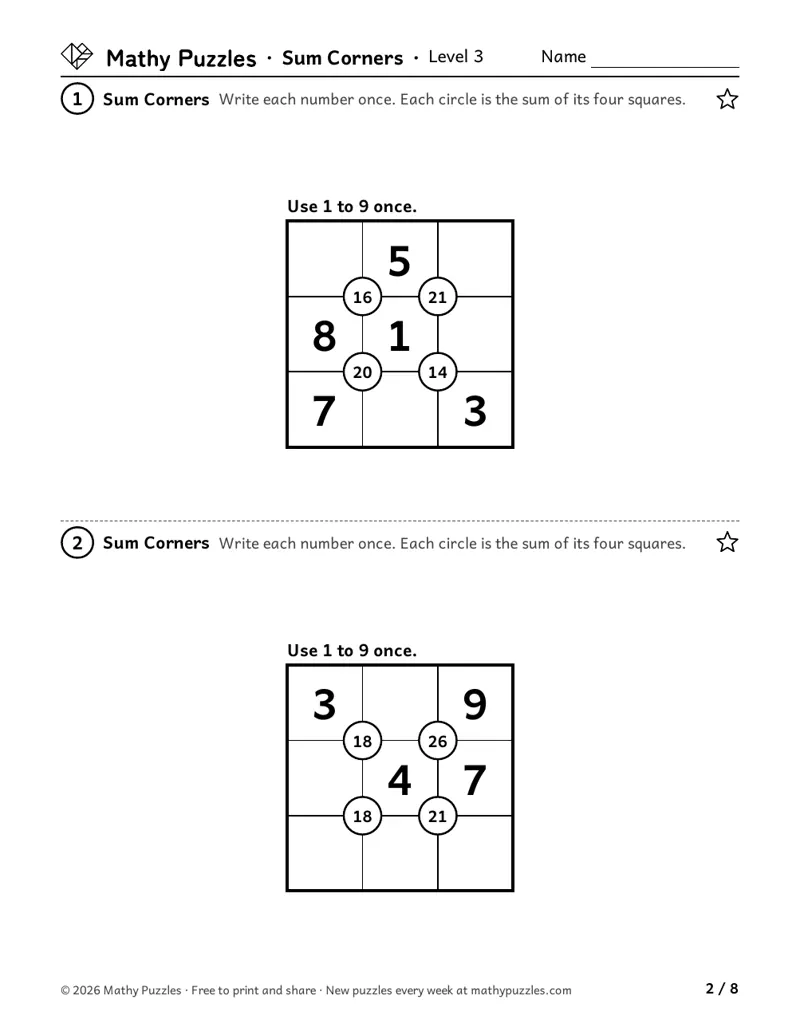 Level 3: a page from the free set
Before starting
- Level 3: add four one-digit numbers; for the 4 × 4 grids, add numbers up to 16
- Level 4: add four numbers up to 25 in your head (totals go up to 94)
What you need
Scrap paper with the numbers to cross off (1 to 9, 1 to 16 or 1 to 25), and a pencil with a good eraser.
Free puzzles to print
Each set: a Learn sheet with a worked example, 10 puzzles from easiest to hardest, and the answers.
Level 3
Ages 8–10 · Grades 3–4
First, 3 × 3 grids with four or five numbers given, then two or three given. Then a 3 × 3 grid with just one number given, or a 4 × 4 grid (1 to 16, nine circles) with six to eight given. The hardest are 4 × 4 grids with three to five numbers given.
On the sheet: “Write each number once. Each circle is the sum of its four squares.”
Print Level 3 (Letter)Other paper size: A4Level 4
Ages 10–12 · Grades 5–6
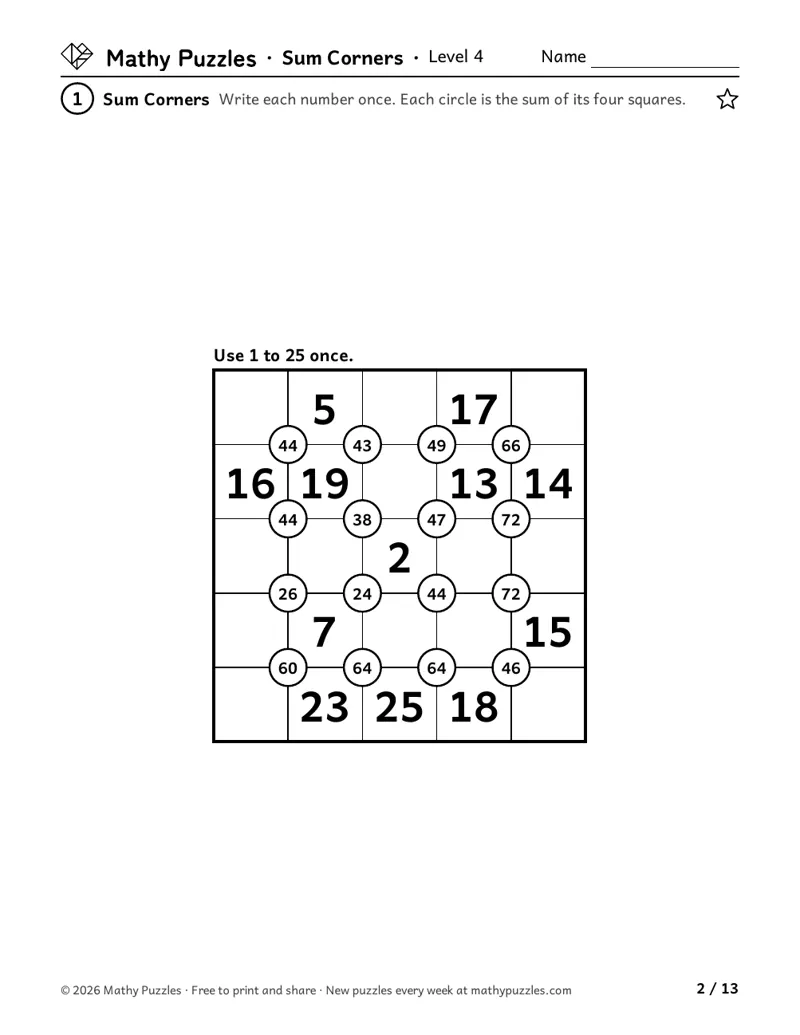
5 × 5 grids with 1 to 25 and sixteen circles. The easiest give 10 to 12 numbers, then 7 to 9. Then 5 or 6, where two circles that share two squares must be compared. The hardest give only 3 or 4 numbers.
On the sheet: “Write each number once. Each circle is the sum of its four squares.”
Print Level 4 (Letter)Other paper size: A4
How it works
Each puzzle is a square grid with a circle wherever four squares meet. The child writes each number once so that each circle shows the total of its four squares. Some numbers are given. Level 3 uses a 3 × 3 grid with 1 to 9, and in the hardest puzzles a 4 × 4 grid with 1 to 16 and nine circles. Level 4 uses a 5 × 5 grid with 1 to 25 and sixteen circles.
How to play
- Cross off the given numbers on your list.
- Find a circle with one empty square: it is the total take away the other three.
- For a circle with two empty squares, work out what they must make, and list the unused pairs that make it.
- Very small or very big totals help most: 1 + 2 + 3 + 4 = 10 is the smallest any circle can be.
- In bigger grids, compare two circles side by side: they share two squares, so their other two squares differ by the difference of the totals.
When it gets hard
Using a number twice.
Hint: Cross each number off the list as soon as you write it.
Checking only one circle.
Hint: Most squares touch two or more circles. Check every circle a square touches.
Putting a big number next to a small total.
Hint: Work out what the empty squares must make before writing anything.
Tip for grown-ups: Point out the center square of a 3 × 3 grid: it touches all four circles. Ask your child what that might tell them.
Frequently asked questions
- What should my child do when there seems to be no next move?
- Look for the circle with the fewest empty squares, or the smallest or biggest total. Every puzzle can be solved by reasoning, with no guessing.
- How does this fit a Grade 3 class?
- It is addition practice with a reason to add: children add four numbers again and again while deciding which numbers fit. Start with the 3 × 3 grids that give four or five numbers.
- Are the bigger grids a big jump?
- They are a step up. The 4 × 4 grid uses 1 to 16 and has nine circles; it appears only in the hardest Level 3 puzzles, after the 3 × 3 ones. Level 4's 5 × 5 grid uses 1 to 25 with sixteen circles, and starts with many numbers given.
Questions about printing, levels, answers or membership: see all questions.
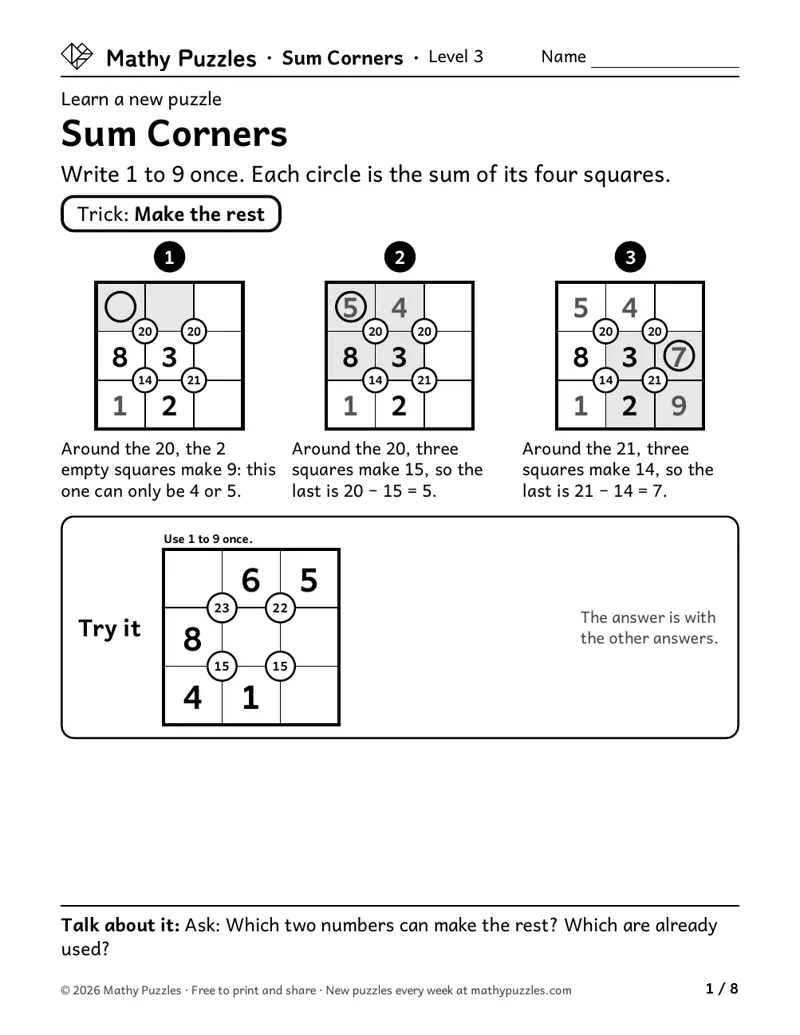
Worked example
From the Level 3 Learn sheet
- Write 1 to 9 once. Each circle is the sum of its four squares.
- Pick a circle with only one or two empty squares. Take the given numbers away from its total: the empty squares must make the rest.
- A small rest takes small numbers. If only one unused number fits, write it.
- When a circle has one empty square left, its number is the total take away the other three.
A question to ask: “Which two numbers can make the rest? Which are already used?”
Free every Sunday A mixed bag of 20 new puzzles, all four levels. Get them by email
The thinking it works on
Finding numbers that make a total
Finds which unused numbers make a needed total.
Among 48 children aged 6 to 8, those who understood how numbers can be split and recombined more often solved addition problems by splitting numbers or recalling facts. They were also faster and more accurate. Source
Waiting until one number is left
Writes a number only when the circles leave one choice.
Students in grades 2 to 5 were asked to explain their answers. They gave different kinds of explanation for conclusions that had to be true than for ones that were only likely, and were more confident of the first kind. Source
Reasoning about size
Knows a small total needs small numbers and a big total big ones.
Researchers asked 215 children aged 5 to 9 to estimate the answers to addition sums. Those further along in addition gave more reasonable estimates. Each child had a zone of partly understood sums just beyond what they could work out exactly. Source
Using shared squares
Compares two circles that share squares.
Keeping track
Keeps a running list of numbers used.
Bulley and colleagues (2020) found that children aged 4 to 11 put down markers to help them remember more often when the memory task was harder. Source
Where is this thinking used?
- Budgeting: Fitting a set of costs into several totals at once.
- Picking teams: Splitting players so each team's points add up fairly.
- Packing: Filling boxes so each one meets a weight limit.
- Schedules: Planning a day where each block of time has a set length.
For teachers
Curriculum areas
- Common Core
- Number and operations in base ten: adding up to four numbers (Grade 2) and adding and subtracting within 1,000 (Grade 3), used as tools
- NCERT
- Maths Mela (Class 3): the "Magic Sums" puzzles in Vacation with My Nani MaaLevel 4: No direct curricular match.
- National Curriculum (England)
- Number – addition and subtraction: missing number problems using number facts (Year 3), used as review
- Cambridge Primary Mathematics
- Number: adding whole numbers (Stage 3)
Math practices: see the box below.
Math practices this puzzle uses
- Uses: MP1 Make sense of problems and persevere in solving them
- Not used: MP2 Reason abstractly and quantitatively
- Not used: MP3 Construct viable arguments and critique the reasoning of others
- Not used: MP4 Model with mathematics
- Not used: MP5 Use appropriate tools strategically
- Not used: MP6 Attend to precision
- Uses: MP7 Look for and make use of structure
- Not used: MP8 Look for and express regularity in repeated reasoning
From the Common Core Standards for Mathematical Practice.
More Sum Corners puzzles for members
Members get at least 5 more worksheets at each difficulty for every puzzle, 80 new puzzles every Sunday, and the whole archive. $39 a year or $25 for 6 months.
See membershipNot ready yet?
One email, all four levels: 20 puzzles, 5 for each level.
For grown-ups (18+). One email every Sunday with the puzzles and the odd note about membership; unsubscribe any time. We never ask about your child. How we use your email