
Multiplication Grid
If 6 cookies are shared out and each friend gets 2, there were 3 friends. That is division running multiplication backward, and these grids are built on it: know an answer and one of the numbers, and you can find the other.
Free sets by level, ages 8–12:
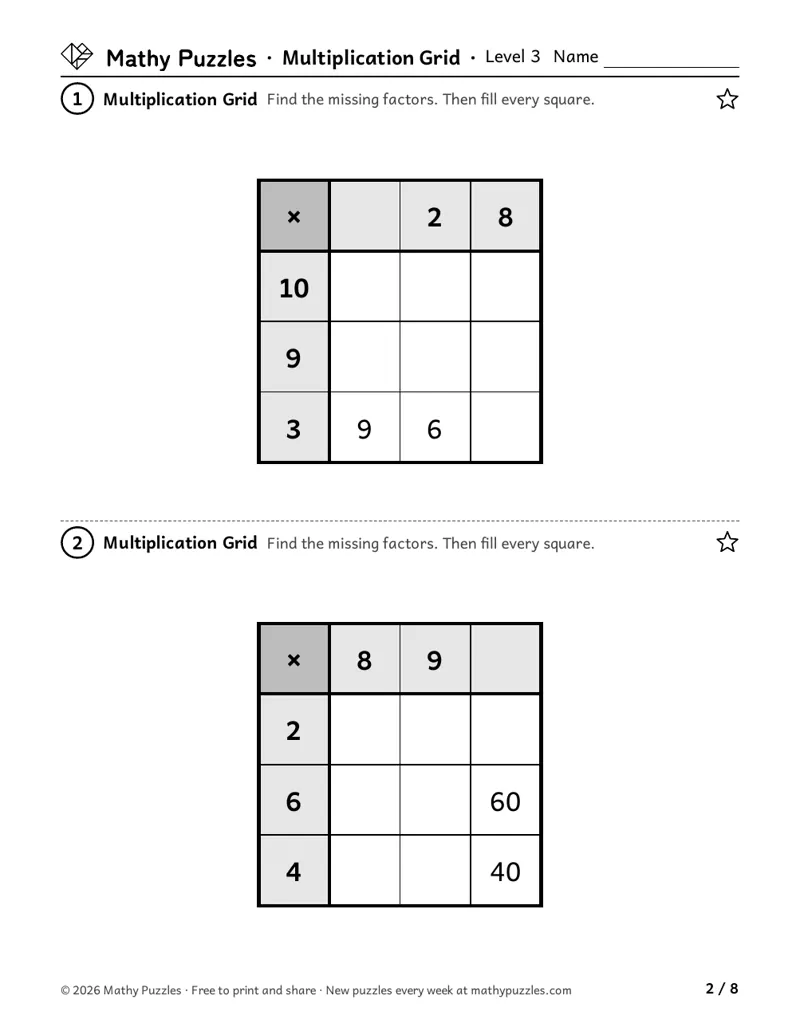 Level 3: a page from the free set
Before starting
- Level 3: multiplication facts to 10 × 10, or a chart to check against
- Level 4: multiplication facts to 12 × 12
- Know that division undoes multiplication
- Know the words factor and product (the sheet uses them)
What you need
A multiplication chart for the first few, if facts are still new, and a pencil.
Free puzzles to print
Each set: a Learn sheet with a worked example, 10 puzzles from easiest to hardest, and the answers.
Level 3
Ages 8–10 · Grades 3–4
A 3 × 3 table with one or two outside numbers missing, each found by one division. Then 4 × 4 tables where one found number helps find the next. Then every outside number is hidden. The child looks for the one number from 2 to 10 that divides two answers in the same row. The hardest are 5 × 5 and need that more than once.
On the sheet: “Find the missing factors. Then fill every square.”
Print Level 3 (Letter)Other paper size: A4Level 4
Ages 10–12 · Grades 5–6
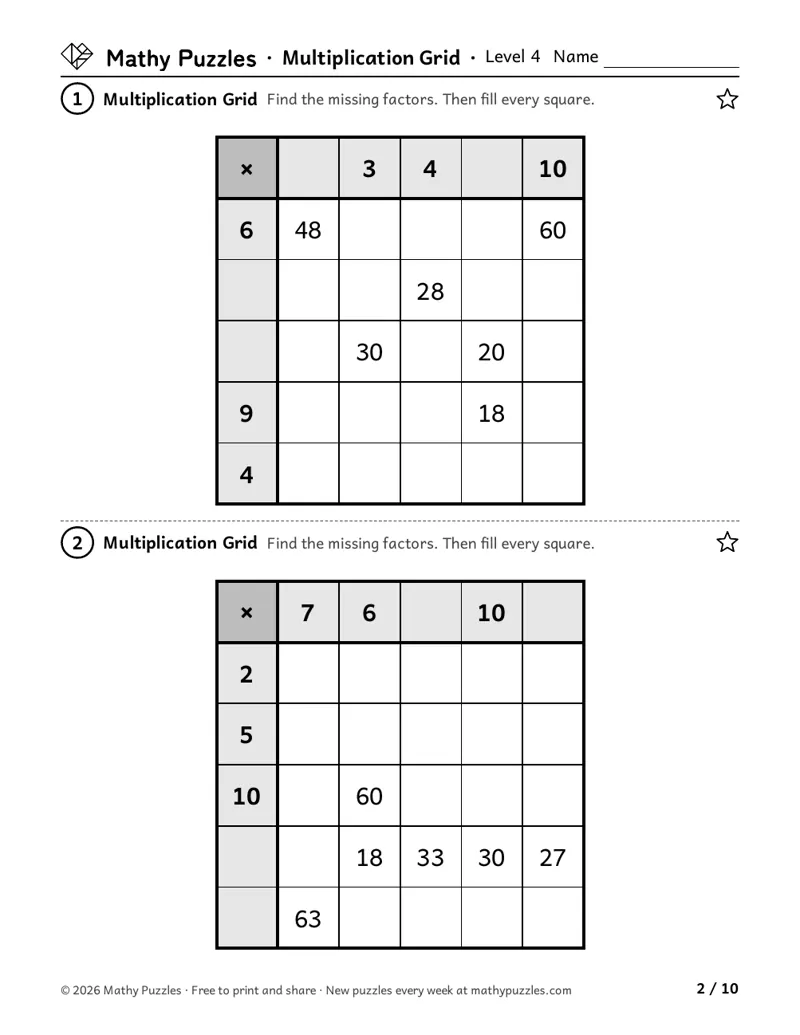
Factors from 2 to 12. The easiest are 5 × 5 tables with four to six outside numbers hidden, found one after another by dividing. Then every outside number is hidden, so a number that divides two answers is needed. Then 6 × 6 tables with every outside number hidden. The hardest show only 7 to 9 inside numbers and need that step three times or more.
On the sheet: “Find the missing factors. Then fill every square.”
Print Level 4 (Letter)Other paper size: A4
How it works
Each puzzle is a multiplication table with gaps. Factors run along the top and down the left in gray squares: 2 to 10 at Level 3, 2 to 12 at Level 4. Each inside square is its row factor times its column factor. Some outside numbers and most inside numbers are missing: the child finds the outside numbers by dividing, then fills every square.
How to play
- Find an inside number whose row or column number is shown. Divide to find the missing one.
- Write each number you find in its gray square.
- If no row or column number is shown, look for two answers in one row. Find a number that divides both (2 to 10 at Level 3, 2 to 12 at Level 4).
- When every gray square is filled, multiply to fill the inside.
When it gets hard
Picking a number that divides both answers but gives a result that is too big.
Hint: Outside numbers go from 2 to 10 at Level 3 and 2 to 12 at Level 4. If a division gives 27, try another number.
Using the same number twice along one side.
Hint: The numbers along the top are all different, and so are the ones down the side.
Mixing up the row and column number.
Hint: Put a finger on the inside square, slide left for its row number and up for its column number.
Level 4: forgetting the 11s and 12s when looking for factor pairs.
Hint: At Level 4, 132 is 11 × 12 and 72 can be 6 × 12 as well as 8 × 9. List every pair up to 12.
Tip for grown-ups: Ask "What times what makes this?" and accept every pair your child finds before choosing. Listing the pairs is the skill.
Frequently asked questions
- Is this just a multiplication drill?
- It uses multiplication facts, but the puzzle is working backward: finding the hidden row and column numbers by division and by spotting a number that divides two answers.
- What if my child doesn't know all the facts yet?
- Keep a multiplication chart on the table. The easiest Level 3 tables need just one division each, and looking facts up while solving is still practice. Level 4 uses facts up to 12 × 12, so a chart to 12 helps there.
Questions about printing, levels, answers or membership: see all questions.
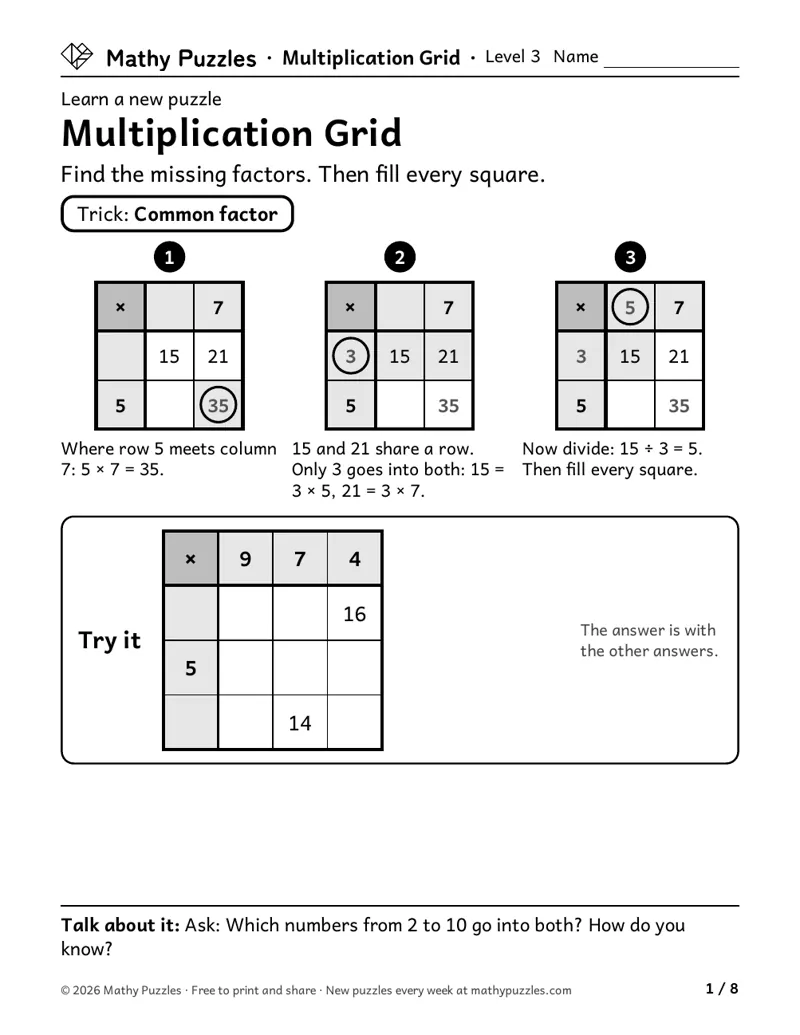
Worked example
From the Level 3 Learn sheet
- Each inside square is its row number times its column number.
- Two answers sit in the same row. Which number from 2 to 10 goes into both? Often only one does.
- That's the row number. Divide to find each column number, then fill every square.
A question to ask: “Which numbers from 2 to 10 go into both? How do you know?”
Free every Sunday A mixed bag of 20 new puzzles, all four levels. Get them by email
The thinking it works on
Knowing multiplication facts
Recalls or looks up products to 10 × 10, and to 12 × 12 at Level 4.
Steel and Funnell (2001) found that 8- and 9-year-olds mixed recall with working facts out. The 10- to 12-year-olds mostly recalled smaller facts and fell back on slower methods for larger ones. Source
Dividing to undo multiplying
Uses division to undo multiplication.
Mulligan and Mitchelmore (1997) followed girls in grades 2 and 3 solving multiplication and division word problems. They found three intuitive models at work: counting one by one, adding in groups, and multiplying. The model a child chose reflected the structure she saw in the problem. Source
Listing factor pairs
Lists every factor pair of a product.
Reasoning with two clues
Finds the one number that fits two answers at once.
Seeing how rows and columns build a table
Understands how rows and columns build each square.
Battista and colleagues (1998) found that many students do not yet see a grid of squares as rows and columns at once, as adults assume. They described levels in how students come to see it. Source
Where is this thinking used?
- Arranging chairs: Rows and columns that make a given number of seats.
- Recipes: Scaling a recipe up or down by a whole number.
- Gardening: Planting in neat rows to fill a bed.
- Money: Working out the price of one item from the cost of several.
For teachers
Curriculum areas
- Common Core
- Operations and algebraic thinking: multiplication and division within 100, division as an unknown-factor problem (Grade 3); factor pairs (Grade 4). The number system: common factors (Grade 6)
- NCERT
- Maths Mela: multiplication, division and equal groups (Classes 3–4), including the Class 4 "Mystery Matrix"; The Dairy Farm and Animal Jumps (Class 5)
- National Curriculum (England)
- Number – multiplication and division: times tables up to 12 × 12 (Year 4); common factors (Year 6)
- Cambridge Primary Mathematics
- Number: times tables; multiplication and division (Stages 3–4); common factors (Stage 6)
Math practices: see the box below.
Math practices this puzzle uses
- Not used: MP1 Make sense of problems and persevere in solving them
- Uses: MP2 Reason abstractly and quantitatively
- Not used: MP3 Construct viable arguments and critique the reasoning of others
- Not used: MP4 Model with mathematics
- Not used: MP5 Use appropriate tools strategically
- Not used: MP6 Attend to precision
- Uses: MP7 Look for and make use of structure
- Not used: MP8 Look for and express regularity in repeated reasoning
From the Common Core Standards for Mathematical Practice.
More Multiplication Grid puzzles for members
Members get at least 5 more worksheets at each difficulty for every puzzle, 80 new puzzles every Sunday, and the whole archive. $39 a year or $25 for 6 months.
See membershipNot ready yet?
One email, all four levels: 20 puzzles, 5 for each level.
For grown-ups (18+). One email every Sunday with the puzzles and the odd note about membership; unsubscribe any time. We never ask about your child. How we use your email