
Factor Hunts
Every whole number can be taken apart, like a toy built from bricks, until only the smallest bricks are left: the primes. Know how a number breaks apart, and you can find the numbers hidden in rainbows, trees and riddles.
Free sets by level, ages 8–12:
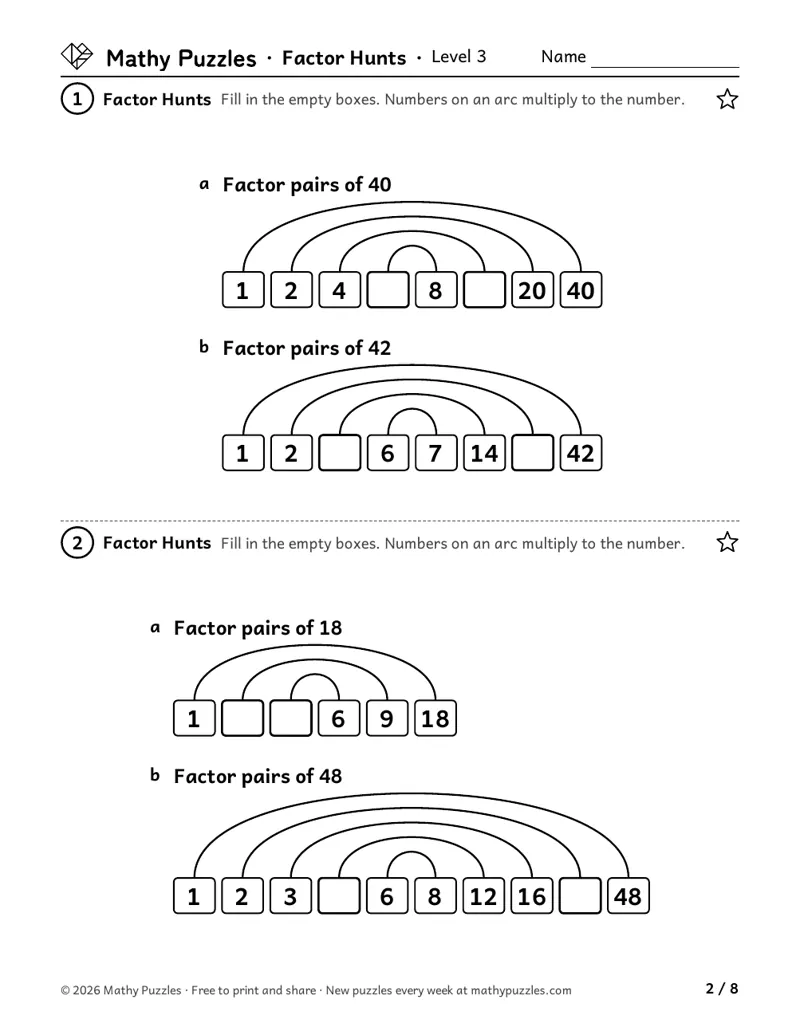 Level 3: a page from the free set
Before starting
- Level 3: multiplication and division facts to 10 × 10
- Level 4: know what a factor and a multiple are
- Helpful at both levels: know that a prime has exactly two factors, 1 and itself
What you need
Scrap paper for trying divisions, and a pencil.
Free puzzles to print
Each set: a Learn sheet with a worked example, 10 puzzles from easiest to hardest, and the answers.
Level 3
Ages 8–10 · Grades 3–4
The easiest puzzles are factor-pair rainbows for numbers 12 to 48, with two boxes empty, each in a different pair (2 × ? = 24). Then rainbows for numbers 36 to 100 where a whole pair is missing, so the child tries the numbers between its neighbors. Then lists of every factor in order, with no arcs and three or four hidden, sometimes the number itself. The hardest ask which one number is prime among four to six numbers up to 200. They also ask which number in a range up to 120 has the most factor pairs.
On the sheet: “Find the hidden factors.”
Print Level 3 (Letter)Other paper size: A4Level 4
Ages 10–12 · Grades 5–6
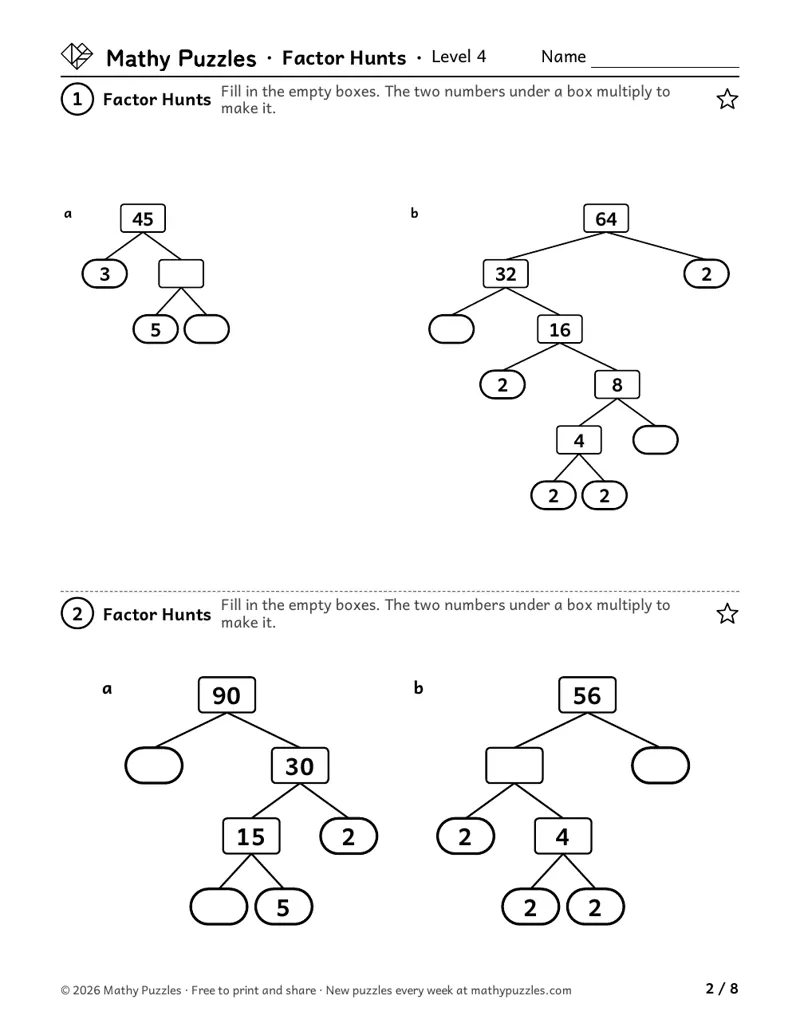
The easiest puzzles are factor trees for numbers 12 to 100 with two empty boxes (multiply up or divide down). Then bigger trees for numbers 100 to 500 with three boxes empty, one of them the top number. Then "Which number am I?" riddles with three or four clues about factors, multiples, digit sums, odd and even, squares and size; every clue is needed. The hardest find two numbers from their greatest common factor (GCF) and least common multiple (LCM).
On the sheet: “Find the hidden numbers.”
Print Level 4 (Letter)Other paper size: A4
How it works
These are number puzzles about factors and primes. At Level 3 the easiest are factor-pair rainbows: every factor of a number in a row, smallest first, with arcs joining the pairs that multiply to it. Some boxes are empty. Then come lists of factors with no arcs, and "which one is prime?" questions. At Level 4 the easiest are factor trees with two empty boxes. The two numbers under a box multiply to make it, and the round boxes at the bottom are primes. Harder ones hide the top of a bigger tree. Then come "Which number am I?" riddles with clues about factors and multiples. Last come two numbers found from their greatest common factor and least common multiple.
How to play
- In a rainbow, find an empty box whose partner on the arc you know. Divide the number by the partner.
- If a whole pair is missing, try each number between its neighbors until one divides evenly.
- In a list with no arcs, pair the first factor with the last, the second with the second-to-last, and so on.
- In a tree, find a box with both numbers under it known, and multiply them. If you know a box and one number under it, divide to find the other.
- In a riddle, start with the clue that leaves the fewest numbers. List them, then cross out with each other clue.
- For two numbers from a GCF and LCM: both are multiples of the GCF and factors of the LCM. List those and test pairs.
When it gets hard
Missing a factor when listing or counting them.
Hint: List factors in pairs from the outside in: 1 and 36, 2 and 18, 3 and 12. Stop when the pairs meet.
Calling an odd number prime just because it is odd, like 51 or 91.
Hint: Try dividing by 3, 7 and 11 too. 51 = 3 × 17 and 91 = 7 × 13.
Picking a riddle answer from one clue.
Hint: Every clue is needed. Check your number against all of them.
Mixing up GCF and LCM.
Hint: The GCF divides both numbers. The LCM is a multiple of both, so it is never smaller than either number.
Tip for grown-ups: Say factor pairs out loud together, from the outside in. Noticing that the pairs meet in the middle, and that a square number has a pair that repeats, is a small discovery worth pausing on. Scrap paper for trying divisions keeps the sheet tidy.
Frequently asked questions
- Is this much harder than multiplication practice?
- It uses the same facts, but runs them backward and asks the child to reason with them. The easiest Level 3 rainbows and Level 4 factor trees need facts to 10 × 10 and simple division. The bigger numbers, prime questions, riddles and GCF puzzles are a step up.
- Will these fit a Grade 6 unit on GCF and LCM?
- The hardest Level 4 puzzles give a GCF and an LCM and ask for the two numbers, the reverse of the usual exercise. Some of their LCMs go up to 200, beyond what the Grade 6 standard asks for. Level 3 fits a Grade 4 unit on factor pairs, primes and composites.
- What does "I have exactly 6 factors" mean?
- Count every whole number that divides it with nothing left over, including 1 and the number itself. 12 has six: 1, 2, 3, 4, 6 and 12.
Questions about printing, levels, answers or membership: see all questions.
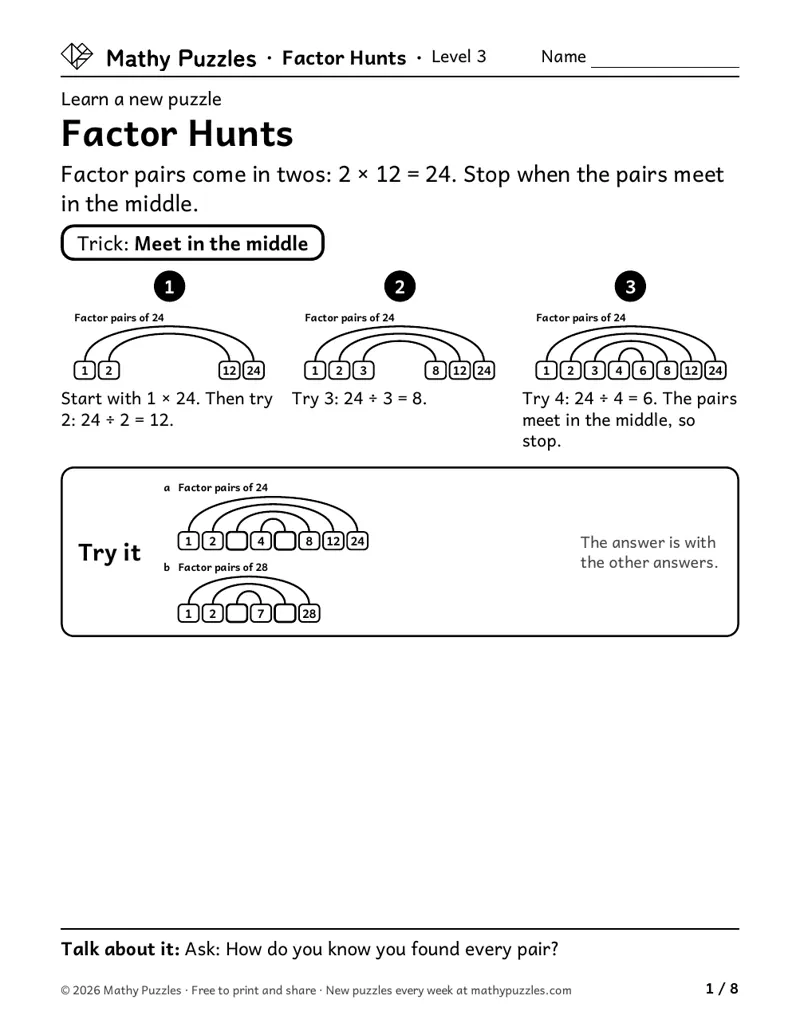
Worked example
From the Level 3 Learn sheet
- Factor pairs come in twos: two numbers on an arc multiply to make the number.
- Start with 1 times the number. Then try 2 and divide to find its partner.
- Try 3, then 4, dividing each time. A number that doesn't divide evenly has no pair.
- When the pairs meet in the middle, stop: every pair is found.
A question to ask: “How do you know you found every pair?”
Free every Sunday A mixed bag of 20 new puzzles, all four levels. Get them by email
The thinking it works on
Thinking in multiplication
Moves between a number and its factors, both up and down.
Interviews with 336 children in grades 1 to 5 found thinking in multiplication appearing early, in 45% of second graders. But it developed slowly: only 48% of fifth graders used it consistently. Source
Seeing how numbers are built
Sees primes as the parts every number is made from.
Sutarto and colleagues (2021) traced some of fourth graders' mistakes with common factors and common multiples to a shaky idea of what a prime number is. Source
Reasoning from several clues
Narrows a range of numbers clue by clue until one is left.
Crone and colleagues (2009) found that 8- to 12-year-olds were far less accurate than adults on reasoning puzzles that needed two clues combined. Source
Listing in order
Lists factors in pairs, or multiples in order, so none is missed.
A five-year case study followed one child from grade 1 to grade 5 on tasks about finding every combination. It traced how she learned to classify, organize and reorganize her lists on the way to making proofs. Source
Checking against every condition
Tests a candidate against all the facts before writing it.
Where is this thinking used?
- Sharing evenly: Splitting 24 cookies into equal bags with none left over.
- Timing: Working out when two buses that leave every 6 and every 8 minutes next leave together.
- Tiling: Finding the biggest square tile that covers a floor with no cutting.
- Secret messages: Codes that protect messages online, some of them built from two very large primes.
For teachers
Curriculum areas
- Common Core
- Operations and algebraic thinking: multiplying and dividing within 100 (Grade 3), factor pairs, primes and composites (Grade 4); The number system: greatest common factor and least common multiple (Grade 6). The hardest Level 4 puzzles look ahead: their least common multiples go above the Grade 6 limit of 12.
- NCERT
- Maths Mela: Equal Groups (Class 4, multiplying and dividing), Animal Jumps (Class 5: factors, multiples, primes, common factors), The Dairy Farm (Class 5: "Which number am I?"); Ganita Prakash (Class 6): Prime Time, including prime factorisation
- National Curriculum (England)
- Number: factor pairs (Year 4); multiples, factors and primes (Year 5); common factors and multiples (Year 6); prime factorization (Key Stage 3)
- Cambridge Primary Mathematics
- Number: factors and multiples (Stage 4); prime numbers (Stage 5); common factors (Stage 6)
Math practices: see the box below.
Math practices this puzzle uses
- Uses: MP1 Make sense of problems and persevere in solving them
- Not used: MP2 Reason abstractly and quantitatively
- Not used: MP3 Construct viable arguments and critique the reasoning of others
- Not used: MP4 Model with mathematics
- Not used: MP5 Use appropriate tools strategically
- Not used: MP6 Attend to precision
- Uses: MP7 Look for and make use of structure
- Not used: MP8 Look for and express regularity in repeated reasoning
From the Common Core Standards for Mathematical Practice.
More Factor Hunts puzzles for members
Members get at least 5 more worksheets at each difficulty for every puzzle, 80 new puzzles every Sunday, and the whole archive. $39 a year or $25 for 6 months.
See membershipNot ready yet?
One email, all four levels: 20 puzzles, 5 for each level.
For grown-ups (18+). One email every Sunday with the puzzles and the odd note about membership; unsubscribe any time. We never ask about your child. How we use your email