
Loop the Dots
A fence around a field has to close up, with no gaps and no branches. Loop the Dots builds one fence like that from small facts: a number in a square says how many of its four sides belong to the fence.
Free sets by level, ages 10–12:
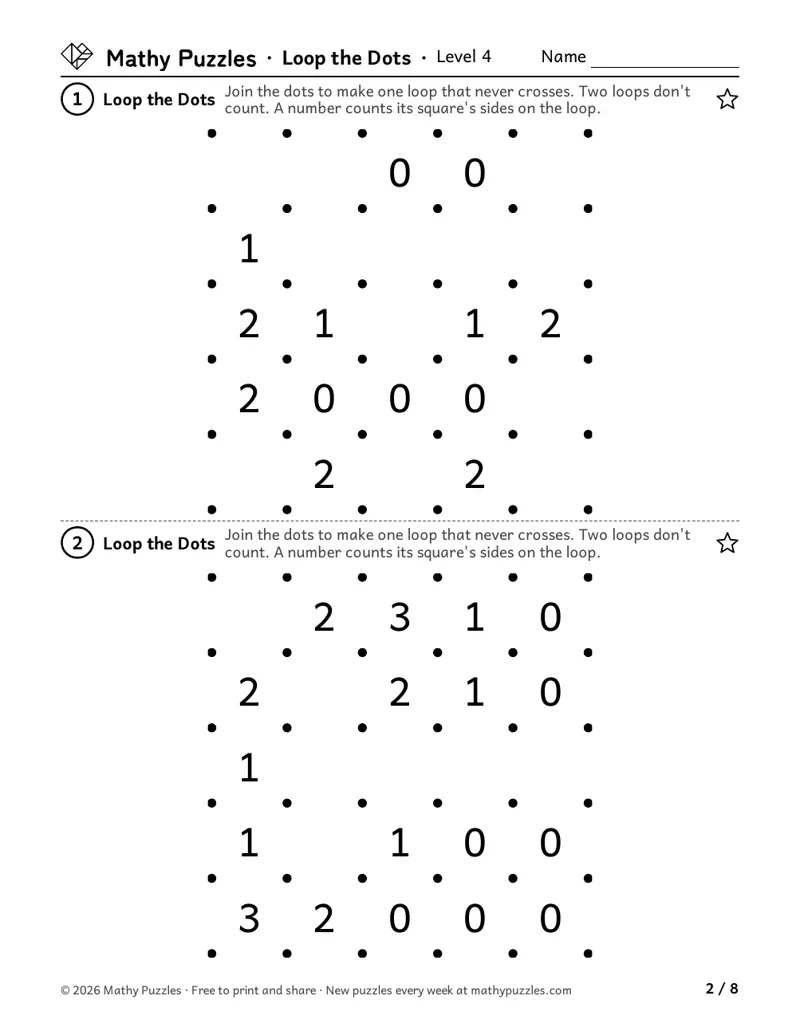 Level 4: a page from the free set
Before starting
- Know that a square has four sides
- Draw short straight lines between dots
- Know what a closed shape is: no loose ends
- Comfortable with Level 3 grid puzzles such as Light Up or Tents & Trees
Free puzzles to print
Each set: a Learn sheet with a worked example, 10 puzzles from easiest to hardest, and the answers.
Level 4
Ages 10–12 · Grades 5–6
A 5 × 5 grid with many numbers, then 6 × 6 grids with fewer numbers. These need two clues read together, such as a 3 in a corner or a 3 beside a 0. Some also need the child to keep a small loop from closing too early. The hardest are 7 × 7 grids that always need that, and may need one "what if" test.
On the sheet: “Join the dots to make one loop that never crosses. Two loops don't count. A number counts its square's sides on the loop.”
Print Level 4 (Letter)Other paper size: A4
How it works
Each puzzle is a grid of dots with numbers in some of the squares between them. The child joins neighboring dots with straight lines to make one closed loop. The loop never crosses itself or splits, and two separate loops don't count. A number says how many of its square's four sides are part of the loop.
How to play
- Start with every 0. Put a small X on all four of its sides.
- Look at each dot. The loop passes through a dot with two lines, or not at all.
- When a number has just enough open sides left, draw a line on each one.
- Keep joining until the line makes one closed loop. Two separate loops don't count.
When it gets hard
Finishing two small loops instead of one.
Hint: Before you close a loop, check that every line on the grid is part of it.
Leaving a dot with one line: a dead end.
Hint: Count the lines at each dot. It must be 0 or 2.
Counting the sides of the wrong square.
Hint: A number counts only the four sides of its own square.
Tip for grown-ups: Encourage X marks on empty sides as well as lines. Knowing where the loop can't go is half the puzzle.
Frequently asked questions
- Can the loop touch itself at a dot?
- No. Each dot has two lines or none, so the loop never crosses, touches itself or splits.
- Why is this puzzle only at Level 4?
- The one-loop rule asks a child to think about the whole drawing at once, which suits ages 10–12. Level 4 starts small, with a 5 × 5 grid and many numbers.
- Is there a good warm-up before using this with a class?
- Draw a 2 × 2 grid with a 3 and a 0 and ask which sides must be lines. Light Up and Tents & Trees at Level 3 build the same habit of marking what can't be true.
Questions about printing, levels, answers or membership: see all questions.
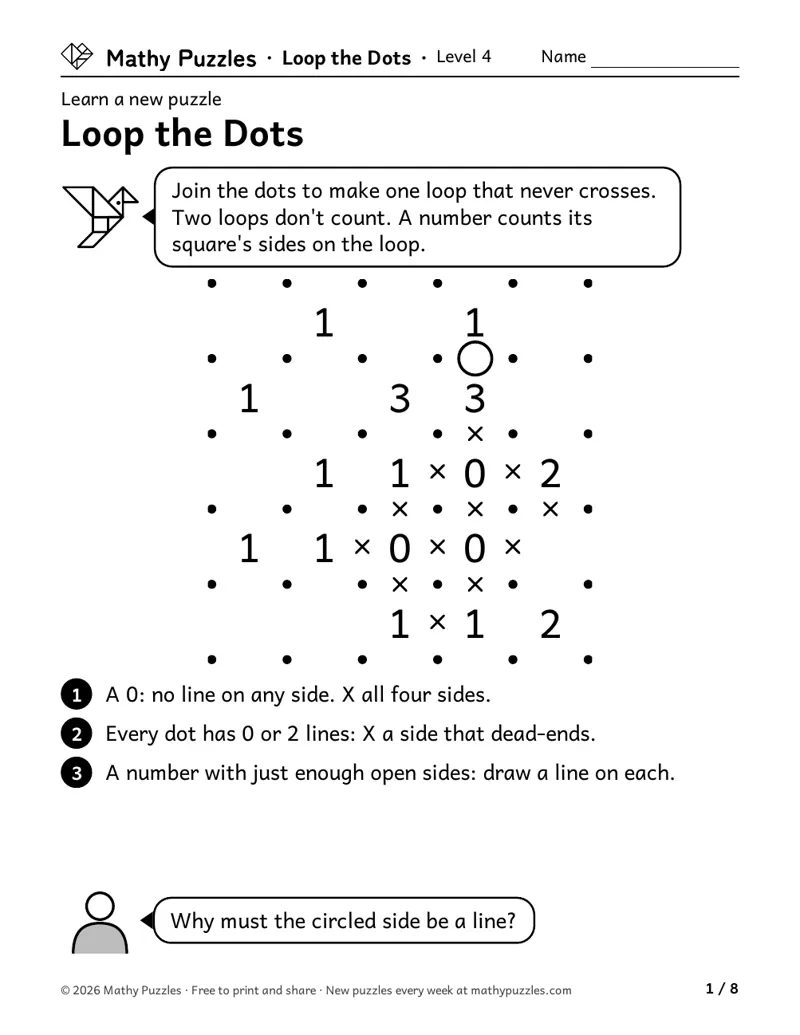
Worked example
From the Level 4 Learn sheet
- Join the dots to make one loop that never crosses. Two loops don't count. A number counts its square's sides on the loop.
- A 0: no line on any side. X all four sides.
- Every dot has 0 or 2 lines: X a side that dead-ends.
- A number with just enough open sides: draw a line on each.
A question to ask: “Why must the circled side be a line?”
Free every Sunday A mixed bag of 20 new puzzles, all four levels. Get them by email
The thinking it works on
Building a whole from parts
Sees how small line pieces join into one loop.
Mondloch and colleagues (2003) found that 10-year-olds still noticed a big shape ahead of its small parts more strongly than adults did. This lean fades between 10 and 14. Source
Counting sides
Reads a number as sides of its square on the loop.
Ruling out sides at the dots
Uses "0 or 2 lines at every dot" to rule out sides.
Spotting patterns
Recognizes clue pairs that settle sides together.
Planning ahead
Avoids closing a small loop too early.
Luciana and colleagues (2009) gave a tower puzzle that must be planned ahead to 9- to 20-year-olds; the 9- to 11-year-olds solved the fewest problems perfectly. Source
Testing a "what if"
Draws a trial line and follows where the loop must go.
Foltz, Overton and Ricco (1995) asked 100 adolescents to uncover a hidden figure. Those with more advanced (formal) reasoning looked for cases that could prove an idea wrong; others gathered cases that only agreed. Source
Where is this thinking used?
- Fencing a field: One fence goes all the way around, with no gaps and no extra branches.
- Electric circuits: A bulb lights only when the wire makes one complete loop.
- Planning a route: A bus route starts and ends at the same stop without crossing its own path.
- Drawing maps: A border is one closed line with an inside and an outside.
For teachers
Curriculum areas
- Common Core
- No direct curricular match.
- NCERT
- No direct curricular match.
- National Curriculum (England)
- No direct curricular match.
- Cambridge Primary Mathematics
- No direct curricular match.
Math practices: see the box below.
Math practices this puzzle uses
- Uses: MP1 Make sense of problems and persevere in solving them
- Not used: MP2 Reason abstractly and quantitatively
- Not used: MP3 Construct viable arguments and critique the reasoning of others
- Not used: MP4 Model with mathematics
- Not used: MP5 Use appropriate tools strategically
- Uses: MP6 Attend to precision
- Uses: MP7 Look for and make use of structure
- Not used: MP8 Look for and express regularity in repeated reasoning
From the Common Core Standards for Mathematical Practice.
More Loop the Dots puzzles for members
Members get at least 5 more worksheets at each difficulty for every puzzle, 80 new puzzles every Sunday, and the whole archive. $39 a year or $25 for 6 months.
See membershipNot ready yet?
One email, all four levels: 20 puzzles, 5 for each level.
For grown-ups (18+). One email every Sunday with the puzzles and the odd note about membership; unsubscribe any time. We never ask about your child. How we use your email