
Connect the Pairs
Anyone who has untangled a drawer of cables knows lines get in each other's way. Connect the Pairs asks for lines that never cross and together fill every square, so each line has to be planned around the others.
Free sets by level, ages 4–8:
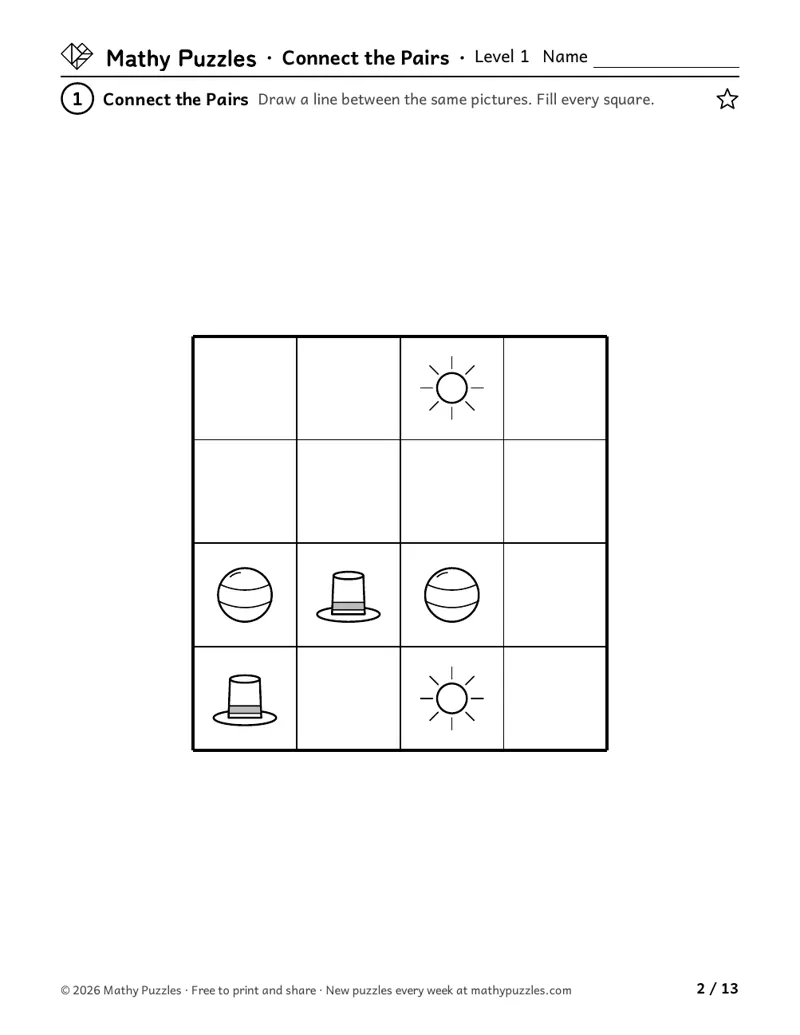 Level 1: a page from the free set
Before starting
- Draw a line from one square to the next
- Level 1: know the numbers 1 to 4 (1 to 10 in the harder puzzles), and count up to 10 dots
- Level 2: add two numbers, with answers up to 20
What you need
A different colored pencil for each pair (optional), and a pencil with a good eraser.
Free puzzles to print
Each set: a Learn sheet with a worked example, 10 puzzles from easiest to hardest, and the answers.
Level 1
Ages 4–6 · Pre-K–K
4 × 4 grids with 3 pairs of pictures, then 5 × 5 grids with 4 pairs of numbers 1 to 4. Next, numbers joined to dice cards (1 to 6). The hardest puzzles are 6 × 6 with 5 pairs. There each number joins a card of up to 10 dots in a mixed pattern, such as ten-frame rows or two dice.
On the sheet: “Join the pairs. Lines can't cross. Fill every square.”
Print Level 1 (Letter)Other paper size: A4Level 2
Ages 6–8 · Grades 1–2
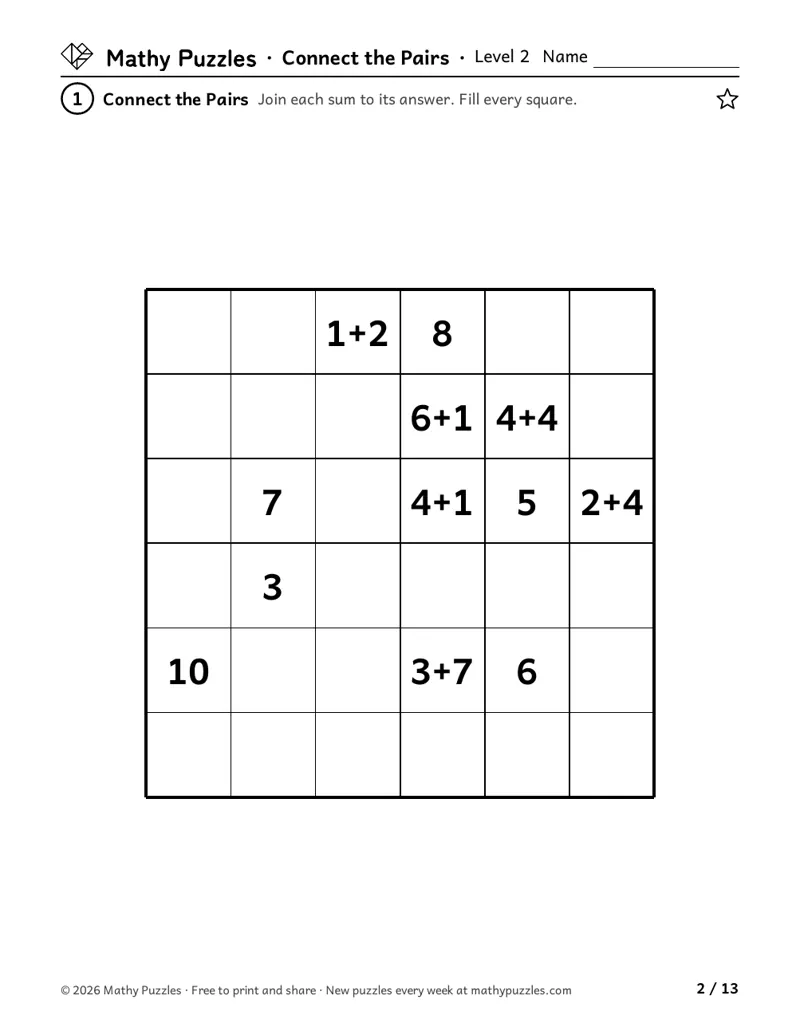
6 × 6 grids with 6 pairs, where a sum joins its answer (3+4 with 7), first with answers to 10, then to 20. Then two sums that make the same number join each other (8+5 with 6+7). The hardest puzzles are 7 × 7 with 8 pairs.
On the sheet: “Join the matching sums. Lines can't cross. Fill every square.”
Print Level 2 (Letter)Other paper size: A4
How it works
Each puzzle is a square grid with matching pairs in some squares: two apples, two 3s, or a 3 and a card with 3 dots. At Level 2 the labels are sums: a sum joins its answer (3+4 with 7). In harder puzzles, two sums that make the same number join each other. The child draws a line joining each pair. Lines go from square to square, never cross, and together they fill every square.
How to play
- Find a picture or number with only one empty square next to it: its line has just one way to start. Corners are good places to look.
- Draw that line along the edge if you can; edge lines rarely block others.
- Look for empty squares with only two ways in. A line must pass through them.
- Keep going until every pair is joined and no square is empty.
When it gets hard
Joining a pair with the shortest line, leaving squares nobody can reach.
Hint: Count the empty squares. Which line could bend to pass through them?
Cutting across a corner from one square to another.
Hint: Lines move up, down, left or right, through the side of a square.
Joining a number to the wrong dot card.
Hint: Count the dots on the card, then find the number that says the same.
Level 2: joining two sums that look alike but make different numbers.
Hint: Work out each sum and write its answer small in the corner of the square before drawing.
Tip for grown-ups: Let the first line be wrong. Erasing and rerouting is the real work here; ask which square is still lonely. A different color for each pair keeps the lines apart.
Frequently asked questions
- Why does every square have to be filled?
- Without that rule, lines could wander anywhere and many drawings would work. Filling every square makes the routes depend on each other, so a matching page becomes a planning puzzle.
- Our lines don't match the answers. What now?
- Check that every square has a line, no lines cross, and each line joins a true pair. If one of these breaks, find the empty square and reroute the line next to it. A grid that keeps all three rules is right.
- Does this fit a kindergarten math block?
- Yes. The easier puzzles are about planning routes. The harder ones join a number to a card with that many dots, which is kindergarten work on numbers and how many. One puzzle fills a page.
Questions about printing, levels, answers or membership: see all questions.
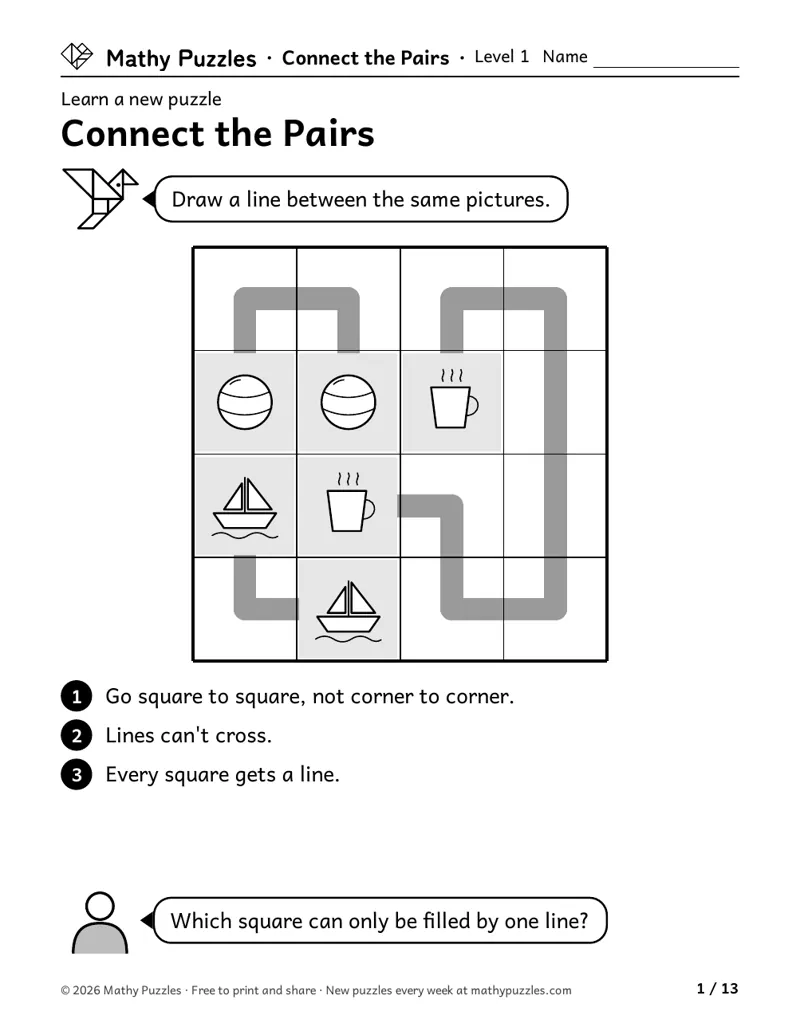
Worked example
From the Level 1 Learn sheet
- Draw a line between the same pictures.
- Go square to square, not corner to corner.
- Lines can't cross.
- Every square gets a line.
A question to ask: “Which square can only be filled by one line?”
Free every Sunday A mixed bag of 20 new puzzles, all four levels. Get them by email
The thinking it works on
Planning ahead
Thinks about where the other lines must go before drawing one.
Unterrainer and colleagues (2013) tested children aged 4 and 5, and again a year later, on a task where some problems need a few moves of look-ahead. Accuracy on those problems rose with age and over the year. Problems needing no look-ahead were easy even at 4. Source
Spotting moves that must happen
Finds squares that only one line can reach.
Gautam, Suddendorf and Redshaw (2021) found that children from 2½ passed a simple version of the empty-cup test (reasoning by elimination). Only 5-year-olds passed a version that ruled out shortcuts. Source
Holding back the first idea
Stops the quick, straight line when it would cause trouble.
Carlson (2005) reported how 602 children aged 2 to 6 did on self-control tasks, with age trends and a scale of which tasks are hard at each age. Source
Matching numbers to dots
Matches a written number to a card with that many dots.
Mundy and Gilmore (2009) found that matching written numbers to dot sets, and dot sets to written numbers, develops between ages 6 and 8. Source
Adding to find a partner
Works out each sum to see which label it pairs with.
Farrington-Flint and colleagues (2010) found that 5- to 7-year-olds used links between related addition problems more often as they got older. Source
Finding routes on a grid
Follows routes through a grid, square by square.
Checking work
Looks over the whole grid for empty squares and crossings.
Lyons and Ghetti (2011) found that 3- to 5-year-olds could already tell when an answer of theirs was likely wrong. This sense of certainty sharpened with age. Source
Where is this thinking used?
- Wiring and pipes: Lines that must never cross still have to reach every spot.
- Circuit boards: Many connections share one small board, so each route is planned around the others.
- Garden and park paths: Paths join the places that belong together without cutting through each other.
- Delivery routes: Every stop gets visited, and no road is wasted.
For teachers
Curriculum areas
- Common Core
- Counting and cardinality: matching a written number to a group of dots (Kindergarten)
- Common Core
- Operations and algebraic thinking: adding within 20 and what the equal sign means (Grades 1–2)
- NCERT
- Joyful Mathematics (Class 1): matching a number to a group of dots (Mango Treat), and matching sums to their answers (How Many?, Vegetable Farm)
- National Curriculum (England)
- Early years number: numbers to 10 (Reception); Number: representing numbers with pictures (Year 1); addition facts to 20 (Year 2)
- Cambridge Primary Mathematics
- Number: counting and recognizing amounts (Stage 1); adding within 20 (Stage 1)
Math practices: see the box below.
Math practices this puzzle uses
- Uses: MP1 Make sense of problems and persevere in solving them
- Not used: MP2 Reason abstractly and quantitatively
- Not used: MP3 Construct viable arguments and critique the reasoning of others
- Not used: MP4 Model with mathematics
- Not used: MP5 Use appropriate tools strategically
- Not used: MP6 Attend to precision
- Not used: MP7 Look for and make use of structure
- Not used: MP8 Look for and express regularity in repeated reasoning
From the Common Core Standards for Mathematical Practice.
More Connect the Pairs puzzles for members
Members get at least 5 more worksheets at each difficulty for every puzzle, 80 new puzzles every Sunday, and the whole archive. $39 a year or $25 for 6 months.
See membershipNot ready yet?
One email, all four levels: 20 puzzles, 5 for each level.
For grown-ups (18+). One email every Sunday with the puzzles and the odd note about membership; unsubscribe any time. We never ask about your child. How we use your email