
Dot Cards
Roll a die and you know it shows five before you have counted a single dot. Dot Cards play on that. Small numbers are seen at a glance, and bigger ones are seen as parts, so eight dots become two fours, or a five and a three.
Free sets by level, ages 4–6:
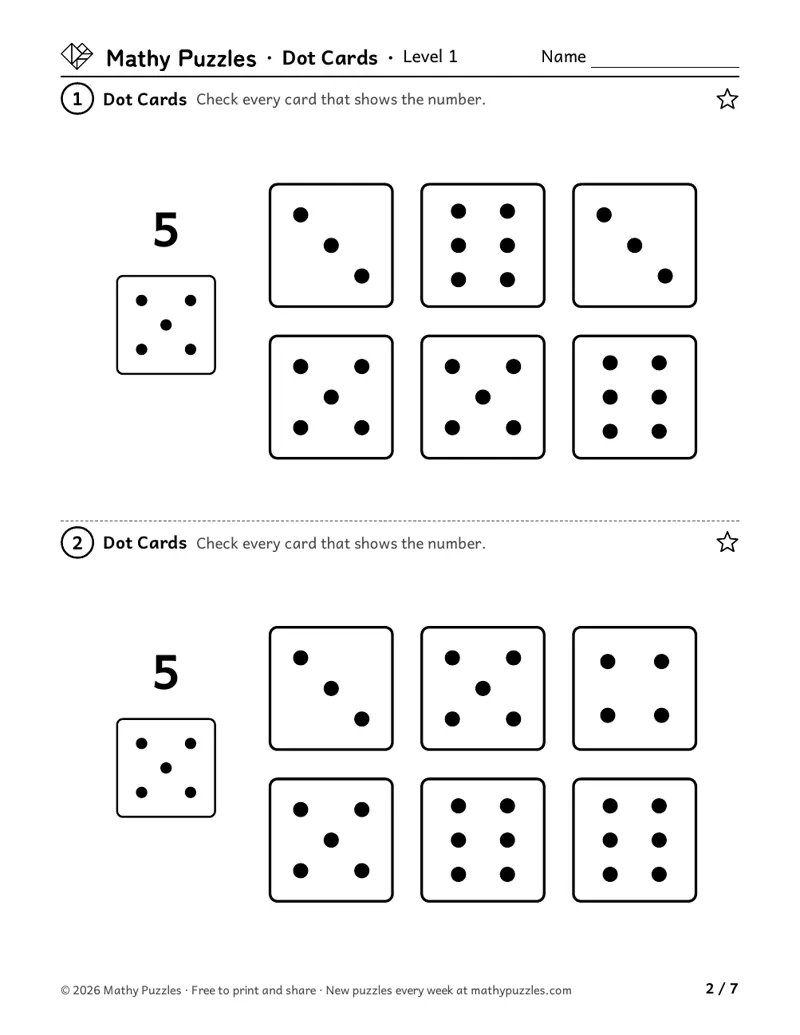 Level 1: a page from the free set
Before starting
- Level 1: say the numbers 1 to 10 in order
- Level 1: count a small group of things, touching each once
Free puzzles to print
Each set: a Learn sheet with a worked example, 10 puzzles from easiest to hardest, and the answers.
Level 1
Ages 4–6 · Pre-K–K
The easiest puzzles use dice patterns from 1 to 6; the number to find is 2 to 5, and 2 of the 6 cards show it.
Then mixed patterns up to 10: dice, ten-frame rows, two rows, two dice side by side, and scattered dots.
Then two-part cards with filled and open dots, such as 5 and 3, up to 10.
The hardest puzzles show 4 cards on top and 4 below with the same four numbers in different patterns; the child draws a line between cards that match.
On the sheet: “Look quickly. How many dots?”
Print Level 1 (Letter)Other paper size: A4
How it works
Each page holds small cards with dots in a pattern: dice faces, ten-frame rows, two rows, two groups, or scattered dots. The child checks every card that shows the number asked for. In the hardest puzzles they join the cards that show the same number. To make it a game, cover the cards with your hand and lift it for one second. There's no time to count, so the child has to see the number.
How to play
- Look at the number at the top. That is the number to find.
- Look at one card at a time. Try to see the number without counting each dot.
- If a card is hard, look for parts: a row of 5 and 2 more, or two small dice faces.
- Check every card that matches. There can be more than one.
When it gets hard
Stopping after the first matching card.
Hint: Look at every card; two or three can show the number.
Picking a card that is one more or one less.
Hint: Close numbers look alike. Find the parts: 5 on top and how many more?
Counting the same dot twice on a scattered card.
Hint: Touch each dot once with the pencil tip, or find small groups first.
Tip for grown-ups: Make the quick look a game: cover the card, lift your hand for a second, and ask how many. Then ask how they saw it.
Frequently asked questions
- Why cover the cards?
- On paper a child can count every dot slowly. A quick look of about one second pushes them to see the number, or to see parts like 5 and 2. It is a game, not a test, and slow counting afterward is fine.
- My child counts every dot one by one. Is that okay?
- Yes. Counting comes first. Over time, ask "Can you see a 3 in there?" and point to small groups.
- How can I run quick looks with a small group?
- Hold one printed card up for a second, then hide it, and ask how many and how they knew. Children often see the same card in different ways, and hearing each other is part of the lesson.
Questions about printing, levels, answers or membership: see all questions.
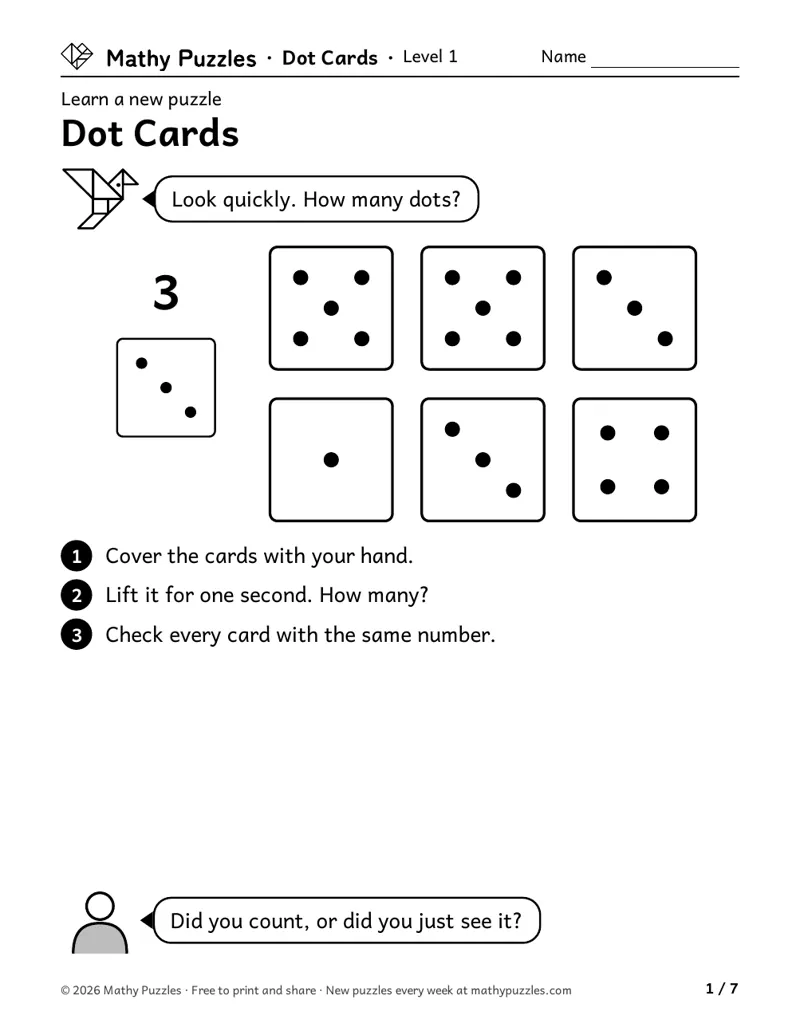
Worked example
From the Level 1 Learn sheet
- Look quickly. How many dots?
- Cover the cards with your hand.
- Lift it for one second. How many?
- Check every card with the same number.
A question to ask: “Did you count, or did you just see it?”
Free every Sunday A mixed bag of 20 new puzzles, all four levels. Get them by email
The thinking it works on
Seeing numbers at a glance
Knows how many dots there are without counting them one by one.
Starkey and Cooper (1995) concluded that seeing how many are in a small set at a glance develops before counting does, in children aged 2 to 5. Source
Seeing parts of a number
Sees a bigger number as two smaller groups.
Starkey and McCandliss (2014) found that kindergartners counted dots arranged in small groups no faster than scattered dots, while from first grade on, grouping made counting faster. Source
The number stays the same
Knows that 6 dots are 6 in any pattern.
Gelman and Tucker (1975) found that 3- and 4-year-olds treated swapping an item for one of a different color or kind as leaving the number the same. Source
Telling close numbers apart
Notices when a card has one dot too many or too few.
Halberda and Feigenson (2008) tested 3- to 6-year-olds and adults on telling two groups of dots apart. The ability to tell close numbers apart kept sharpening through childhood, reaching adult levels surprisingly late. Source
Careful searching
Looks at every card, not just the first match.
Matching pairs
Joins two cards that show the same number in different patterns.
Mix (2008) found that preschoolers matched sets by number less often when the objects' looks suggested another match; only children who knew the number words beat chance. Source
Where is this thinking used?
- Board games: Dice and dominoes are read at a glance, not counted dot by dot.
- Scorekeeping: Tally marks in groups of five are read faster than single lines.
- Checking a set: A box of six eggs or a row of crayons shows at once whether one is missing.
- Reading charts: A glance at a picture chart says which group is bigger.
For teachers
Curriculum areas
- Common Core
- Counting and cardinality: telling how many in lines, arrays and scattered groups up to 10, and seeing that the number stays the same however the dots are arranged (Kindergarten)
- NCERT
- Joyful Mathematics (Class 1): dot patterns and flash cards in Making 10
- National Curriculum (England)
- Early years number: recognizing quantities without counting, up to 5 (Reception); representing numbers with pictures (Year 1)
- Cambridge Primary Mathematics
- Number: seeing how many objects are in a pattern without counting (Stages 1–2)
Math practices: see the box below.
Math practices this puzzle uses
- Not used: MP1 Make sense of problems and persevere in solving them
- Not used: MP2 Reason abstractly and quantitatively
- Not used: MP3 Construct viable arguments and critique the reasoning of others
- Not used: MP4 Model with mathematics
- Not used: MP5 Use appropriate tools strategically
- Not used: MP6 Attend to precision
- Uses: MP7 Look for and make use of structure
- Not used: MP8 Look for and express regularity in repeated reasoning
From the Common Core Standards for Mathematical Practice.
More Dot Cards puzzles for members
Members get at least 5 more worksheets at each difficulty for every puzzle, 80 new puzzles every Sunday, and the whole archive. $39 a year or $25 for 6 months.
See membershipNot ready yet?
One email, all four levels: 20 puzzles, 5 for each level.
For grown-ups (18+). One email every Sunday with the puzzles and the odd note about membership; unsubscribe any time. We never ask about your child. How we use your email