
Ten-Frame Puzzles
A box of ten chocolates shows at a glance how many have been eaten. A ten frame works the same way. Five on top and some more shows a number quickly. The empty boxes show how many more make 10, and full frames count as tens.
Free sets by level, ages 4–8:
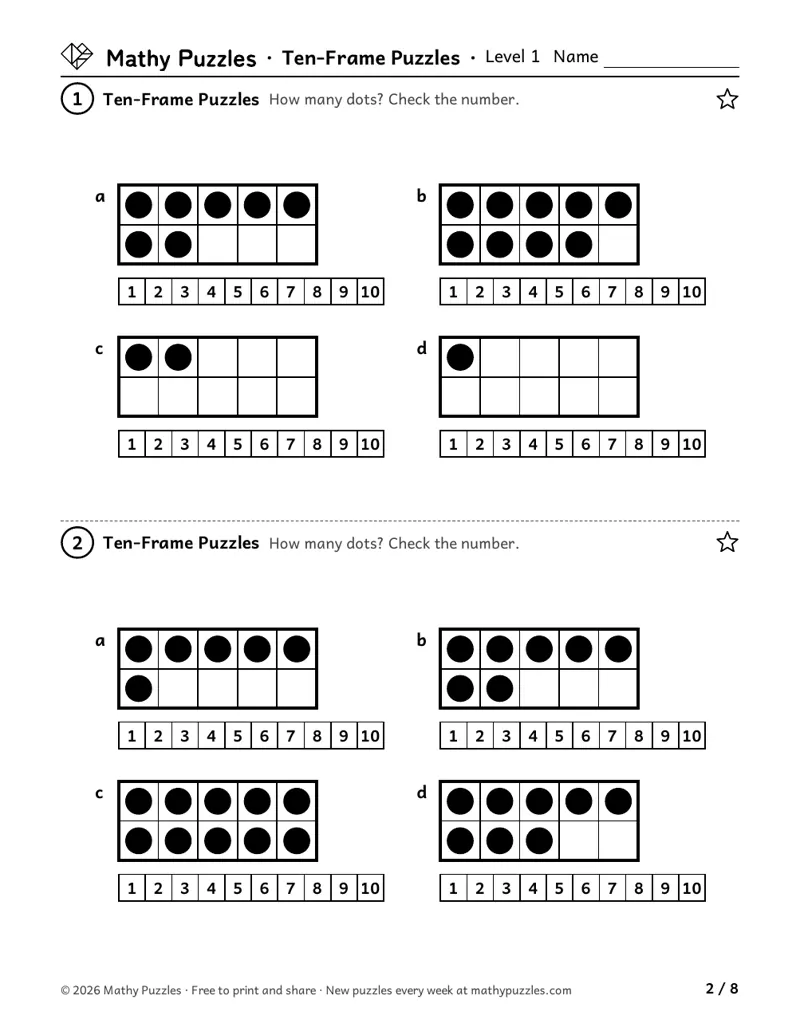 Level 1: a page from the free set
Before starting
- Level 1: count to 10 (to 20 for the hardest)
- Level 1: recognize the numbers 1 to 10
- Level 2: know the pairs that make 10, and count to 100
What you need
Ten small things, like beans or coins, to build the frames on the table, and a pencil.
Free puzzles to print
Each set: a Learn sheet with a worked example, 10 puzzles from easiest to hardest, and the answers.
Level 1
Ages 4–6 · Pre-K–K
The easiest cards ask "How many dots?" on five frames and ten frames filled the usual way (top row first, left to right). Then "How many more make 10?" on four ten frames. Then find the two frames that make 10 together, and the frame that is not like the others. Three frames show the same number in different layouts, and one shows one more or one less; some dots are scattered. The hardest cards use double ten frames for 11 to 20, and the child writes the number.
On the sheet: “Look at the ten frames. Answer each one.”
Print Level 1 (Letter)Other paper size: A4Level 2
Ages 6–8 · Grades 1–2
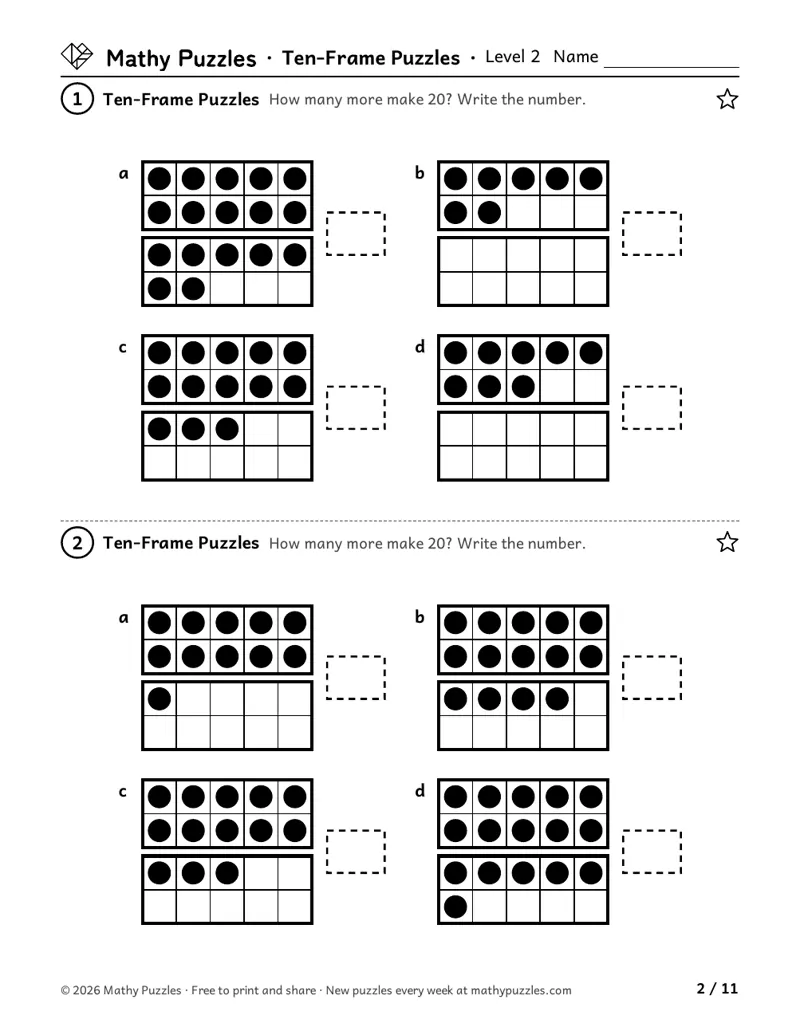
First, "How many more make 20?" on double frames. Then adding on two frames, such as 8 + 5, where hollow dots fill the first frame to ten and the rest spill into the second. Then check the two double frames that make a teen number, such as 15. The hardest show several full frames and one part frame, and the child writes the number of tens and ones, up to 99.
On the sheet: “Look at the ten frames. Answer each one.”
Print Level 2 (Letter)Other paper size: A4
How it works
A ten frame is 2 rows of 5 boxes, with dots in some boxes. Each card asks short questions about the frames. How many dots? How many more make 10? Which two frames make 10 together, and which frame is not like the others? For the teen numbers, how many dots are in a double frame? At Level 2 the questions grow. They ask how many more make 20, and add by making a ten first (8 + 5). They also ask which two double frames make a teen number, and count tens and ones to 100.
How to play
- Look at the top row first. A full row is 5.
- Count the dots in the bottom row and add them to 5. A full frame is 10.
- For "how many more make 10", count the empty boxes.
- Check or write the answer for each frame on the card.
When it gets hard
Counting every dot one by one, even in a full row.
Hint: A full row is always 5. Start at 5 and count on.
Giving the number of dots when the question asks how many more make 10.
Hint: Read the question again. Count the empty boxes.
Picking a frame that looks different as the odd one.
Hint: The odd one has a different number, not a different pattern. Count each frame.
Level 2: counting every dot on a tens-and-ones card.
Hint: Each full frame is 10. Count the full frames by tens, then add the part frame.
Tip for grown-ups: Ask "How did you see it?" Children who say "5 and 2" are using the frame, which is the point.
Frequently asked questions
- Why does the top row always fill first?
- Filling the top row first, left to right, makes numbers easy to see: a full row is 5, so 7 is 5 and 2. Some harder puzzles scatter the dots on purpose, so the child counts and doesn't rely on the look alone.
- What does a double ten frame show?
- Two ten frames, one above the other. When the top frame is full it shows 10, so a full frame and 3 more is 13. It shows why the teen numbers start with a 1.
Questions about printing, levels, answers or membership: see all questions.
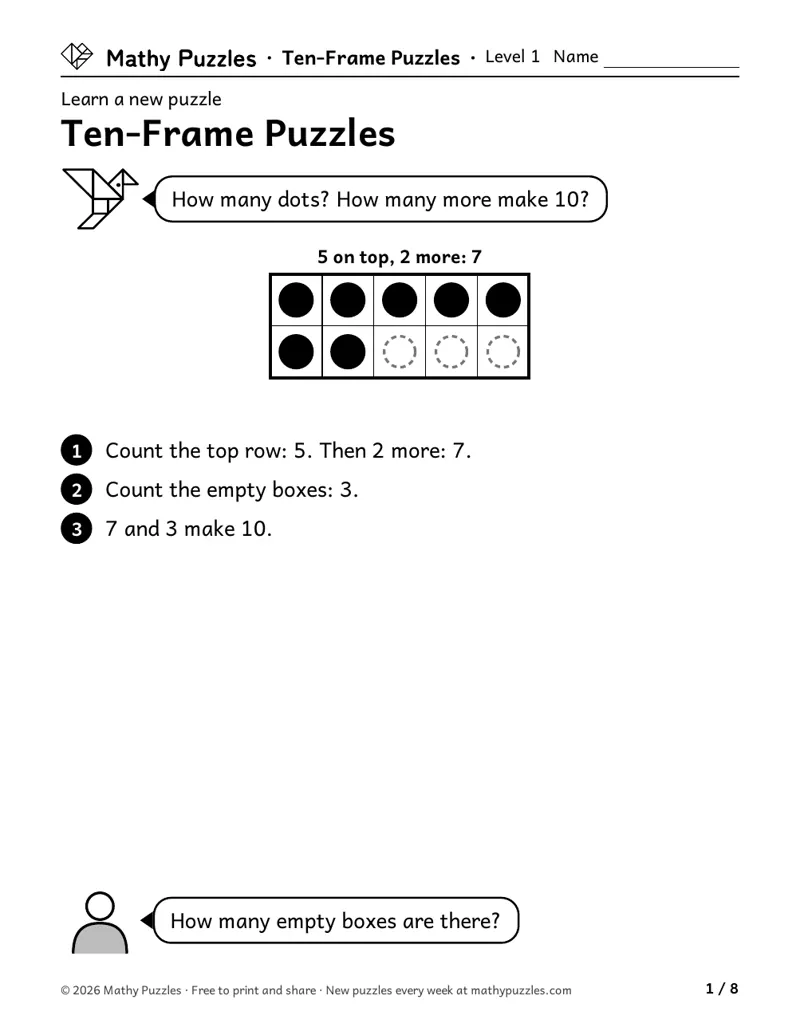
Worked example
From the Level 1 Learn sheet
- How many dots? How many more make 10?
- Count the top row: 5. Then 2 more: 7.
- Count the empty boxes: 3.
- 7 and 3 make 10.
A question to ask: “How many empty boxes are there?”
Free every Sunday A mixed bag of 20 new puzzles, all four levels. Get them by email
The thinking it works on
Seeing numbers in fives
Uses the row of 5 to see a number quickly.
Jansen and colleagues (2014) found that 4- to 6-year-olds saw up to three dots at a glance. The layout of larger sets, such as dice patterns, mattered a lot. Source
Pairs that make 10
Knows how many more make 10.
Fuson and Kwon (1992) found that Korean first graders solved most sums over 10 correctly, often by breaking numbers apart around ten. Number words like 'ten two' for 12 helped them. Source
Teen numbers as ten and more
Sees a full frame and some more as a teen number.
In Ho and Fuson's (1998) study, about half of the Chinese 5-year-olds who could count high already saw a teen amount as ten and some ones. Their number words say 'ten two' for 12. Source
The number stays the same
Knows the number doesn't change when dots move.
Houdé and colleagues (2011) found that 5- and 6-year-olds did not yet treat a number as unchanged when its items were moved apart, while 9- and 10-year-olds did. Source
Testing pairs
Checks pairs of frames in a steady way.
Tens and ones
Counts full frames as tens and the rest as ones.
Mix and colleagues (2014) found that even 3-year-olds showed some skill at reading numbers with more than one digit. Children reached the top of these tasks by first grade. Source
Where is this thinking used?
- Fingers and hands: Two hands make ten, and one full hand is five.
- Coins: Ten pennies trade for a dime, so amounts are counted in tens and ones.
- Packs of ten: Pencils, crayons and markers often come in boxes of ten, so a gap shows what's missing.
- Rows of seats: Five seats in a row and two rows make a quick count of who is missing.
For teachers
Curriculum areas
- Common Core
- Counting and cardinality: telling how many; Operations and algebraic thinking: finding the number that makes 10 (Kindergarten) and adding within 20 by making ten (Grade 1); Number and operations in base ten: teen numbers as ten and some ones (Kindergarten), tens and ones to 100 (Grade 1)
- NCERT
- Joyful Mathematics (Class 1): ten frames, pairs that make 10 and teen numbers in Making 10; tens frames for numbers to 50 in Fun with Numbers
- National Curriculum (England)
- Early years number: the parts of numbers to 10 and number bonds (Reception); number bonds within 20 (Year 1); facts to 20 and tens and ones (Year 2)
- Cambridge Primary Mathematics
- Number: seeing amounts without counting; pairs that make 10 and 20; tens and ones (Stages 1–2)
Math practices: see the box below.
Math practices this puzzle uses
- Not used: MP1 Make sense of problems and persevere in solving them
- Not used: MP2 Reason abstractly and quantitatively
- Not used: MP3 Construct viable arguments and critique the reasoning of others
- Not used: MP4 Model with mathematics
- Not used: MP5 Use appropriate tools strategically
- Not used: MP6 Attend to precision
- Uses: MP7 Look for and make use of structure
- Not used: MP8 Look for and express regularity in repeated reasoning
From the Common Core Standards for Mathematical Practice.
More Ten-Frame Puzzles for members
Members get at least 5 more worksheets at each difficulty for every puzzle, 80 new puzzles every Sunday, and the whole archive. $39 a year or $25 for 6 months.
See membershipNot ready yet?
One email, all four levels: 20 puzzles, 5 for each level.
For grown-ups (18+). One email every Sunday with the puzzles and the odd note about membership; unsubscribe any time. We never ask about your child. How we use your email