
Light Up
A lamp in a hallway lights the whole hall until a wall gets in the way. Light Up asks for just enough lamps to light every square, with no lamp shining on another, so each one has to earn its place.
Free sets by level, ages 8–12:
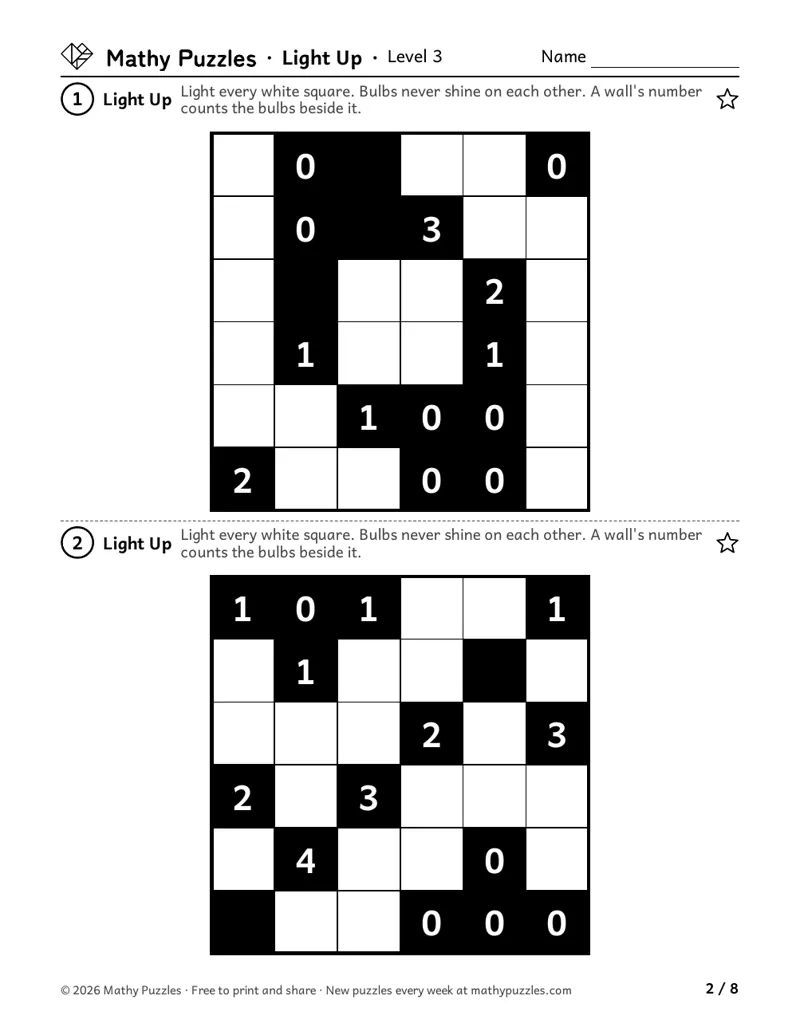 Level 3: a page from the free set
Before starting
- Know rows and columns
- Count to 4
- Know that a wall blocks light
- Level 4: comfortable with Level 3 grids
What you need
Colored pencils for shading the lit squares (optional), and a pencil with a good eraser.
Free puzzles to print
Each set: a Learn sheet with a worked example, 10 puzzles from easiest to hardest, and the answers.
Level 3
Ages 8–10 · Grades 3–4
A 6 × 6 grid with most walls numbered, then 7 × 7 grids that need "only one square can light it"; the hardest have fewer numbers.
On the sheet: “Light every white square. Bulbs never shine on each other. A wall's number counts the bulbs beside it.”
Print Level 3 (Letter)Other paper size: A4Level 4
Ages 10–12 · Grades 5–6
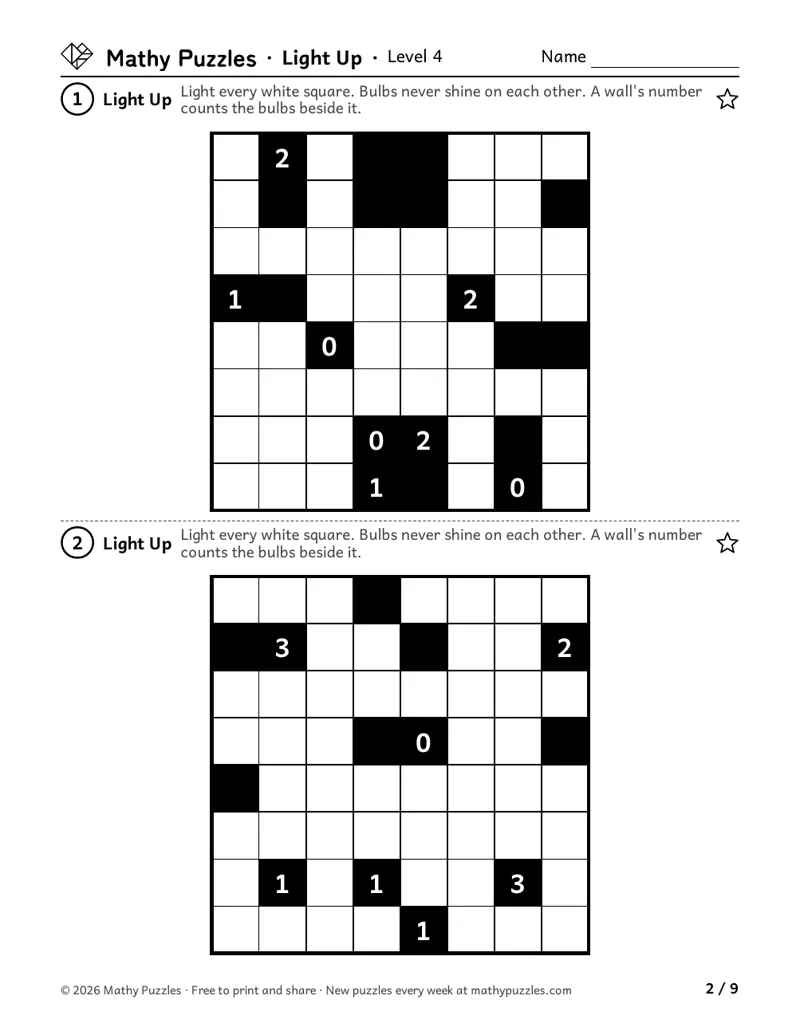
8 × 8, then 9 × 9 grids, where two clues sharing squares may need comparing. The hardest are 10 × 10 and a full-page 12 × 12, with few numbers and one "what if" test.
On the sheet: “Light every white square. Bulbs never shine on each other. A wall's number counts the bulbs beside it.”
Print Level 4 (Letter)Other paper size: A4
How it works
Each puzzle is a square grid with some black walls. The child draws light bulbs in white squares. A bulb lights its whole row and column until a wall stops the light. Every white square must be lit, and no bulb may shine on another bulb. A number on a wall says how many bulbs touch it: above, below, left or right.
How to play
- Start with the numbered walls. A 0 gets no bulbs beside it; a 4 gets a bulb on every side.
- Draw a bulb, then dot every square its light reaches, up to the walls.
- Find a dark square that only one spot can still light. Put the bulb there.
- Check that every number has the right count of bulbs and every white square is lit.
When it gets hard
Letting the light turn a corner.
Hint: Light only goes straight. Trace it with a finger and stop at the first wall.
Counting a bulb at a wall's corner toward its number.
Hint: A wall's number counts only the squares above, below, left and right of it.
Two bulbs in one row with no wall between them.
Hint: After each bulb, dot its light. A dotted square can never take a bulb.
Tip for grown-ups: Lightly shading the lit squares helps: seeing the light spread makes the dark squares stand out.
Frequently asked questions
- Can light pass through a wall with a number?
- No. Every black square is a wall, numbered or not. Light stops at the first wall it meets.
- Why do some walls have no number?
- A plain wall still blocks light; it just doesn't say how many bulbs touch it. The hardest puzzles have fewer numbers, so the light itself becomes the main clue.
Questions about printing, levels, answers or membership: see all questions.
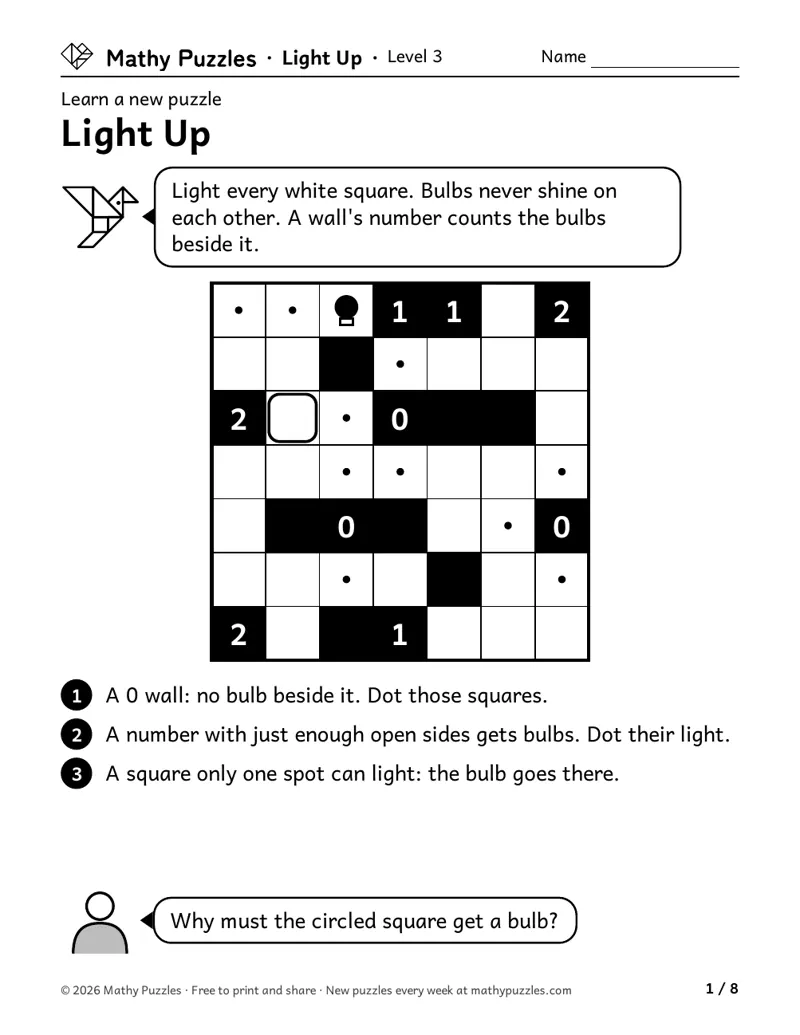
Worked example
From the Level 3 Learn sheet
- Light every white square. Bulbs never shine on each other. A wall's number counts the bulbs beside it.
- A 0 wall: no bulb beside it. Dot those squares.
- A number with just enough open sides gets bulbs. Dot their light.
- A square only one spot can light: the bulb goes there.
A question to ask: “Why must the circled square get a bulb?”
Free every Sunday A mixed bag of 20 new puzzles, all four levels. Get them by email
The thinking it works on
Following light in straight lines
Works out which squares a bulb reaches before a wall.
Counting neighbors
Reads a wall's number as bulbs on its four sides.
Trick, Enns and Brodeur (1996) tested groups aged about 6, 8, 10, 22 and 72. Telling apart small numbers of items (1 to 4) at a glance got more efficient through childhood. Source
Reasoning by elimination
Finds the one spot that can still light a dark square.
Pillow and Pearson (2009) tested kindergartners through fourth graders. From kindergarten, children judged a conclusion forced by the facts as surer than a weak hunch, and from third grade surer than a strong hunch. Source
Holding several rules at once
Keeps lighting, no-shining and numbers all true.
Davidson and colleagues (2006) studied children aged 4 to 13, about 30 at each age. Even the youngest could keep a rule in mind and hold back a first reaction, as long as the rules stayed the same. Switching between rules took longer to develop; 13-year-olds were still not at adult level. Source
Comparing two clues that share squares
Reads a number and a dark square together.
Barrouillet and Lecas found that children in grades 3, 6 and 9 took more of the possible cases into account as they got older. The number of cases a child could hold went with working memory. Source
Testing a "what if"
Pencils in a bulb as a test and follows its light.
Rafetseder, Schwitalla and Perner (2013) found that 9- to 11-year-olds reasoned about "what if things had been different" no better than 6-year-olds. Twelve- to 14-year-olds came close to adults. Source
Where is this thinking used?
- Lighting a room: Placing lamps so every corner is lit and no spot is left dark.
- Guarding a gallery: Choosing where guards stand so every hallway is in someone's view.
- Watering a garden: Choosing sprinkler spots so every patch gets water.
- Video games: Working out what a character can see from where it stands, until a wall blocks the view.
For teachers
Curriculum areas
- Common Core
- No direct curricular match.
- NCERT
- No direct curricular match.
- National Curriculum (England)
- No direct curricular match.
- Cambridge Primary Mathematics
- No direct curricular match.
Math practices: see the box below.
Math practices this puzzle uses
- Uses: MP1 Make sense of problems and persevere in solving them
- Not used: MP2 Reason abstractly and quantitatively
- Not used: MP3 Construct viable arguments and critique the reasoning of others
- Not used: MP4 Model with mathematics
- Not used: MP5 Use appropriate tools strategically
- Uses: MP6 Attend to precision
- Not used: MP7 Look for and make use of structure
- Not used: MP8 Look for and express regularity in repeated reasoning
From the Common Core Standards for Mathematical Practice.
More Light Up puzzles for members
Members get at least 5 more worksheets at each difficulty for every puzzle, 80 new puzzles every Sunday, and the whole archive. $39 a year or $25 for 6 months.
See membershipNot ready yet?
One email, all four levels: 20 puzzles, 5 for each level.
For grown-ups (18+). One email every Sunday with the puzzles and the odd note about membership; unsubscribe any time. We never ask about your child. How we use your email