
Hidden Stars
Lost keys are found faster by ruling places out: not in the coat, not on the table. Each number and arrow on this grid rules squares in or out for the stars, until only the real hiding spots are left.
Free sets by level, ages 8–12:
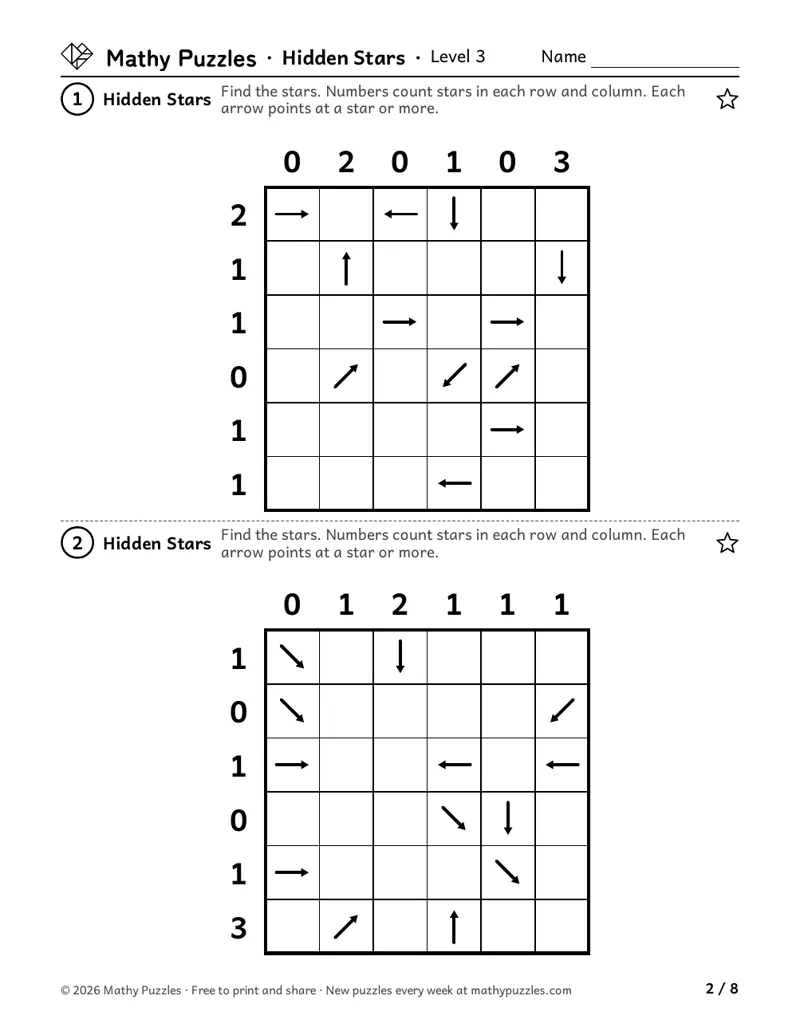 Level 3: a page from the free set
Before starting
- Count to 12
- Know rows (across) and columns (down)
- Follow a slanted line from corner to corner across a grid
- Level 4: comfortable with Level 3 grids
What you need
A ruler for following slanted arrows, and a sharp pencil with an eraser.
Free puzzles to print
Each set: a Learn sheet with a worked example, 10 puzzles from easiest to hardest, and the answers.
Level 3
Ages 8–10 · Grades 3–4
6 × 6 grids with 6 or 7 stars, first with many arrows, then fewer. The hardest puzzles are 7 × 7, where the next step can often be found in only one place.
On the sheet: “Find the stars. Numbers count stars in each row and column. Each arrow points at a star or more.”
Print Level 3 (Letter)Other paper size: A4Level 4
Ages 10–12 · Grades 5–6
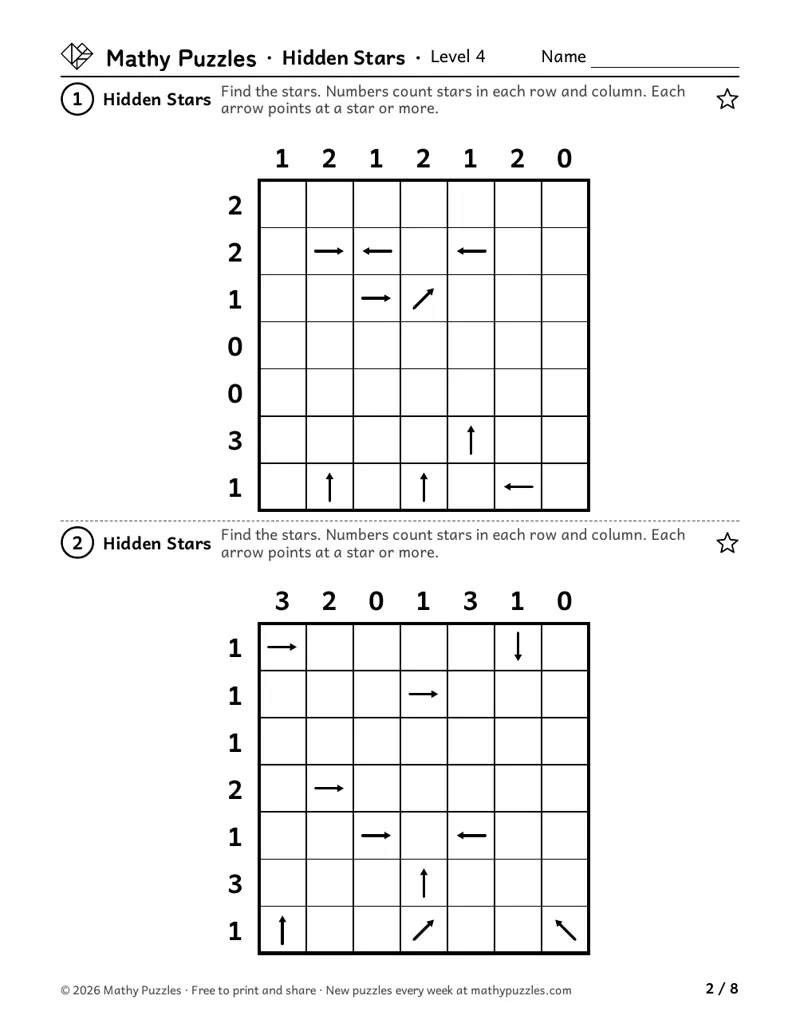
7 × 7, then 8 × 8 grids with up to 12 stars. The first two steps need the "every arrow needs a star" count, and the hardest need one "what if" test.
On the sheet: “Find the stars. Numbers count stars in each row and column. Each arrow points at a star or more.”
Print Level 4 (Letter)Other paper size: A4
How it works
Each puzzle is a square grid with numbers along the top and side and arrows in some squares. Stars hide in the empty squares. Each number says how many stars are in its row or column. Each arrow points at one or more stars somewhere along its line: across, down or corner to corner, all the way to the edge. A square with an arrow never holds a star. The child marks every star.
How to play
- Look for a 0. Dot every square in that row or column: no stars there.
- Find a row or column whose number matches its open squares. Put a star in each one.
- Follow an arrow to the edge. If only one open square is left on its line, the star goes there.
- When a row or column has all its stars, dot the rest. Keep going until every number and every arrow is kept.
When it gets hard
Drifting off a slanted arrow's line.
Hint: Lay a ruler or a finger along the arrow and move one square at a time, corner to corner, to the edge.
Putting a star in a square that holds an arrow.
Hint: Arrow squares never hold stars. Skip them when you count open squares.
Thinking an arrow points only at the square next to it.
Hint: An arrow looks all the way to the edge. Its star can be anywhere along that line.
Tip for grown-ups: Before your child marks anything, ask them to trace one arrow's line with a finger. Most slips come from losing the line, not from the logic. Laying a ruler along a slanted arrow keeps the line easy to follow.
Frequently asked questions
- Why do some arrows point at a slant?
- Those arrows point corner to corner. Their line runs diagonally, one square at a time, to the edge of the grid, and the star can be anywhere along it.
- Does an arrow point at only one star?
- Not always. An arrow promises at least one star on its line, and there may be more. The row and column numbers decide which squares they are.
- How can I introduce this to a class?
- Draw a small grid on the board with one arrow and ask where its star could be. Then add a row number that leaves one choice. That shows both kinds of clue working together.
Questions about printing, levels, answers or membership: see all questions.
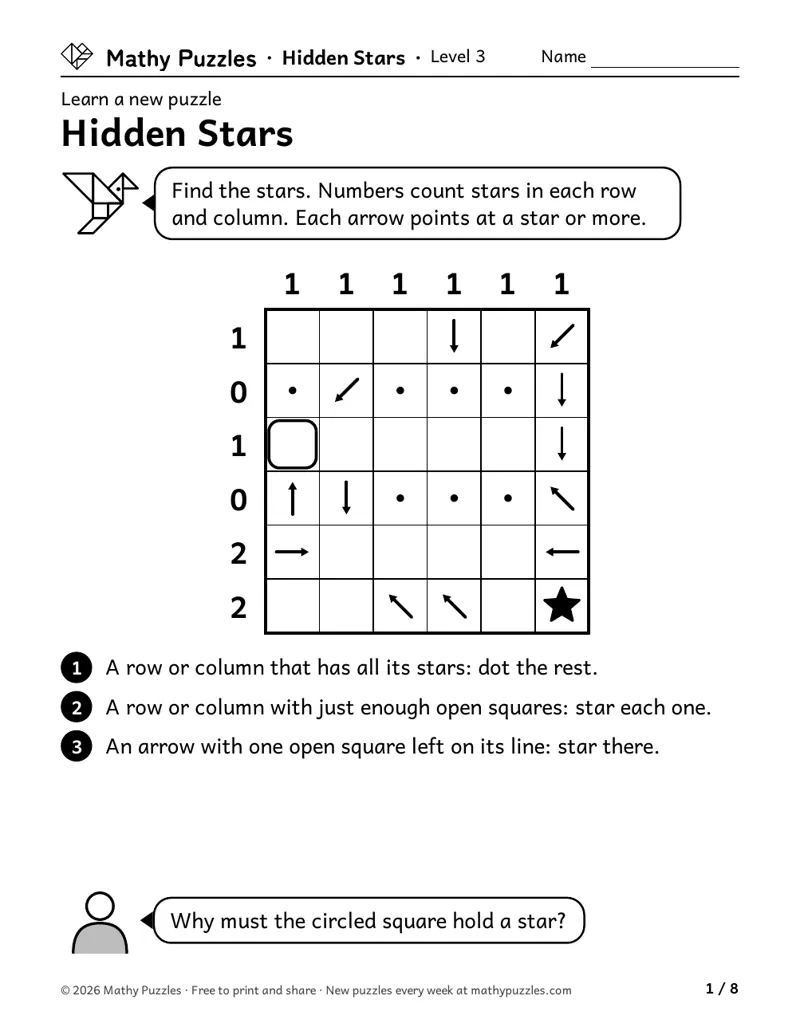
Worked example
From the Level 3 Learn sheet
- Find the stars. Numbers count stars in each row and column. Each arrow points at a star or more.
- A row or column that has all its stars: dot the rest.
- A row or column with just enough open squares: star each one.
- An arrow with one open square left on its line: star there.
A question to ask: “Why must the circled square hold a star?”
Free every Sunday A mixed bag of 20 new puzzles, all four levels. Get them by email
The thinking it works on
Reasoning from counts
Compares a row's number with the open squares left in it.
Pillow (2002) tested children from kindergarten to fourth grade. From first grade, they rated a conclusion they had worked out as surer than a guess, and by third grade surer than a merely likely one. Source
Tracking straight lines, including diagonals
Follows an arrow square by square to the edge of the grid.
Reasoning by elimination
When an arrow has one open square left, the star must be there.
Janveau-Brennan and Markovits (1999) gave 512 children in grades 1 to 6 "if... then" problems and found that, with age, children more often answered "can't tell" when the facts did not settle the question. Source
Combining two kinds of clue
Keeps the numbers and the arrows in step.
Richland, Morrison and Holyoak (2006) found that children from 3 to 14 did worse on picture analogies when they had to hold two relations together. Older children were pulled off less often by a look-alike item. Source
Matching needs to places
Counts arrows against the stars a row still needs.
Testing a "what if"
Tries a star in one square and follows the clues until something gives.
Moshman and Franks (1986) asked children to sort arguments. No fourth graders, but 45 percent of seventh graders, sorted them by whether the conclusion had to follow rather than by whether it was true. Source
Where is this thinking used?
- Map reading: Following one compass direction across a grid until you reach the edge.
- Spreadsheets: Row and column totals show whether every entry is in the right place.
- Finding lost things: A few hints, each pointing one way, narrow down where a lost glove can be.
- Chess: A bishop or a rook looks along a straight line, across, down or corner to corner.
For teachers
Curriculum areas
- Common Core
- No direct curricular match.
- NCERT
- No direct curricular match.
- National Curriculum (England)
- No direct curricular match.
- Cambridge Primary Mathematics
- No direct curricular match.
Math practices: see the box below.
Math practices this puzzle uses
- Uses: MP1 Make sense of problems and persevere in solving them
- Not used: MP2 Reason abstractly and quantitatively
- Not used: MP3 Construct viable arguments and critique the reasoning of others
- Not used: MP4 Model with mathematics
- Not used: MP5 Use appropriate tools strategically
- Uses: MP6 Attend to precision
- Uses: MP7 Look for and make use of structure
- Not used: MP8 Look for and express regularity in repeated reasoning
From the Common Core Standards for Mathematical Practice.
More Hidden Stars puzzles for members
Members get at least 5 more worksheets at each difficulty for every puzzle, 80 new puzzles every Sunday, and the whole archive. $39 a year or $25 for 6 months.
See membershipNot ready yet?
One email, all four levels: 20 puzzles, 5 for each level.
For grown-ups (18+). One email every Sunday with the puzzles and the odd note about membership; unsubscribe any time. We never ask about your child. How we use your email