
Cross-Number
Picture a crossword where every answer is a number: "a square number", "a multiple of 6". Each clue leaves a short list of possibilities, and where two answers cross, the shared digit picks the right one from each list.
Free sets by level, ages 8–12:
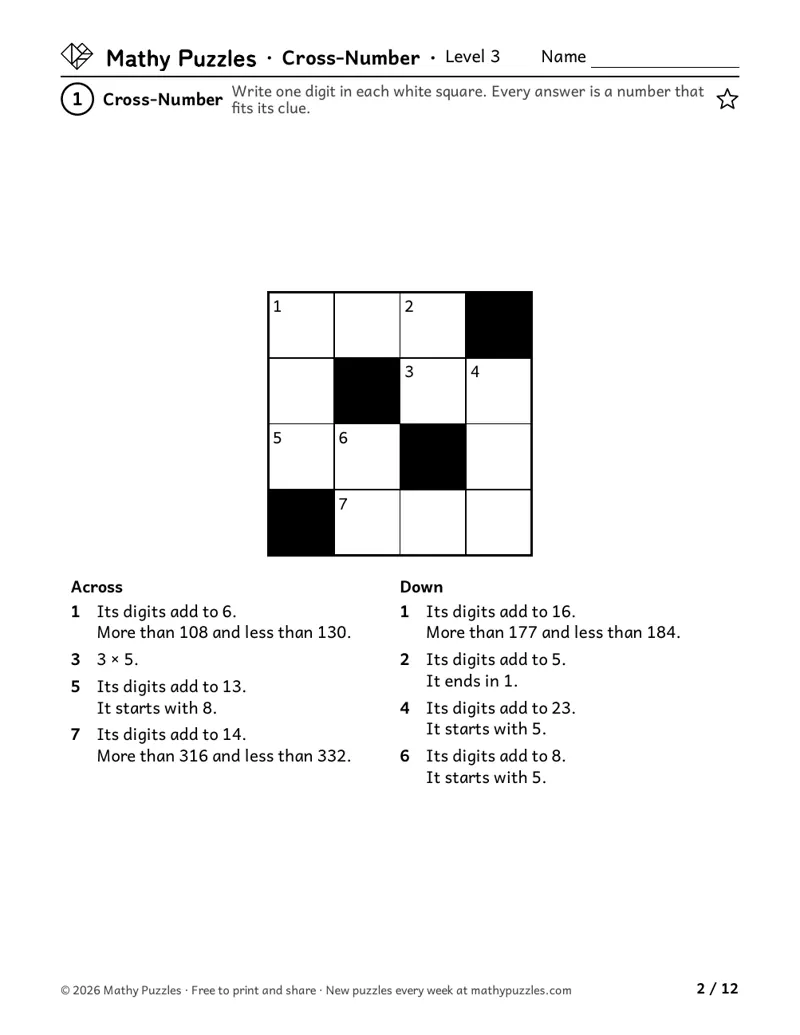 Level 3: a page from the free set
Before starting
- Level 3: multiplication facts to 10 × 10; know square numbers to 100
- Level 4: also know what prime, cube and factor mean (a staircase clue lists its first few numbers)
- Read short clue sentences
What you need
Scrap paper for listing the numbers that fit a clue, and a pencil.
Free puzzles to print
Each set: a Learn sheet with a worked example, 10 puzzles from easiest to hardest, and the answers.
Level 3
Ages 8–10 · Grades 3–4
4 × 4 grids with answers of 2 or 3 digits, where most clues lead to one number. Then 5 × 5, where crossings settle the lists. The hardest puzzles work an answer out from another ("3 Across reversed", "Half of 1 Down"). Multiples come from the 3 to 10 multiplication tables.
On the sheet: “Write one digit in each white square. Every answer is a number that fits its clue.”
Print Level 3 (Letter)Other paper size: A4Level 4
Ages 10–12 · Grades 5–6
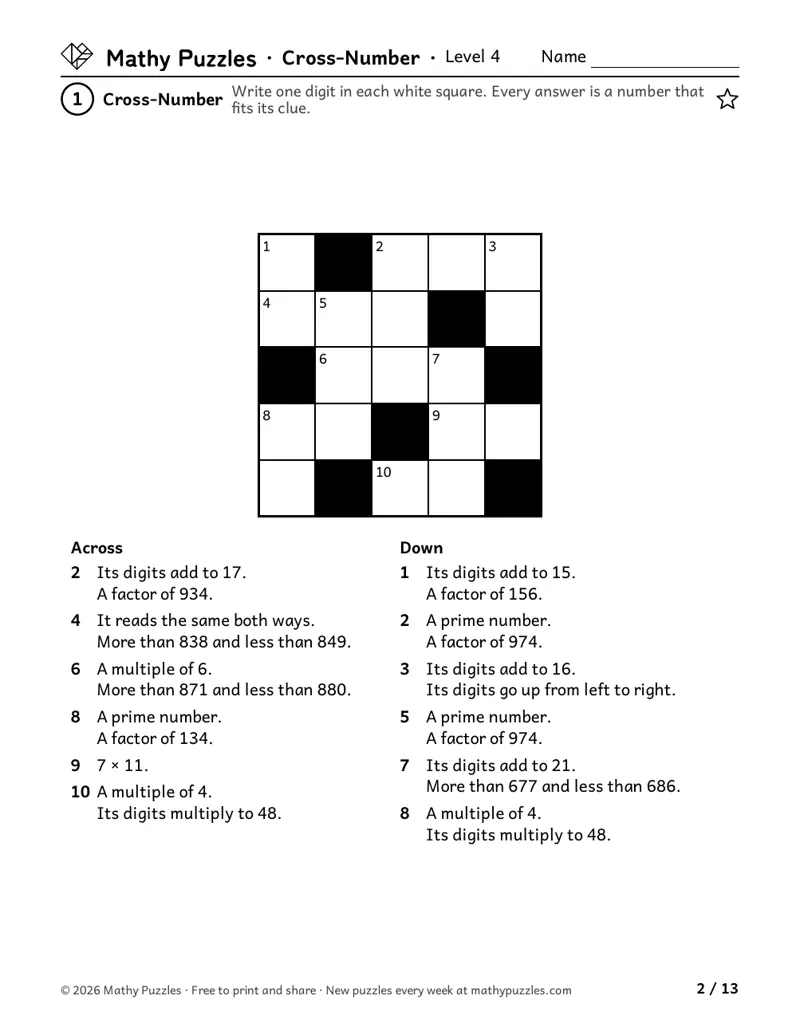
5 × 5, then 6 × 6 grids with answers up to 4 digits. Clues add prime, cube and staircase numbers (1, 3, 6, 10…), factors, and digits that multiply to a number. The hardest puzzles chain answers worked out from other worked-out answers.
On the sheet: “Write one digit in each white square. Every answer is a number that fits its clue.”
Print Level 4 (Letter)Other paper size: A4
How it works
Each puzzle is a small number crossword, one digit to a square. Each clue is a number fact: "A square number", "A multiple of 6", "Its digits add to 10", "It reads the same both ways". No answer starts with 0.
How to play
- Read every clue for an answer and count its squares: that tells you how many digits it has.
- List the numbers that fit. A two-digit square number can only be 16, 25, 36, 49, 64 or 81.
- Find the shortest list and settle it first. Write its digits in.
- Use each written digit to cut down the lists of the answers that cross it.
When it gets hard
Mixing up a digit and a number: "its digits add to 9" read as "it is 9".
Hint: A digit fills one square; a number is the whole answer. Point to each square as you read.
Writing a Down answer from the bottom up.
Hint: Across answers go left to right, Down answers top to bottom, starting at the small clue number.
Listing a number that starts with 0.
Hint: No answer starts with 0, so 07 is not a two-digit number here.
Tip for grown-ups: Ask your child to read each clue aloud and say how many digits the answer needs before listing anything. Most slips come from skipping that step. Listing the numbers that fit a clue on scrap paper keeps the grid tidy.
Frequently asked questions
- Which number facts does my child need first?
- For Level 3, multiplication facts to 10 × 10 and the square numbers to 100. Level 4 adds primes, cubes and factors. A list of facts on the table is fine while they are still new.
- Can a cross-number be a whole-class warm-up?
- Yes. Put one clue on the board, have the class list every number that fits, then reveal a crossing digit. The talk about why numbers drop out is the lesson.
- What is a staircase number?
- A number you can stack as steps: 1, then 1 + 2 = 3, then 1 + 2 + 3 = 6, then 10, 15, and so on. These clues appear only at Level 4.
Questions about printing, levels, answers or membership: see all questions.
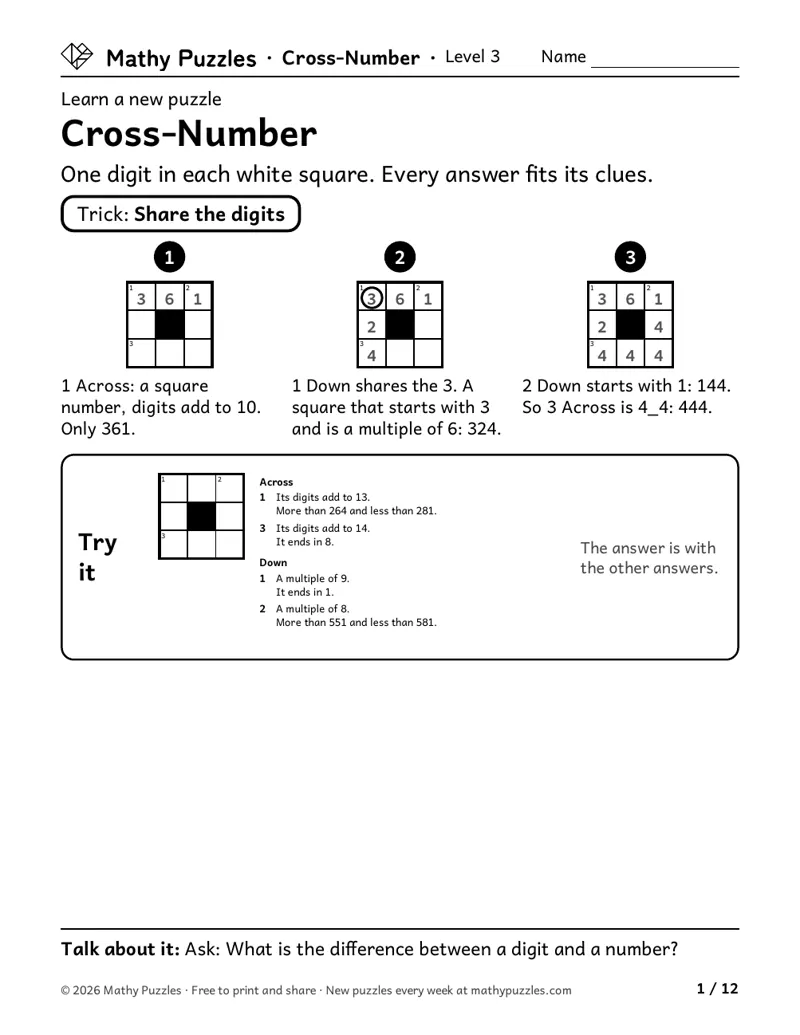
Worked example
From the Level 3 Learn sheet
- Start with an answer whose clues together allow just one number, such as a square number whose digits add to a given total.
- Write its digits. Each digit is also part of an answer that crosses it.
- Use that shared digit to choose from the crossing answer's list.
- Keep going until every answer fits all its clues.
A question to ask: “What is the difference between a digit and a number?”
Free every Sunday A mixed bag of 20 new puzzles, all four levels. Get them by email
The thinking it works on
Knowing what number words mean
Knows what square, multiple, odd and palindrome mean in real numbers.
Sutarto and colleagues (2021) gave 124 fourth graders open questions on factors and multiples. Their errors came from weak ideas of multiplication and of prime numbers, and from mixing up a number's multiples with its factors. Source
Listing every number that fits
Writes every number that fits an answer's clues.
Maher and Martino (1996) interviewed one child from grade 1 to grade 5 on combination tasks. They recorded her growing skill at sorting and organizing the possibilities, so she could argue that none were missing. Source
Reasoning with crossing answers
Uses a shared digit to pick from a list.
Richland, Morrison and Holyoak (2006) found that children aged 3 to 14 had most trouble with analogies that needed two relations combined, though errors fell with age. Source
Precise reading
Reads digit, number, Across and Down exactly as written.
Holding a chain of steps
Works an answer out from another, and then another.
Luciana and colleagues (2005) tested 9- to 20-year-olds. Remembering one piece of spatial information to guide an action was adult-like by 11 to 12. Holding and rearranging several pieces kept developing to 13 to 15. Source
Where is this thinking used?
- Codes and PINs: A few rules (no repeats, starts with 4, even) narrow the possible numbers.
- Reading tables: Finding the one row and column that meet at the number you need.
- Calendars and schedules: A date that is a Tuesday, after the 10th and before the 20th.
- Checking data entry: A number that must match two lists at once.
For teachers
Curriculum areas
- Common Core
- Operations and algebraic thinking: multiplication facts within 100 (Grade 3); multiples, factors and primes (Grade 4, used again at Level 4). Number and operations in base ten: reading and writing multi-digit numbers (Grade 4). Expressions and equations: whole-number exponents for square and cube numbers (Grade 6)
- NCERT
- Maths Mela: multiples (Class 4), numbers that read the same both ways (Class 3), factors and primes (Class 5); Ganita Prakash (Class 6): square, cube and triangular numbers, digit sums and palindromes, primes
- National Curriculum (England)
- Number: times tables to 12 × 12 (Year 4); multiples, factors, square and cube numbers (Year 5); common factors, multiples and primes (Year 6)
- Cambridge Primary Mathematics
- Number: times tables, multiples and factors (Stages 3–4); prime, square and cube numbers (Stages 5–6)
Math practices: see the box below.
Math practices this puzzle uses
- Not used: MP1 Make sense of problems and persevere in solving them
- Not used: MP2 Reason abstractly and quantitatively
- Not used: MP3 Construct viable arguments and critique the reasoning of others
- Not used: MP4 Model with mathematics
- Not used: MP5 Use appropriate tools strategically
- Uses: MP6 Attend to precision
- Uses: MP7 Look for and make use of structure
- Not used: MP8 Look for and express regularity in repeated reasoning
From the Common Core Standards for Mathematical Practice.
More Cross-Number puzzles for members
Members get at least 5 more worksheets at each difficulty for every puzzle, 80 new puzzles every Sunday, and the whole archive. $39 a year or $25 for 6 months.
See membershipNot ready yet?
One email, all four levels: 20 puzzles, 5 for each level.
For grown-ups (18+). One email every Sunday with the puzzles and the odd note about membership; unsubscribe any time. We never ask about your child. How we use your email