
Crack the Code
Spies in old stories hid messages by moving every letter a few places along the alphabet. Every code here follows one rule like that. Shown one word and its code, a child can work out the rule, then undo it for the whole message.
Free sets by level, ages 8–12:
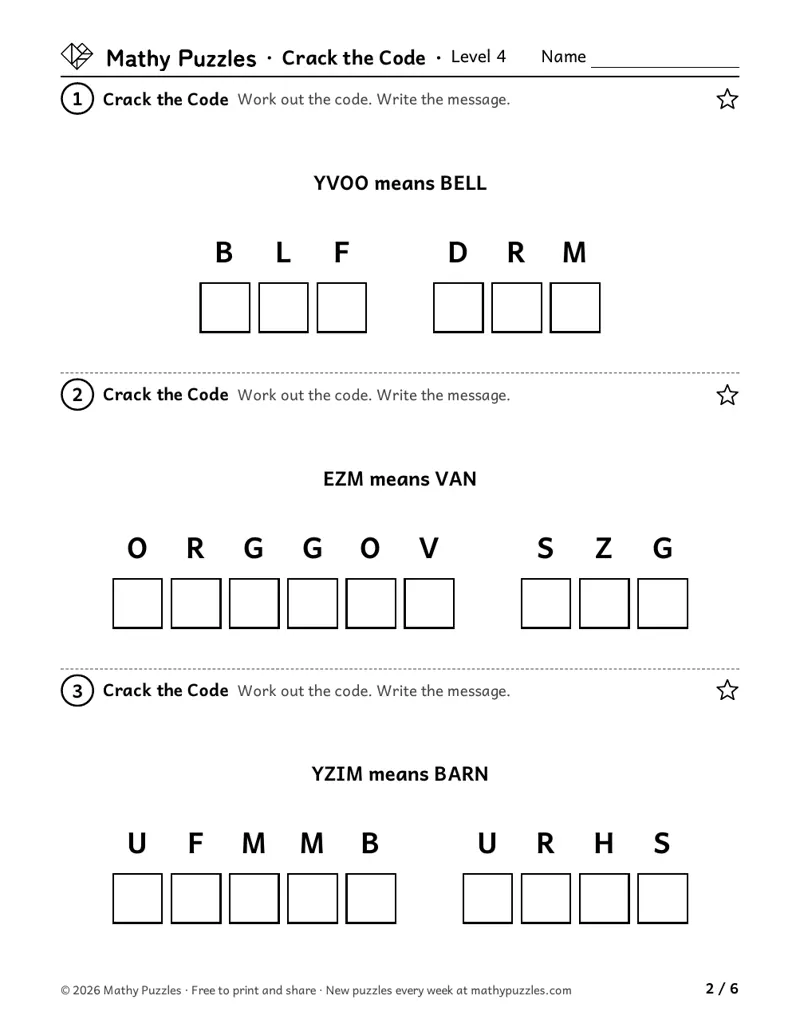 Level 4: a page from the free set
Before starting
- Know the alphabet in order, forward and backward
- Count on and back along a line of letters
- Level 3: numbers to 26
What you need
Scrap paper with the alphabet written along the top to count on, and a pencil.
Free puzzles to print
Each set: a Learn sheet with a worked example, 10 puzzles from easiest to hardest, and the answers.
Level 3
Ages 8–10 · Grades 3–4
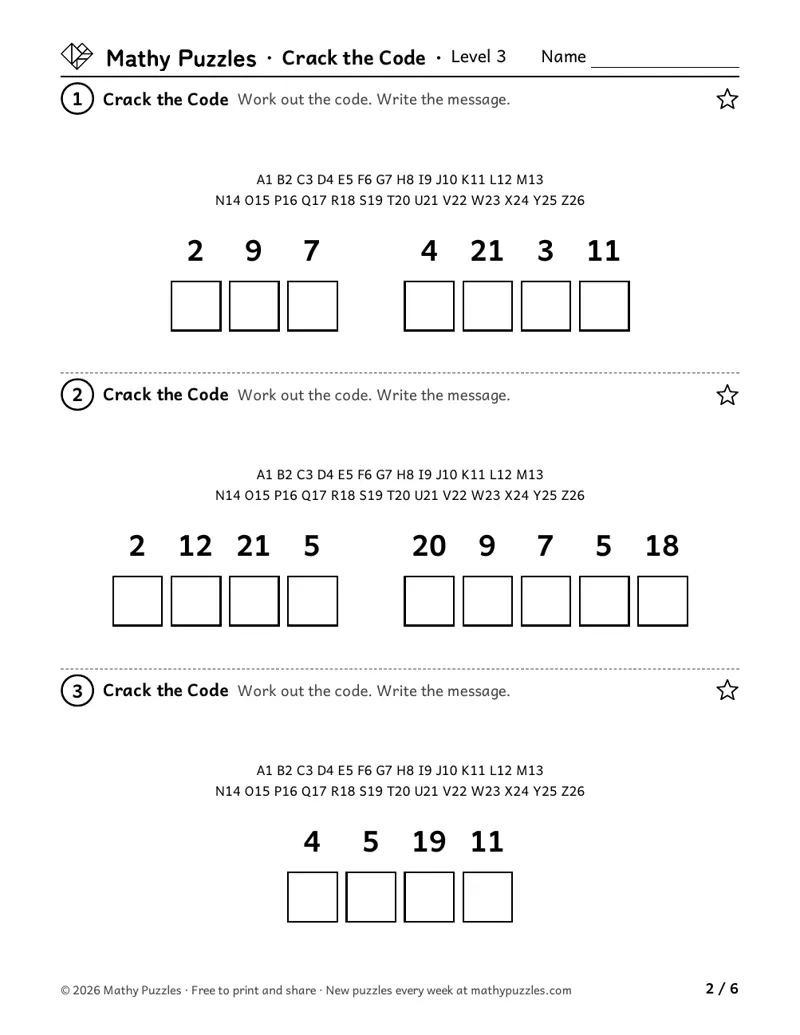
Number codes (A is 1) with a number strip. Then a shift of 1 to 3 places, shown by one known word. The hardest puzzles use a shift of 3 to 6 on a two-word message, where some letters go past Z and start again at A.
On the sheet: “Work out the code. Write the message.”
Print Level 3 (Letter)Other paper size: A4Level 4
Ages 10–12 · Grades 5–6
The backward alphabet (A is Z, B is Y), shown by one known word. Then two known words, and the child must decide which rule it is: a shift, the backward alphabet or numbers. The hardest puzzles use a keyword alphabet, with the keyword given.
On the sheet: “Work out the code. Write the message.”
Print Level 4 (Letter)Other paper size: A4
How it works
Each puzzle is a coded message with no key. In the easiest puzzles the code is numbers (A is 1, B is 2) and a number strip is printed. After that, one word the child already knows is shown with its code, such as "FDW means CAT". The child works out how the letters changed, for example each one moved 3 along the alphabet, and changes the message back.
How to play
- Find the word you know and its code.
- Compare the first letters. How far apart are they in the alphabet, or what else changed?
- Check that the same change works for every letter of the known word.
- Undo the change for each letter of the message. Write the message.
When it gets hard
Shifting the message the same way as the code, instead of back.
Hint: If the code moved each letter forward, move each one back to decode.
Stopping at Z when counting on.
Hint: After Z, start again at A, like a clock going past 12.
Checking the rule on only the first letter.
Hint: Test the rule on every letter of the known word before using it.
Tip for grown-ups: Write the alphabet in a long strip and let your child slide a finger along it; counting the steps out loud makes the rule easy to see.
Frequently asked questions
- How is this different from Secret Codes?
- Secret Codes always gives a key. Here there is no key: one word your child already knows shows the rule, and your child works it out. It is the next step after Secret Codes.
- What does "going past Z" mean?
- In the hardest Level 3 puzzles a letter near the end of the alphabet moves past Z and starts again at A. Moving Y on by 3 gives B. Think of the alphabet as a circle.
Questions about printing, levels, answers or membership: see all questions.
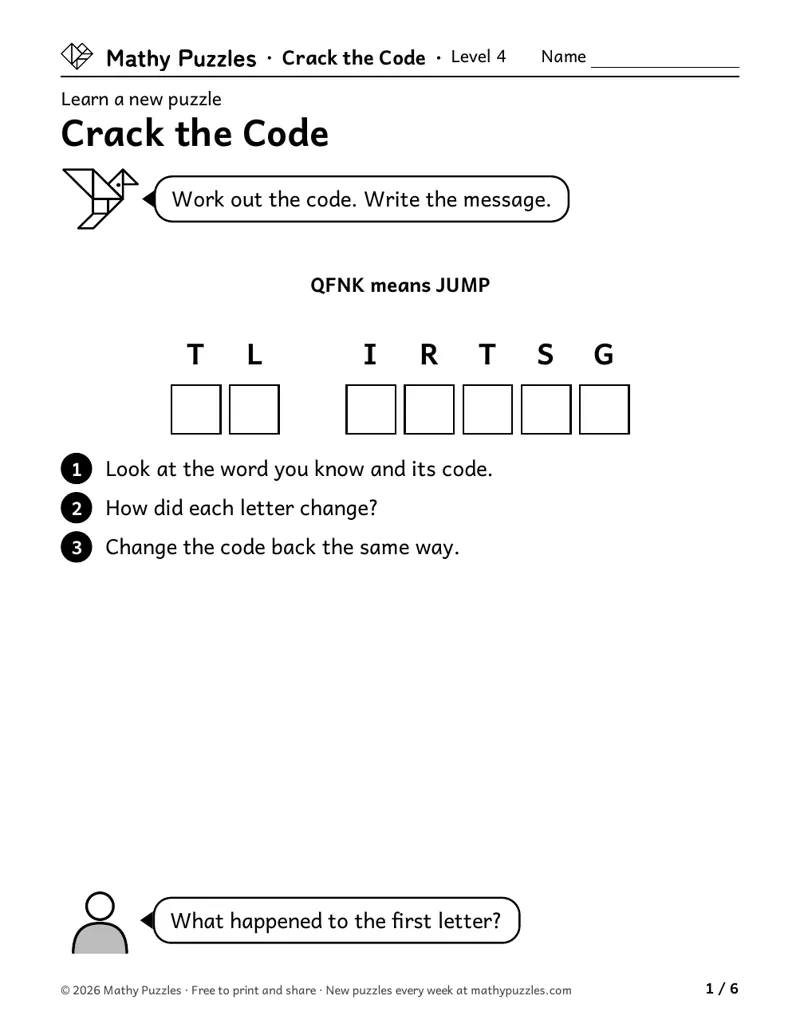
Worked example
From the Level 4 Learn sheet
- Look at the word you know and its code.
- How did each letter change?
- Change the code back the same way.
A question to ask: “What happened to the first letter?”
Free every Sunday A mixed bag of 20 new puzzles, all four levels. Get them by email
The thinking it works on
Finding the rule from an example
Works out the rule from one known word and its code.
Csapó (1997) tested more than 2,000 students in grades 3, 5, 7, 9 and 11 on six rule-finding tasks. These included number and word series, analogies and a coding task. Growth was fastest between grades 5 and 9, with a big step already before grade 5. Source
Undoing a rule
Runs the rule backward to decode.
Robinson and Dubé (2009) gave children in grades 2, 3 and 4 problems like 3 + 26 − 26. Some in every grade saw that subtracting undoes adding and others did not; grade made little difference. Source
Counting along an ordered list
Counts on and back along the alphabet, going past Z to A.
Testing an idea
Checks a rule on every letter before trusting it.
Klahr, Fay and Dunbar (1993) asked third graders, sixth graders and adults to find out how a new robot command worked. The children focused on likely ideas and ran few tests. Source
Keeping track of position
Holds a place in the message while working on one letter.
In a study of children aged 4 to 15, Gathercole and colleagues (2004) found that each part of working memory expands sizably across the school years. Working memory is what keeps "which letter am I on" in mind. Source
Where is this thinking used?
- Calendars: Counting on past the end of a month or week back to the start.
- Clocks: Hours go past 12 and start again.
- Spotting patterns: Finding the rule behind a list of examples.
- Puzzle hunts: Treasure hunts and escape games often hide clues in letter codes.
For teachers
Curriculum areas
- Common Core
- No direct curricular match.
- NCERT
- No direct curricular match.
- Computer science (CSTA)
- Simple codes that hide a message, a first look at encryption (networks and the internet, ages 11–14)
- National Curriculum (England)
- No direct curricular match.
- Cambridge Primary Mathematics
- No direct curricular match.
Math practices: see the box below.
Math practices this puzzle uses
- Not used: MP1 Make sense of problems and persevere in solving them
- Not used: MP2 Reason abstractly and quantitatively
- Not used: MP3 Construct viable arguments and critique the reasoning of others
- Not used: MP4 Model with mathematics
- Not used: MP5 Use appropriate tools strategically
- Not used: MP6 Attend to precision
- Uses: MP7 Look for and make use of structure
- Uses: MP8 Look for and express regularity in repeated reasoning
From the Common Core Standards for Mathematical Practice.
More Crack the Code puzzles for members
Members get at least 5 more worksheets at each difficulty for every puzzle, 80 new puzzles every Sunday, and the whole archive. $39 a year or $25 for 6 months.
See membershipNot ready yet?
One email, all four levels: 20 puzzles, 5 for each level.
For grown-ups (18+). One email every Sunday with the puzzles and the odd note about membership; unsubscribe any time. We never ask about your child. How we use your email