
Find the Rule
Every child has had a guess that seemed perfect until one example broke it. Find the Rule makes that the game: four cards fit a secret rule, four don't, and a guess only counts if it works for all eight.
Free sets by level, ages 8–12:
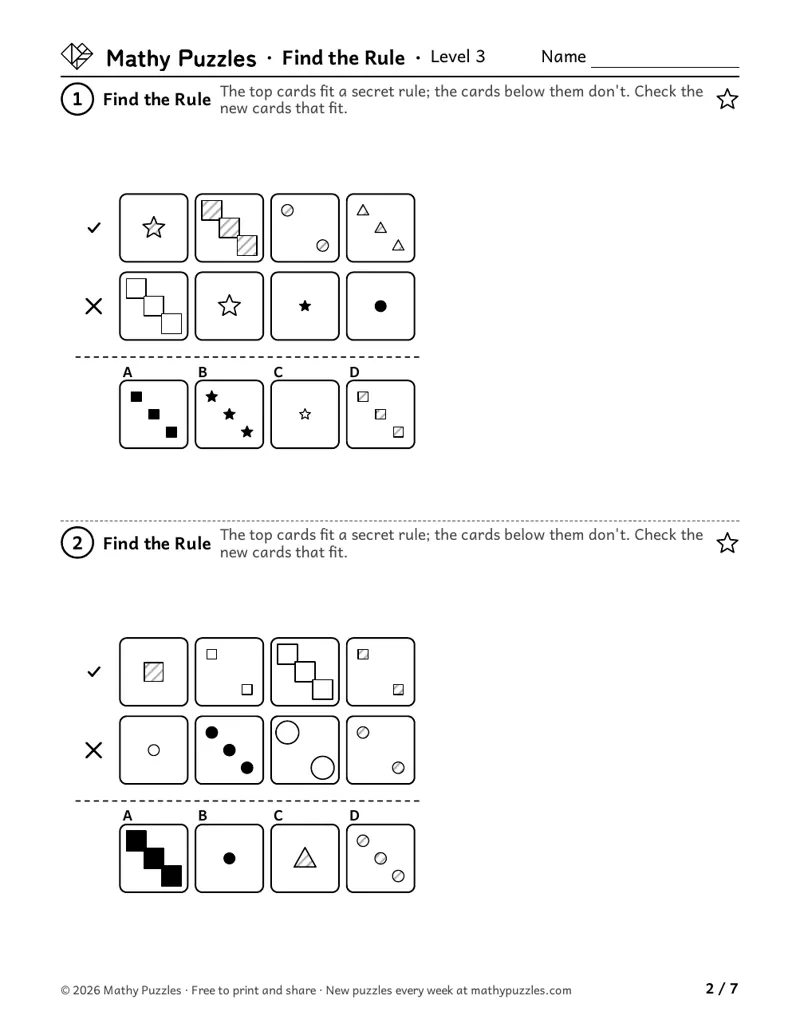 Level 3: a page from the free set
Before starting
- Name a circle, square, triangle and star
- Count to 3
- Level 4: read short sentences such as "It is not black."; count the sides of a triangle, square and other shapes
Free puzzles to print
Each set: a Learn sheet with a worked example, 10 puzzles from easiest to hardest, and the answers.
Level 3
Ages 8–10 · Grades 3–4
The rule is one thing ("it is black"). Then two things that must both be true ("black and big"), then either of two things ("a star or striped").
On the sheet: “The top cards fit a secret rule; the cards below them don't. Check the new cards that fit.”
Print Level 3 (Letter)Other paper size: A4Level 4
Ages 10–12 · Grades 5–6
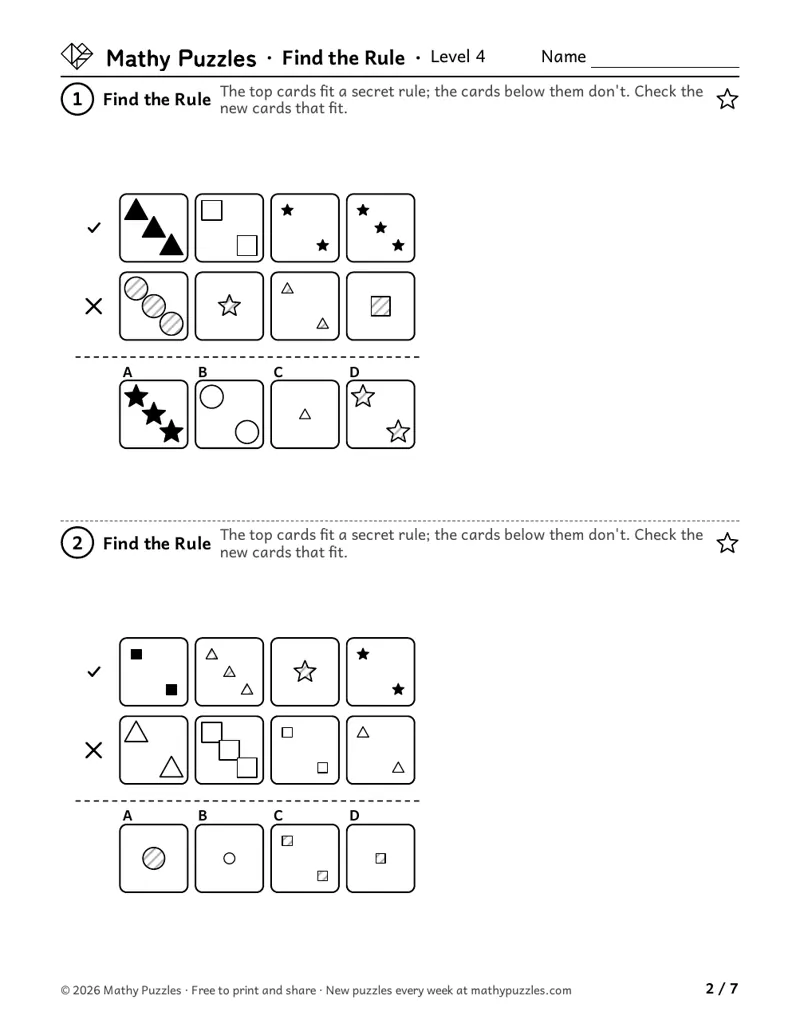
The easiest puzzles: the rule uses "not" ("it is not a circle"). Next, four written rules: the child picks the one that fits the whole top row and keeps every bottom card out. It can be a plain rule, an "and", an "or" or a "not".
The harder puzzles: each card is a shape with some dots, and the rule compares them: as many dots as sides, fewer, or more.
The hardest puzzles: a comparison joined to a color ("as many dots as sides, and not black").
On the sheet: “The top cards fit a secret rule; the cards below them don't. Check the new cards that fit.”
Print Level 4 (Letter)Other paper size: A4
How it works
Four cards in the top row fit a secret rule. Four cards in the row below do not. Each card shows one to three shapes (circles, squares, triangles or stars) that are white, black or striped, and big or small. The child works out the rule, then checks which of four new cards fit it. One Level 4 form asks the child to pick the secret rule from four written rule cards instead. In the two hardest Level 4 steps, each card shows one shape (a triangle up to a hexagon) with some dots. The rule compares the dots with the shape's sides.
How to play
- Look at the four cards in the top row. Say one thing they all have.
- Look at the four cards in the bottom row. If any of them has that thing too, the guess is wrong. Try another.
- When a guess passes both rows, test each new card with it.
- Check every new card that fits. One, two or three of them may fit.
When it gets hard
Stopping at the first thing the top cards share.
Hint: Test the guess on the bottom row too. The rule must keep all of those cards out.
Checking just one new card.
Hint: Up to three new cards can fit. Test all four.
Trying only one-part rules.
Hint: Some rules join two things: both together, or either one. Try a pair when no single thing works.
Level 4 dot cards: looking only at the number of dots.
Hint: Count the shape's sides too. The rule may compare the two.
Tip for grown-ups: Have each guess said out loud before it is tested. When a guess fails, say so warmly: throwing out a wrong guess is real progress.
Frequently asked questions
- What if my child finds a different rule that also works?
- The cards are chosen so that the simple rules which fit all eight cards pick the same new cards. If your child's rule fits all eight and picks the same cards, it counts. The answers name one rule.
- How can I run this as a class game?
- Draw the cards on the board. Students suggest a rule, and the class tests it on every card before anyone checks a new one.
- Why does this start at Level 3?
- Holding a guess, testing it on eight cards and dropping it when it fails takes memory and patience, so it suits ages 8–12. Younger children can start with Which Belongs? or Sorting Box.
Questions about printing, levels, answers or membership: see all questions.
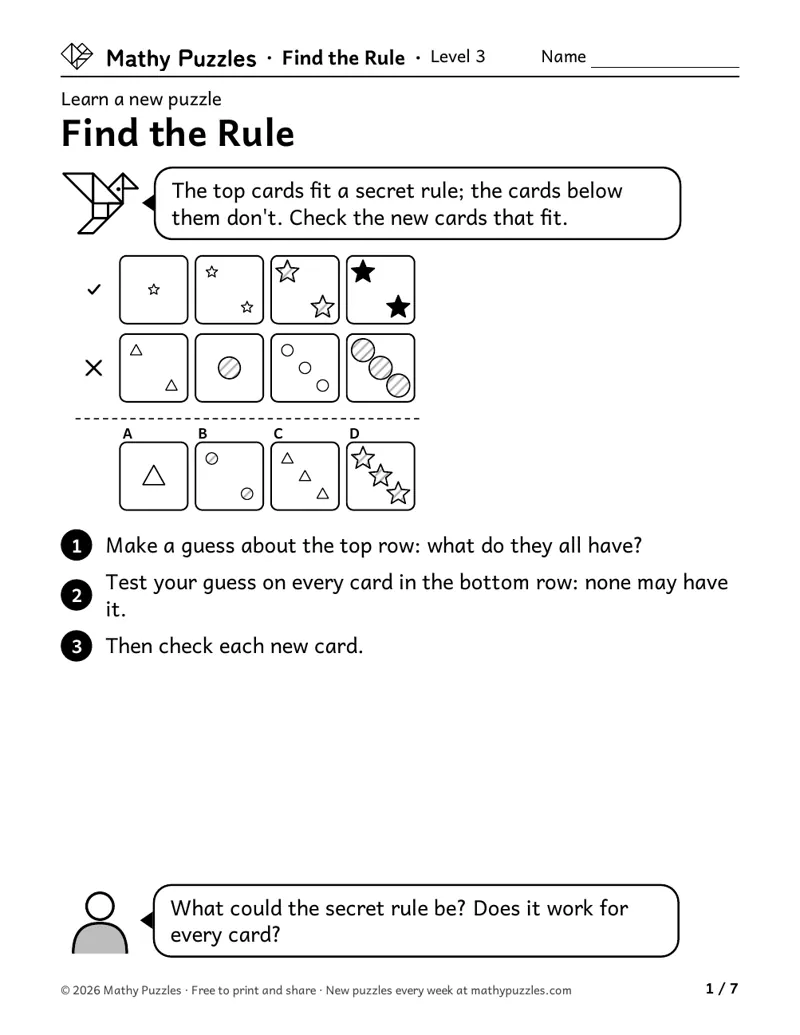
Worked example
From the Level 3 Learn sheet
- Make a guess about the top row: what do they all have?
- Test your guess on every card in the bottom row: none may have it.
- Then check each new card.
A question to ask: “What could the secret rule be? Does it work for every card?”
Free every Sunday A mixed bag of 20 new puzzles, all four levels. Get them by email
The thinking it works on
Making and testing a guess
Makes a guess about the rule and tests it on every card.
Sodian, Zaitchik and Carey (1991) gave first and second graders two ideas to choose between. Most first graders and almost all second graders picked a test that would settle which one was right. Source
Learning from cards that don't fit
Uses the bottom row to throw out guesses.
Samarapungavan (1992) found that 7-year-olds, like 11-year-olds, preferred an explanation that fit all the evidence over one that fit only some of it. This held as long as the explanation did not clash with what they already believed. Source
Logic words: and, or, not
Tells "and", "or" and "not" rules apart.
Comparing several features at once
Checks shape, fill, size and number on every card.
Reading a rule precisely
Matches a written rule word for word against the cards.
Comparing two amounts on one card
Checks the dots against the shape's sides.
Where is this thinking used?
- Science: An idea has to fit every result, and one result that doesn't fit sends you back to think again.
- Repairs: Finding what all the broken ones have in common, and what the working ones lack.
- Games: Working out the hidden rule in a game a friend made up.
- Email filters: A rule like "from school and not a newsletter" decides where each message goes.
For teachers
Curriculum areas
- Common Core
- Geometry: shapes with a given number of sides (Grade 2), used in the hardest Level 4 rulesLevel 3: No direct curricular match.
- NCERT
- No direct curricular match.
- National Curriculum (England)
- Geometry – properties of shapes: number of sides of 2-D shapes (Year 2), used in the hardest Level 4 rulesLevel 3: No direct curricular match.
- Cambridge Primary Mathematics
- Geometry and measure: sorting 2D shapes by their sides, used in the hardest Level 4 rules (Stage 2)Level 3: No direct curricular match.
Math practices: see the box below.
Math practices this puzzle uses
- Not used: MP1 Make sense of problems and persevere in solving them
- Not used: MP2 Reason abstractly and quantitatively
- Uses: MP3 Construct viable arguments and critique the reasoning of others
- Not used: MP4 Model with mathematics
- Not used: MP5 Use appropriate tools strategically
- Not used: MP6 Attend to precision
- Uses: MP7 Look for and make use of structure
- Not used: MP8 Look for and express regularity in repeated reasoning
From the Common Core Standards for Mathematical Practice.
More Find the Rule puzzles for members
Members get at least 5 more worksheets at each difficulty for every puzzle, 80 new puzzles every Sunday, and the whole archive. $39 a year or $25 for 6 months.
See membershipNot ready yet?
One email, all four levels: 20 puzzles, 5 for each level.
For grown-ups (18+). One email every Sunday with the puzzles and the odd note about membership; unsubscribe any time. We never ask about your child. How we use your email