
Sort the Circles
A strawberry is red, and it is a fruit. Draw one circle for red things and one for fruit, and the strawberry belongs where they cross. These puzzles are about that middle part, where both are true.
Free sets by level, ages 6–12:
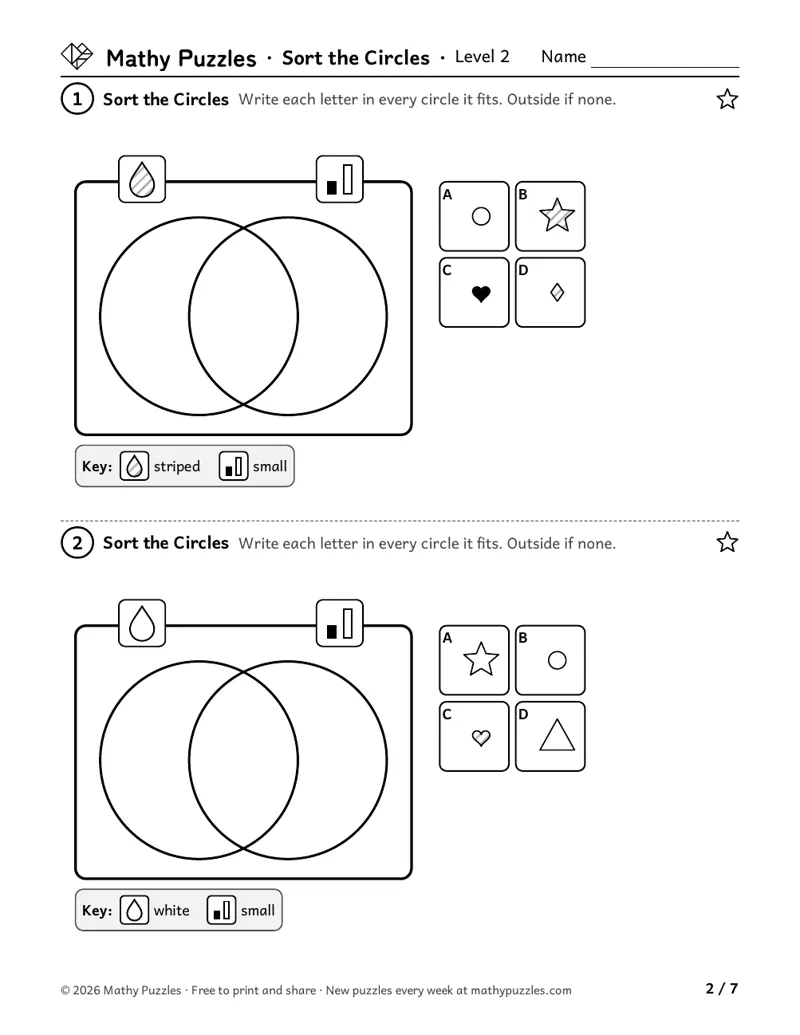 Level 2: a page from the free set
Before starting
- Name shapes and fills (white, black, striped)
- Tell big from small
- Write capital letters A to F
- Level 4: read short sentences with "all", "no" and "at least one"
Free puzzles to print
Each set: a Learn sheet with a worked example, 10 puzzles from easiest to hardest, and the answers.
Level 2
Ages 6–8 · Grades 1–2
Four pictures with nothing outside, then six pictures that use the middle and the outside. The hardest puzzles show the sorted pictures and ask which two of four cards go on the circles.
On the sheet: “Write each letter where it belongs.”
Print Level 2 (Letter)Other paper size: A4Level 3
Ages 8–10 · Grades 3–4
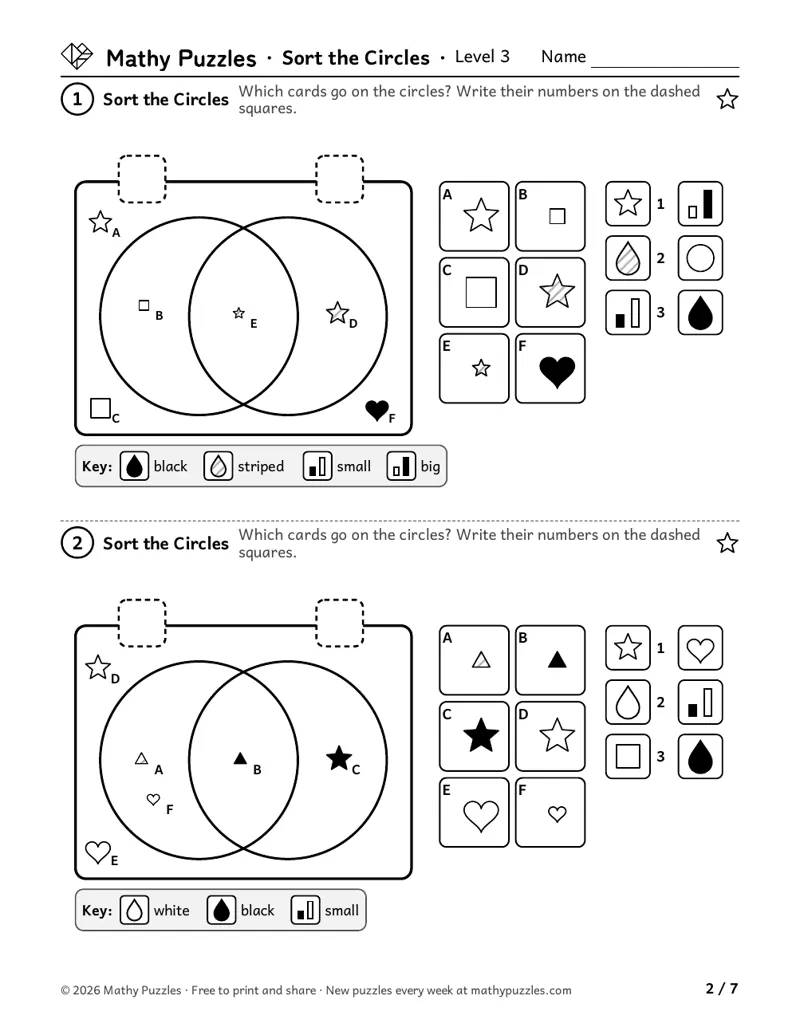
First, find both cards from six. Then come three circles, where a picture can fit one card, two, all three or none. Next, one card is hidden and the child picks it from five. The hardest puzzles ask the child to sort, then mark with an X each part where no picture could ever go (two circles want different shapes or fills).
On the sheet: “Write each letter where it belongs.”
Print Level 3 (Letter)Other paper size: A4Level 4
Ages 10–12 · Grades 5–6
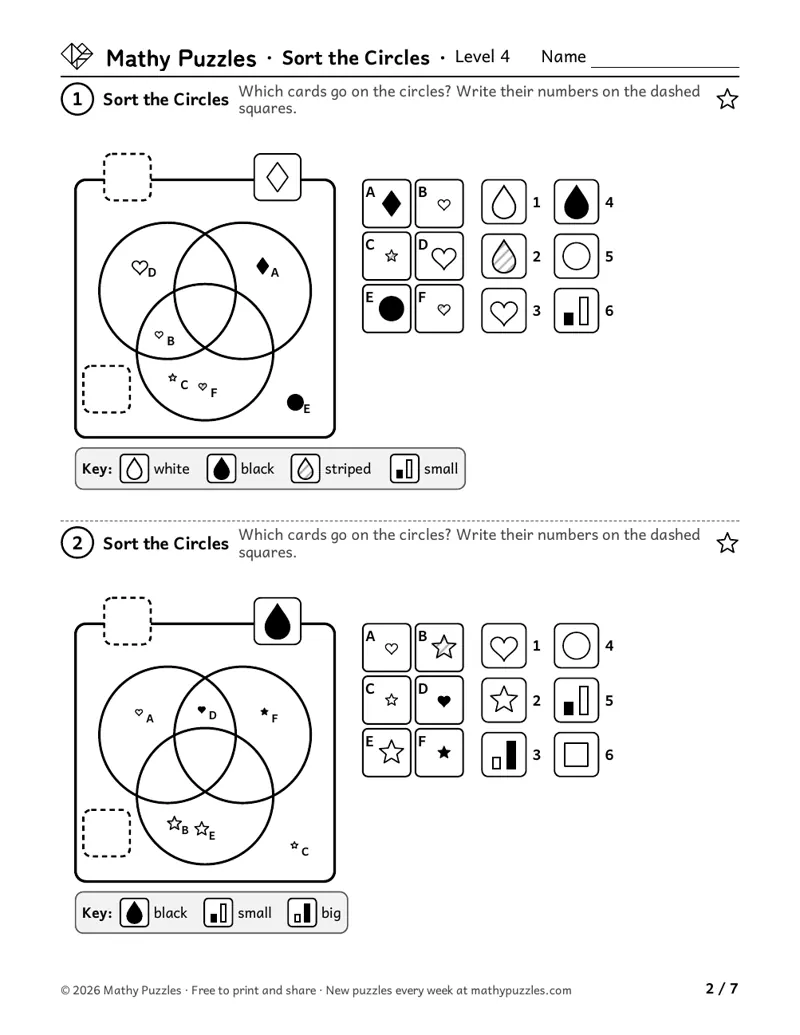
Three circles throughout. First find two hidden cards from six, then all three from seven. Then check which sentences about the sorted pictures are true ("All the pictures in…", "At least one…", "No picture is in both…"). The hardest puzzles hide all three cards and mix in slashed cards that mean "not".
On the sheet: “Write each letter where it belongs.”
Print Level 4 (Letter)Other paper size: A4
How it works
Each puzzle has two or three overlapping circles, each with a picture card: a shape, a paint drop for a fill, or two bars for small or big. The child writes each picture's letter in its place: in one circle, where circles cross (it fits more than one card), or outside (it fits none). Harder puzzles show the pictures already sorted and ask which cards go on the circles. Level 3 adds three circles, and Level 4 uses three circles throughout, with true-or-false sentences about the sort and slashed cards that mean "not".
How to play
- Read the two cards. Say what each circle wants.
- Take one picture. Ask: does it fit the left card? Does it fit the right card?
- Write its letter where the answers meet: one circle, the middle, or outside.
- Cross the picture off and do the next one.
When it gets hard
Putting a picture that fits both cards in only one circle.
Hint: Ask both questions every time, even after the first answer is yes.
Leaving out a picture that fits neither card.
Hint: Outside the circles is a real place. Write the letter there.
In "find the cards", picking a card that fits only some of a circle's pictures.
Hint: Test the card on every picture inside that circle and every one outside it.
Level 4: checking an "All" sentence after looking at only a few pictures.
Hint: "All" needs every picture in that circle. Point to each one before you check it.
Tip for grown-ups: Lay two hoops or loops of string on the floor so they overlap, and sort toys first. The paper circles make sense quickly after that.
Frequently asked questions
- Why does the middle of the circles matter so much?
- It is where "both" lives. Many children first put a picture in one circle and stop. Learning to ask the second question is the main idea of the puzzle.
- Can I make a giant version on the classroom floor?
- Yes. Two hoops or rope circles and a basket of blocks work well; children sort the real things, then do the sheet.
- Why are there no words on the cards?
- Cards use pictures so children who are still learning to read can sort: a shape, a paint drop for a fill, bars for small or big. A panel on the sheet says what each card means. Only the Level 4 sentence puzzles ask the child to read.
Questions about printing, levels, answers or membership: see all questions.
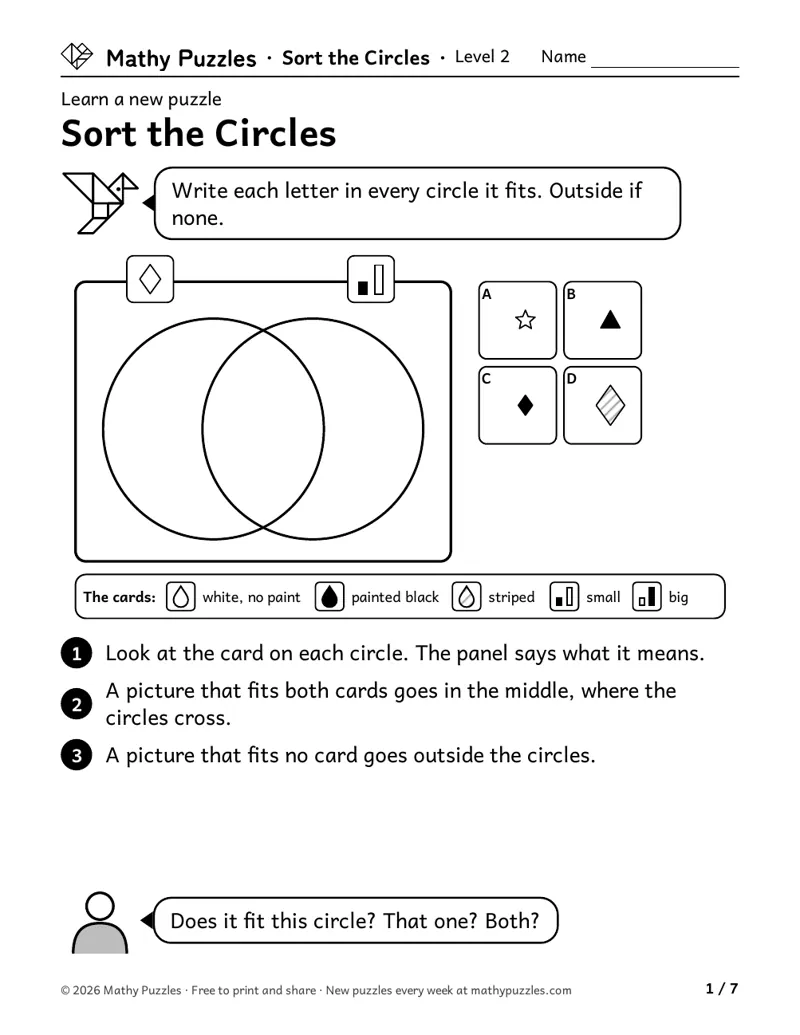
Worked example
From the Level 2 Learn sheet
- Look at the card on each circle. The panel says what it means.
- A picture that fits both cards goes in the middle, where the circles cross.
- A picture that fits no card goes outside the circles.
A question to ask: “Does it fit this circle? That one? Both?”
Free every Sunday A mixed bag of 20 new puzzles, all four levels. Get them by email
The thinking it works on
Sorting by two rules at once
Tests every picture against two cards.
Understanding overlap
Sees that the middle holds things that fit both.
Placing what fits neither
Uses the outside as a real answer.
Working back to the rules
Finds the cards from pictures already sorted.
Chelune and Baer (1986) used a card-sorting test where the sorting rule has to be worked out from feedback. By about age 10, children's scores were indistinguishable from adults'. Source
Three-way sorting
Handles three overlapping circles.
Spotting what can never happen
Finds the parts of the circles that must stay empty.
Reading "all", "no" and "at least one"
Checks a sentence against every picture it talks about.
Noveck (2001) found that 8- and 10-year-olds, more often than adults, accepted 'some' as true when 'all' was true. They took it in the strict sense of 'at least one'. Source
Where is this thinking used?
- Planning: Friends free on Saturday, on Sunday, or on both days.
- Shopping: Items needed for two recipes go on the list once, in the middle.
- Science: Animals that swim, that fly, or that do both.
- Libraries: A book can be both funny and about animals.
For teachers
Curriculum areas
- Common Core
- Measurement and data: sorting into categories (Kindergarten–Grade 1); Geometry: telling a shape's kind from its color and size (Grade 1)Levels 3–4: No direct curricular match.
- NCERT
- Joyful Mathematics (Class 1): sorting objects into groups; Maths Mela (Class 4): sorting shapes into overlapping circles
- Computer science (CSTA)
- Showing sorted information in a picture that makes links clear (data and analysis, ages 8–11)Level 2: No direct curricular match.
- National Curriculum (England)
- Geometry: comparing and sorting shapes (Year 2); Probability: listing sets and their overlaps with Venn diagrams (Key Stage 3)
- Cambridge Primary Mathematics
- Statistics: sorting into Venn diagrams (Stages 2–5)
Math practices: see the box below.
Math practices this puzzle uses
- Not used: MP1 Make sense of problems and persevere in solving them
- Not used: MP2 Reason abstractly and quantitatively
- Uses: MP3 Construct viable arguments and critique the reasoning of others
- Not used: MP4 Model with mathematics
- Not used: MP5 Use appropriate tools strategically
- Uses: MP6 Attend to precision
- Uses: MP7 Look for and make use of structure
- Not used: MP8 Look for and express regularity in repeated reasoning
From the Common Core Standards for Mathematical Practice.
More Sort the Circles puzzles for members
Members get at least 5 more worksheets at each difficulty for every puzzle, 80 new puzzles every Sunday, and the whole archive. $39 a year or $25 for 6 months.
See membershipNot ready yet?
One email, all four levels: 20 puzzles, 5 for each level.
For grown-ups (18+). One email every Sunday with the puzzles and the odd note about membership; unsubscribe any time. We never ask about your child. How we use your email