
Letter Series
Every letter has a house number: A is 1, B is 2, all the way to Z at 26. So a row of letters can hide a number rule, and once the jumps are found, the next letter follows.
Free sets by level, ages 8–12:
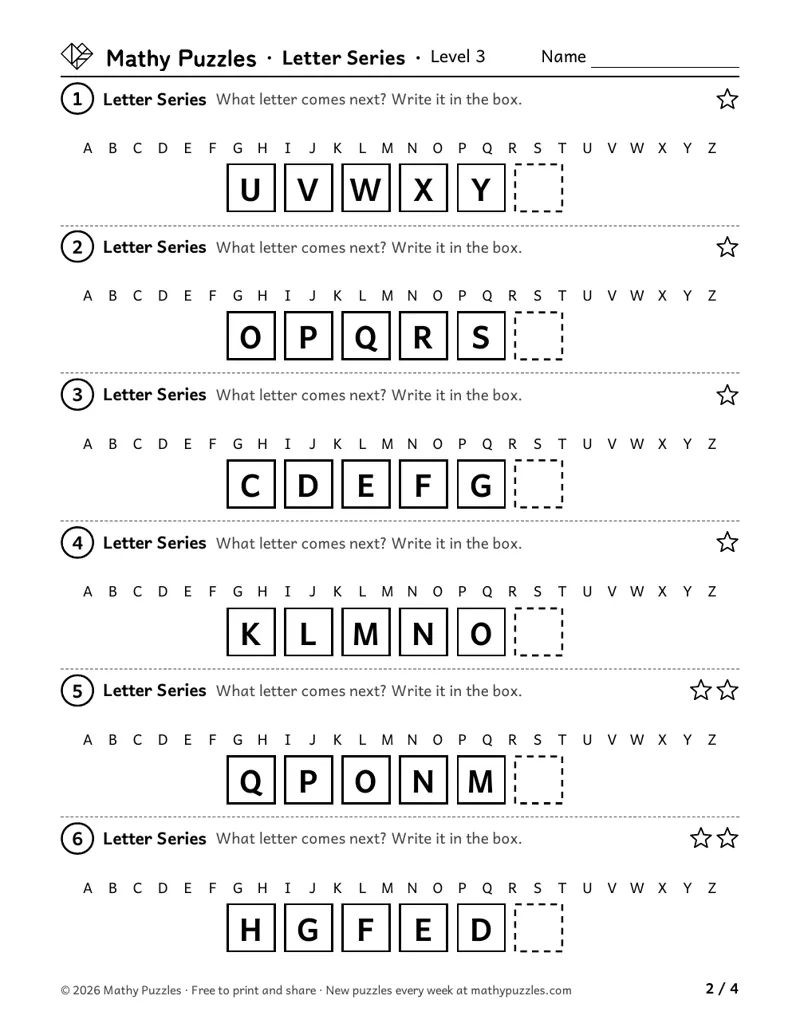 Level 3: a page from the free set
Before starting
- Know the alphabet in order (the strip on the page helps)
- Count forward and back by 1, 2 or 3
- Level 4: spot a jump that grows by one each time
Free puzzles to print
Each set: a Learn sheet with a worked example, 10 puzzles from easiest to hardest, and the answers.
Level 3
Ages 8–10 · Grades 3–4
A jump of 1 or 2 forward, then 3 forward, or 1 or 2 back. Then jumps that take turns (+1, +2, +1, +2). The hardest puzzles weave two series together, every other letter.
On the sheet: “What letter comes next? Write it in the box.”
Print Level 3 (Letter)Other paper size: A4Level 4
Ages 10–12 · Grades 5–6
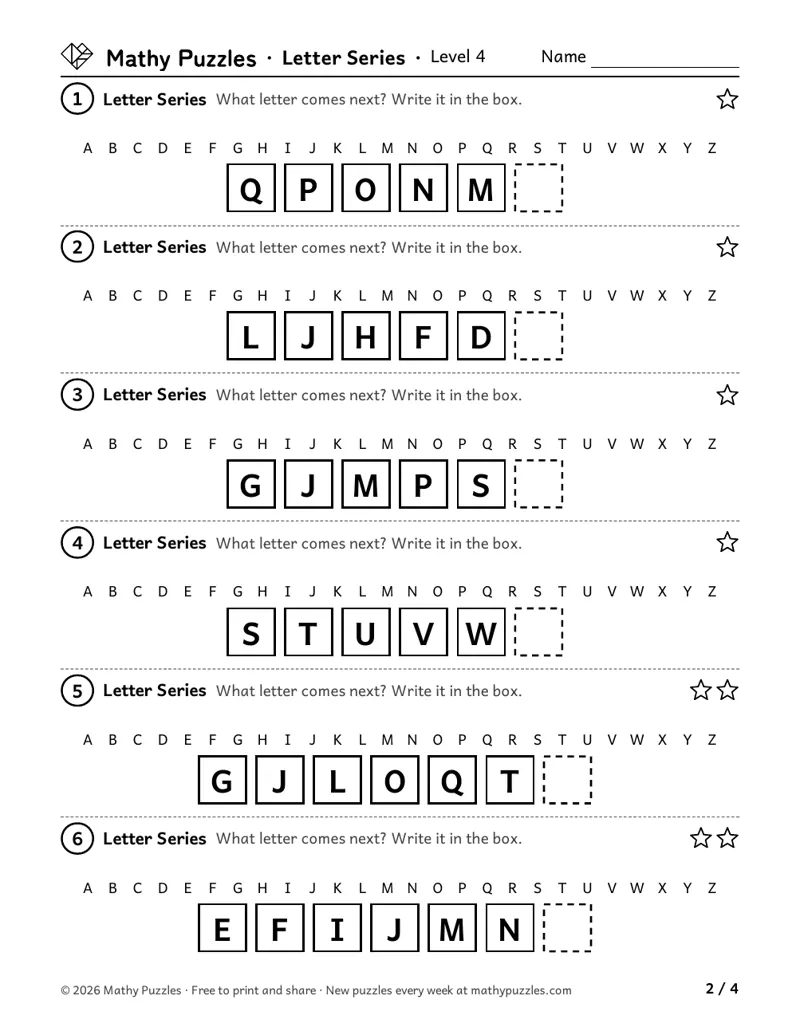
A jump of 1 to 3, forward or back. Then jumps that take turns, or two woven series. Then a jump that grows by one each time, forward or back. The hardest puzzles use letter pairs, the first letters going forward and the second going back.
On the sheet: “What letter comes next? Write it in the box.”
Print Level 4 (Letter)Other paper size: A4
How it works
Each puzzle is a row of capital letters that follows a rule, then an empty box. An alphabet strip printed across the top of each puzzle lets the child count the jumps between letters. The child finds the rule and writes the next letter (in the hardest Level 4 puzzles, the next pair of letters). The letters never wrap from Z back to A.
How to play
- Point to each letter on the alphabet strip.
- Count the hops from one letter to the next. Write the jump small under the gap.
- Look at the jumps. Are they the same, taking turns, or growing?
- Make the next jump from the last letter. Write that letter in the box.
When it gets hard
Counting the starting letter as a hop.
Hint: Put a finger on the letter and count only the moves: A to C is 2 hops.
Missing that the letters run backward.
Hint: Check the direction first: are the letters heading toward Z or toward A?
Looking for one rule when two series take turns.
Hint: Read every other letter. Each set may follow its own rule.
Tip for grown-ups: Counting hops with a finger on the strip is the right method at any age. Keep the strip in view and ask for the jumps to be written down.
Frequently asked questions
- Does my child need to know the alphabet by heart?
- No. An alphabet strip is printed across each puzzle, so the child counts on it. Knowing the order helps, but the strip carries the memory load.
- Is this a spelling activity?
- No words are spelled. Letters stand for places in the alphabet. Rows that would spell a rude word are screened out.
- Can I pair this with number patterns in a grade 4 class?
- Yes. Writing the jumps under the letters is the same move as finding the rule in a number pattern, so Number Series makes a good partner.
Questions about printing, levels, answers or membership: see all questions.
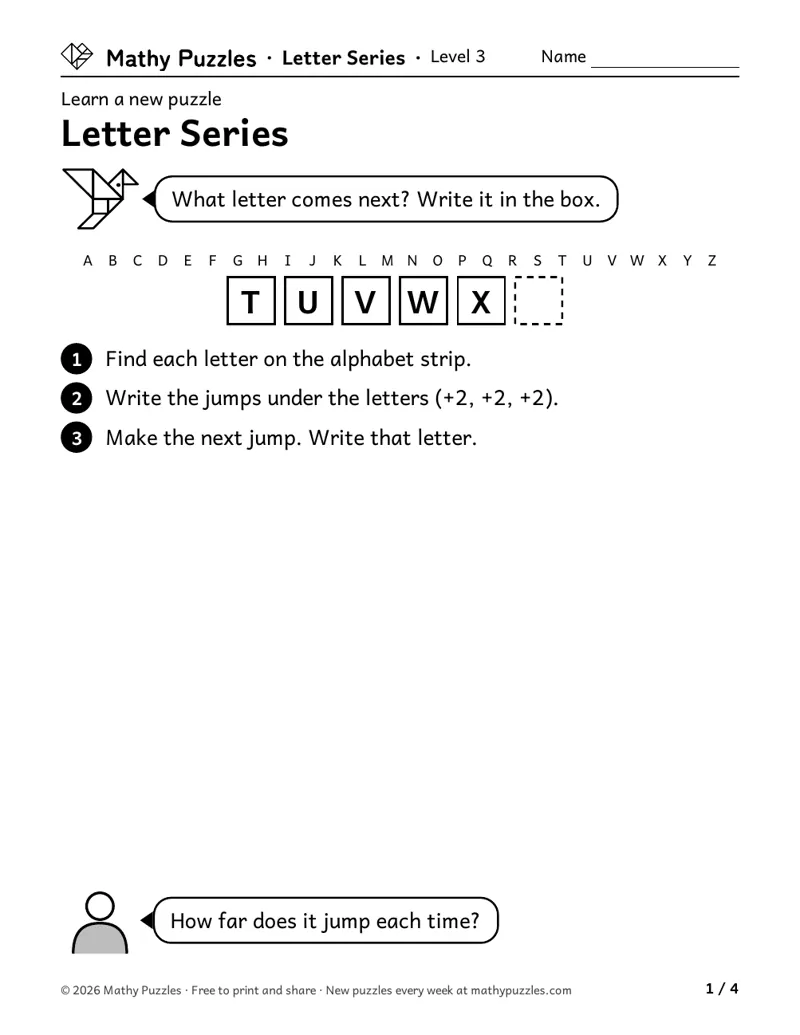
Worked example
From the Level 3 Learn sheet
- Find each letter on the alphabet strip.
- Write the jumps under the letters (+2, +2, +2).
- Make the next jump. Write that letter.
A question to ask: “How far does it jump each time?”
Free every Sunday A mixed bag of 20 new puzzles, all four levels. Get them by email
The thinking it works on
Finding the rule in a row of letters
Works out the rule that makes each letter from the one before.
In Csapó's (1997) tests of more than 2,000 students, rule-finding tasks such as number and word series showed a large gain before grade 5. Growth was fastest from grade 5 to grade 9. Source
Letters as places on a line
Turns letters into positions on the alphabet strip.
Tracking the jumps
Writes down the jump between each pair of letters.
Following two series at once
Keeps two woven series apart.
Checking the rule on every step
Tests the rule on all the letters before writing an answer.
Where is this thinking used?
- Codes: Shifting every letter a set number of places to hide a message.
- Indexes and files: Finding where a name sits in alphabetical order.
- Calendars: Spotting an every-other-week or every-third-day pattern.
- Spreadsheets: Columns lettered A, B, C continue by a rule.
For teachers
Curriculum areas
- Common Core
- Operations and algebraic thinking: patterns that follow a rule (Grade 4)
- NCERT
- Patterns chapters, such as Ganita Prakash (Class 6), Chapter 1: Patterns in MathematicsLevel 3: No direct curricular match.
- National Curriculum (England)
- No direct curricular match.
- Cambridge Primary Mathematics
- Number: sequences that grow by the same step, and sequences that do not (Stages 3–4)
Math practices: see the box below.
Math practices this puzzle uses
- Not used: MP1 Make sense of problems and persevere in solving them
- Not used: MP2 Reason abstractly and quantitatively
- Not used: MP3 Construct viable arguments and critique the reasoning of others
- Not used: MP4 Model with mathematics
- Not used: MP5 Use appropriate tools strategically
- Not used: MP6 Attend to precision
- Uses: MP7 Look for and make use of structure
- Uses: MP8 Look for and express regularity in repeated reasoning
From the Common Core Standards for Mathematical Practice.
More Letter Series puzzles for members
Members get at least 5 more worksheets at each difficulty for every puzzle, 80 new puzzles every Sunday, and the whole archive. $39 a year or $25 for 6 months.
See membershipNot ready yet?
One email, all four levels: 20 puzzles, 5 for each level.
For grown-ups (18+). One email every Sunday with the puzzles and the odd note about membership; unsubscribe any time. We never ask about your child. How we use your email