
Binary Code
A light switch has two settings, on and off. Line up five switches and you can name every letter of the alphabet, because each place is worth a number: 16, 8, 4, 2, 1.
Free sets by level, ages 10–12:
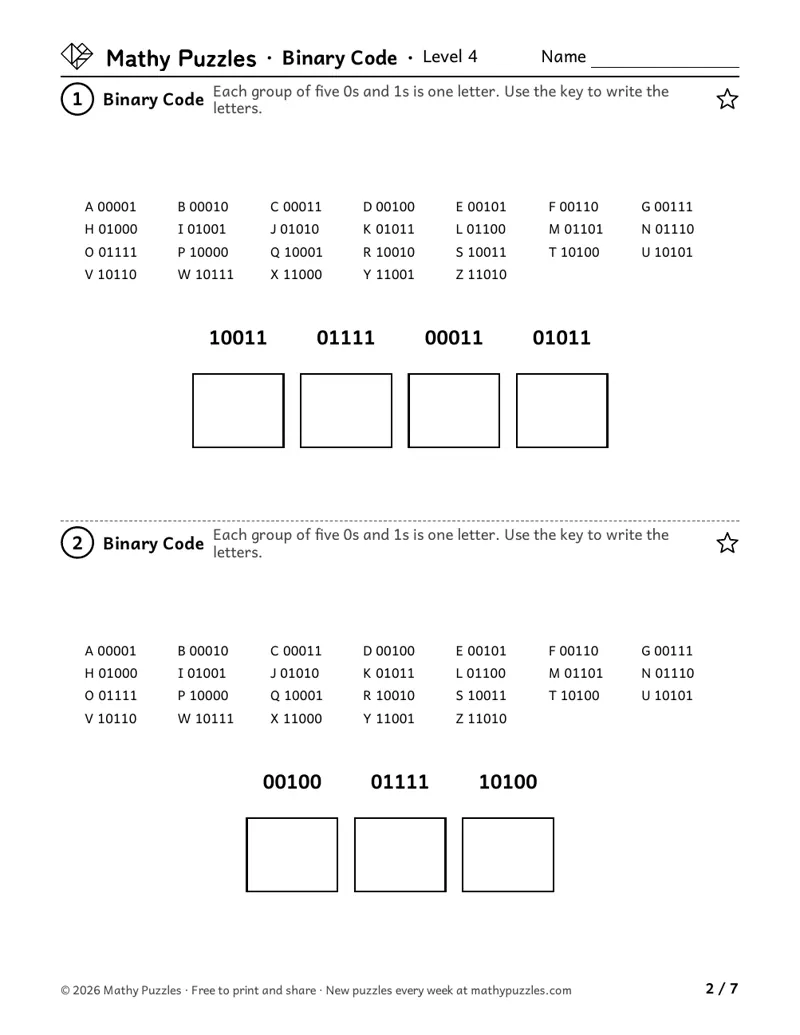 Level 4: a page from the free set
Before starting
- Add numbers up to 31
- Know the alphabet in order, with A as 1 and Z as 26
- Read a five-digit group carefully
What you need
Five small cards to make dot cards, scrap paper for the sums in the hardest puzzles, and a pencil.
Free printable: Binary numbers
Free puzzles to print
Each set: a Learn sheet with a worked example, 10 puzzles from easiest to hardest, and the answers.
Level 4
Ages 10–12 · Grades 5–6
Decode one short word with the full key, then a two-word message, then write a word in binary. The hardest puzzles have no letter key. They give only the place values 16, 8, 4, 2, 1, one worked example and a strip that shows A is 1, B is 2 and so on.
On the sheet: “Each group of five 0s and 1s is one letter. Use the key to write the letters.”
Print Level 4 (Letter)Other paper size: A4
How it works
Each letter is written as five 0s and 1s, using the number of the letter: A is 1 (00001), B is 2 (00010), and Z is 26 (11010). The child decodes words and short messages with a key, then writes a word in binary. In the hardest puzzles there is no letter key. The child adds the place values 16, 8, 4, 2 and 1 over each 1 to find the letter's number.
How to play
- Look at the first group of five 0s and 1s.
- Find the same group in the key, or add the place values over each 1.
- That number is the letter: A is 1, B is 2. Write it in the box.
- Do every group, then read the message.
When it gets hard
Reading the group from the wrong end.
Hint: The left place is worth 16 and the right place is worth 1.
Adding the place values over the 0s too.
Hint: Only the places with a 1 count. Underline the 1s first.
Being one letter off (counting A as 0).
Hint: A is 1, so A is 00001, not 00000. Check the key.
Tip for grown-ups: Make five cards with 16, 8, 4, 2 and 1 dots. Turn cards face up for 1 and face down for 0, and count the dots together to make any number up to 31. Scrap paper helps with the sums in the hardest puzzles.
Frequently asked questions
- Is this how computers store letters?
- The idea is the same: computers store everything as 0s and 1s. Real computer letter codes use longer groups, usually 8 or more 0s and 1s per letter. This puzzle uses a simple 5-digit code where A is 1.
- My child is stuck on the puzzles with no letter key.
- Underline the 1s in the group. Write the place value above each one (16, 8, 4, 2, 1) and add them. Then count that far along the A-is-1 strip. The worked example in the key shows each step.
- Does this link to place value?
- Yes. In base ten each place is ten times the next; in binary each place is two times the next. Writing 16, 8, 4, 2, 1 above the digits makes the link easy to see.
Questions about printing, levels, answers or membership: see all questions.
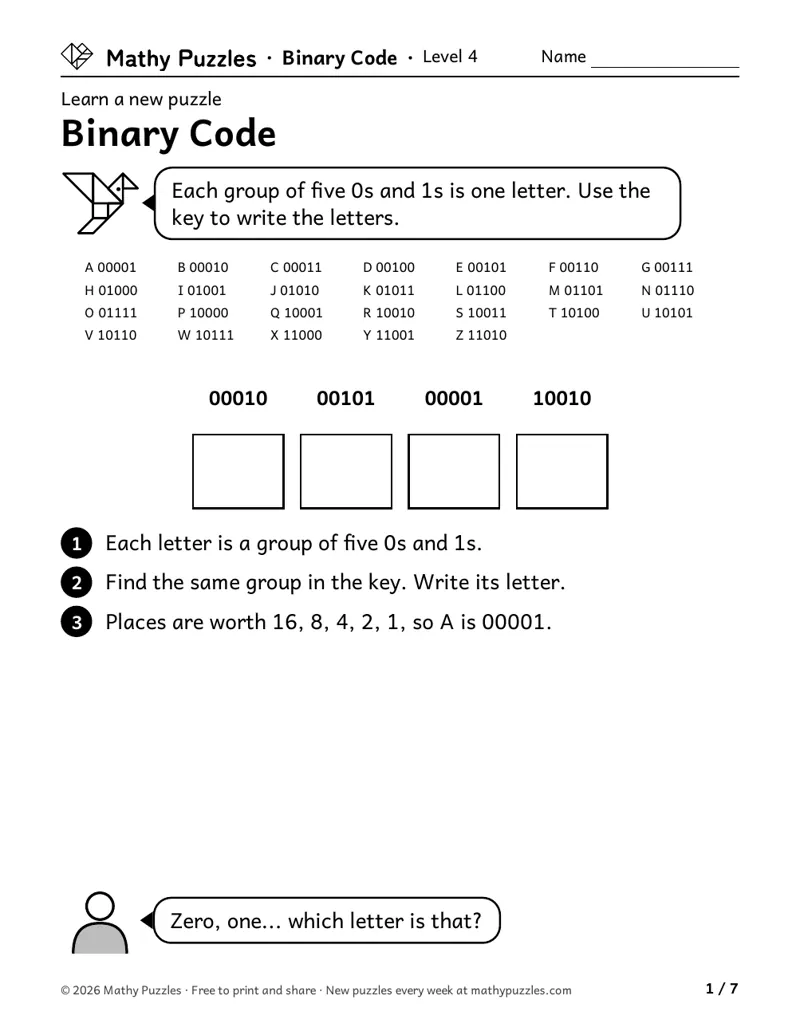
Worked example
From the Level 4 Learn sheet
- Each letter is a group of five 0s and 1s.
- Find the same group in the key. Write its letter.
- Places are worth 16, 8, 4, 2, 1, so A is 00001.
A question to ask: “Zero, one... which letter is that?”
Free every Sunday A mixed bag of 20 new puzzles, all four levels. Get them by email
The thinking it works on
Place-value reasoning
Understands that each place is worth double the one to its right.
Thomas and Mulligan (1999) interviewed 132 children from kindergarten to grade 6. Most did not yet see each place in a number as worth ten times the next, with little progress in grades 5 and 6. Source
Adding in the head
Adds the place values over each 1.
Lemaire and Callies (2009) found that children in grades 3, 5 and 7, like adults, most often split both numbers into tens and ones to add them. They chose methods differently as they got older. Source
Writing a letter in code
Turns a letter into five 0s and 1s.
Reading five digits carefully
Keeps five digits in order without dropping or swapping one.
Seeing structure in a pattern
Notices how the codes count up in order.
Where is this thinking used?
- Computers: Every file, picture and letter is stored as 0s and 1s.
- Switches: A row of on-off switches can count, like the lights on a panel.
- Barcodes: Thick and thin, or black and white, carry numbers in two kinds of mark.
- Place value: Tens and ones work the same way, with ten in place of two.
For teachers
Curriculum areas
- Common Core
- Number and operations in base ten: place value (Grade 5), the base-ten version of the same idea
- Computer science (CSTA)
- Writing the same information in more than one code, including 0s and 1s (data and analysis, ages 11–14)
- NCERT
- Patterns in Mathematics (Class 6): doubling and powers of 2
- National Curriculum (England)
- Number: powers of 2 (Key Stage 3)
- Cambridge Primary Mathematics
- No direct curricular match.
Math practices: see the box below.
Math practices this puzzle uses
- Not used: MP1 Make sense of problems and persevere in solving them
- Not used: MP2 Reason abstractly and quantitatively
- Not used: MP3 Construct viable arguments and critique the reasoning of others
- Not used: MP4 Model with mathematics
- Not used: MP5 Use appropriate tools strategically
- Uses: MP6 Attend to precision
- Uses: MP7 Look for and make use of structure
- Not used: MP8 Look for and express regularity in repeated reasoning
From the Common Core Standards for Mathematical Practice.
More Binary Code puzzles for members
Members get at least 5 more worksheets at each difficulty for every puzzle, 80 new puzzles every Sunday, and the whole archive. $39 a year or $25 for 6 months.
See membershipNot ready yet?
One email, all four levels: 20 puzzles, 5 for each level.
For grown-ups (18+). One email every Sunday with the puzzles and the odd note about membership; unsubscribe any time. We never ask about your child. How we use your email