
Count the Shapes
Ask a child how many triangles are in a drawing and most will count the small ones and stop. The bigger triangles, made from two or three small ones put together, are hiding in plain sight, and they count too.
Free sets by level, ages 4–8:
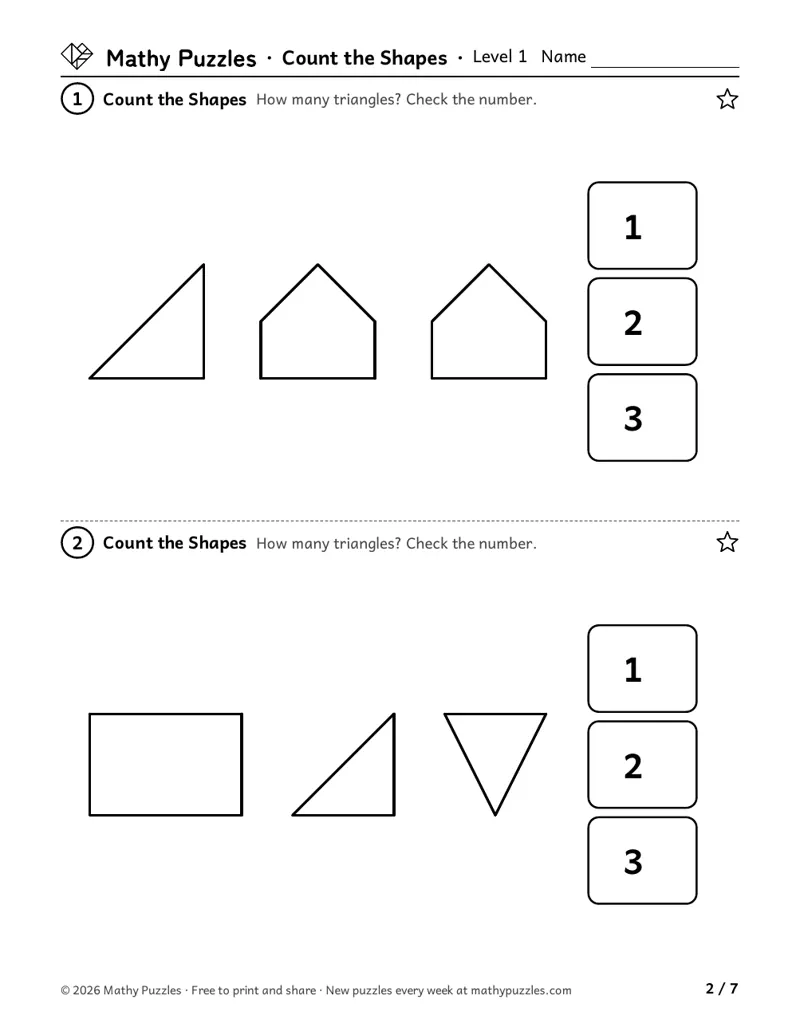 Level 1: a page from the free set
Before starting
- Name a triangle and a square
- Count to 6 (Level 1) or to 20 (Level 2)
- Level 2: write numbers to 20
What you need
Colored pencils to trace each shape in a new color, and a pencil.
Free puzzles to print
Each set: a Learn sheet with a worked example, 10 puzzles from easiest to hardest, and the answers.
Level 1
Ages 4–6 · Pre-K–K
The easiest puzzles: a few separate shapes in a row, nothing touching. Count the triangles or the squares (up to 5) and check the right number card.
The middle puzzles: a little picture of 3 to 6 squares and triangles that touch; each one is still counted on its own.
The hardest puzzles: one shape cut by one line, so two small triangles make a big one, and the big one counts too.
On the sheet: “How many? Big ones made of small ones count too.”
Print Level 1 (Letter)Other paper size: A4Level 2
Ages 6–8 · Grades 1–2
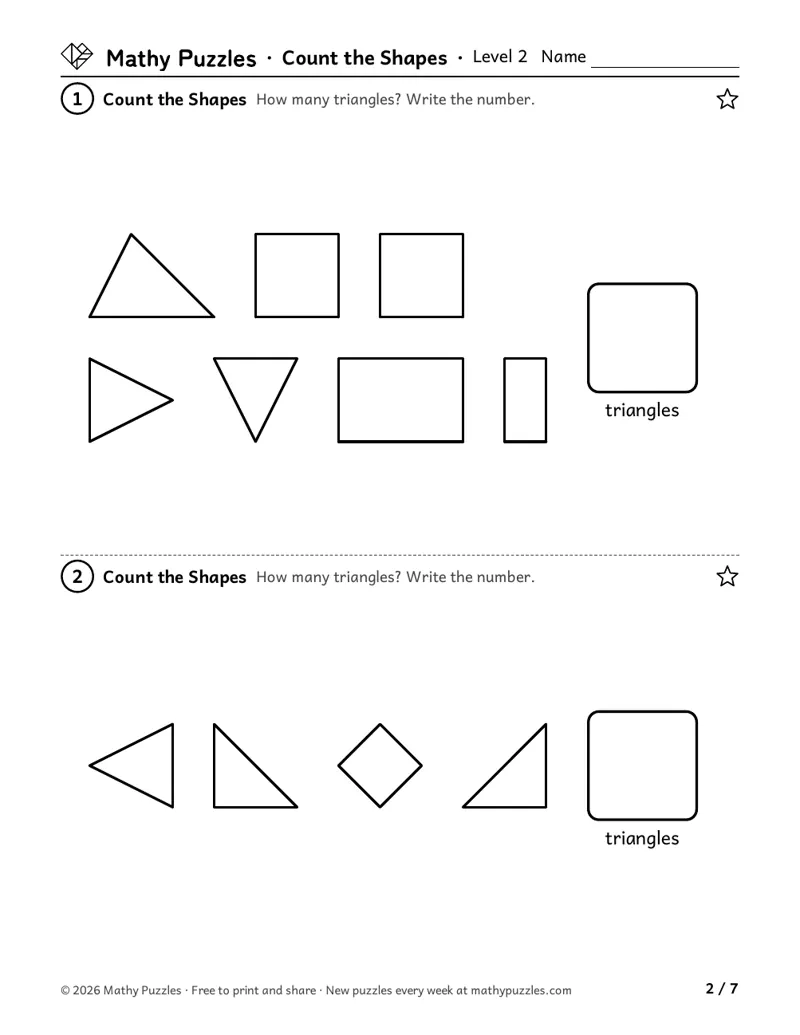
The easiest puzzles: separate shapes, nothing crossing; find the triangles among other shapes.
The middle puzzles: one triangle or rectangle cut by one or two lines, 3 to 8 triangles.
The harder puzzles: shapes cut by two or three lines (up to 13 triangles), or a small grid of squares.
The hardest puzzles: shapes cut by three or four lines (14 to 20 triangles). Or a bigger grid, such as 3 by 4, with 11 to 20 squares.
On the sheet: “How many? Big ones made of small ones count too.”
Print Level 2 (Letter)Other paper size: A4
How it works
Each sheet has a line drawing and one question, such as "How many triangles?" or "How many squares?". At Level 1 the child checks one of three number cards. At Level 2 they write the total in the answer box. Counting by size helps: all the smallest shapes first, then the ones made of two, and so on.
How to play
- Count the smallest shapes first. Touch each one, or number it lightly in pencil.
- Now look for shapes made of two small ones joined together.
- Then shapes made of three or more, and finally the whole outline.
- Add up all your counts. Write the total, or at Level 1 check the card with that number.
When it gets hard
Counting only the small shapes.
Hint: The rule says big ones made of small ones count too. Is the whole outline a triangle?
In the square-grid puzzles, counting a 1-by-2 box as a square.
Hint: A square has four equal sides and four square corners.
Losing count halfway.
Hint: Write a tally for each size: small, two-piece, three-piece, whole.
At Level 1, checking the card that is one too small.
Hint: That card leaves out the big triangle. Did you count the one made of two small ones?
Tip for grown-ups: Ask "how many?" before and after; a changed answer means a found shape, and that is the moment to ask where it was hiding. Tracing each shape in a new color makes it easy to see which ones are already counted.
Frequently asked questions
- My child gets a different total every time.
- Counting order is the fix: small shapes first, then shapes made of two, then bigger. Numbering each shape lightly in pencil stops double counting.
Questions about printing, levels, answers or membership: see all questions.
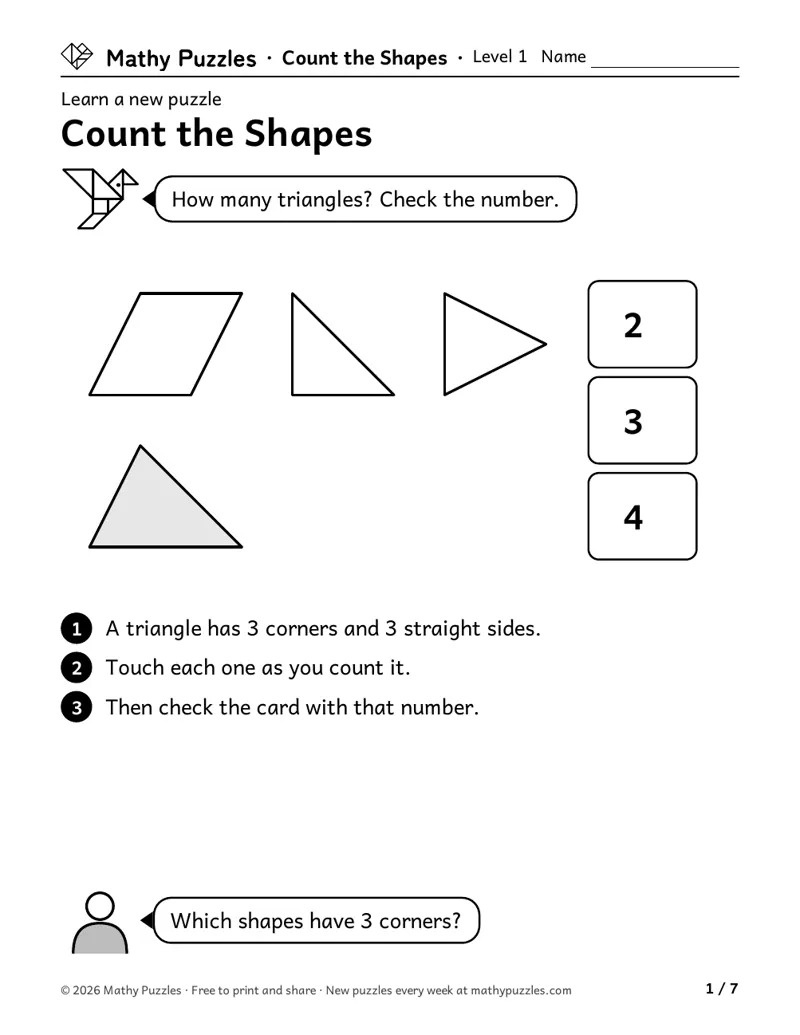
Worked example
From the Level 1 Learn sheet
- A triangle has 3 corners and 3 straight sides.
- Touch each one as you count it.
- Then check the card with that number.
A question to ask: “Which shapes have 3 corners?”
Free every Sunday A mixed bag of 20 new puzzles, all four levels. Get them by email
The thinking it works on
Seeing the whole and the parts at once
Switches between looking at the small pieces and the whole outline.
Mondloch and colleagues (2003) found that 6- and 10-year-olds see a whole shape before its parts even more strongly than adults do. This pull toward the whole settles to the adult level between ages 10 and 14. Source
Systematic counting
Counts small shapes first, then two-piece shapes, then bigger ones.
English (1991) gave children aged 4½ to 9 tasks of finding every combination and saw six strategies, from random picking to a fixed, systematic order. Source
Knowing what makes a triangle or a square
Checks sides and corners, so a tilted triangle counts and a slanted box doesn't.
Clements and colleagues (1999) interviewed 97 children aged 3 to 6. The children judged shapes mostly by overall look, so a tilted or stretched triangle was often not called a triangle. Source
Taking shapes apart and putting them together
Sees which small triangles join to make a bigger one, and which don't.
Clements, Wilson and Sarama (2004) found that, for children aged 3 to 7, seeing several small shapes as one new, bigger shape comes late, after trial and error. Source
Seeing rows and columns in a grid
Finds 2-by-2 squares inside a bigger grid of squares.
Many students do not yet see a grid of squares as rows and columns; Battista and colleagues (1998) described several levels in how children structure such grids. Source
Keeping a running record
Holds the count so far, or writes it down, while hunting for the next shape.
Gathercole and colleagues (2004) found that the mental space for holding a count while searching grows roughly in a straight line from age 4 to 15. Source
Where is this thinking used?
- Floor plans and maps: One outline holds rooms inside rooms.
- Inventories: Checking a list without missing or double-counting anything.
- Diagrams: Spotting a hidden pattern inside a bigger picture, as in science or circuit drawings.
For teachers
Curriculum areas
- Common Core
- Geometry: composing and decomposing shapes; defining features of shapes (Grades K–2)
- NCERT
- Shapes in a design (Class 2); counting the rectangles, squares and triangles in a picture (Classes 3–4)
- National Curriculum (England)
- Geometry – properties of shapes: recognizing and naming common 2-D shapes (Year 1)
- Cambridge Primary Mathematics
- Geometry and measure: recognizing 2D shapes, including in different positions (Stages 1–2)
Math practices: see the box below.
Math practices this puzzle uses
- Not used: MP1 Make sense of problems and persevere in solving them
- Not used: MP2 Reason abstractly and quantitatively
- Not used: MP3 Construct viable arguments and critique the reasoning of others
- Not used: MP4 Model with mathematics
- Not used: MP5 Use appropriate tools strategically
- Uses: MP6 Attend to precision
- Uses: MP7 Look for and make use of structure
- Not used: MP8 Look for and express regularity in repeated reasoning
From the Common Core Standards for Mathematical Practice.
More Count the Shapes puzzles for members
Members get at least 5 more worksheets at each difficulty for every puzzle, 80 new puzzles every Sunday, and the whole archive. $39 a year or $25 for 6 months.
See membershipNot ready yet?
One email, all four levels: 20 puzzles, 5 for each level.
For grown-ups (18+). One email every Sunday with the puzzles and the odd note about membership; unsubscribe any time. We never ask about your child. How we use your email