
Block Fit
Packing a suitcase is a puzzle most grown-ups know: everything fits only if the big things go in first and something gets turned on its side. Block Fit is that puzzle on paper, and sometimes a piece only fits once it is flipped over.
Free sets by level, ages 6–8:
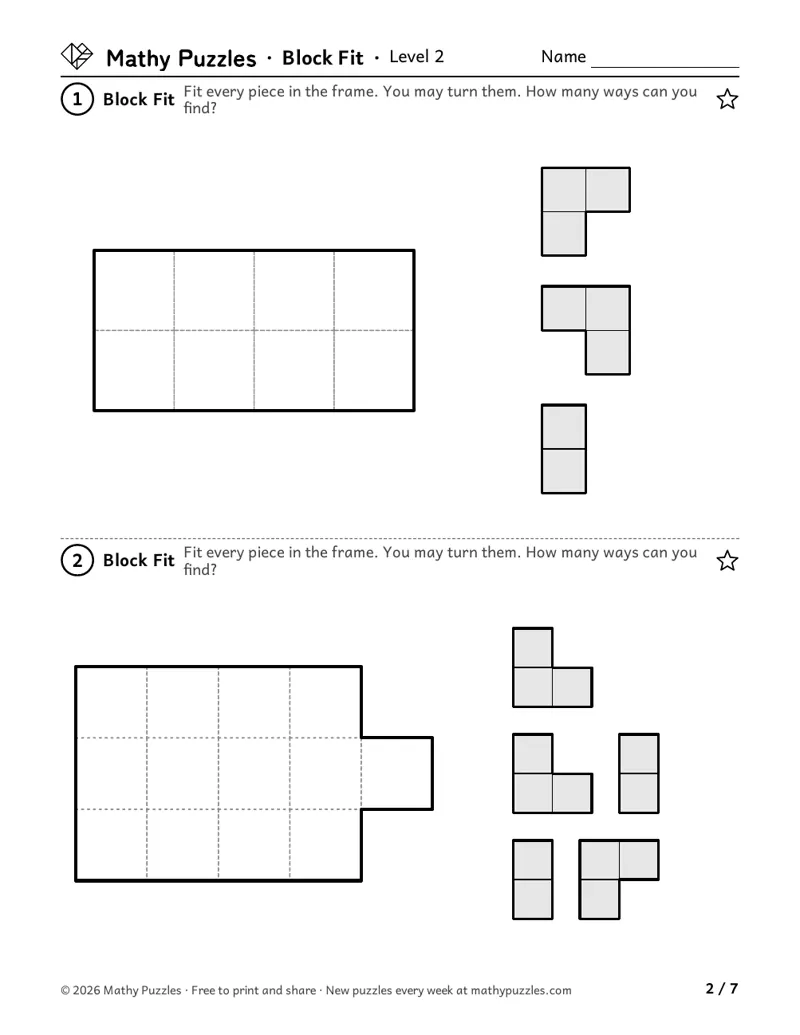 Level 2: a page from the free set
Before starting
- Count squares up to about 20
- Know that a piece can be turned around
- Draw a line along a grid with a pencil
What you need
Scrap paper and scissors to cut out copies of the tray pieces, and a pencil with an eraser.
Free puzzles to print
Each set: a Learn sheet with a worked example, 10 puzzles from easiest to hardest, and the answers.
Level 2
Ages 6–8 · Grades 1–2
The easiest puzzles: a small frame (such as 2 × 4 or 3 × 3 squares) and 3 to 5 pieces of 2 or 3 squares. Turning the pieces is enough.
The middle puzzles: frames up to 4 × 4 or 5 × 3, with 3 to 5 pieces and the biggest 4 squares. At least one piece must be flipped over: no fit works with turns alone.
The hardest puzzles: a 5 × 4 frame with a corner cut off, and 4 or 5 pieces of 3 to 5 squares. At least one must be flipped.
On the sheet: “Draw lines to fit every piece in the frame.”
Print Level 2 (Letter)Other paper size: A4
How it works
Each puzzle has a frame made of squares and a tray of block pieces, each made of 2 to 5 squares. The child draws lines inside the frame to show where every piece goes, using each piece once. Pieces may be turned, and in the harder puzzles at least one must be flipped over. A puzzle may be filled in more than one way, so every puzzle asks: how many ways can you find?
How to play
- Count the squares in the frame and in all the pieces. The totals match.
- Start in a corner. Which piece can fill it? Turn it in your head, or turn a paper copy.
- Draw lines along the grid to show where that piece goes.
- Keep going until every piece is in once. Then look for another way.
When it gets hard
Using a piece twice, or leaving one out.
Hint: Put a small check by each tray piece as you draw it in.
Starting in the middle and ending with odd gaps.
Hint: Start in a corner or a narrow spot. Fewer pieces fit there, so the choice is easier.
Deciding a piece can't fit because it faces the wrong way.
Hint: Flip it over like a pancake. In the middle and hardest puzzles, at least one piece has to be flipped.
Tip for grown-ups: When one way works, ask: "Can you find another?" The answers show one way as an example. Any fit that uses every piece once is right.
Frequently asked questions
- Is the answer page the only right answer?
- No. A puzzle may have more than one way, and any way that uses every piece once and fills the frame is right. The answers show one example, so finding a different one is a win.
- Should my child cut out the pieces?
- It helps at first, especially for flips. Trace the tray pieces on scrap paper, cut them out, and let your child turn and flip them on the frame. Later, ask them to try it in their head first.
Questions about printing, levels, answers or membership: see all questions.
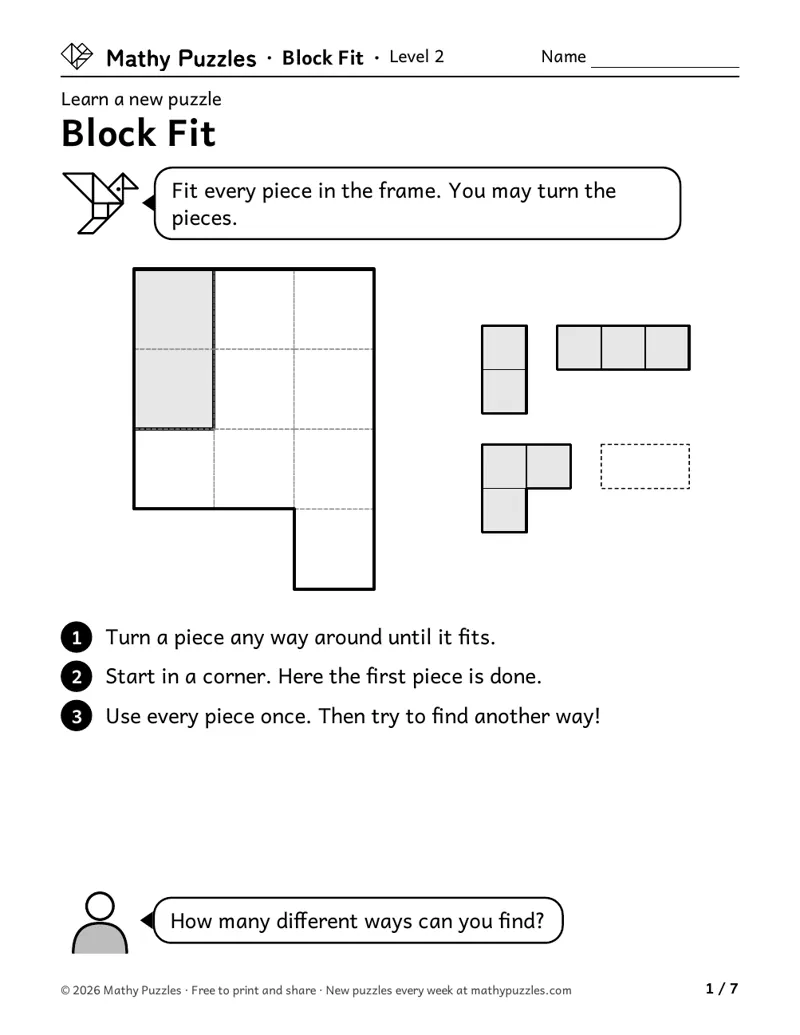
Worked example
From the Level 2 Learn sheet
- Fit every piece in the frame. You may turn the pieces.
- Start in a corner. Here the first piece is already drawn in; it had to be turned to fit.
- Use every piece once.
- Then try to find another way.
A question to ask: “How many different ways can you find?”
Free every Sunday A mixed bag of 20 new puzzles, all four levels. Get them by email
The thinking it works on
Fitting parts into a whole
Sees which pieces together fill the frame with nothing left over.
Clements, Wilson and Sarama (2004) studied 72 children aged 3 to 7. They found that the last step in putting shapes together is combining pieces into a new whole that the child can treat as one unit. Source
Turning shapes in the mind
Pictures a piece turned before drawing it in.
Estes (1998) found that 6-year-olds turned shapes in their heads as readily as adults on a computer matching game. They could also say this was how they decided. Source
Seeing mirror images
Notices when only a flipped piece will fit.
Hawes and colleagues (2015) tested 165 children aged 4 to 8 on turning real 3-D objects in the mind. Most children under 7 found it hard: they often guessed and were tripped up by mirror-image objects. Source
Planning ahead
Checks that the space left can still take the other pieces.
Luciana and Nelson (1998) gave a planning task to 181 children aged 4 to 8. Four-year-olds did worse than 5- to 7-year-olds, and 8-year-olds had not yet reached adult level on the hardest problems. Source
Trying again after a dead end
Erases and tries a new place when a fit fails.
Huizinga and van der Molen (2007) gave a card-sorting task to 7-, 11-, 15- and 21-year-olds. Dropping a rule that has stopped working and trying another reached adult level by age 11. Source
Looking for other ways
Hunts for a second and third way once one works.
In English's (1991) study of children aged 4½ to 9, many moved by themselves to a tidier system for finding every possible combination. Some 7-year-olds kept one item fixed while changing the others. Source
Where is this thinking used?
- Packing: Fitting bags and boxes into a car trunk or a suitcase.
- Room layout: Arranging furniture so it all fits in a room.
- Tiling: Laying floor tiles or paving stones with no gaps.
- Games: Video and board games where shaped pieces must fit together.
For teachers
Curriculum areas
- Common Core
- Geometry: putting flat shapes together to make a larger shape (Grade 1)
- NCERT
- Shapes made by joining squares, in Fun with Shapes (Maths Mela, Class 3)
- National Curriculum (England)
- No direct curricular match.
- Cambridge Primary Mathematics
- Geometry and measure: making a shape by combining shapes (Stage 4)
Math practices: see the box below.
Math practices this puzzle uses
- Uses: MP1 Make sense of problems and persevere in solving them
- Not used: MP2 Reason abstractly and quantitatively
- Not used: MP3 Construct viable arguments and critique the reasoning of others
- Not used: MP4 Model with mathematics
- Not used: MP5 Use appropriate tools strategically
- Not used: MP6 Attend to precision
- Uses: MP7 Look for and make use of structure
- Not used: MP8 Look for and express regularity in repeated reasoning
From the Common Core Standards for Mathematical Practice.
More Block Fit puzzles for members
Members get at least 5 more worksheets at each difficulty for every puzzle, 80 new puzzles every Sunday, and the whole archive. $39 a year or $25 for 6 months.
See membershipNot ready yet?
One email, all four levels: 20 puzzles, 5 for each level.
For grown-ups (18+). One email every Sunday with the puzzles and the odd note about membership; unsubscribe any time. We never ask about your child. How we use your email