
Who Is It?
Spotting a friend at a busy school gate is quicker when you know they are wearing a red hat and no scarf. Who Is It? works that way: check every friend against one clue at a time, and the one who passes them all is the answer.
Free sets by level, ages 4–8:
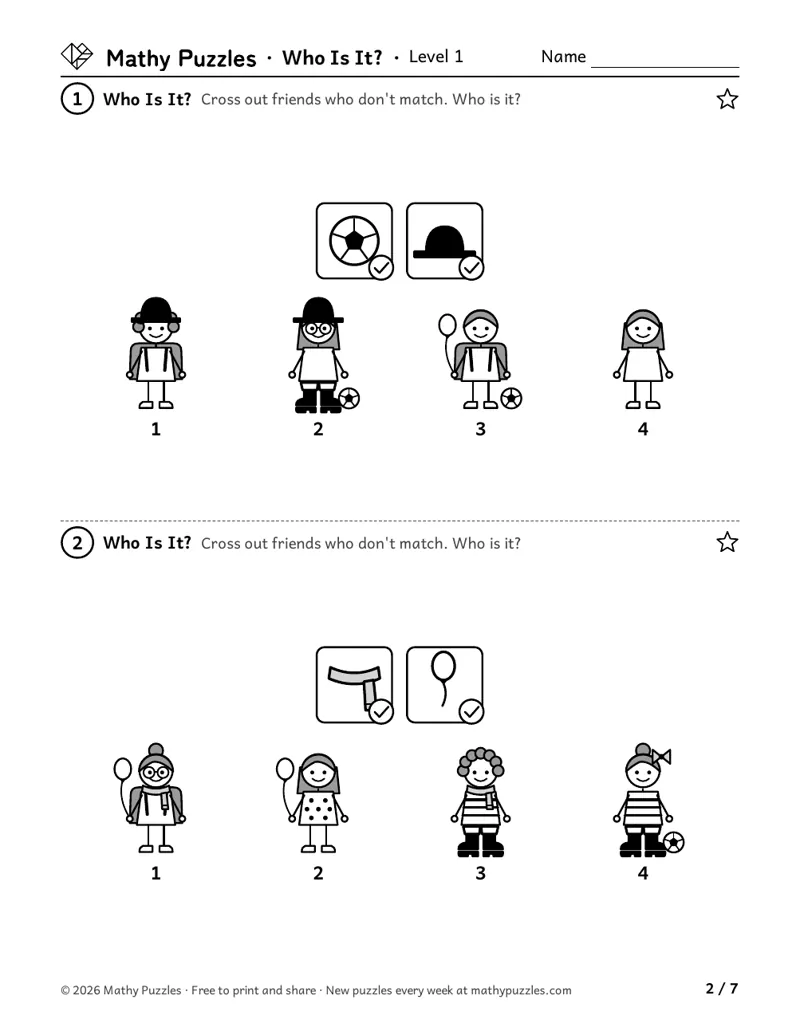 Level 1: a page from the free set
Before starting
- Level 1: no reading; the clues are pictures
- Know the check (has it) and the circle with a slash (does not have it)
- Level 2: a plus sign joins two pictures for "and", and the word "or" sits between them for "or"; a short sentence under the clues says the same
Free puzzles to print
Each set: a Learn sheet with a worked example, 10 puzzles from easiest to hardest, and the answers.
Level 1
Ages 4–6 · Pre-K–K
4 friends and 2 "has" clues; then 6 friends and 3 clues; the hardest add one "does not have" clue.
On the sheet: “Cross out friends who don't match. Who is it?”
Print Level 1 (Letter)Other paper size: A4Level 2
Ages 6–8 · Grades 1–2
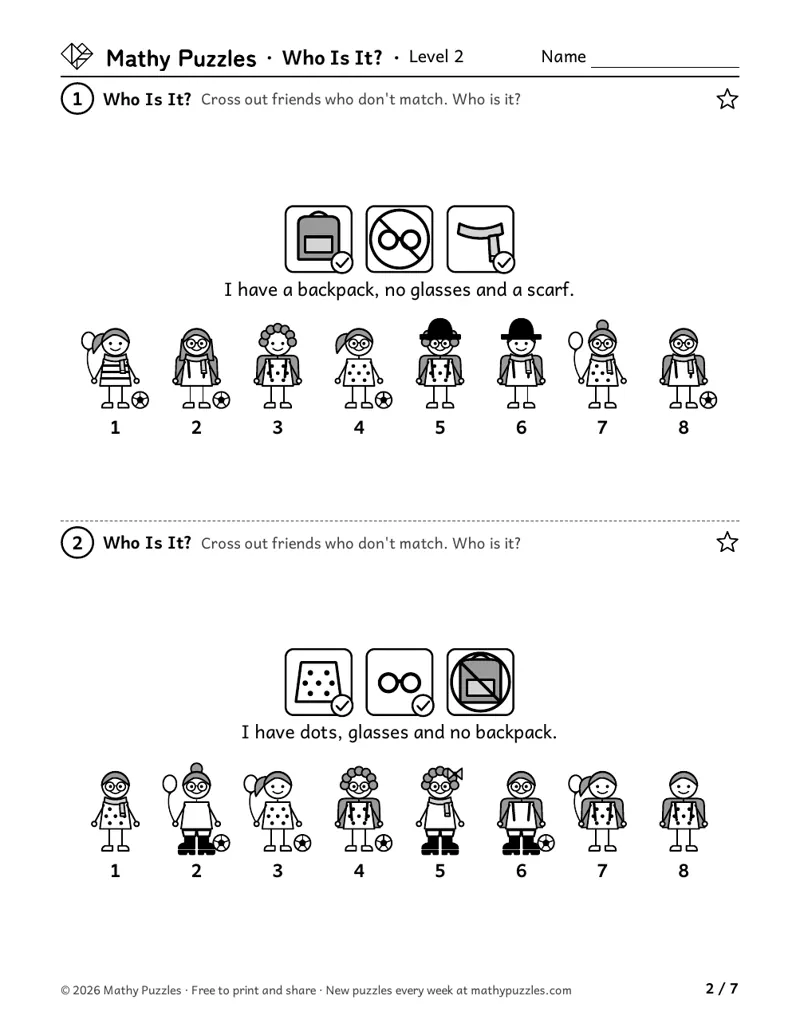
8 friends with a "not" clue; then 10 to 12 friends with an "and" clue (a hat and a scarf). Then 4 clues where every one is needed; the hardest use an "or" clue.
On the sheet: “Cross out friends who don't match. Who is it?”
Print Level 2 (Letter)Other paper size: A4
How it works
Each puzzle shows a row of drawn friends and a strip of picture clues. A clue with a check means the friend has that thing, such as a hat; a clue with a slash means they don't. The child crosses out every friend a clue rules out and finds the one left.
How to play
- Look at the first clue. Does it have a check or a slash?
- Look at every friend. Cross out each one who doesn't match.
- Do the next clue the same way, with the friends still left.
- Check the last friend against every clue.
When it gets hard
Checking only some of the friends for a clue.
Hint: Touch every friend, left to right, for every clue.
Reading a slash clue as a "has" clue.
Hint: A slash means no. Cross out the friends who do have it.
At Level 2, reading "or" as "and".
Hint: "Hat or scarf" keeps a friend with either one, or both.
Tip for grown-ups: Let your child say each clue as a sentence, "The friend has a hat," before crossing anyone out.
Frequently asked questions
- Can a 4-year-old do this without reading?
- Yes. Level 1 clues are pictures only: the thing with a check, or the thing with a slash for "not". Do the first clue together, then let your child cross out.
- Does this work for a small group at a table?
- Yes, and no reading is needed at Level 1. Show the slash sign once, then ask each child to explain one friend they crossed out.
- Why are clues never about faces or hair?
- Clues are only about things you can see and change: hats, glasses, scarves, balloons. Hair and faces vary for fun, but no clue ever rules a friend out for who they are.
Questions about printing, levels, answers or membership: see all questions.
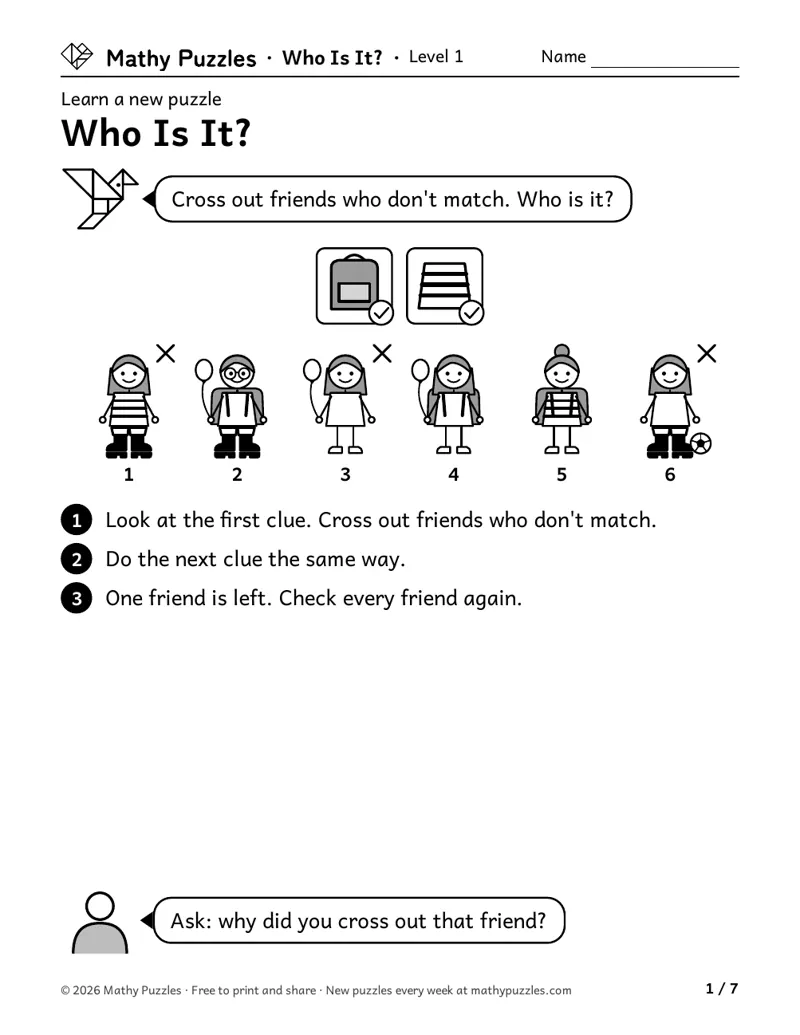
Worked example
From the Level 1 Learn sheet
- Look at the first clue. Cross out friends who don't match.
- Do the next clue the same way.
- One friend is left. Check every friend again.
A question to ask: “Why did you cross out that friend?”
Free every Sunday A mixed bag of 20 new puzzles, all four levels. Get them by email
The thinking it works on
Ruling out
Crosses out every friend a clue rules out.
Mody and Carey (2016) hid a sticker in one of two cups and showed one cup empty. Children of 3 to 5 reasoned that it must be in the other, while 2-and-a-half-year-olds did not yet. Source
Careful looking
Scans every friend for one small feature.
Donnelly and colleagues (2007) found that 6- to 7-year-olds and 9- to 10-year-olds searched more slowly than adults when the target was defined by two features together. They also took longer to decide a target was not there. Source
Understanding "not"
Reads a slash clue as "does not have".
Doyle and colleagues (2019) gave 4- and 5-year-olds 'not' sentences, such as 'the next item is not an orange'. Unlike adults, the children took longer to act on these than on plain sentences. Source
Using "and" and "or"
Keeps friends who have both, or at least one.
Zhu, Chen and Wang (2026) found that younger Chinese-speaking children often read 'or' as 'and'. Even 11- and 12-year-olds did not yet read 'or' as adults do. Source
Checking the answer
Checks the last friend against every clue.
Lyons and Ghetti (2011) found that even 3-year-olds could say when they were unsure of an answer. By age 5, their confidence told right from wrong answers more sharply. Source
Where is this thinking used?
- Finding someone in a crowd: Red hat, then glasses, until one person fits.
- Lost and found: Is it blue? Does it have a zipper? Narrowing down which bag is yours.
- Bird watching: Red chest, no crest: a guidebook narrows it to one bird.
- Online shopping: Filtering by size and color until one item fits.
For teachers
Curriculum areas
- Common Core
- Measurement and data: sorting objects into groups by one feature (Kindergarten); the real work is elimination (see Math practices)
- NCERT
- No direct curricular match.
- National Curriculum (England)
- No direct curricular match.
- Cambridge Primary Mathematics
- No direct curricular match.
Math practices: see the box below.
Math practices this puzzle uses
- Uses: MP1 Make sense of problems and persevere in solving them
- Not used: MP2 Reason abstractly and quantitatively
- Not used: MP3 Construct viable arguments and critique the reasoning of others
- Not used: MP4 Model with mathematics
- Not used: MP5 Use appropriate tools strategically
- Uses: MP6 Attend to precision
- Not used: MP7 Look for and make use of structure
- Not used: MP8 Look for and express regularity in repeated reasoning
From the Common Core Standards for Mathematical Practice.
More Who Is It? puzzles for members
Members get at least 5 more worksheets at each difficulty for every puzzle, 80 new puzzles every Sunday, and the whole archive. $39 a year or $25 for 6 months.
See membershipNot ready yet?
One email, all four levels: 20 puzzles, 5 for each level.
For grown-ups (18+). One email every Sunday with the puzzles and the odd note about membership; unsubscribe any time. We never ask about your child. How we use your email