
Which Belongs?
A dog, a cat and a cow all have four legs, and so does a table. Which Belongs? asks for the one thing all three pictures share, not just two of them, because only that is the rule.
Free sets by level, ages 6–10:
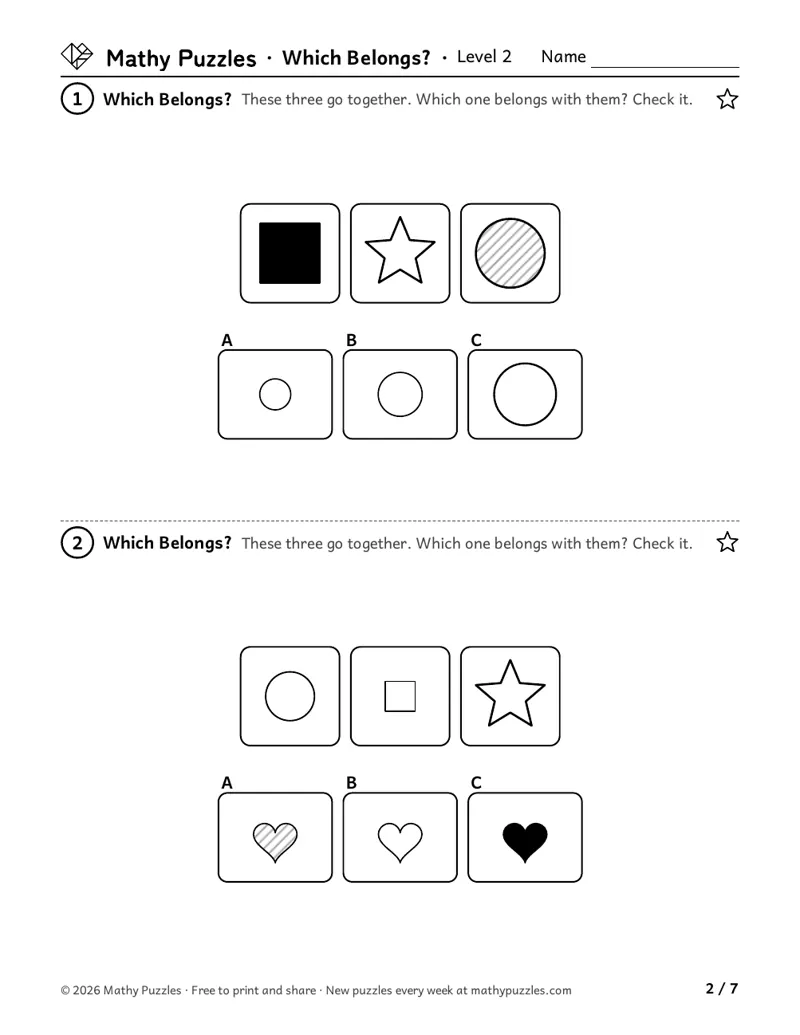 Level 2: a page from the free set
Before starting
- Level 2: name shapes, fills (white, black, striped) and sizes
- Level 3: count to 6
- Level 3, hardest puzzles: count the sides of a triangle, square, diamond, pentagon and hexagon
Free puzzles to print
Each set: a Learn sheet with a worked example, 10 puzzles from easiest to hardest, and the answers.
Level 2
Ages 6–8 · Grades 1–2
One shared feature; then one shared feature among near-misses that only two of the three share. Then two shared features together; the hardest puzzles add a near-miss to two shared features.
On the sheet: “These three go together. Which one belongs with them? Check it.”
Print Level 2 (Letter)Other paper size: A4Level 3
Ages 8–10 · Grades 3–4
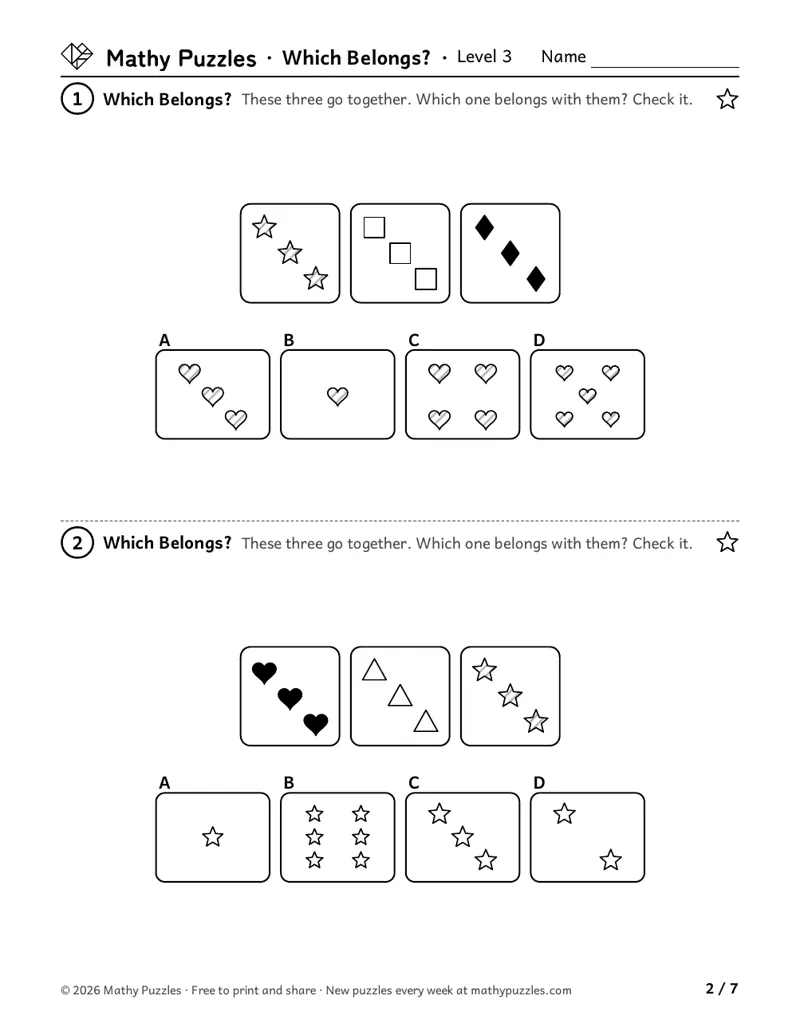
The same count in every box. Then the same count among near-misses (a shape or a fill that only two of the three share). The hardest puzzles use "as many shapes as each shape has sides", alone and then with a shared fill.
On the sheet: “These three go together. Which one belongs with them? Check it.”
Print Level 3 (Letter)Other paper size: A4
How it works
Three pictures share something. The child works out what all three have and checks the one option that has it too. At Level 2 the shared thing is a shape, a fill or a size, or two of these. At Level 3 it is how many shapes are in each box. In the hardest puzzles it is a link inside each picture: as many shapes as each shape has sides.
How to play
- Look at the first picture. Name everything about it.
- Keep only the things the other two have as well.
- Say the rule: "They are all ..."
- Check the option that has every part of the rule.
When it gets hard
Choosing something only two of the three share.
Hint: Check all three pictures before you decide.
Picking the option that looks most like the three.
Hint: The answer can differ in every other way. It only needs the shared thing.
At Level 3, counting the shapes but not their sides.
Hint: Count the shapes in a box, then count the sides of one shape.
Tip for grown-ups: When your child picks an option, ask "What do all three have that this one has too?" Saying the rule aloud is how a near-miss gets caught.
Frequently asked questions
- How is this different from Odd One Out?
- Odd One Out asks which picture breaks the group. Which Belongs? gives three that share a rule and asks the child to use it on new pictures, so the rule has to be found and then applied.
- Could this work as a warm-up for a geometry lesson?
- It could. The Level 3 sides-and-count puzzles pair well with a lesson on polygons, and the Level 2 ones with describing shapes.
- Why does the right answer look so different from the three?
- On purpose. The answer shares only the rule, so a child can't pick it by overall look; everything else is mixed up.
Questions about printing, levels, answers or membership: see all questions.
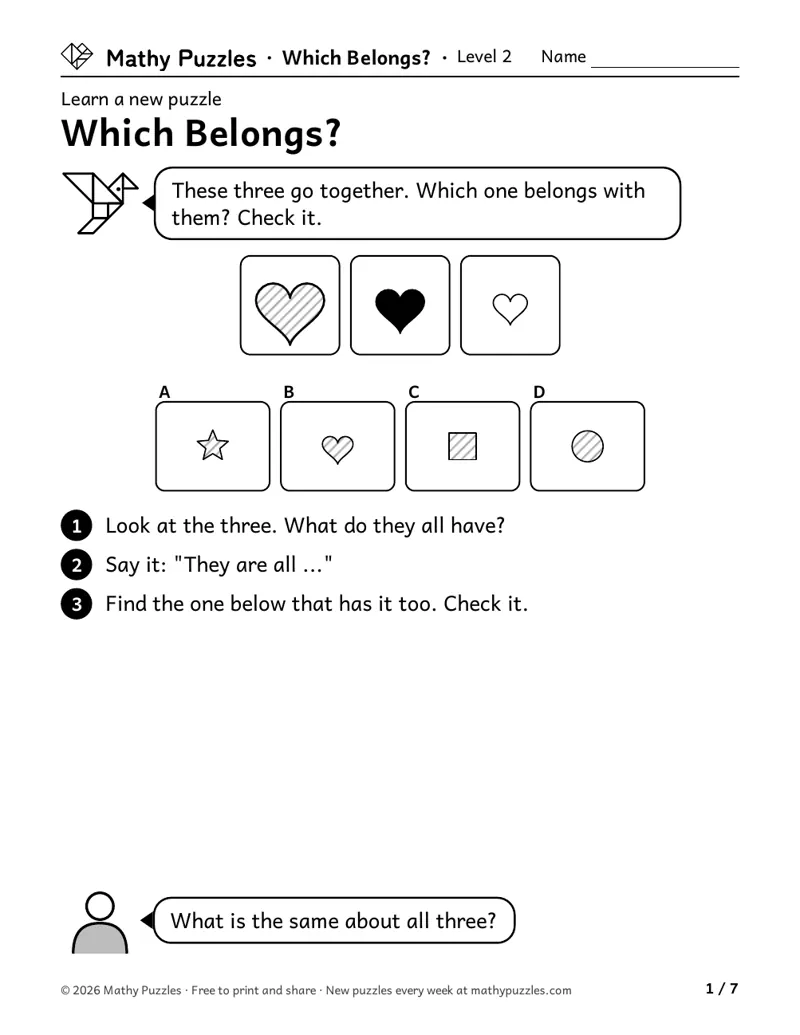
Worked example
From the Level 2 Learn sheet
- Look at the three. What do they all have?
- Say it: "They are all ..."
- Find the one below that has it too. Check it.
A question to ask: “What is the same about all three?”
Free every Sunday A mixed bag of 20 new puzzles, all four levels. Get them by email
The thinking it works on
Finding a shared rule
Works out what all three pictures have in common.
Checking all, not most
Makes sure the rule holds for every one of the three.
Seeing past the overall look
Picks by the rule, not by which option looks closest.
Gentner and Toupin (1986) found that both 5- to 7-year-olds and 8- to 10-year-olds were thrown when matching characters in two stories did not look alike. Only the older group could use the story's structure to get past that. Source
Combining two rules with "and"
Finds an option that has both shared features.
Podjarny, Kamawar and Andrews (2022) found that 4- and 5-year-olds could already pick the item that had to match on two features at once. Source
Reasoning about a link inside a picture
Sees that the count matches the number of sides.
Kotovsky and Gentner (1996) found that 6- and 8-year-olds could match a pattern, such as symmetry or steady increase, across different features. One card might show it in size and the other in shading. The 4-year-olds matched only when the feature was the same. Source
Where is this thinking used?
- Science: Deciding whether a new animal belongs in a group by the features the group shares.
- Spare parts: A replacement must share every feature that matters.
- Organizing: A new book goes on the shelf whose books it matches.
- Shopping: Finding another item that fits what is on the list.
For teachers
Curriculum areas
- Common Core
- Geometry: describing shapes by their attributes and naming shapes by their number of sides (Grades 1–2)
- NCERT
- Joyful Mathematics (Class 2): find the odd one out; Maths Mela (Class 3): sides and corners of shapes
- National Curriculum (England)
- Geometry – properties of shapes: comparing and sorting shapes; number of sides (Year 2)
- Cambridge Primary Mathematics
- Geometry and measure: sorting 2D shapes by their properties (Stages 2–3)
Math practices: see the box below.
Math practices this puzzle uses
- Not used: MP1 Make sense of problems and persevere in solving them
- Not used: MP2 Reason abstractly and quantitatively
- Uses: MP3 Construct viable arguments and critique the reasoning of others
- Not used: MP4 Model with mathematics
- Not used: MP5 Use appropriate tools strategically
- Not used: MP6 Attend to precision
- Uses: MP7 Look for and make use of structure
- Not used: MP8 Look for and express regularity in repeated reasoning
From the Common Core Standards for Mathematical Practice.
More Which Belongs? puzzles for members
Members get at least 5 more worksheets at each difficulty for every puzzle, 80 new puzzles every Sunday, and the whole archive. $39 a year or $25 for 6 months.
See membershipNot ready yet?
One email, all four levels: 20 puzzles, 5 for each level.
For grown-ups (18+). One email every Sunday with the puzzles and the odd note about membership; unsubscribe any time. We never ask about your child. How we use your email