
Two-Trait Grid
Laying floor tiles so every row and column has each color once is tricky enough. Two-Trait Grid adds a second thing to track: each square holds a shape and a fill, and no shape-and-fill pair may appear twice.
Free sets by level, ages 6–12:
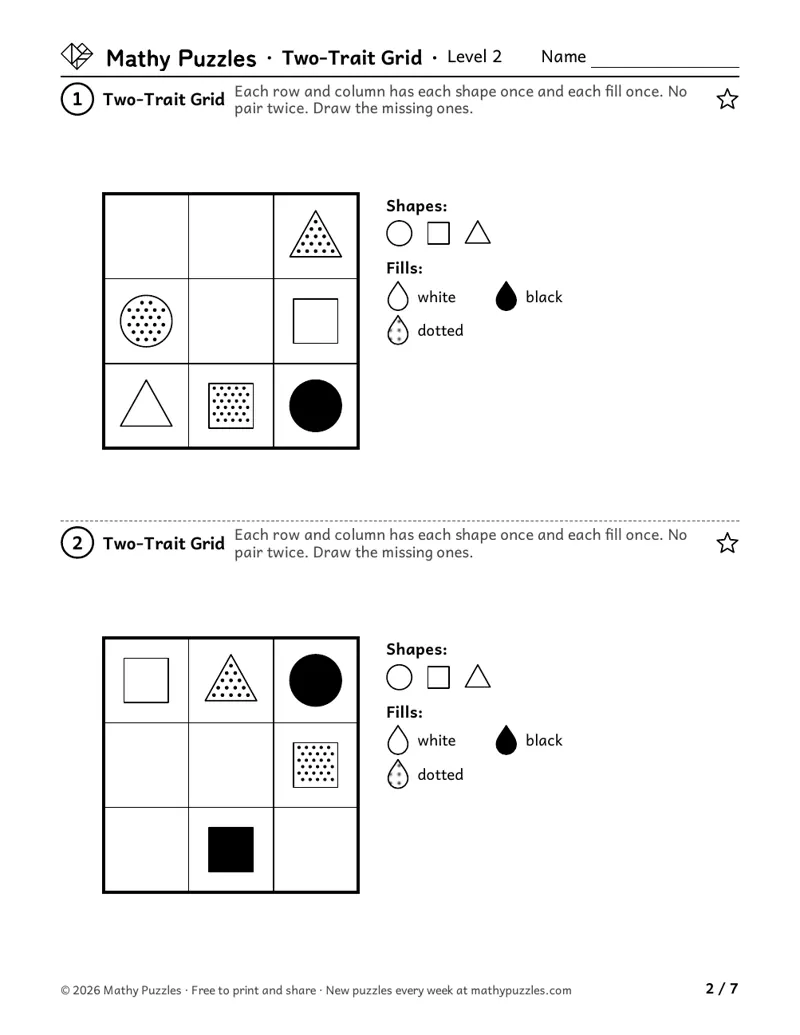 Level 2: a page from the free set
Before starting
- Level 2: draw a circle, square and triangle, and fill one in black or with dots
- Level 3: also draw a star and stripes
- Know rows (across) and columns (up and down)
- Level 4: draw each shape big or small
- Level 4: comfort with the 4 × 4 grid at Level 3 helps
- Patience for a long puzzle
Free puzzles to print
Each set: a Learn sheet with a worked example, 10 puzzles from easiest to hardest, and the answers.
Level 2
Ages 6–8 · Grades 1–2
A 3 × 3 grid with five or six whole clues, then three or four. The hardest puzzles give half clues: a shape with a "?" (find its fill) or a paint drop with a "?" (find its shape).
On the sheet: “Each row and column has each shape once and each fill once. No pair twice. Draw the missing ones.”
Print Level 2 (Letter)Other paper size: A4Level 3
Ages 8–10 · Grades 3–4
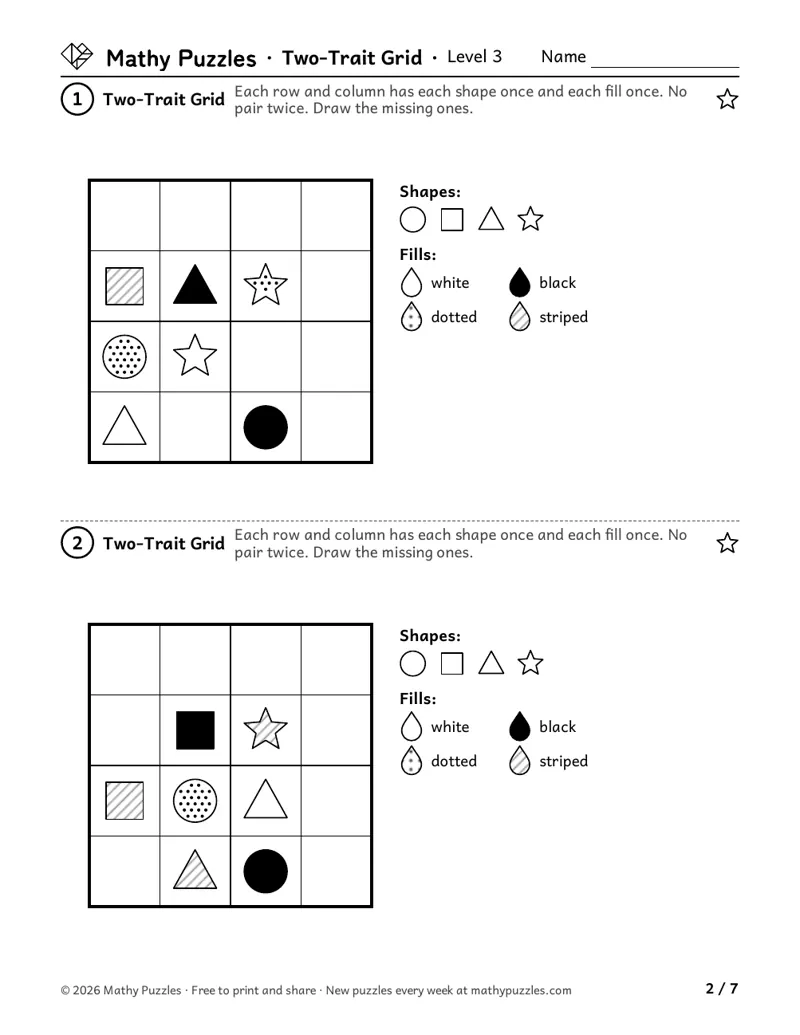
A 4 × 4 grid with six or seven clues, then four or five. Next come six clue cells, half of them half clues; the hardest puzzles have only five clue cells.
On the sheet: “Each row and column has each shape once and each fill once. No pair twice. Draw the missing ones.”
Print Level 3 (Letter)Other paper size: A4Level 4
Ages 10–12 · Grades 5–6
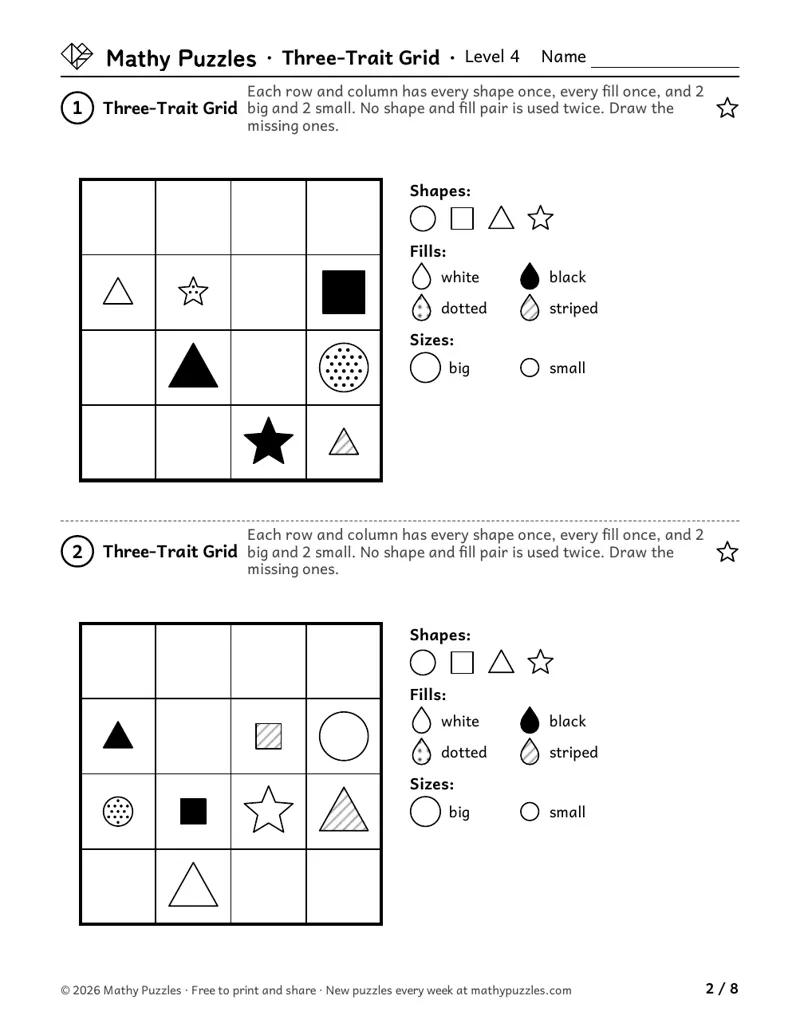
Easier puzzles: seven or eight whole clues, then five or six.
Harder puzzles: six clue cells where every second one is a half clue, plus corner-mark size clues. The hardest puzzles have five clue cells and need a chain of "that pair is already used" steps.
On the sheet: “Each row and column has every shape once, every fill once, and 2 big and 2 small. No shape and fill pair is used twice. Draw the missing ones.”
Print Level 4 (Letter)Other paper size: A4The sheet is titled “Three-Trait Grid”.
How it works
Each puzzle is a square grid with some shapes already drawn. Every row and column must have each shape once and each fill once, and no shape-and-fill pair may appear twice. The child draws the missing shapes in their fills. Level 2 is 3 × 3 (circle, square, triangle; white, black, dotted). Level 3 is 4 × 4 and adds a star and stripes. A key beside each grid shows the shapes and fills. Level 4 adds a third feature, size: every row and column also has two big and two small pictures. Its sheets are titled "Three-Trait Grid".
How to play
- Pick a row or column with one empty cell. Which shape is missing? Which fill?
- Draw it, then check the other line through that cell agrees.
- Mark the pair as used so it isn't drawn twice.
- Keep going until every cell has a shape and a fill. At Level 4, settle the big and small cells first.
When it gets hard
Getting the shape right but the fill wrong.
Hint: Ask two questions for every cell: which shape, then which fill.
Drawing a pair twice, such as two black circles.
Hint: Keep a list of the pairs and cross each one off as you draw it.
Guessing a cell when stuck.
Hint: Look for a line with one gap, or a pair already used. The puzzles can be finished without guessing.
Drawing three big pictures in one row.
Hint: Count the big ones first: two per row and two per column.
Tip for grown-ups: Before drawing, have your child say the cell's shape and fill out loud ("dotted triangle"). Drawing comes after the thinking.
Frequently asked questions
- Is this sudoku with shapes?
- It's a relative. As in sudoku, each row and column uses each item once. Here every cell holds two things, a shape and a fill, and no pair may repeat. That second rule is the twist.
- Can students work on this in pairs?
- Yes. One partner names the shape, the other names the fill, and both agree before drawing.
- What does a paint drop with a question mark mean?
- It's a half clue: the fill is given, the shape is not. A shape with a "?" inside means the opposite: find its fill. The key beside each grid shows both.
Questions about printing, levels, answers or membership: see all questions.
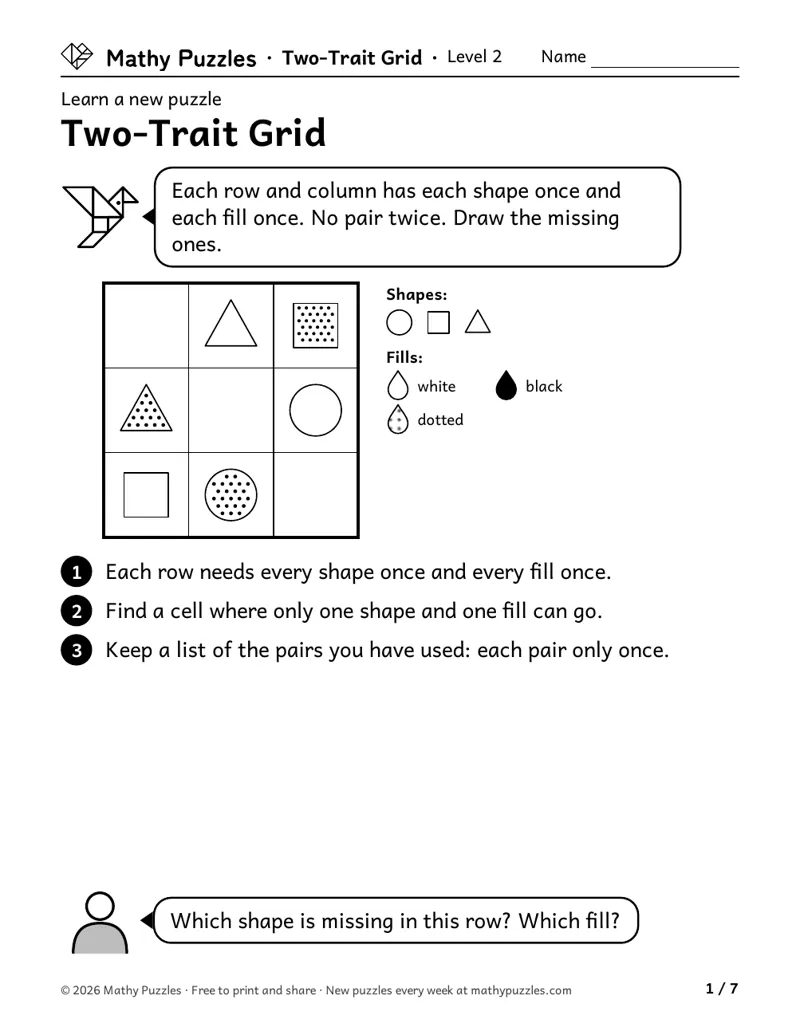
Worked example
From the Level 2 Learn sheet
- Each row needs every shape once and every fill once.
- Find a cell where only one shape and one fill can go.
- Keep a list of the pairs you have used: each pair only once.
A question to ask: “Which shape is missing in this row? Which fill?”
Free every Sunday A mixed bag of 20 new puzzles, all four levels. Get them by email
The thinking it works on
Holding two features in mind
Thinks about shape and fill for every cell.
Alloway, Gathercole and Pickering (2006) found that in children aged 4 to 11, the same parts of working memory were in place from age 4 and stayed stable. They included a separate store for what things look like and where they are. Source
Reasoning by elimination
Finds what is missing from a row or column.
Birney, Halford and Andrews (2006) built a one-rule shape-grid puzzle and tested 204 students aged 8 to 19. Items that needed more of the grid weighed together were harder. Source
Using every pair once
Keeps track of which shape-and-fill pairs are used.
English (1993) asked 7- to 12-year-olds to dress toy bears in every mix of tops and pants; strategies ran from trial and error to holding one item fixed. Source
Keeping a record
Lists used pairs so memory is free for the next step.
Bulley and colleagues (2020) offered children aged 4 to 11 a way to mark hidden locations. The children took it up quickly, and used it more when the memory task was harder. Source
Reasoning from half clues
Uses a clue that gives only the shape or only the fill.
Juggling three rules
Keeps shape, fill and size rules apart and together.
Huizinga, Dolan and van der Molen (2006) tested 7-, 11-, 15- and 21-year-olds. Holding and working with information in mind kept developing into young adulthood, and switching between rules into adolescence. Source
Where is this thinking used?
- Experiments: Scientists arrange tests so every pairing of two factors shows up once.
- Sports schedules: Each team plays on each field and at each time once.
- Seating plans: No table gets two people from the same group.
- Gardens: Each bed gets each crop once over the seasons.
For teachers
Curriculum areas
- Common Core
- No direct curricular match.
- NCERT
- Joyful Mathematics (Class 1) puzzle pages: each shape once in every row and columnLevels 3–4: No direct curricular match.
- National Curriculum (England)
- No direct curricular match.
- Cambridge Primary Mathematics
- No direct curricular match.
Math practices: see the box below.
Math practices this puzzle uses
- Uses: MP1 Make sense of problems and persevere in solving them
- Not used: MP2 Reason abstractly and quantitatively
- Not used: MP3 Construct viable arguments and critique the reasoning of others
- Not used: MP4 Model with mathematics
- Not used: MP5 Use appropriate tools strategically
- Uses: MP6 Attend to precision
- Uses: MP7 Look for and make use of structure
- Not used: MP8 Look for and express regularity in repeated reasoning
From the Common Core Standards for Mathematical Practice.
More Two-Trait Grid puzzles for members
Members get at least 5 more worksheets at each difficulty for every puzzle, 80 new puzzles every Sunday, and the whole archive. $39 a year or $25 for 6 months.
See membershipNot ready yet?
One email, all four levels: 20 puzzles, 5 for each level.
For grown-ups (18+). One email every Sunday with the puzzles and the odd note about membership; unsubscribe any time. We never ask about your child. How we use your email