
Triple Match
Picture three socks: all the same color is a match, and all different colors is a match too, but two blue and one red is not. Triple Match uses that rule for every feature on a card: shape, number, fill and, from Level 3, size.
Free sets by level, ages 6–12:
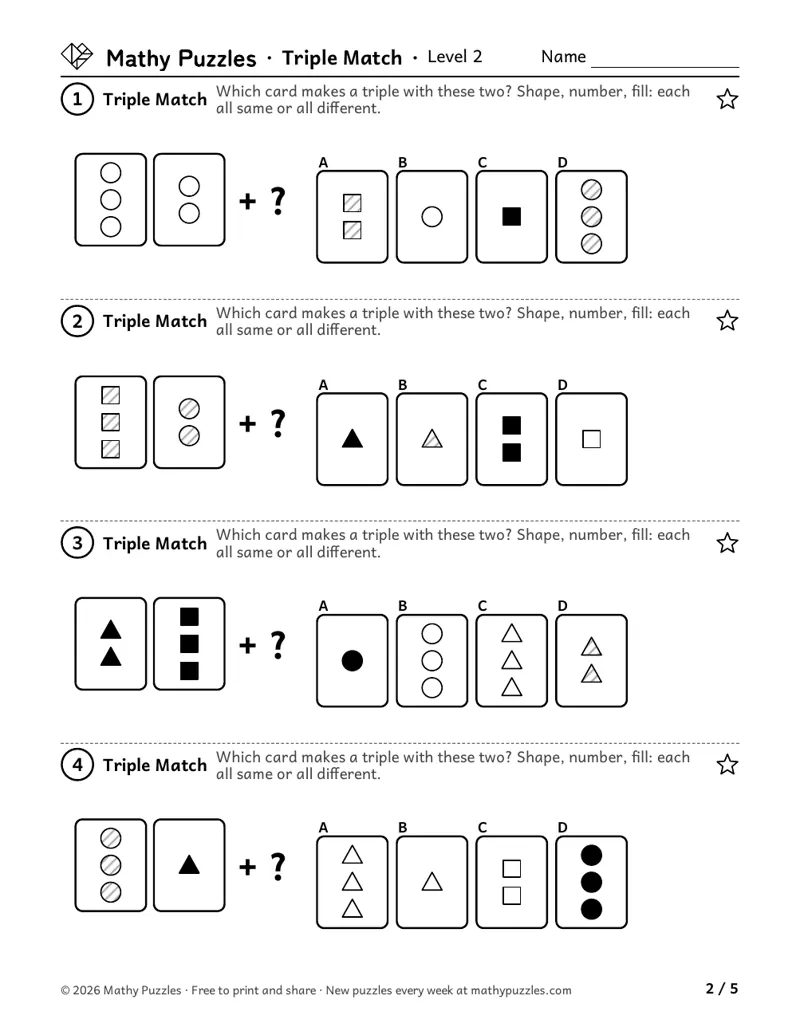 Level 2: a page from the free set
Before starting
- Name a circle, a square and a triangle
- Count to 3
- Tell same from different
- Level 3: notice size (small, medium, big)
Free puzzles to print
Each set: a Learn sheet with a worked example, 10 puzzles from easiest to hardest, and the answers.
Level 2
Ages 6–8 · Grades 1–2
Three features. First pick the card that completes a triple from 4 choices, then find it on a 6-card board, then find the one triple hidden among 6 cards.
On the sheet: “Shape, number, fill: each all same or all different.”
Print Level 2 (Letter)Other paper size: A4Level 3
Ages 8–10 · Grades 3–4
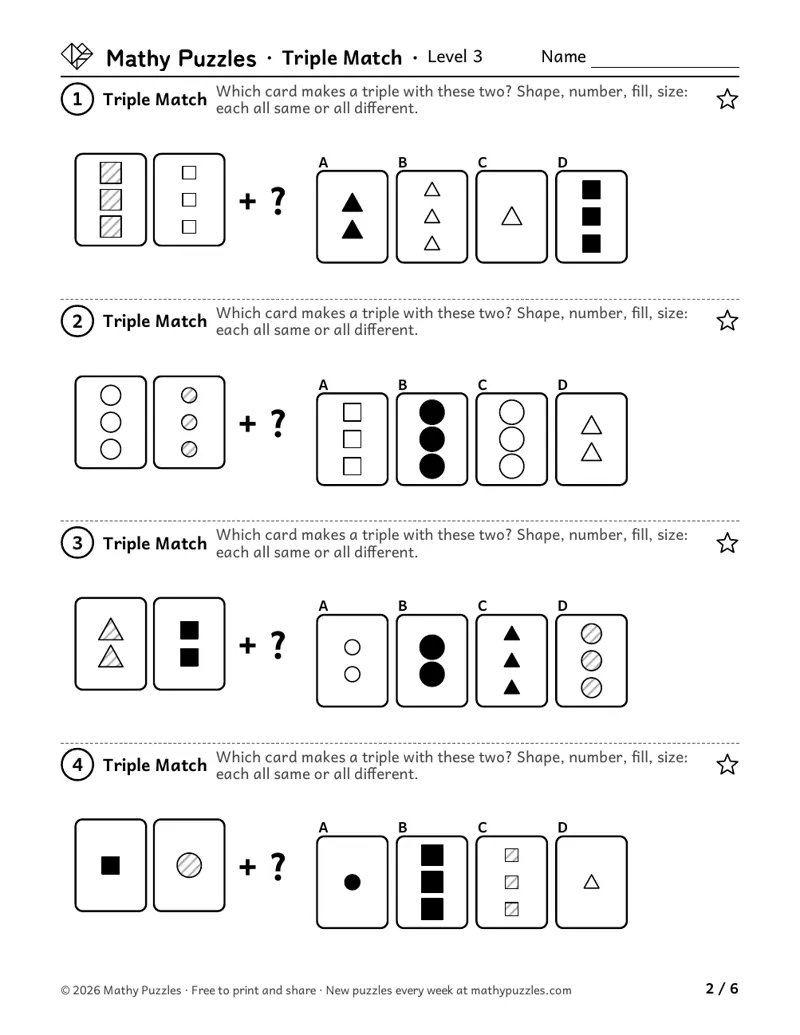
Size joins as a fourth feature. Complete a triple, then find every triple on 9 cards, then on 12.
On the sheet: “Shape, number, fill, size: each all same or all different.”
Print Level 3 (Letter)Other paper size: A4Level 4
Ages 10–12 · Grades 5–6
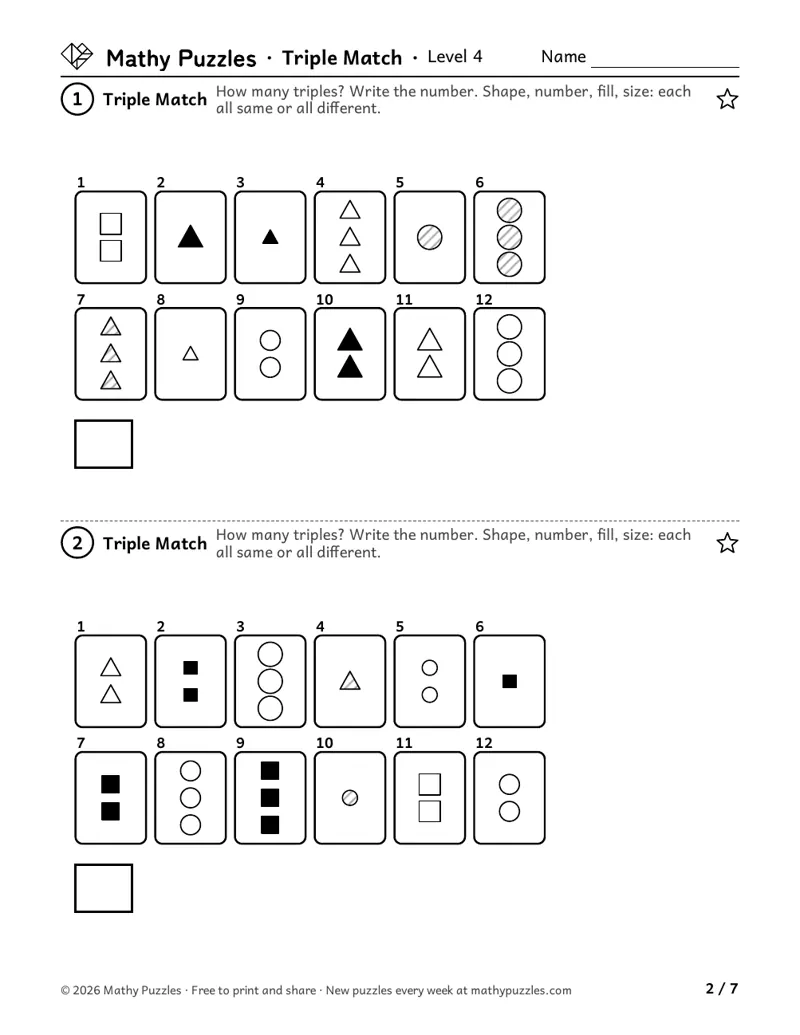
Four features. First count the triples on a 12-card board. Then decide whether a 12-card board has any triple at all. Last, choose the one card that can join an 8-card board without making a new triple.
On the sheet: “Shape, number, fill, size: each all same or all different.”
Print Level 4 (Letter)Other paper size: A4
How it works
Each card shows 1, 2 or 3 shapes. Every card has a shape (circle, square or triangle), a number, a fill (white, striped or black) and, from Level 3, a size (small, medium or big). Three cards make a triple when, for each feature, the cards are all the same or all different. The child finds the card that completes a triple, or finds the triples hidden on a board.
How to play
- Pick one feature, such as shape. Are the three cards all the same, or all different?
- Do the same for number, then fill, and size from Level 3.
- If any feature has two the same and one different, it is not a triple.
- To finish a triple from two cards: where they match, the third matches too; where they differ, the third takes the one left over.
When it gets hard
Checking shape and forgetting fill or number.
Hint: Say each feature aloud in order and count them off on your fingers.
Thinking "two the same" is close enough.
Hint: Two the same and one different breaks the triple, every time.
Searching a big board at random.
Hint: Pick one card, pair it with each other card in turn, and ask what the third card would have to be.
Tip for grown-ups: Listen for a reason for each feature ("all circles, all different numbers, all black"). Putting it in words keeps every feature in view.
Frequently asked questions
- Do I need a color printer for this?
- No. The cards use shape, number, fill and size only, so they print clearly in black and white.
- How do I find the card that finishes a triple?
- Build it from the two cards you have, one feature at a time. Where they match, the third card matches; where they differ, it takes the value that is left. Then look for that card among the choices.
- Can I run this as a group activity with copies for everyone?
- Yes. Big boards work well in pairs: one child finds a triple, the other checks it feature by feature.
Questions about printing, levels, answers or membership: see all questions.
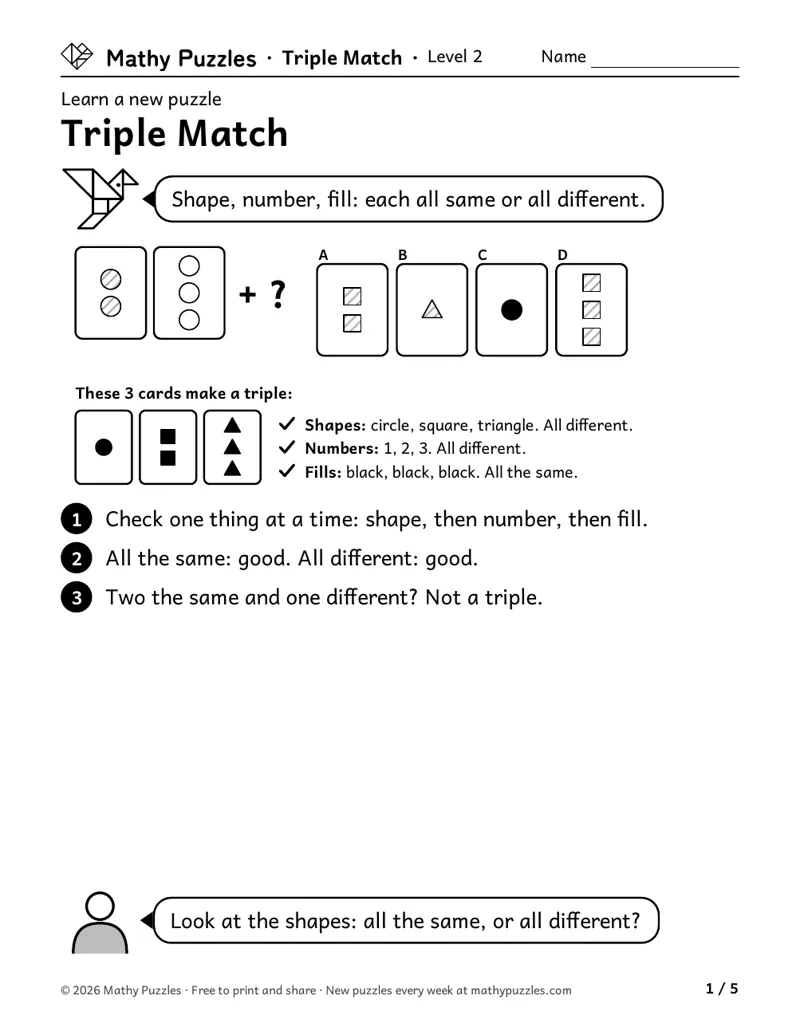
Worked example
From the Level 2 Learn sheet
- Shape, number, fill: each all same or all different.
- Check one thing at a time: shape, then number, then fill.
- All the same: good. All different: good.
- Two the same and one different? Not a triple.
A question to ask: “Look at the shapes: all the same, or all different?”
Free every Sunday A mixed bag of 20 new puzzles, all four levels. Get them by email
The thinking it works on
Looking at one feature at a time
Looks at shape, number, fill and size separately.
Smith and Kemler (1977) found that kindergartners sort objects by overall likeness, while fifth graders sort by one feature at a time, with second graders in between. Source
All the same or all different
Accepts all-same or all-different, and rejects two-and-one.
Kotovsky and Gentner (1996) found that 4-year-olds matched a pattern across two sets only when both used the same feature. The 6- and 8-year-olds matched it across different features. Source
Holding details in mind
Keeps three cards' features in mind while checking.
Alloway, Gathercole and Pickering (2006) studied children aged 4 to 11. Memory for pictures and positions was separate from memory for words, and both were in place by 4. Source
Working out the missing card
Builds the third card from two.
Searching in order
Checks a board pair by pair so nothing is missed.
English (1991) describes how children faced with 'find them all' problems gradually give up random tries for a fixed order that leaves nothing out. Source
Reasoning about "none"
Shows that a board has no triple, or that a card makes none.
Foltz, Overton and Ricco (1995) studied how adolescents test an idea. Those who reasoned formally looked for the case that would disprove it, instead of collecting cases that fit. Source
Where is this thinking used?
- Sorting: Grouping things by more than one feature at once, such as size and shape.
- Science keys: Telling living things apart by checking one feature at a time.
- Quality checks: Comparing items feature by feature to see what matches and what doesn't.
- Card games: Games where players look for sets that follow a rule.
For teachers
Curriculum areas
- Common Core
- Geometry: telling a shape's kind apart from its fill and size (Grade 1)Levels 3–4: No direct curricular match.
- NCERT
- No direct curricular match.
- National Curriculum (England)
- No direct curricular match.
- Cambridge Primary Mathematics
- No direct curricular match.
Math practices: see the box below.
Math practices this puzzle uses
- Not used: MP1 Make sense of problems and persevere in solving them
- Not used: MP2 Reason abstractly and quantitatively
- Not used: MP3 Construct viable arguments and critique the reasoning of others
- Not used: MP4 Model with mathematics
- Not used: MP5 Use appropriate tools strategically
- Uses: MP6 Attend to precision
- Uses: MP7 Look for and make use of structure
- Not used: MP8 Look for and express regularity in repeated reasoning
From the Common Core Standards for Mathematical Practice.
More Triple Match puzzles for members
Members get at least 5 more worksheets at each difficulty for every puzzle, 80 new puzzles every Sunday, and the whole archive. $39 a year or $25 for 6 months.
See membershipNot ready yet?
One email, all four levels: 20 puzzles, 5 for each level.
For grown-ups (18+). One email every Sunday with the puzzles and the odd note about membership; unsubscribe any time. We never ask about your child. How we use your email